She looked ordinary, like every other exceptionally rich older woman shopping in Greenbelt 5. However, the people around her were not. Bodyguards flanked her as she slid from rack to rack. Other men in plain clothes stood at at the exits. Nearby customers pointedly examined other clothes. A brave salesgirl shuffled uncertainly from the safety of a parallel aisle with a look on her face that was both eager to help, and nervous. And Imee slid around, unnoticing.
She was wearing an unremarkable shawl and had hair that defied all sorts of laws. Her face was taut and bored. She was short, but had the sort of eyes that could look down on you in spite of it.
I was taller than her, and straightened to my full height. Then, I opened my mouth, hesitated, pursed my lips, and slowly walked away.
Anyway, Martial Law was over. People Power had done its job. Ferdinand Marcos was dead. The billions were in limbo, but we were alright. And for God’s sake I was a decent person who didn’t yell at people in Zara.
Until now I wonder what it is that keeps us quiet. Are we polite, or scared, or practical?
Weeks later, her father, the dictator, was buried in the Libingan Ng Mga Bayani, and I saw her again. This time I was yelling.
The term is “l’esprit de l’escalier.” It describes the feeling of finding the perfect reply too late. It happens to me often. “I should have said that,” I say to myself after an argument ends, after a frenemy leaves a fraught conversation, after I leave Zara with so many things to say to the daughter of a dictator.
It happens to us too, as a country. It’s so impolite to call out wrongdoing. Telling the truth might cause trouble. The perpetrators might feel offended. We would look so improper. Let the person cut in line. Let the bribe be paid. Let the money be stolen.
I’d like to think that we know our history. We know what happened, and we recognize the liberties that others fought for.
But I do I have things to say. Someone plundered my country. Someone imprisoned, tortured, and killed so many of my people. Someone corrupted entire industries and institutions. Someone escaped a broken country, and escaped justice. And his descendants are unrepentant, politically resurgent, and fucking shopping at Zara. If Imee Marcos touched the SALE rack that day I would have loved to tell her that her family’s thievery, which she is complicit in, having been of age and hopefully of sound mind regardless of her conscience when Martial Law took place, deserves better things to be spent on.
(I might also have ended up dead like Archimedes Trajano, the student leader who questioned her at an open forum.)
Until now I wonder what it is that keeps us quiet. Are we polite, or scared, or practical?
I’d like to think that we know our history. We know what happened, and we recognize the liberties that others fought for. We know the atrocities that were committed, and the impunity that persists. We know their names and their faces. We know right from wrong. I guess we also only know what to say when it’s too late. At least it’s the perfect reply.
Today, the Marcos family has almost successfully re-imagined Martial Law as a sort of Golden Age of benevolent authoritarianism. How does a nation push back?
Issues become trivialized by a reduction to personality. We see this clearly in how the struggle of civil society against oppression during Martial Law has become distilled into a rather simplistic opposition of Marcos versus Aquino. Forgotten are the later-period deep-and-wide rejection of and resistance to the rule of Marcos by vast swathes of civil society around the country. The deeper issues surrounding Martial Law, only briefly touched on here, are ignored in positing the Marcos versus Aquino binary. That is a critical failure on our part, one that emboldens and empowers Marcos loyalists. While, perhaps superficially, families Marcos and Aquino have become the totems of opposing views on Philippine history, present, and future, we need to consider the deeper consequences of Martial Law and authoritarianism versus an open and multifaceted democratic space.
We must imbue the phrase “Never Again” with a variety of meanings: From the need for a deeper richer historical sense, the repudiation of historical denialism and forgetfulness, to a more political sense as a mantra against impunity and authoritarianism. All are needed in charting the future of the country.
What we cannot, should not, forget is: Revolution is civil war. Revolutions upend existing social and political order, however it is folly to think that everyone is in agreement with that upending, or even what the “new” social order should be. If we look at 1986 and the intervening years through the prism of civil war, we can easily deduce the arraying of forces: Loyalists who still adhere to the strong-man, Marcos informed dictatorial government, pro-democratic space advocates and all the multiplicity of views that entails. There were counter-coups and attempts at redeeming a fallen idol during the administration of Corazon Aquino, abetted by ‘former’ and extant Marcos loyalists. In part, we can view the resurrection of Fidel Ramos and some of the policies he enacted as another battle in an on-going civil war. There was the ascension of another loyalist and Marcos adherent in Erap Estrada, and post-GMA, the return of a scion of the Aquino family as a riposte in this continuing civil war. The fact remains that we are still gripped in the midst of the after-effects (perhaps even ongoing throes) of a convulsive civil war rooted in the 1986 EDSA Revolution and the toppling of the Marcos regime. 2016 loomed as yet another battlefield, one perhaps that was the most important since 1986. The aftermath left us in a precarious position, teetering as close as we ever have to a successful counter-revolution and the return of the Marcos family and their favored brand of governance to a dominant position in our political and social sphere.
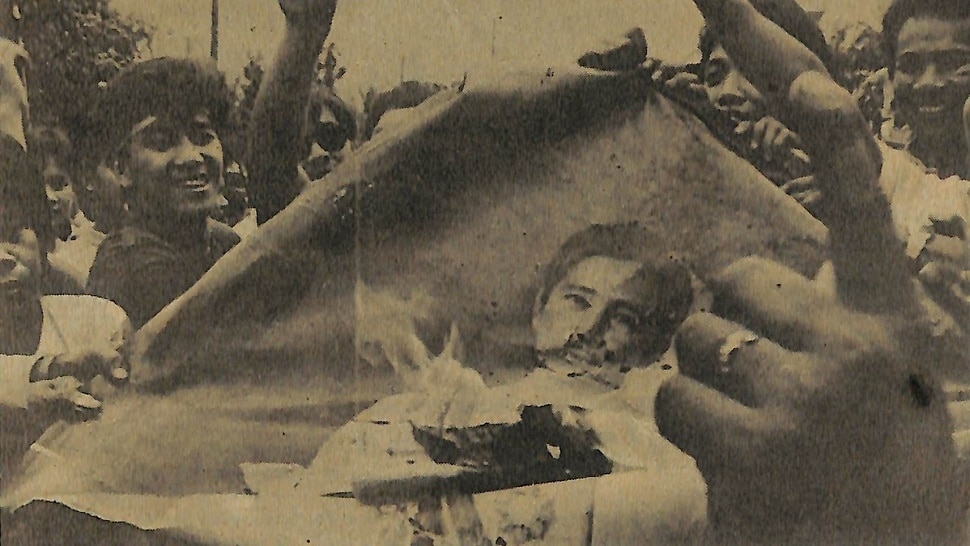
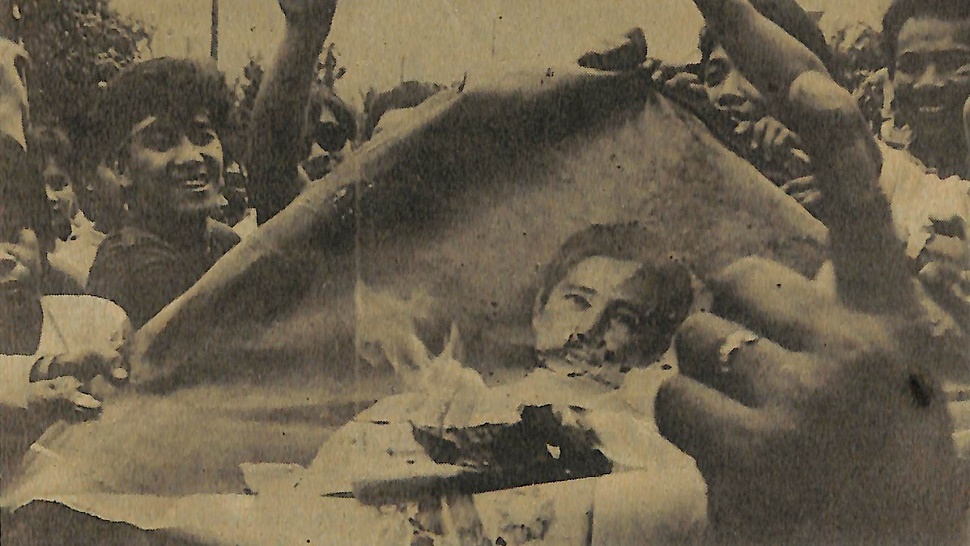
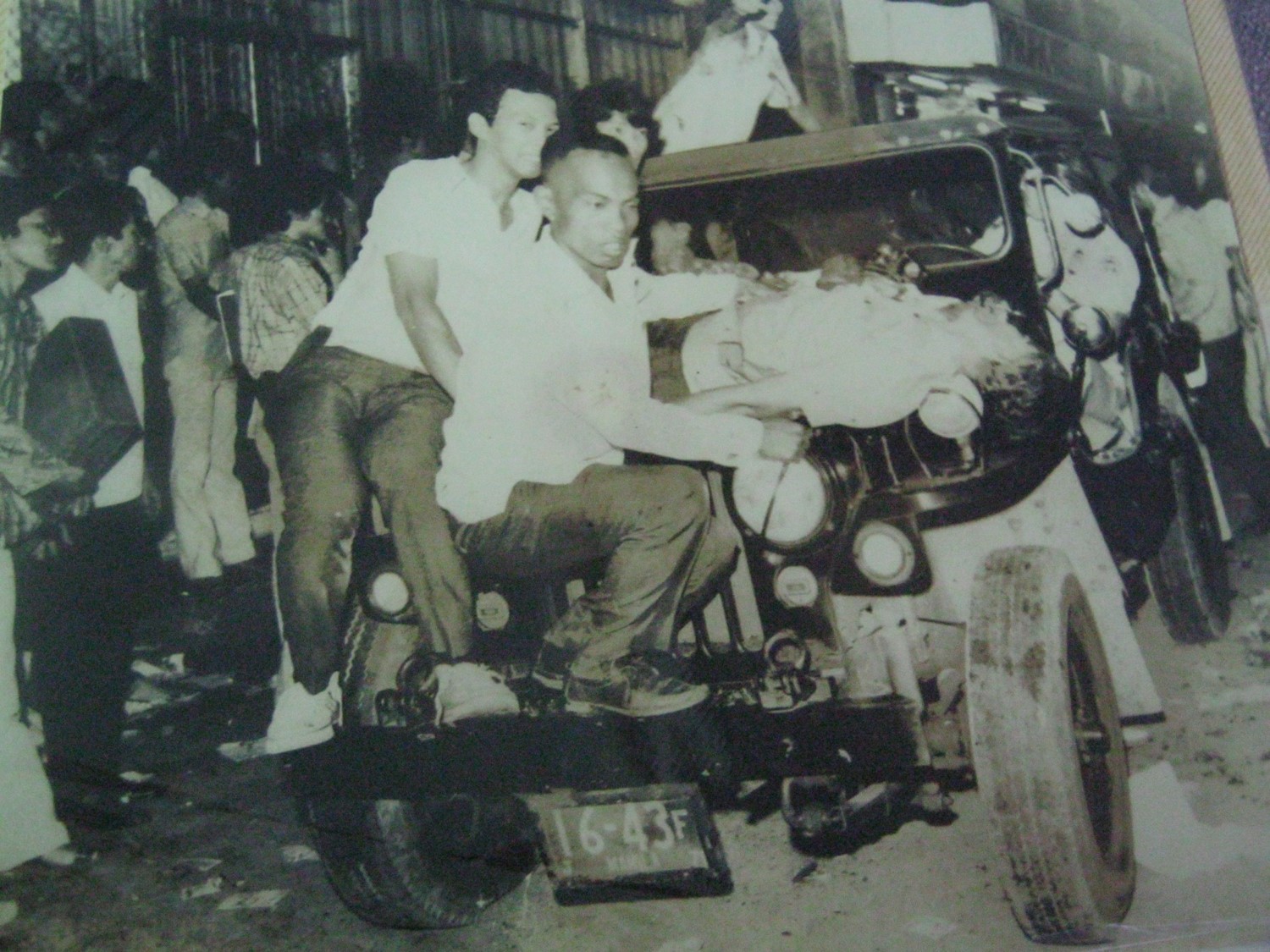
IMAGE Presidential Museum and Library
From the Presidential Museum and Library Flickr account: “Cheering crowd burns the ex-president’s portrait. Malaya, February 28, 1986. (From the newspaper collection of Mr. Jose Antonio Custodio.)” [via]
“Never Again” also speaks to something far deeper than just a clash of personalities. It is a rejection of that form of authoritarian governance, of the willingness for Filipinos to give up their liberty, to sacrifice the lives of neighbors and family members, for nothing more than the ephemeral sense of ‘security’ brought on by increasingly oppressive squads of police and military acting with impunity.
As we discussed, the very return of the Marcoses to politics was designed to push the continuation and redemption of the historical narrative crafted by Ferdinand Marcos. The ascension of a Marcos to Malacañang would have brought them one step closer to historical absolution. We came so close to seeing that reality. Marcos Jr. barely lost his race for the vice-presidency. But, as a result, while quiet for the time being, is now a potent political force.
On the other hand, President Rodrigo Duterte seems to view his campaign promise to bury Marcos in the Libingan as a moral and political imperative—willing to expend massive amounts of political capital to see it done. The effort by the Marcos family to inter Ferdinand Marcos in the Libingan is part of their closely held historical narrative, in fact it is part of its culmination. It confers on Marcos and his record the shine of legitimacy: Here lies Ferdinand Marcos, a soldier and a president. It is obscurantism through funerary rite. Yes, a man has a right to be buried in his country. But, burying Marcos there brings their view of Philippine history closer to redemption. No matter how it is spun, the end goal is not our redemption, nor is it our collective reconciliation.
* * *
We have struggled to find a sense of national reconciliation with the Marcos Era.
Some sectors, including Senator Miriam Defensor Santiago [01] during the campaign period, have argued that an apology is not necessary [02]. This has been proven false time and again in other countries wracked by similarly violent upheavals such as ours. Apologies matter and they help bring us closer to finding a common national redemption, not the absolution of the oppressors. Without an apology, “Never Again” has taken on a sort of totemic mantra for those who would deny the insidiousness of historical denialism and revisionism, who would deny the much sought after conclusion of the Marcos false historical narrative and the absolution of the Marcos family through their ascension to the pinnacle of Philippine political and social spheres.
“Never Again” is a rejection of that form of authoritarian governance, of the willingness for Filipinos to give up their liberty, to sacrifice the lives of neighbors and family members, for nothing more than the ephemeral sense of “security” brought on by increasingly oppressive squads of police and military acting with impunity.
For adherents (loyalists, as we have referred to them in this essay) of the Marcos regime, or at the very least the forms that entailed (dictatorial centralized strongman governance) the phrase “Never Again” is seen repudiation of their personality of choice. And it is, in a way. Yet, “Never Again” also speaks to something far deeper than just a clash of personalities. It is a rejection of that form of authoritarian governance, of the willingness for Filipinos to give up their liberty, to sacrifice the lives of neighbors and family members, for nothing more than the ephemeral sense of ‘security’ brought on by increasingly oppressive squads of police and military acting with impunity. “Never Again” is imbued with a historical sense of responsibility for safeguarding the future of our country, for ensuring that democratic spaces remain such that they are. Remember, government only has as much power is given.
What we cannot allow is “Never Again” to be reduced solely to repudiating the Marcos family; that opens up the reduction of discourse to simple discussions of personalities, it strips away the context of what the Marcos family stands for and how destructive the Marcos regime was for this country. That is what they want.
It is also a warning, one that we should continue to heed, against rampant pillaging and corrupt practices that bring a nation to its knees. Jose Rizal warned against this [03]. Rizal specifically said that unless Filipinos learn to stand up, heads held high, and ready to proclaim themselves as Filipinos, they will just be fodder for further tyranny; the slaves of the past become the tyrants of today. Rizal was right. In his way, Rizal was demanding, calling, for the creation of a deep and abiding sense of historical self for the Filipino. Without that, we as a nation are ripe and ready for the next imperial master to come along, the next tyrant and dictator. When he wrote that warning the Philippines was under Spanish rule. We would suffer the indignities of the reign of three imperial masters after: the United States, Japan, and finally Ferdinand Marcos.
We must imbue the phrase “Never Again” with a variety of meanings: From the need for a deeper richer historical sense, the repudiation of historical denialism and forgetfulness, to a more political sense as a mantra against impunity and authoritarianism. All are needed in charting the future of the country. What we cannot allow is “Never Again” to be reduced solely to repudiating the Marcos family; that opens up the reduction of discourse to simple discussions of personalities, it strips away the context of what the Marcos family stands for and how destructive the Marcos regime was for this country. That is what they want.
Today, the Marcos family has almost successfully re-imagined Martial Law as a sort of Golden Age of benevolent authoritarianism—this sort of historical chicanery is enticing precisely because we lack a deep and enriching historical sense. Their historical denialism is winning. That is a loss for us all. “Never Again” speaks, not only of the Marcoses, but of a return to their way of thinking, to the abrogating of human rights for nebulous “peace and order,” for a return to state institutionalized plunder as a way of life, and the impunity of a nation subsumed and consumed by a Conjugal Dictatorship, lashed by the whims of a family. It stands against connecting patriotism and love of nation to the adoration of personality.
We must imbue the phrase “Never Again” with a variety of meanings: From the need for a deeper richer historical sense, the repudiation of historical denialism and forgetfulness, to a more political sense as a mantra against impunity and authoritarianism.
Ferdinand and Imelda Marcos well understood the power of history and compelling historical narrative. They used history to their advantage, crafting a state-sponsored mythologizing historical story supporting their regime and embedding in social consciousness the sheer ‘rightness’ of their rule. In their telling, they were the power from whence all else flowed in the Philippines—Ferdinand and Imelda Marcos were the fountainhead of Philippine nationalism. This is historical revisionism on a grand scale, abusive in ways we cannot fathom. We are still coping with the insidiousness of their story.
History informs identity. It cannot be left solely in the hands of those with nefarious agendas geared towards self-aggrandizement and ultimately the redemption of one of the darkest periods in our history. Historical denialism and grand revisionism attempts to remake us in the image of someone else. Denial and forgetting consumes the historical self and leaves nothing in its wake. By any other name, this is impunity.
* * *
“Never Again” is a call to many things, for many different people. But at its heart, “Never Again” is a mantra, a talisman, against the insidiousness of historical denialism, a rejection of the debilitation of forgetting.
It is a reminder and a call to historical action and remembrance; to remember who we are, from where we came, and what we may yet become. We are not slaves, nor are we tyrants. Our history tells us this. Our past has the ability embolden and ennoble us, even as we reconcile with its dark notes. Even then, those dark periods are spaces from which we can draw strength and warnings for future actions and decisions. Those dark notes are who we are as well. History tells us who we are, in all of its facets. Our collective history is why we can proudly call ourselves Filipinos. We should never forget that.
This piece originally appeared in the author’s website. We have reproduced it here with minor edits from the EsquireMag.ph editors.
Ferdinand Marcos’s critics (myself included) have failed in one major respect: We have been unable to give due credit. FM was certainly a crook, a liar, a torturer, and a murderer. But someone who held power for over two decades must have done something right. Yet we Marcos critics portray the dictator as evil incarnate, and this allows our interlocutors to accuse us of closed-mindedness. We should learn something from the progressive economist and industrialist Salvador Zaragosa Araneta (1902 to 1982).
Araneta was one of the business elites that Marcos drove away as he destroyed the competition of his cronies. “Don Badong” was the perfect target: He had deep ties with the sugar industry and was related, by marriage, to the powerful Lopez family. He was also a humanist and a political liberal with an ingrained aversion to authoritarianism.
Threatened with possible incarceration, Araneta fled the country and lived the rest of his life in San Francisco and Vancouver.
Araneta despised Marcos. Yet even in bitter exile, he was capable of grudging respect, claiming in a 1975 interview that:
Marcos is now implementing many of the economic theories I had advocated… He doesn’t care about the advice of the Americans and to that extent he is being praised by the people. In this matter, he has guts.
He added that he admired bold financing programs under the regime, yet ultimately concluded that these could not “justify” Marcos’s “continuance in power as a dictator.”
What economic ideas did Araneta advocate in the ’50s and ’60s? And did Marcos really implement them? Broadly, Araneta was a Keynesian.
Today, John Maynard Keynes is known for the idea of pumping credit into the economy to get it moving in times of recession. His early work, however, concerned currency value. In the 1920s and 1930s, Keynes warned against an artificially expensive currency because maintaining its high price requires limiting the amount of money in circulation (to keep something expensive, you reduce the supply), which, in turn, restricts the government’s capacity to spend (less money circulating means less money to spend).
In the 1950s, two Philippine pesos could buy you one U.S. dollar. But contrary to public perception, this high value was not evidence of inherent economic strength. To maintain the rate, the Central Bank of Governor Miguel Cuaderno had to ensure that the pesos circulating were backed by a specific amount of dollar reserves.
Araneta despised this system. Like Keynes, he thought that limiting money supply made it difficult for the government to finance its various programs. More importantly, he argued that an artificially high peso was detrimental for exporters.
Because of the currency peg, Filipino exporters were getting paid two pesos for every dollar earned by selling abroad. Had the peso been depreciated, they would have earned more pesos for every dollar. If the market price became, say, four to one, they would have earned twice. This discrepancy, Araneta explained, amounted to a “conceal tax [sic]” on the export industry, which, in effect, subsidized importers. And since most of the importers at the time were either American or purchased American goods, the strong peso benefited our former colonizers.
But the Central Bank’s Governor Cuaderno refused to depreciate, arguing that doing so would cause inflation. In an import-dependent economy, a strong currency tends to keep prices down, and depreciation would have reduced the peso’s purchasing power. That sounds scary, but inflation is not an absolute evil.
While higher prices make things difficult for consumers, they allow producers (like farmers and manufacturers) to earn more. And when companies earn more, they usually hire more. It is for this reason that, for most of Philippine economic history, higher inflation has corresponded with lower unemployment. Moreover, inflation makes life easier for people in debt. If what the peso can buy today is less than what it could yesterday, it’s effective value is less; so when you pay back your debts after inflation, you are paying at a reduced price.
Finally, as Keynes noted, between inflation and deflation, the latter is always worse. Deflation decreases profits and makes debts more odious, thereby reducing consumption and increasing unemployment. Unfortunately, according to United Nations statistics, the Philippine economy was undergoing deflation for most of the 1950s.
The effects of Cuaderno’s policies were immediately palpable. From 1951 to 1955, the average GDP growth rate was 8.078. But as deflation set in, growth slowed down to an average rate of 4.8 from 1956 to 1960. “It is very clear,” notes former NEDA Director-General Cayetano Paderanga, that immediate postwar Philippines was so “bent on maintaining a particular exchange rate,” that “it was willing to sacrifice growth.”
As Araneta predicted, the slowing down of economic growth also corresponded with the crippling of the export industry that, according to economic historians Vicente Valdepeñas and Germelino Bautista, grew dependent on imported raw material. By the end of the 1950s, export earnings amounted to less than 10 percent of the country’s income.
While some limited depreciation occurred during the presidency of Diosdado Macapagal, it was Ferdinand Marcos and his team of technocrats that facilitated the complete removal of currency controls.
Currency depreciation, along with foreign loans, allowed Marcos to fund ambitious infrastructure and stimulate export industries. Such a strategy of depreciation coupled with targeted pro-export spending is called Export Oriented Industrialization (EOI), and it was the model that facilitated the stunning rise of countries like Japan and South Korea.
Paderanga notes that growth picked up again in the 60s as the government loosened currency controls. This growth continued until a contraction in 1979, and further deteriorated as the country plunged into a major crisis in 1983—the worst in modern history.
Whatever success Marcos’s EOI project had thus ground to a halt. Moreover, it became obvious that, despite increased government spending and growth, the poor were left behind. The poverty rate almost doubled from 1974 onwards. And, of course, the more government spent, the more the Marcos’s pilfered, stealing as much as 10 billion dollars by some accounts.
EOI under Marcos was theoretically sound, but it was implemented under a corrupt dictator, who increasingly used government funds to support cronies, and not a robust export industry.
However, EOI’s capacity to deliver growth after the moribund Cuaderno years shows that the project was not destined to fail. Kyoto University’s Caroline Hau argues that, without ignoring violences and corruption of the regime, it is still possible “to see some of the Marcos programs not solely as naked instruments by which Marcos effected a power-grab for himself, but also politically rational moves to simultaneously court votes while pursuing national development objectives.”
This is an eminently fair assessment of the regime, similar to the one Araneta proffered over 40 years ago. It says we should not throw the baby out with the bath water: The Marcos years ultimately destroyed our economy, but we must credit his economic team for their attempts to boost exports and stimulate growth.
None of this smart policy, however, justified a brutal and corrupt dictatorship. Sound economic thinking does not obviate one of Philippine history’s most obvious conclusions: #MarcosMagnanakaw.
In celebration of Ferdinand Marcos’s 100th birthday (which, ironically enough, falls on September 11), the Marcos Centennial Facebook page posted a call-out for posters “reflecting the outstanding accomplishment and character of President Marcos as a Filipino.”
IMAGE Marcos Centennial
However, the good people of Twitter just aren’t having it. Thysz Adartse called for the creatives of #ArtPH to hijack the contest with their own protest art, and they’ve quickly responded using the hashtags #Marcos100 and #MarcosArtrocities.
Here are some of our favorite posts:
Save this GIF for whenever someone claims that Marcos was a hero.
Because “a few gold bars” is just not enough.
We all need to band together against the White Washers.
Good work, boys.
Appropriating the original poster is a nice touch!
Meanwhile in 1975…
Some artists have taken to Facebook as well. We’re looking forward to seeing the rest of Angelo James Esperante’s series!
Truth.
Because we should never forget the atrocities of Martial Law.
This makes us want to catch A Game of Trolls before its run ends in September!
Even though he played a big role in the uprising that toppled the regime of late President Ferdinand Marcos, former Senate President Juan Ponce Enrile on Wednesday said he could not turn his back on the Marcos family.
“Hindi ko naman matatalikuran ‘yung pamilya ng dating Presidente Marcos na kung saan ako’y kasama nila sa loob ng 20 taon,” Enrile said in an interview on News To Go, in explaining why he agreed to serve as counsel for Ilocos Norte Governor Imee Marcos during a congressional hearing on Tuesday.
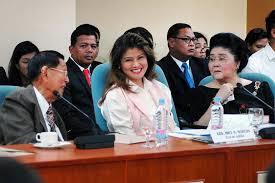
Gov. Marcos, the late president’s daughter, was to face an inquiry into the provincial government’s alleged illegal use of its share of tobacco excise taxes.
“Ako’y tinawagan ni Imee upang samahan siya doon sa hearing sapagka’t nangangamba siya na siya ay ikukulong,” said Enrile, who served as defense minister during the elder Marcos’ administration.
Enrile said he owes his political career to the elder Marcos.
“Ako naman, bilang abogado, at bilang kasama ng kanyang tatay sa loob ng 20 taon sa gobyerno, bilang pagpapasalamat naman sa kanila sa pagbibigay naman sa akin ng pagkakataon na mag-serbisyo sa bayan,” he said.
Enrile, meanwhile, said the issues being leveled against Gov. Marcos were “vague” and “debatable” as he urged both parties to closely scrutinize the circumstances behind the alleged anomaly.
“May batayan si Imee, may batayan din naman si Rudy [Fariñas, House majority leader], so medyo mahirap husgahan ‘yan,” he said. “Bilang abogado, sinasabi ko na na mahihirapan ang magkabilang ‘yan.”
The Court of Appeals (CA) has tossed out the petition seeking to enforce the United States court decision that awarded some $2 billion in compensation to human rights victims during the term of former President Ferdinand Marcos.
In a decision dated July 7, the CA 12th Division affirmed the Makati Regional Trial Court’s ruling dismissing the petition filed by the victims, among them former Commission on Human Rights chair Etta Rosales and film director Joel Lamangan.
According to the CA, the February 3, 1995 ruling handed down by the United States District Court in Hawaii in the class suit filed by some 10,000 rights victims against the Marcos estate, is not binding since the Hawaii court lacked jurisdiction over the case.
The appellate court said the right to due process of all the unnamed claimants as well as the Marcos estate had been violated.
It also said the classification of the claimants into three categories — torture, summary execution and disappearance of victims — only showed “no common question of law and fact exists between/among the claimants.”
“In other words, each claimant in [Class Action No.] MDL 840 had a right, if any, only to the damage that such individual may have suffered, and not one of them had any right to or can claim any interest in the damage or injury which another suffered. Hence, MDL 840 was not and should not have been brought as a class suit,” the CA said through Associate Justice Normandie Pizarro.
The CA added the Hawaii court failed to ensure that the 10 Filipino citizens who brought the suit “were truly and legally authorized by the other purported claimants.”
The 10 claimants are Celsa Hilao, Josefina Hilao Forcadilla, Arturo Revilla, Jr., Rodolfo Benosa, Danila Fuente, Renato Pineda, Adora Faye de Vera, Domiciano Amparo, Christopher Sorio, and Jose Duran.
“It boggles the mind how the final judgment could be enforced when the supposed claimants were not even identified,” the decision stated. “On the other hand, it gave no opportunity for the Marcos Estate to confront each and every claimant. Evidently, the right to due process of both parties was violated.”
The CA also said the Hawaii decision failed to meet the standards for a valid judgment since the decision was issued on the basis of a different law, “presumably” the Torture Victim Protection Act, instead of the Alient Tort Claims Act (ATCA).
ATCA is a law that grants jurisdiction to federal district courts over all causes where a foreigner sues for any harm resulting from a violation of international law, no matter where the harm occurred, or who inflicted the harm, as long as the plaintiff serves process in the US territory.
“Given the foregoing recent development, it is our considered opinion that the instant final judgment may not be enforced in this jurisdiction as it is clear that even the US Supreme Court has come to realize that American laws could not have jurisdiction over sovereign countries,” the CA said.
“While our country follows the doctrine of incorporation with respect to customary international law, which means that this country adopts the generally accepted principles of international law as part of the law of the land, adopting such principles does not, however, mean giving the same primacy, if not application.”
Associate Justices Samuel Gaerlan and Jhosep Lopez concurred with the decision.