
by MLC | Nov 17, 2018 | Martial Law Analysis
Source: CBS NEWS
Former Philippines First Lady and current Congresswoman Imelda Marcos waves to supporters in Manila in October 2015 ERIK DE CASTRO / REUTERS
MANILA, Philippines — A Philippine court found former first lady Imelda Marcos guilty of graft and ordered her arrest Friday in a rare conviction among many corruption cases that she’s likely to appeal to avoid jail and losing her seat in Congress.
The special anti-graft Sandiganbayan court sentenced Marcos, 89, to serve 6 to 11 years in prison for each of the seven counts of violating an anti-corruption law when she illegally funneled about $200 million to Swiss foundations in the 1970s as Metropolitan Manila governor.
Neither Marcos — famous for her huge collection of shoes, jewelry and artwork — nor anyone representing her attended Friday’s court hearing. No one has issued any reaction on her behalf, although her lawyers were expected to appeal the ruling, which anti-Marcos activists and human rights victims welcomed as long overdue.
The court disqualified Marcos from holding public office, but she can remain a member of the powerful House of Representatives while appealing the decision. Her congressional term will end next year but she has registered to run to replace her daughter as governor of northern Ilocos Norte province.
“I was jumping up and down in joy in disbelief,” said former Commission on Human Rights chairwoman Loretta Ann Rosales, who was among many activists locked up after Imelda’s husband, former President Ferdinand Marcos, declared martial law in the Philippines in 1972.
Rosales said the decision was a huge setback to efforts by the Marcos family to revise history by denying many of the atrocities under the dictatorship, and urged Filipinos to fight all threats against democracy and civil liberties.
Imelda Marcos’ husband was ousted by an army-backed “people power” revolt in 1986. He died in self-exile in Hawaii in 1989 but his widow and children returned to the Philippines. Most have been elected to public offices in an impressive political comeback.
Government prosecutor Ryan Quilala told reporters that Marcos and her husband opened and managed Swiss foundations in violation of the Philippine Constitution, using aliases in a bid to hide stolen funds. The Marcoses have been accused of plundering the government’s coffers amid crushing poverty. They have denied any wrongdoing and have successfully fought many other corruption cases.
Imelda Marcos was acquitted Friday in three other cases, which were filed in 1991 and took nearly three decades of trial by several judges and prosecutors. She was once convicted of a graft case in 1993, but the Supreme Court later cleared her of any wrongdoing.
President Rodrigo Duterte, an ally of the Marcoses, said last year the Marcos family had indicated a willingness to return a still-unspecified amount of money and “a few gold bars” to help ease budget deficits. He indicated the family still denied that the assets had been stolen as alleged by political opponents.
Duterte has acknowledged that Imee Marcos, the couple’s daughter and a provincial governor, backed his presidential candidacy. The Reuters news agency notes that she frequently accompanies him to official events.
Reuters reports that Duterte’s spokesperson, Salvador Panelo, said the ruling against Imelda Marcos was proof that Duerte “is not in the business of exerting undue interference or influence” on courts, and he respects the decision.
Duterte permitted the moving of Ferdinand Marcos’ body to a special heroes’ cemetery in 2016, Reuters adds.
Ferdinand Marcos had placed the Philippines under martial rule a year before his term was to expire. He padlocked Congress, ordered the arrest of political rivals and left-wing activists and ruled by decree. His family is said to have amassed an estimated $5 billion to $10 billion while he was in power.
A Hawaii court found Marcos liable for human rights violations and awarded $2 billion from his estate to compensate more than 9,000 Filipinos who filed a lawsuit against him for torture, incarceration, extrajudicial killings and disappearances.

by MLC | Nov 16, 2018 | Martial Law Analysis
By: Nicholas Sakelaris
Source: UPI
Imelda Marcos was convicted on seven charges of graft dating back to time as first lady of the Philippines. Photo by Francis R. Malasig/EPA/EFE
Nov. 9 (UPI) — Former Philippines first lady Imelda Marcos was convicted on seven charges of graft related to the theft of up to $200 million from her nearly two decades in office.
Marcos, 89, currently has a seat in Congress and was not present for the sentencing. She faces between 6 to 11 years in prison for each of the seven charges. She used banks in Switzerland to transfer the money.
In a statement, Marcos said her attorney is studying the verdict and she intends to file a motion asking the court to reconsider. She could also appeal the decision, which could drag on for several more years.
An arrest warrant was ordered for Marcos because she failed to appear in court.
The corruption charges make up a fraction of the billions of dollars Marcos, a former beauty queen, and her husband, President Ferdinand Marcos, are believed to have acquired through illegal means. Ferdinand Marcos ruled the Philippines from 1965 to 1986, a violent period of martial law in the Pacific nation. The government was overthrown in 1986, forcing the ruling family to flee to the United States where Ferdinand Marcos died in 1989. Imelda Marcos later returned to the country where the family has made a comeback.
Still, the charges have hung over the politically powerful Marcos family since 1991 and the timing could jeopardize the next generation. The family is an important ally of populist President Rodrigo Duterte. A government spokesman said the government respects the ruling.

by MLC | Nov 15, 2018 | Martial Law Analysis
Source: Aljazeera
The Marcoses were accused of amassing an estimated $5bn to $10bn in hidden wealth during a US-backed dictatorship.
A special court sentenced Marcos, 89, to serve 6 to 11 years in prison for violating an anti-corruption law [File: AP]
A Philippine court has found former first lady Imelda Marcos guilty in multiple corruption cases. It ordered her arrest on Friday in a rare conviction that she is likely to appeal to avoid jail and losing her seat in Congress.
The special anti-corruption Sandiganbayan court sentenced Marcos, 89, to six to 11 years in prison for each of the seven counts of violation of an anti-corruption law when she illegally funnelled about $200m to Swiss foundations in the 1970s as Metropolitan Manila governor.
Neither Marcos nor anyone representing her attended Friday’s court hearing.
During the US-backed dictatorship of Imelda’s husband, Ferdinand Marcos, the family is said to have amassed an estimated $5bn to $10bn in hidden wealth.
No one has issued any reaction on behalf of Marcos, although her lawyers were expected to appeal the ruling, which activists and human rights victims welcomed as long overdue.
The court disqualified Marcos from holding public office, but she can remain a member of the House of Representatives while appealing the decision.
Her congressional term will end next year but she has registered to run to replace her daughter as governor of northern Ilocos Norte province.
“I was jumping up and down in joy in disbelief,” said Loretta Ann Rosales, former chairwoman of the Commission on Human Rights, who was among many activists locked up after Imelda’s husband, former president Ferdinand Marcos, declared martial law in the Philippines in 1972.
Rosales said the decision was a huge setback to efforts by the Marcos family to revise history by denying many of the atrocities under the dictatorship and urged Filipinos to fight all threats against democracy and civil liberties.
 More than 9,000 Filipinos have filed a lawsuit against the Marcoses for torture, imprisonment, extrajudicial killings and disappearances during the US-backed dictatorship. [File: AP]
Imelda Marcos’ husband was overthrown by an army-backed “people power” revolt in 1986. He died in exile in Hawaii in 1989 but his widow and children returned to the Philippines. Most have been elected to public offices in an impressive political comeback.
‘Conjugal dictatorship’
Government prosecutor Ryan Quilala told reporters that Marcos and her husband opened and managed Swiss foundations in violation of the Philippine Constitution, using aliases in a bid to hide stolen funds. Marcos’ rule was often referred to as a “conjugal dictatorship” because of his wife’s political influence.
The Marcoses have been accused of plundering the government coffers amid crushing poverty. They have denied any wrongdoing and have successfully fought many other corruption cases.
Imelda Marcos was acquitted on Friday in three other cases, which were filed in 1991 and took nearly three decades of trial by several judges and prosecutors. She was once convicted in a corruption case in 1993, but the Supreme Court later cleared her of any wrongdoing.
President Rodrigo Duterte, an ally of the Marcoses, had said last year that the latter were willing to return a still-unspecified amount of money and “a few gold bars” to help ease budget deficits.
Duterte indicated the family still denied that the assets had been stolen as alleged by political opponents, and has often praised the former dictator.
Ferdinand Marcos had placed the Philippines under martial rule a year before his term was to expire. He padlocked Congress, ordered the arrest of political rivals and left-wing activists and ruled by decree.
A Hawaii court found Marcos liable for human rights violations and awarded $2bn from his estate to compensate more than 9,000 Filipinos who filed a lawsuit against him for torture, imprisonment, extrajudicial killings and disappearances.
Duterte has acknowledged that Imee Marcos, the couple’s daughter and a provincial governor, backed his presidential candidacy, and she is running for senator under Duterte’s political alliance. He has also allowed the late dictator’s body to be buried in the country’s heroes’ cemetery in 2016.
 Then US president Ronald Reagan welcoming Philippine dictator Ferdinand Marcos to Washington, DC in 1982. [File: Reuters]

by MLC | Nov 14, 2018 | Martial Law Analysis
By: Darryl John Esguerra
Source: Inquirer.net

Despite being convicted of seven counts of graft charges, former first lady and Ilocos Norte Rep. Imelda Marcos is still qualified to run for the 2019 midterm elections, the Commission on Elections (Comelec) said on Friday.
Comelec Spokesperson James Jimenez said Marcos can still continue her gubernatorial bid even as the Sandiganbayan found her guilty of graft, noting that order was not yet final and executory. “This isn’t a final conviction yet, so it isn’t disqualifying,” Jimenez said in a tweet when asked by a netizen if Marcos’ conviction is a ground for disqualification.
On Friday morning, the Sandiganbayan’s Fifth Division Marcos sentenced to imprisonment of from six years and one month, up to 11 years for each count, for violating R. A. 3019 or the Anti-Graft and Corrupt Practices Act when she transferred around $200 million to seven Swiss foundations during her term as a member of the defunct Batasang Pambansa and as then Minister of Human Settlements
Marcos recently filed her candidacy as Ilocos Norte Governor, a post currently held by her daughter, Imee, who is now eyeing a Senate seat.
READ: Imelda Marcos guilty of graft, ordered arrested
‘People Power’
Imelda Marcos’ husband was ousted by an army-backed “people power” revolt in 1986. He died in self-exile in Hawaii in 1989 but his widow and children returned to the Philippines. Most have been elected to public offices in an impressive political comeback.
Government prosecutor Ryan Quilala told reporters that Marcos and her husband opened and managed Swiss foundations in violation of the Philippine Constitution, using aliases in a bid to hide stolen funds. The Marcoses have been accused of plundering the government’s coffers amid crushing poverty. They have denied any wrongdoing and have successfully fought many other corruption cases.
Imelda Marcos was acquitted Friday in three other cases, which were filed in 1991 and took nearly three decades of trial by several judges and prosecutors. She was once convicted of a graft case in 1993, but the Supreme Court later cleared her of any wrongdoing.
President Rodrigo Duterte, an ally of the Marcoses, said last year the Marcos family had indicated a willingness to return a still-unspecified amount of money and “a few gold bars” to help ease budget deficits. He indicated the family still denied that the assets had been stolen as alleged by political opponents.
Ferdinand Marcos had placed the Philippines under martial rule a year before his term was to expire. He padlocked Congress, ordered the arrest of political rivals and left-wing activists and ruled by decree. His family is said to have amassed an estimated $5 billion to $10 billion while he was in power.
A Hawaii court found Marcos liable for human rights violations and awarded $2 billion from his estate to compensate more than 9,000 Filipinos who filed a lawsuit against him for torture, incarceration, extrajudicial killings and disappearances.
Duterte has acknowledged that Imee Marcos, the couple’s daughter and a provincial governor, backed his presidential candidacy./ with a report from Associated Press/ac
Click here for more elections stories.

by MLC | Jun 6, 2018 | Martial Law Analysis
At this age of technology, we would assume that we have everything at the tips of our fingertips. A few taps and scrolls and we get to purchase things, know more about background stories, widen our knowledge, and such.
The internet is full of information. And we should choose to know, choose to understand, choose to research. With technology at our advantage, we have no excuse in not knowing. As cliché as it sounds, knowledge is power.
Let’s talk about the Martial Law of 1972. These days, it’s quite sad that this event and what it had led to is being trivialized. “Why would I concern myself with an event that has happened decades ago? Why would should I remember an event that has happened way before I was born?”. A few of the questions one might ask in regard to Martial Law.
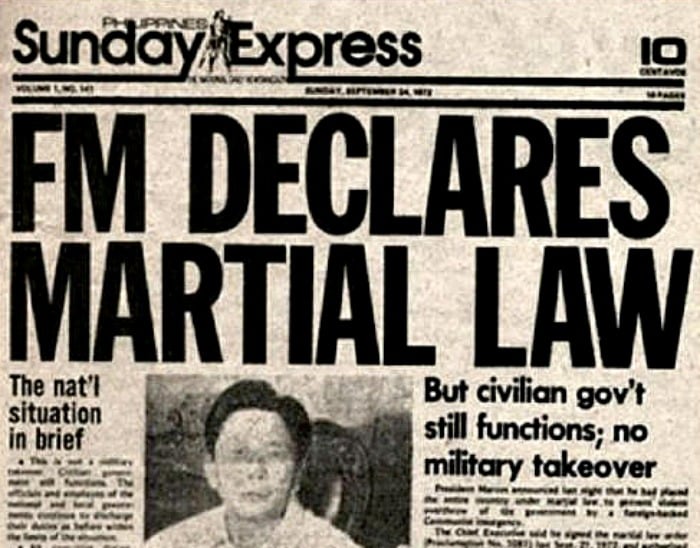
Before we answer those questions, let’s look back at history and know what has transpired first. It was the 21st of September 1972 when Ferdinand Marcos, the then-president declared Martial Law over the whole country. He was elected as president in 1965, and he was on his way towards his 7th year in presidency that time.
Photo from the website of Imelda Romualdez-Marcos
According to Marcos the country was in a state of disarray that time. He claimed that there were a lot of cases of civil unrest and Martial Law can protect the country from this chaos. From 1972, his rule extended up to 1986.
When Martial law is declared – civil laws, civil rights, habeas corpus are suspended and military rule is extended to civilians even. There was little room for freedom that time. Opposing views regarding the government was not well-tolerated.
Case in point, Liliosa Hilao. She was vocal on her opinions regarding the government and she was the editor-in-chief of PLM’s (Pamantasan ng Lungsod ng Maynila’s) school publication. One day in April 1973, she was illegally arrested in her own home.
Unfortunately, she was never seen alive again after that. She was murdered and her body exhibited signs of abuse. Lilli was the first of many who was detained and killed.
Marcos’ reported annual income didn’t exceed $13,500 but through the years their spending exceeded that value. His wife Imelda had a penchant for beautiful things and was not shy about her purchases.
By the end of Martial Law, she has acquired her infamous collection of shoes, gowns, handbags, jewelries, and even artworks such as masterpieces from Claude Monet.
The government after Marcos’ rule estimates that the total amount of the ill-gotten wealth is at USD 10 billion. Martial Law increased Marcos’ power and gave himself access to the coffers of the government.
Marcos benefited from the coco levy funds, taxes that were paid by hard working coconut farmers. He controlled the coconut and sugar industries. He took over large public and private companies and investing the funds he got into shares and real estate. Some of the funds were stored away from the Philippines, in Swiss deposit banks.
Going back to the earlier questions, is it right to forget when people have sacrificed and died? Is it right to turn a blind eye when someone stole from the coffers of the country?
Whichever angle you look at it, it will never be right. It’s not justifiable. Forgetting means to disrespect and condone such acts. Understanding and knowing what happened means to never forget.
Sources:
Ana Roa, “Regime of Marcoses, cronies, kleptocracy,” http://newsinfo.inquirer.net/641277/regime-of-marcoses-cronies-kleptocracy, (September 29, 2014).
Nick Davies, “The $10bn question: what happened to the Marcos millions?,” https://www.theguardian.com/world/2016/may/07/10bn-dollar-question-marcos-millions-nick-davies, (May 7, 2016).
by MLC | May 30, 2018 | Martial Law Analysis
It has always been part of our nature as humans to document our milestones, even way before paper and ink was invented. And for every event, most often there is a corresponding date that is recorded. From the cave etchings up to now, we have always felt the need to tell our story.
It’s not just an ordinary story, we have been creating and recording our history through time. Through history, we understand ourselves more – we look back at how things came to be and what brought us to where we are now.
And as we write down history, it is important to put everything down. There should be no sort of sugarcoating involved. Because when this happens, our real history is changed. We forget through time, we will no longer remember. We accept what has been presented as the truth.
We should understand that we are where we are now because of the sum of the good and bad events that has happened in the past. Whether it’s a good or bad event, we should take a good look at it because it is our REAL history.
We can’t deny that some things happened just because it’s painful or embarrassing. It is the truth and we must not deny its existence. Unspeakable or not, history is history and we should face it as it is. It’s part of our identity.
It is also a disservice to the people who have brought us to where we are today. Let us give honor where it is due, heroism that should not be forgotten.
That’s why we should not forget about what happened on the 21st of September, 1972. It was a dark time in the Philippines, but it should definitely not be forgotten. Actually, it was postdated because of the superstitions and numerology beliefs by the then-president, Ferdinand Marcos.
Marcos, that time, claimed that the Philippines was in a state of unrest that he felt it was necessary to declare the country in a state of Martial Law.
For those who are not familiar what Martial Law is, it is declared in areas (that time it was the whole country) where there is civil unrest or ravaged by major natural disasters.
To control the situation, the government may use measures such as curfews, suspensions of civil laws, rights and habeas corpus. Those who defy the measures are subjected to military tribunal. And so the government in 1972 placed the Philippines under such measures and it went way beyond.
Sadly, the Martial Law went beyond time and abuse. Freedom was curtailed and it was reduced as an excuse for detaining anyone who is critical to the government. Where freedom stopped, reports of illegal detention, torture, abuse, and even murder increased.
The Martial Law was “intended” to protect the country and its people. However, it just increased the power of those in position. Power over the powerless.
Years have passed by from 1972, and some people have tried to justify what happened. That’s an abomination to say the least. It is indeed a painful past but lives and human dignity were sacrificed and we must never, ever forget that.
Sources:
“Declaration of Martial Law,” http://www.officialgazette.gov.ph/featured/declaration-of-martial-law/
Ellen-Rae Cachola, “The Haunting of Martial Law: Records from the Marcos Regime,” http://library.law.hawaii.edu/2017/09/07/the-haunting-of-martial-law-records-from-the-marcos-regime/, (September 7, 2017).
