The history of Martial Law, is first and foremost, the history of the people resisting and fighting tyranny. It was a social movement, an Anti-Dictatorship Movement that succeeded to end Marcos fascist rule.
There are two sides to the history of Martial Law: On one hand, Ferdinand Marcos usurped powers, and established a dictatorship that plundered and committed atrocities against the people.
The other side is that the people resisted and fought back. Not just the activists. Not just the communists and the NPA. Not just the Aquinos, Lopezes and yellow-ribbon followers. But the people throughout the archipelago, numbering to MILLIONS!
Those who fought the dictatorship was a broad spectrum of social and political forces. Sectors included the church, student, teachers, workers, Igorots, Moros, urban poor, Filipinos in the US and Canada, artists, media people, politicians and eventually soldiers.
As shown in the SNAP election that Marcos called in 1985, the diverse political groups included Laurel’s UNIDO; Pimentel and Mitra’s PDP-Laban; Gonzales’ SocDem party; Bishop-Businessmen Conference; Zobel, del Rosario and Ongpin’s Makati Business Club; Conception’s NAMFREL; Diokno’s KAAKBAY, Aquino’s ATOM; Salonga’s wing in the Liberal Party; Bayan-NAJFD and other “Nat-Dem (National Democratic)” groups.
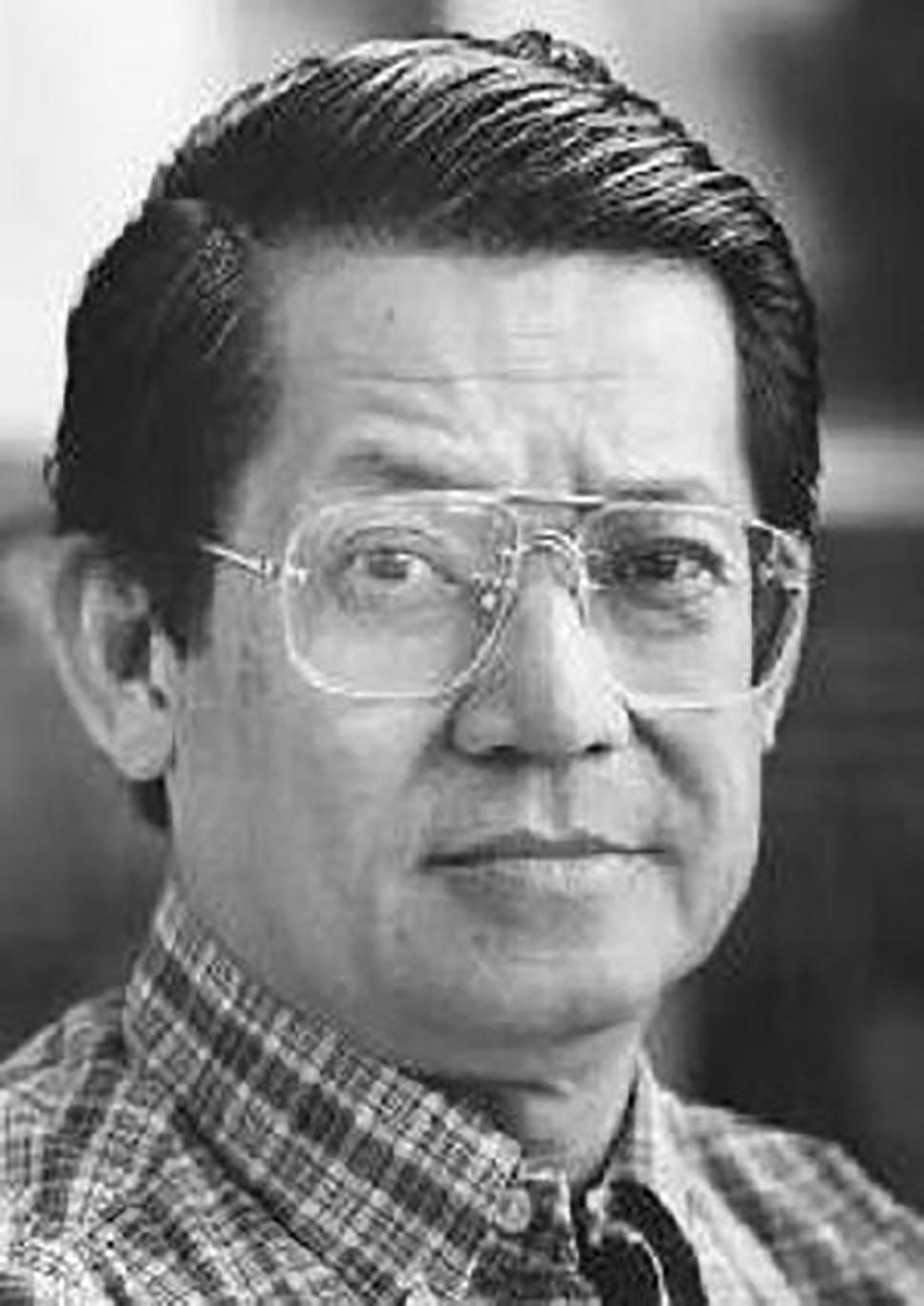
Notable figures included Jose W. Diokno, Ninoy Aquino, Cardinal Jaime Sin, Senator Lorenzo Tanada, Prof. Francisco Nemenzo, film director Lino Brocka,
Prof. Randy David, Nanay Soling Duterte (in the Yellow Friday Movement). They all fought the Marcos Dictatorship.
Among the many who fought the Marcos Dictatorship, there were those who took the path of armed resistance and war (1). Some took the path of dissent and reforms in the armed forces, eventually leading to a plot and failed attempt at coup d’état. Then were those who tried to bring down the regime, through the ballot box. Perhaps it remains debatable what was the “correct strategy” and “forms of struggle” (2).
What history strikingly shows us is the prominent role of mass protest actions, organized and spontaneous, that eventually proved in weakening and bringing about the downfall of the dictatorship.
Protest actions, organizations and movements grew in scope, scale and intensity — from ripples of protests beginning in 1973, building up as big waves until 1982, then a crescendo of “Welgang Bayans” (Peoples’ Strike), and finally ending with people power at EDSA. These went beyond placards, pickets and rallies, often described as “parliament of the streets”. These were general workers strikes, general transport strikes, barricades, student boycotts, gigantic demonstrations and electoral rallies, combined that effectively paralyzed major cities and towns.
What history strikingly shows us is the prominent role of mass protest actions, organized and spontaneous, that eventually proved in weakening and bringing about the downfall of the dictatorship.
These mass actions, while dealing with local and national issues, were expressly and pointedly directed against Marcos terror rule. The Anti-Dictatorship Movement was political in nature, and homogeneous.
EDSA was a culminating point, the last push that swept away the Marcos regime. It paved the way for the restoration of pre-Martial Law democracy. It
showed, moreover, that even the military, especially junior officers and the soldiers, who found their rifles decorated with rosaries and flowers at EDSA, took the side of resistance and fighting the dictatorship.
However, the pages of history cannot be reduced to February ’86 or EDSA (3). Those four days do not represent nor substitute the 13 years of resistance and fight under Martial Law, that weakened and eventually did away with the Dictatorship.
History, more precisely, events and facts during those 13 years projects a larger framework — a massive movement against the dictatorship and for democracy. Focus is mass protest actions that happened, wave upon wave, in major cities and towns of the country, in factories, universities, peasant communities, workers and urban poor areas. It was mainly for such resistance and struggle against dictatorship and against Martial Law, that victims and heroes rendered sacrifices and gave their lives.
…the pages of history cannot be reduced to February ’86 or EDSA. Those four days do not represent nor substitute the 13 years of resistance and fight …events and facts during those 13 years projects a larger framework a massive movement against the dictatorship and for democracy.
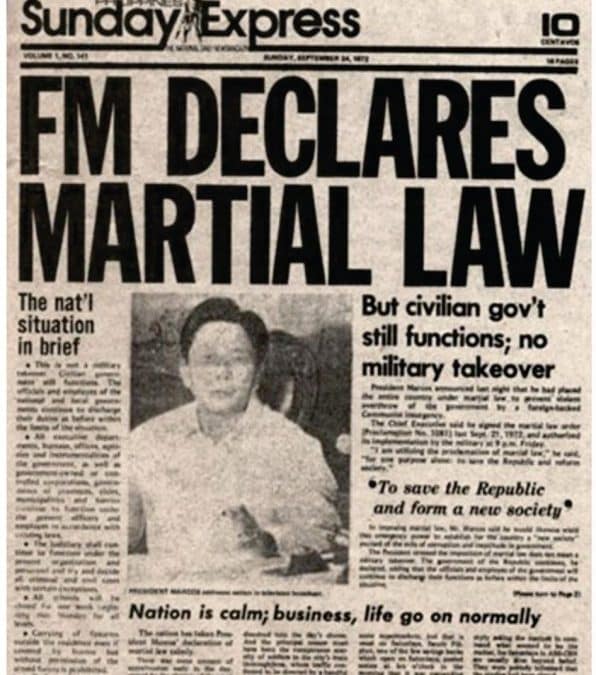
Here is a short review of some events from September 1972 when Martial Law was declared to EDSA of 1986:
September 21, 1972
Huge rally of 50,000 people under the alliance “Movement of Concerned Citizens for Civil Liberties (MCCCL)” was held at Plaza Miranda, just a few hours before Marcos signed Proclamation 1081 (Martial Law) and days before announcing it. The rally attacked “Oplan Sagittarius”, the secret plan to declare martial law.
January 1973
Lightning protests in Metro Manila against the 1973 Marcos Constitution, the initial stirrings of resistance.
November 1973
Roughly 5000 urban poor dwellers under the Zone One Tondo Organization marched to Mendiola, protesting against demolition of their homes under Marcos’ “New Society”
May 1975
First Bodong or peace pact meeting of 150 Bontoc and Kalinga leaders who united to oppose the Chico River Dam project of the Dictatorship. The Dam would have submerged sacred tribal lands. Their resistance continued to the ’80s despite the assassination of their leader, Macli-ing Dulag on April 24, 1980.
October 1975
The first wave of mass protest began at the La Tondena Distillery. Five hundred workers, chanting “Tama Na, Sobra, Welga Na,” went on strke, defying the dictator’s ban on strike and police repression. In the months that followed, the strike spread out to 200 strikes nationwide, counting an estimated 80,000 participants. In Manila alone, there were 25 strikes, with 40,000 participating.
Oct 1976
About 5,000 demonstrators, marched to Malacañang Palace to protest a referendum-plebiscite and four years of Martial Law.
July 1977
A wave of student protest rocked Metro Manila. Over 200,000 students joined protest actions, demanding a stop to tuition fee increases, push for the restoration of student councils and newspapers that have been banned under Martial Law, and opposing the militarization of universities and colleges.
March 1978
Filipino employees in various US bases in the Philippines, numbering to about 20000 went on strike.
April 1978
Large swaths of Metro Manila were swept by a ‘noise barrage’, amplifying a growing electoral movement and protest as Marcos cooked the elections that imposed a rubber stamp parliament called “Interim Batasang Pambansa”.
January 1981
After Marcos nominally lifted Martial Law, a wave of 260 strikes took place, with over 76,000 workers involved. Labor unions against the dictatorship increased in number and strength in the months and years that followed.
June 1981
Organizing and actions by Filipinos in different cities in the USA, against the Marcos Dictatorship, stepped up after Filipino-American labor activists Gene Viernes and Silme Domingo were murdered in Seattle. Later, a 1989 US federal jury determined that Marcos ordered the murders in retaliation to Filipino anti-dictatorship activities.
December 1982
Huge marches and demonstrations, numbering to 170,000 participants were held in Mindanao. Kuratong bamboo drums reverberated in many areas — a noise barrage against widespread militarization and hamletting in Mindanao.
August 31, 1983
At least two million Filipinos turned out to be counted in the funeral of Ninoy Aquino. They joined the procession, lined the streets, displayed banners and ribbons, and chanted all throughout an eleven-hour journey.
September-November 1983
Different groups united into a loose coalition against the Marcos Dictatorship and the assassination of Aguino. On Sept 21, the “Justice for Aquino, Justice for All (JAJA) coalition spearheaded widespread protest. Half-a-million people attended the Indignation rally at Liwasang Bonifacion in Manila. Other protests were in Davao City, with estimated 6000 participants and Zamboanga City, with estimated 10000 participants. In November 1983, observing the 51st birth anniversary of Ninoy Aquino, another JAJA rally in Luneta drew 250,000 demonstrators.
January 1984
“Tarlac to Tarmac” march, in memory of slain opposition leader Benigno Aquino, was staged by opposition and coalition groups. About 300 joggers, showered with confetti and cheered by thousands of Filipinos ended a 90-mile run Jan 29. Separately, about 10,000 demonstrators converged at Manila’s Central Post Office calling for opposition to Marcos’s rule. The wave of protest culminated January 31, drawing 2 million people in the largest antigovernment rally since Aquino’s funeral.
September 1984
QC Welcome Rotonda protest dispersal turns violent; student leader and future UP Diliman chancellor Fidel Nemenzo was shot in the kidney and nearly killed; photographs of 80-year-old former Senator Lorenzo Tanada and 71-year old Manila Times founder Chino Roces facing water cannons become iconic of the Marcos administration’s use of excessive force.
June 1985
June 18 “Welgang Bayan Laban sa Plantang Nukleyar” (“People’s Strike”) begins in Balanga, the capital of Bataan. By June 20, the protest activities of 22 anti-nuclear organizations forced the entire province of Bataan to stand still which eventually enveloped the country.
August 1984
About a million people joined protests nationwide during the first anniversary of Aquino’s death.
November 1984
The whole of Mindanao went on a “Welgang Bayan (or People’s Strike)”. Transport strike, barricades, noise barrage paralyzed major cities. Shops, schools, offices closed down. The cities of Davao, Cagayan de Oro, Butuan, Surigao, Iligan, and General Santos came to a standstill. Tagum, Mrbel, Digos, Bayugan and other towns also joined the Welgang Bayan. The military killed some demonstrators, arrested thousands and dismantled barricades. But the barricades came back, extending even up to 3 days in some places.
December 1984
Jose Burgos Jr. relaunched the fortnightly “WE Forum” in addition to “Malaya”, a daily broadsheet. Burgos and his staff were arrested on Dec. 7, 1982, and detained for a month. The paper’s facilities were shut down for hard hitting coverage of the Marcos government.
September 1985
A crowd estimated at 5,000 people composed of sugar workers, farmers, fisher-folk, students, urban poor, church people and professionals staged a protest at the of Escalante, a town in Negros island, commemorating the 13th anniversary of martial law. Some 50 combat-ready Regional Special Action Forces (RSAF), plus local policemen, members of the Civilian Home Defense Force (CHDF), and unidentified armed civilians attacked the crowd in what is now known as the Escalante Massacre. At least 20 people were killed.
October 1985
Thousands of peasants joined a “Lakbayan rally”, a 5-day march originating from various points in Luzon and coverging at Manila’s Liwasang Bonifacio. The marchers never reached Liwasang Bonifacio. Just before noon of October 21, 1985, police forcibly broke into their ranks while they were at Taft Avenue, killing a number of protestors.
December 1985
A big protest march was held outside Malacanang palace, on the occasion of Human Rights Day and on the eve of the snap presidential election called by Marcos. Huge rallies were held in other parts of the country, notably in Bacolod city where 20000 demonstrators converged.
February 1986
At the end of the campaign period of the Marcos snap election of February 1986, hundreds of thousands attended the opposition rally of Corazon Aquino. Marcos rigged the Feb. 7 polls and thereafter, on Feb 20, declared himself the winner of the presidential election. On the same day, two million people held a “people’s victory rally” and responded to Corazon C. Aquino call for civil disobedience. Public protest and anger would eventually lead to a 4-day “People Power” that would topple the Marcos Dictatorship.
Today, the history of the Martial Law years that we see is unrecognizable, Not only have Marcos and Duterte trolls spewed out lies, they have successfully changed the frame of the debate… Excluded from the narrative is the Anti-Dictatorship Movement.
obfuscated and distorted. Not only have Marcos and Duterte trolls spewed out lies, they have successfully changed the frame of the debate. Did Marcos plunder the coffers of government, or did he have the Tallano gold? Was Ninoy a hero (worth naming the airport) or the communist-backed winner of the Aquino versus Marcos political battle? Were those killed during those years red-yellow terrorists?
Excluded from the narrative is the Anti-Dictatorship Movement.
The generation of the Martial Law years must speak out their truth. It is not enough to show and say, “I was at EDSA in 1986!”. We need to show and say, “I was there during the 1973 lightning rallies shouting ‘No to the Marcos Constitution’. I was there, in the mid-70’s, during labor strikes at South Superhighway, Parañaque. I was there at the university belt when students sang ‘Ibalik ang Students Council’. I was there when people people were honking their vehicles and making noise when Marcos imposed his 1978 IBP parliament. I was there among the barricaders of Bajada, in the last day of a Mindanao-wide welgang Bayan. I was there under the JAJA banner expressing my anger at Liwasang Bonifaction Sept 21, 1983.”
“I was there in the Anti-Dictatorship Movement of the Marcos Martial Law years!”
Notes:
Two groups opposed the Marcos Dictatorship through arms or by means of war:
The first was the Moro National Liberation Front (MNLF). A botched plan of the Marcos government to invade and reclaim Sabah in 1968 ended in the massacre of Muslim recruits, in what would be known as the “Jabidah Massacre”. The MNLF began and grew from Muslim students radicalized by the Jabidah Massacre and advocated separatism for Muslim Mindanao.
From 1972 to 1976, the separatist MNLF and its military wing, the Bangsa Moro Army, with an estimated 10000 troops and 30000 reserve became strong enough to engage the AFP in positional warfare. Military stalemate pushed Marcos to carpet bomb Cotobato and other Muslim areas, and eventually seek a negotiated political settlement in Tripoli, Libya.
The Tripoli agreement of 1976 was used by Marcos to give Muslim nominal autonomy. It split the Moro movement into MNLF and MILF. When Muslim armed groups resumed guerilla warfare in 1977, armed Moro regulars were down to about 3000 and a reserve of about 12000 under 9 provincial commands.
The second is the the Communist Party of the Philippines. The CPP’s armed wing the New People’s Army, grew rapidly in the early ’80s. According to 1986 documents of the Executive Committee of the CPP, it had about 4000 regular fighters, 7000 guerillas and a organized mass base of about 700,000.
The MNLF-MILF and the CPP-NPA, as history shows, have failed to achieve their goals thru military means. They politically prepared and mobilized the population they reached, to resist the dictatorship. However those efforts, that tied the people resistance to military strategies, argue-ably led only to derailment and diversion of the people, from different, timely and effective ways to fight the dictatorship.
Under the shadow of a failed “protracted people’s war”, a number of people in the Left, including former CPP members may hesitate to expound on the protest actions and movements during the Martial Law years. It is a known fact that many of the mass protest actions during Martial Law years were initiated by the CPP, where its cadres and forces directed those mass actions and mass organizations to support, directly or indirectly the NPA.
However, a closer view of the people’s protest movements would show that communists did not have a monopoly of the protest movement. For example, in the labor movement during the first half of the ’80s, the CPP had influence only in less than 20% of unions and strikes. During times when the political struggle shifted to the electoral arena, like the snap elections of 1986, the CPP and its forces were a minority and eventually marginalized in 1986 because of its position to boycott election.
(3) EDSA ended with the Americans spiriting away the Marcoses to Hawaii (bringing with them some of their immense loot), revealing the fact that the Americans controlled the end-game of the so-called “EDSA revolution”. US president Reagan simply waited for the last hour to implement a “transition plan” prepared in Washington months ahead of the EDSA coup attempt. The National Security Strategy Directive (NSSD) was completed in November 1984 and adopted as policy in January 1985. (https://www.rappler.com/…/analysis-how-united-states…/)
American influence, through the Enrile-Ramos faction, toegether with the vacuum created by a largely absent Left, meant that the Cory Aquino government would pursue reforms for democracy, only to a limited extent and in a limited way. Decades later we would see the result of such limitations: the destabilization of institutions of the 1935 and 1987 constitutions, the consolidation of political dynasties – Estradas, Macapagal, Duterte, Garcias, etc and the return of the Marcoses.
Ryan Quimpo
co-author, “Subversive Lives”
July 25, 2022
Photo: Human barricade at Iligan City in the second Welgang Bayan that paralyzed Mindanao in May 1985. (from photo collection of Filippijnengroep Nederland)
Don’t just teach your students to read. Teach them to question what they read, what they study. Teach them to doubt. Teach them to think. – Richard Feynman
Many of my relatives worked under the government offices of Martial Law (ML), and it provided food on our table.
One can say that the ML government-supplied even the milk I was fed with, so one can only imagine how grateful my family was towards the Marcoses.
I love my relatives, and this article is in no way to discredit how they feel towards ML; however, it is about time I write about how one is short of being brainwashed to believe lies and how more than often, this starts with one’s family.
So, I apologize if this article might sound irreverent or disrespectful.
Still, in the spirit of searching for truth, more often than not, everything about what truth ought to be, seems to be offensive, as Dr. Jordan Peterson pointed out.
“In order to be able to think, you have to risk being offensive.” ― Jordan B. Peterson
May my relatives find it in their hearts to read this article with an open mind and focus on where the evidence rests.
————–
Political discussions with kids weren’t the strongest suit of my family.
Whenever discussions arise, we were ordered to stay in another place.
I wasn’t sure if they were shielding us from the discussions, or they were afraid that we might unwittingly mention it elsewhere; nonetheless, we were ‘incommunicado’ at best whenever these things happen at home.
However, that didn’t stop me from inculcating the myths surrounding Ferdinand Marcos (FM) and Martial Law (ML).
And growing up in an environment where my relatives benefited from ML didn’t help promote critical thinking in the family. (Critical thinking in the sense that one is also able to take a stand to argue for an issue and afterward take up the opposite stand)
“It is a narrow mind which cannot look at a subject from various points of view.” – George Eliot, Middlemarch.
I was indoctrinated from a very young age that Ferdinand Marcos was the real hero of EDSA (I know, I know don’t roll your eyes just yet), that Martial Law was heaven for the Philippines and that Cory and Ninoy Aquino were EVIL people.
Whenever I ask why, my relatives would answer, Marcos said so, and because THEY too said so, and that’s the end of it.
You see, in our family, you never question authority; everything they said is the law (sort of like Martial Law daily, and that does not include the beatings, but that’s another story).
I think that was the way my relatives were also brought up back in the province.
I remember I would go to school shouting “Marcos, Marcos, Marcos Pa Rin!” complete with the V sign and the red shirt that I was so proud to wear.
I would hate the color yellow and would look condescendingly at it every chance I get.
Give that mindset and worldview ten years or more, and you will find yourself a full-fledged Marcos apologist.
Sort of what one would call in the U.S. a white supremacist, I guess…
I was also trained to look at Marcos’s “Golden Age”in an era where the grownups are the only source of information. Never mind that the school system never brought up the history of Martial Law for whatever reason they didn’t; I can only guess.
Most of my history teachers think that Philippine History ended after World War 2, the only ones who talked to me about Martial Law in a hush as if being careful not to have anyone hear them and, of course, outside of the school curriculum were both U.P. Alumni.
So imagine this experience by my generation multiply it with the millions of others in other schools, and you will have a recipe for historical revisionism/negationism.
To note, there was no internet back then, and my mind was too young to understand the intricacies of a healthy debate. (and honestly, I was too pre-occupied with basketball and playing the guitar)
So, I stuck with what “I felt was right” by the authority of my relatives who raised me.
“The most dangerous thing you can do is to take any one impulse of your own nature and set it up as the thing you ought to follow at all costs. There’s not one of them which won’t make us into devils if we set it up as an absolute guide.” – C.S. Lewis
Therefore, for years I glorified Ferdinand Marcos and his New Society and would always defend his legacy, always using the same arguments of Marcos Loyalists like:
Marcos built this and built that.
It was Imelda’s fault and not Marcos’s on why there were problems at that time.
Marcos made the country rich.
Marcos made the country peaceful.
Marcos stopped the communists from overrunning the country.
Marcos cleaned everything, from trash to squatters.
Marcos was the most intelligent and the ablest President ever, and he was also a war hero.
The EDSA revolution happened, but it also made the country a total mess, compared to Marcos’ Philippine heaven.
EDSA Revolution has been just a ploy to replace Marcos and prop up Elite Rule.
All of our politicians steal from the country; at least Marcos made something out of it; see the buildings and bridges he built?
The country was the Tiger of Asia at the time of Marcos, but look at it now we are swimming in poverty.
(This list I would later see when Facebook (FB) came to light, being spread around and random people just sharing it)
You name it, I knew it. I can almost see myself joining this flash mob dance for Marcos’s birthday celebration.
The verbal arguments and demonizing of the Aquino’s to the victim-blaming the Marcoses towards communists and activists, I’ve used them.
I’ve used all of these arguments, most often successfully, influencing people around me and arguing them down, those people who had a minimal amount of information between their ears (technically like me but worse).
And to make it far worse, fate was on my side, as I can easily dismiss all that is negative in society at the time and point at the‘effectiveness of Martial Law’ in instilling ‘discipline.’
Because yes, the country is messed up no matter how one looks at it (only for me to find out it was primarily because of Marcos).
IT WAS THAT EASY; I GIVE PEOPLE A FALSE SENSE OF HISTORICAL GLORY AND ASSOCIATE IT WITH MARCOS.
Or perhaps because nobody bothered to correct me and challenge what I know.
So, I get it when Marcos apologists are the way they are, and it is because they weren’t born that way; it is because they were grown that way.
Your assumptions are your windows on the world. Scrub them off every once in a while, or the light won’t come in. – Isaac Asimov
How could an ardent, well-trained from birth Marcos lover become one of those people standing up on FB whenever people are spreading the legacy of Marcos?
What triggered my conversion?
I think the breakthrough began when I ran away from home.
Yes, I did run away from home and lived in different houses and eventually settled down with my current family now.
I soon found out that they were victims of Marcos and ML.
That was when the stories came out.
It took some time for me to digest everything, as I wasn’t entirely convinced that the victims of ML were telling the truth.
Now and then, I would slide back in doubt, only realizing afterward that I am doing myself a great injustice by not looking for facts and just assuming anything at face value.
It became more evident that my fanaticism was based on the stories programmed within me by my family.
And because of this, it enabled me to deny any evidence unless I view history with an open mind minus the pre-suppositions.
It wasn’t easy; it entails thinking over a lot of things and swallowing my pride.
“Hold everything in your hands lightly, otherwise it hurts when God pries your fingers open.” – Corrie Ten Boom
And that is harder than most things to accept, especially for people to realize they made a mistake.
To admit and recognize that there is a problem with what I believe is painful, one might call it cathartic, and it also entails a lot of humility.
It is never too late to give up your prejudices – Henry David Thoreau
I soon realize that to be convinced of the merits of ML would also mean I would have to deny the atrocities and injustices that happened back then.
Consequently, it would also mean accepting all of them as “necessary.”
And that makes it an ultimate moral dilemma, not to mention a horrible case of cognitive dissonance.
I have to ask myself:
Who was Ferdinand Marcos?
Was ML moral?
Did these things (incarceration, tortures, disappearances, murders) happen? If so, why?
Why was Martial Law proclaimed in the first place?
Who benefited from Martial Law?
Why was there an EDSA insurrection?
Was EDSA insurrection necessary?
Who were Ninoy Aquino and his wife?
Who were the people who suffered under Martial Law, and what were their stories?
Why did people hate Marcos at that time?
What was the state of the country at that time?
If Marcos was so great, why can’t he control Imelda?
If Marcos was so great, why did these things (incarceration, tortures, disappearances, salvaging, murders) happen under his watch?
What was Marcos‘ reason for declaring ML, and why?
Did Marcos steal money from the country? If yes, how much? How did it affect our country in the short term and the long run?
If I was one of the victims of the abuses of Martial Law, what would I feel?
If one of my loved ones was a victim of ML, what would I think and feel?
If a family of mine got tortured, disappeared, and murdered by ML, would I continue to support it?
“WHY SHOULD I BELIEVE WHAT I BELIEVE ABOUT ML?”
I realize that I have to ask these questions and go where the evidence leads me.
I would have to look at the facts and evidence from outside of the country, from people and organizations that are not influenced by the political forces of the government.
I realize that I cannot just justify Martial Law based ONLY on my opinion because even though I may have the right to do so, I cannot have the right to have my facts.
“If someone is able to show me that what I think or do is not right, I will happily change, for I seek the truth, by which no one was ever truly harmed. It is the person who continues in his self-deception and ignorance who is harmed.” – Marcus Aurelius, Meditations
I have to find the truth, and the truth is, most, if not all, of the justifications I heard about the implementation of ML, can never hold water under intense scrutiny and solid evidence.
It would crumble philosophically, scientifically, morally, and ethically if one plans on getting at the bottom of it.
Some people say that Martial Law also did something good for the country despite its shortcomings.
I’m afraid I have to disagree.
It condones the idea that a physically and emotionally abusive husband is still a moral person as long as he provides for the family.
Unfortunately, I believed this kind of statement back then. For the life of me, I will do anything today in my capacity to stop the future generations in accepting the same.
So, Was Ferdinand Marcos The Best President Of All Time?
I think you already know the answer to this question.
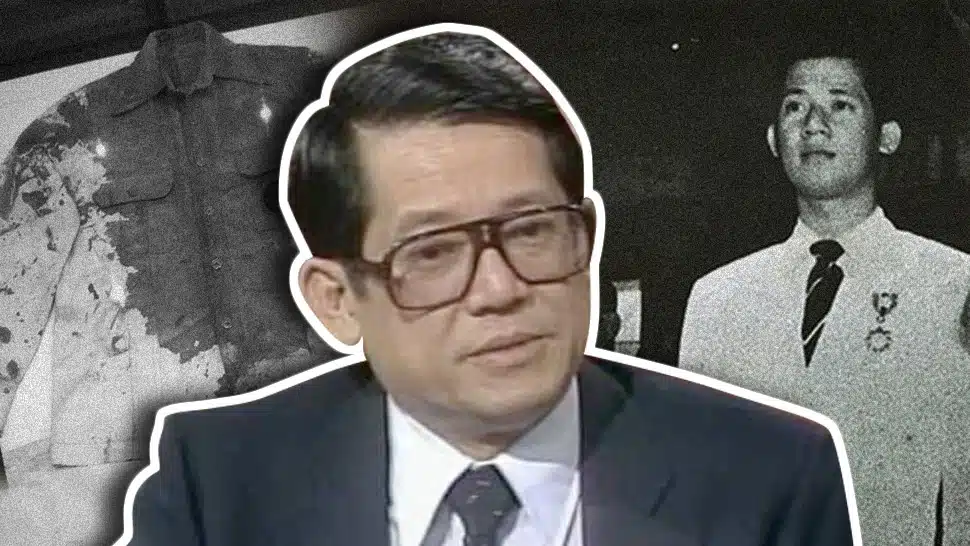
Whether you consider yourself a “Marcos loyalist,” or a “Yellow supporter,” or neither, Benigno “Ninoy” Aquino Jr.’s legacy to the Filipino nation cannot be denied. He was more than consequential; his life (and death) truly shaped the nation. He was a driving force in Philippine politics.
But his life was also filled with controversy. And, in the age of post-truth, it’s sometimes hard to separate fact from misinformation. Let’s take a deep dive into some of the things surrounding Ninoy’s life.
Did Ninoy co-found the CPP-NPA-NDF?
It’s impossible to talk about Ninoy without talking about his strange relationship with Prof. Jose Maria Sison, founding chairman of the Communist Party of the Philippines.
A lot of stories abound regarding his involvement with the CPP, ranging from him being a founding member, to a supporter, to even letting NPA cadres use Hacienda Luisita as a safe haven.ADVERTISEMENT – CONTINUE READING BELOW
The truth is slightly more complicated than that. Joma and Ninoy knew each other in the ’60s; that was true. Ninoy was an ambitious up-and-coming senator and Joma was making waves as a labor leader and chairman of Kabataang Makabayan.
Ninoy even floated the idea of a hunger strike with the KM chair in late 1968 in opposition to Marcos’ policies, but Joma refused. This was the extent of their interactions.
The rest is hearsay. Ninoy did not have a hand in introducing Bernabe Buscayno, alias Commander Dante to Joma. Nor did Ninoy have any knowledge that Joma was Amado Guerrero, CPP chairman.
If anything, Ninoy being supported by the CPP was almost impossible, since Ninoy represented the very thing the CPP fought against: the old, land-owning bourgeois elite. As far as they were concerned, Ninoy and Marcos weren’t too different.
It might seem hard to imagine Ninoy being with anybody else besides Cory Aquino, but there was indeed a time when Ninoy was the most eligible bachelor in Tarlac.
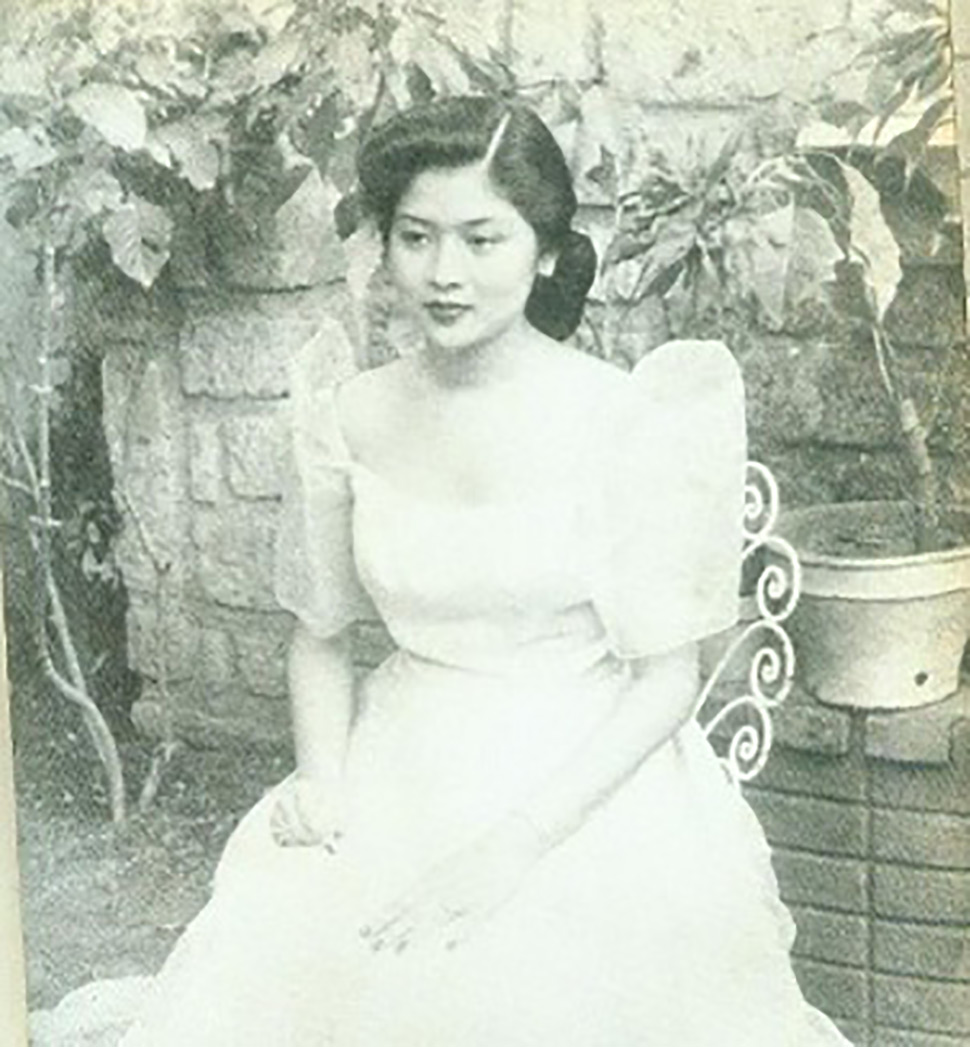
Back in the 1950s, when Ninoy was a student at the University of the Philippines, he used to court none other than the former beauty queen, Imelda Romualdez. Not too far-fetched; the rich tend to flock together. In various interviews, Ninoy would recall Imelda was “the most beautiful woman” and “looked like the Virgin Mary.”
Of course, things didn’t work out. Imelda didn’t fall for Ninoy’s charms, calling him a bit too chatty. She would later meet and marry Ninoy’s Lonsi brod, Ferdinand Marcos, on May 1, 1954. Ninoy, for his part, would meet the daughter of the owner of Hacienda Luisita, Corazon Cojuangco, and get married in October of that same year.
Aside from being a communist, Ninoy was often branded as a tool of the CIA or, at least, a collaborator in some capacity. Different theories suppose that Ninoy contacted the CIA during his stay in the U.S., or soon after his marriage to Cory during their honeymoon, or shortly after he convinced Huk Supremo Luis Taruc to surrender.
In any case, CIA collaboration with Ninoy seemed unlikely. In a declassified report from the CIA, the agency referred to Ninoy as an “opportunist” who was “consumed with ambition to run the Philippines as President.” Hardly a sterling recommendation for a supposed agent. Ninoy has also been described as “unable to keep quiet,” making him an unlikely candidate for keeping secrets.
That said, CIA involvement in the Philippines is no secret. Agents have been involved in Philippine affairs since its “independence” in 1946. There were CIA agents in the Philippines, but maybe it wasn’t Ninoy.
Did you ever stop to think why Sabah is included on most Philippine maps? It’s because, during the Marcos dictatorship, the Philippines was asserting its claim to Sabah through the Sultanate of Sulu.
These days, Sabah isn’t as sore a point of contention as before, ever since Marcos’ 1977 promise to drop the claim (officially, the Philippines has yet to drop the claim); Malaysia and the Philippines have enjoyed warm relations since 1989.
But during the Marcos era, the Sabah claim and the government’s attempt to assert this claim through Operation Merdeka and the subsequent Jabidah massacre led to the severance of diplomatic ties between the two countries, and even the creation of the Moro National Liberation Front. And the person who led this expose? None other than Ninoy Aquino.
This has naturally led to accusations of Ninoy collaborating with Malaysia to try and topple the Marcos dictatorship. This, along with with a statement he made of promising to drop the Sabah claim if he became President, and a rumor about him “dying a Malaysian citizen” or co-founding the MNLF all contribute to theories of Ninoy being a Malaysian turncoat.
While some are true, such as the Jabidah Senate hearings and Ninoy’s promise of dropping the Sabah claim, rumors of him being a founding member of the MNLF or having a Malaysian passport are both false.
A note about Ninoy being a “naturalized Malaysian citizen”: This is proven untrue. Ninoy’s fake passport, which he used to enter the Philippines (named Marcial Bonifacio), was given to him by Jose Ampeso, who was vice consul in the Philippine Consulate in New Orleans. They were Philippine passports.
PHOTO BY WIKIPEDIA.
So who was Ninoy?
Ninoy Aquino was a lot of things. To some, he was a hero. To others, he represented the worst of the Filipino. Whether he was the beacon of democratic statesmanship or an opportunistic politician, it’s undeniable that he was instrumental in toppling the Marcos dictatorship.
It becomes important to us, as the people who live in the post-Ninoy generation, to learn how to read his actions. We have to learn from our past and make sure it doesn’t come back to haunt our present.
Sources:
Ampeso, J. (2014, August 22) How Ninoy Aquino got his 2 passports in New Orleans. Philippine Daily Inquirer.
Rappler.com (2018, August 21) HOAX: ‘Ninoy Aquino died a Malaysian citizen’. Rappler.
Lopez, M. (2012, February 25) She might’ve been ‘Imelda Aquino’. Philstar.
Munda, C. (2017, January 20) CIA Report says Ninoy was an “opportunist” and was “consumed with ambition” to be President. Mindanation.
Sison, J. (2010, October 1) On Ninoy Aquino’s Relations with CPP & NPA. Jose Maria Sison.
Last January 2018, I had been helping my father clean when I discovered that he had Marcos propaganda with him. I was inspired by the discovery to read everything that Marcos had written, and then collate my insights about them through a short book. Of course, I also had to properly situate myself, so I also sought books that were a more sober analysis of the Martial Law era.
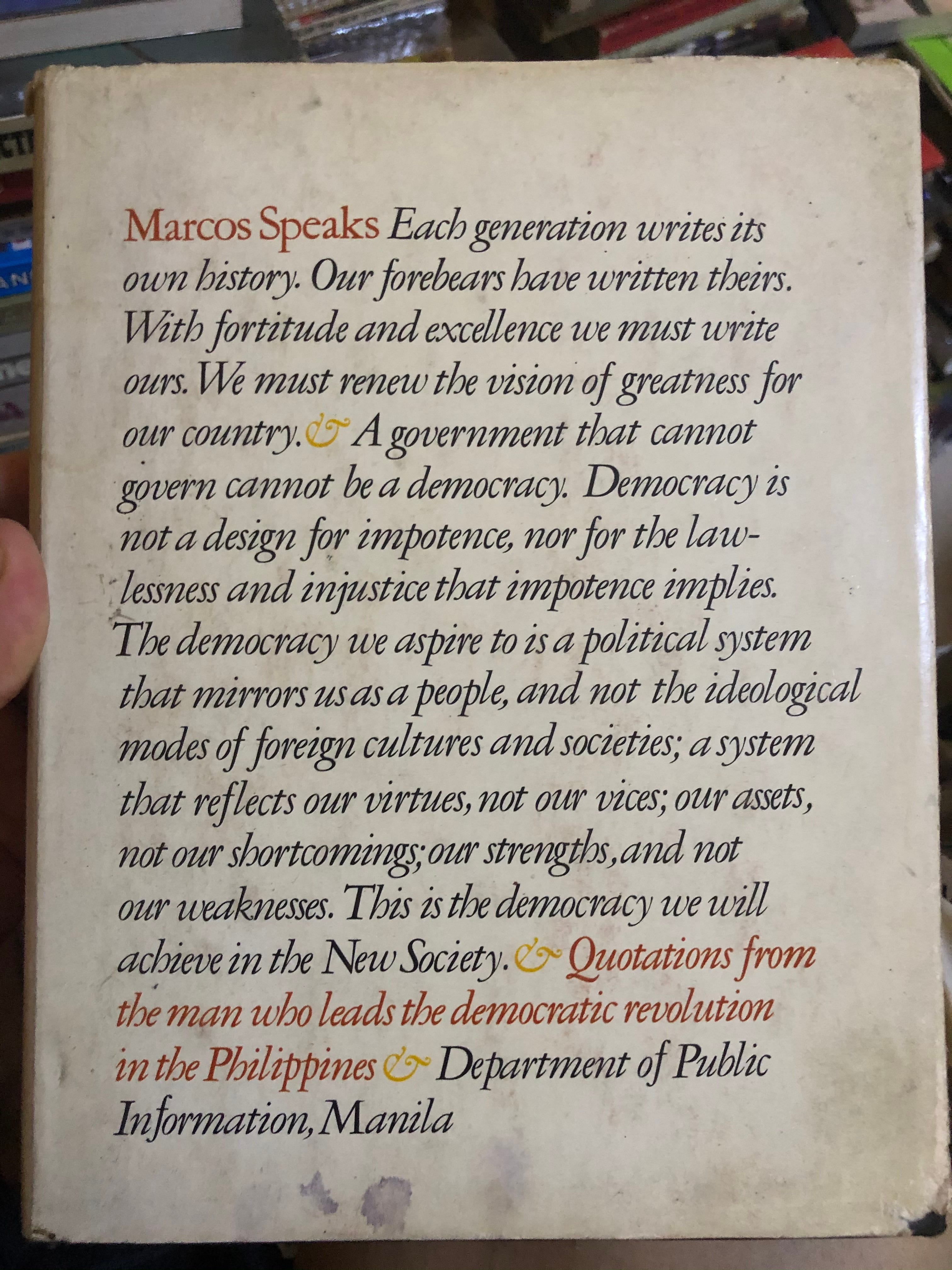
My father had a copy of Today’sRevolution: Democracy, and it was the first book I read from his oeuvre. It was Marcos’s attempt to leaven the idea of Martial Law to Filipinos, and I thought it was decent.
The first book I purchased, however, if I remembered correctly, was one volume of Marcos’s Tadhana (It was Volume Two, Part Two). I thought that it was serviceable as a history book (and found out later that year that UP scholars wrote it). However, I also discovered that it was leading toward a sort of synthesis, presumably the inexorability of Marcos’s rule. It was sold to me by a history teacher, Sir Marlon Riobuya — and we’re still friends to this day. He sold it to me at an affordable price because I was upfront with him: I told him that I sought to write about the pervasiveness of Marcos’s fraud, because it seemed to me that people had already forgotten about what he had done. In my little way, it was how I planned to pay my dues to history.
I had started my readings with Mijares’s Conjugal Dictatorship: it seemed to be the most popular book that exposed Marcos’s shortcomings during Martial Law. However, Mijares also had reason to besmirch Marcos’s name: to the analytical reader, the work might have been him sour graping. After all, prior to the exposé, Mijares was Marcos’s press relations man. I buttressed this with Belinda Aquino’s Politics of Plunder, and noticed similarities.
These were similarities that arose from James K. Boyce’s Political Economy of Growth and Impoverishment in the Marcos Era, Mark R. Thompson’s Anti-Marcos Struggle, Raymond Bonner’s Waltzing with a Dictator, William Rempel’s Delusions of a Dictator, and Charles McDougald’s Marcos File. All these books confirmed through copious evidence that Marcos was a thief, although he was smart enough to use his cronies to steal.
Back in October 2018, however, I was still starting my research. Because I accompanied my younger sister to a K-pop concert, I took the extra time I had to go around Recto and purchase whatever Marcosiana I could find. I had been very fortunate with one seller, because she was clearing out her shop and sold Five Years of the New Society and Notes on the New Society II at cheap prices.
I planned a chronological analysis on Marcos’s bibliography, and started reading and annotating his books that I gradually obtained. I used my salary to fund my research, and gradually obtained most of his penned works (except the other Tadhana books). I used Jacques Ellul’s Propaganda as the launching point of my work: he had, after all, written that “He who intends to establish a dictatorship always insists that his adversaries are bent on dictatorship.”
This was definitely the case with Marcos.
Last 2019, I was able to complete collecting nearly all book-length works attributed to Ferdinand Marcos (with the sole exception of The UN: 40 Years After).
I was also able to write short exegesis on the books that I had. Had there been no COVID-19 pandemic, I would have been able to publish a short tract.
Last week, however, I conversed with Ma’am Sibyl Jade Peña whose stepfather had worked with Adrian Cristobal in a think tank. It was from her that I was able to realize that Marcos didn’t even write his books! One of his last works, The Filipino Ideology, she stated, was written by Nilo Tayag.
Through her guidance, I was able to come across Miguel Paolo Reyes’s article Producing Marcos, The Scholarly Author. This article was published in Philippine Studies, and is an even more thorough exegesis of the books I had gradually collected over these past two years.
I had presumed that I would be able to attack Marcos’s words through a close exegesis of what he had written. My tragedy was that the books weren’t even written by Marcos in the first place!
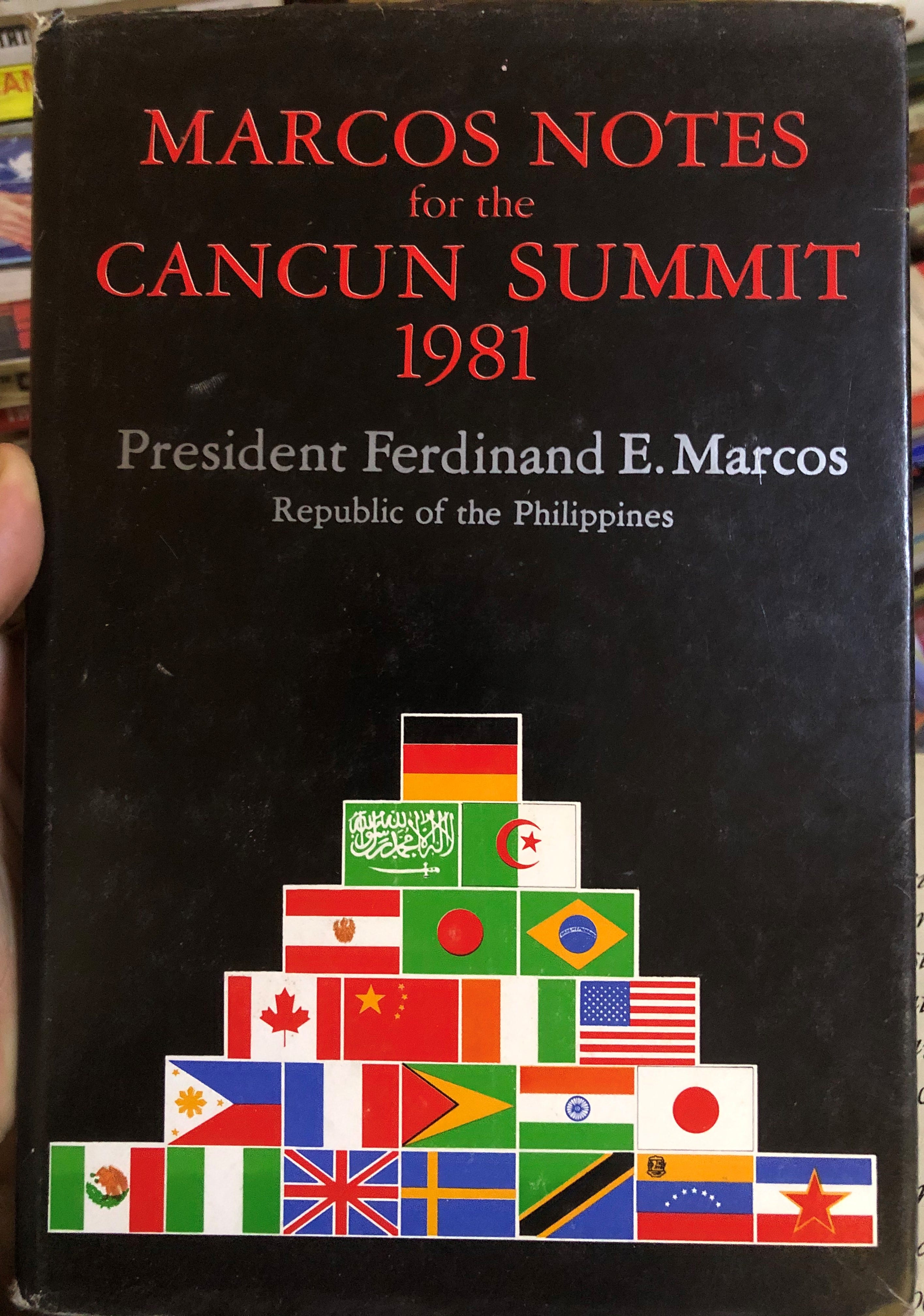
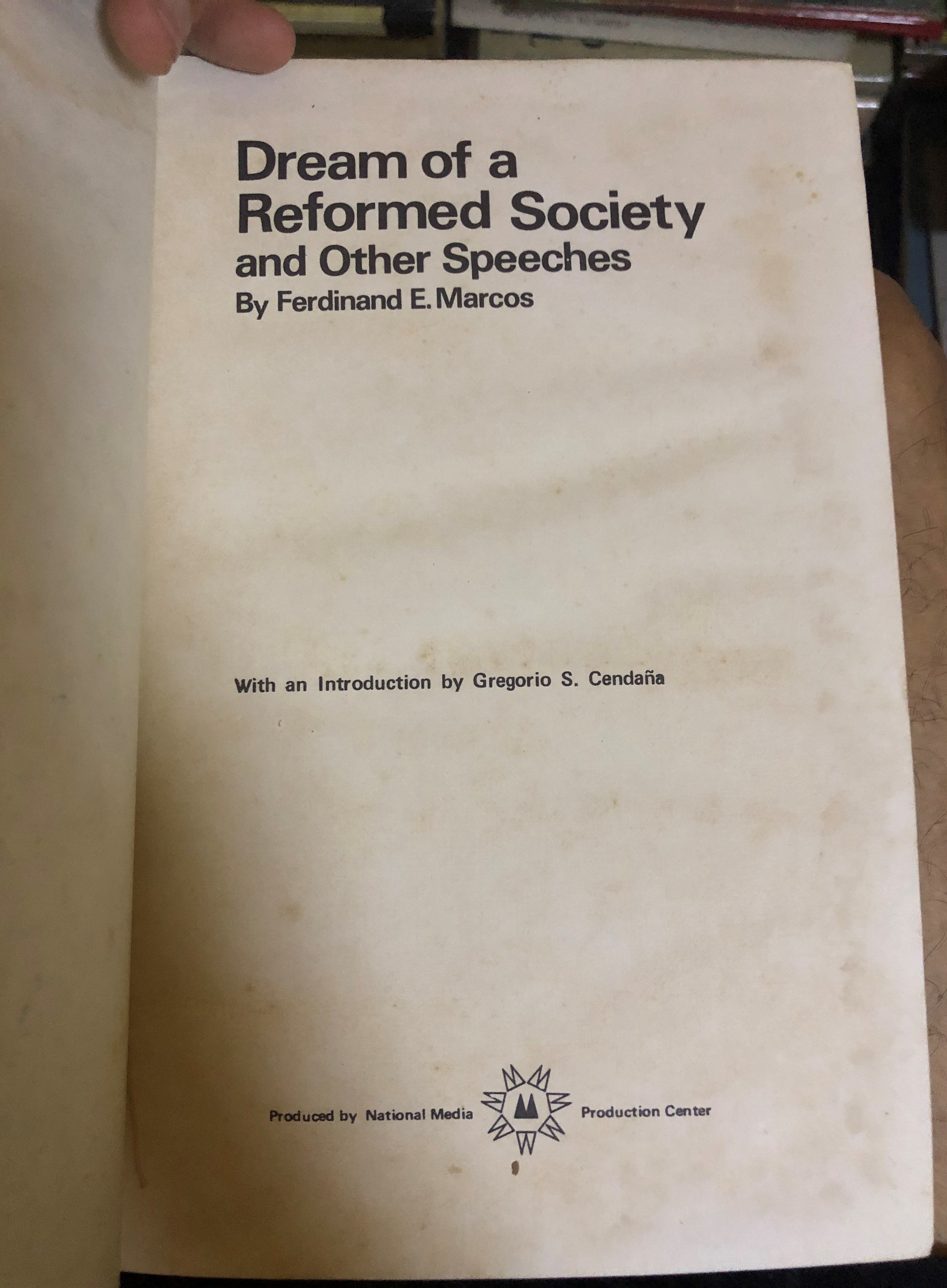
Reyes’s article, backed by copious evidence, research, and interviews, pointed out that the author of both Today’s Revolution: Democracy and Notes on the New Society of the Philippines was Adrian Cristobal. In my unpublished work, I also noted of the repetitive nature of the works succeeding those two (i.e. everything after Notes on the New Society of the Philippines). Reyes further divided “Marcos’s” oeuvre into the Marcos Bibles (the two books mentioned in this paragraph), rehashed combinations, accomplishment briefers, The Filipino Ideology books, and books that were “bonus material.” While his categories were apropos and illuminating, he was unable to include Marcos Notes on the Cancun Summit, The New Philippine Republic, Dream of a Reformed Society and Other Speeches, and The UN: 40 Years After. (I’d say Cancun Summit and The UN belong to “bonus material,” while The New Philippine Republic belongs to the “accomplishment briefers” category.)
He made an excellent point regarding the publishing of these books: they often came as accompaniments to “major” occurrences within the regime (as The New Philippine Republic) was.
Anyway, the following are “Marcos” books written in chronological order (barring the few that I do not have).
The Books
New Filipinism: The Turning Point
This was simply Marcos’s SONA on January 27, 1969.
He was running for re-election on November that year. This was an earlier foray of Marcos in written media (with more obviously propagandistic works as Benjamin Gray’s Rendezvous with Destiny and Hartwell Spence’s Marcos of the Philippines). Like the rest of “his” works, this was written by his speechwriters and not by Marcos himself. At 118 pages, one knows that it was quite a prolix SONA. This could be categorized as the earliest example of Reyes’s “accomplishment bearers.”
It’s a rare book, which is why I am very grateful for Sir Christopher Bonoan for providing me his only copy. (He’d been kind in letting me purchase his Marcosiana, and he has been pivotal toward letting me have a more comprehensive understanding of Martial Law.)
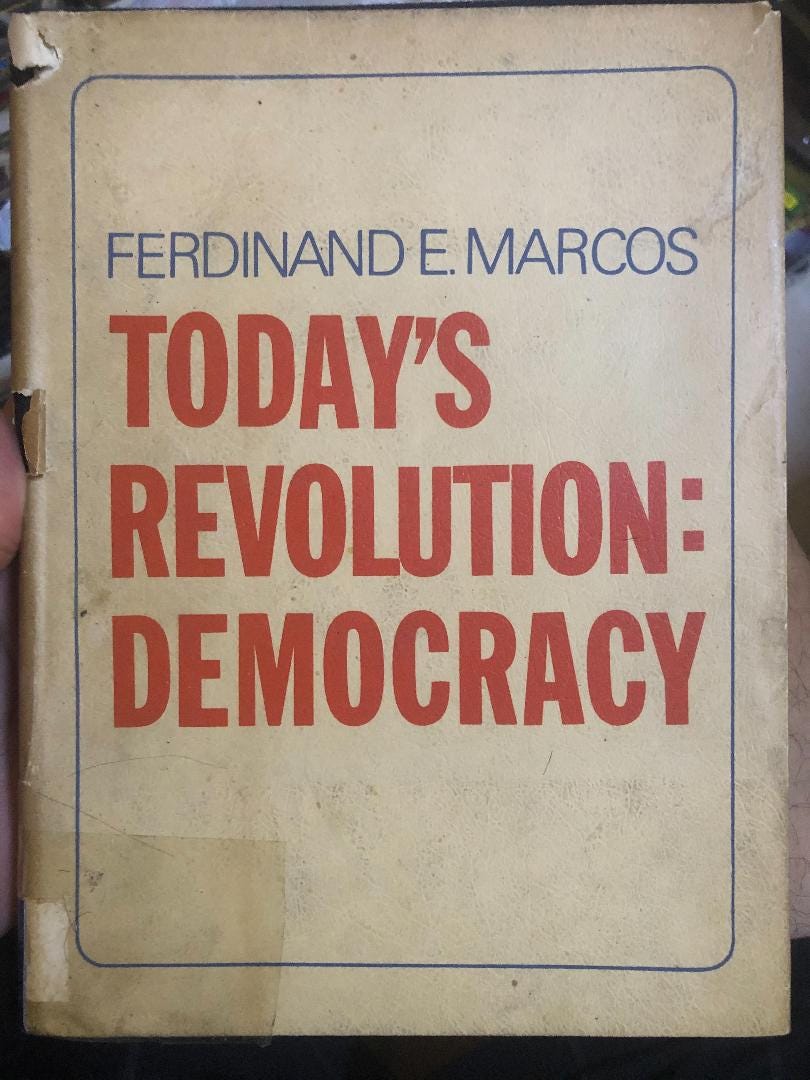
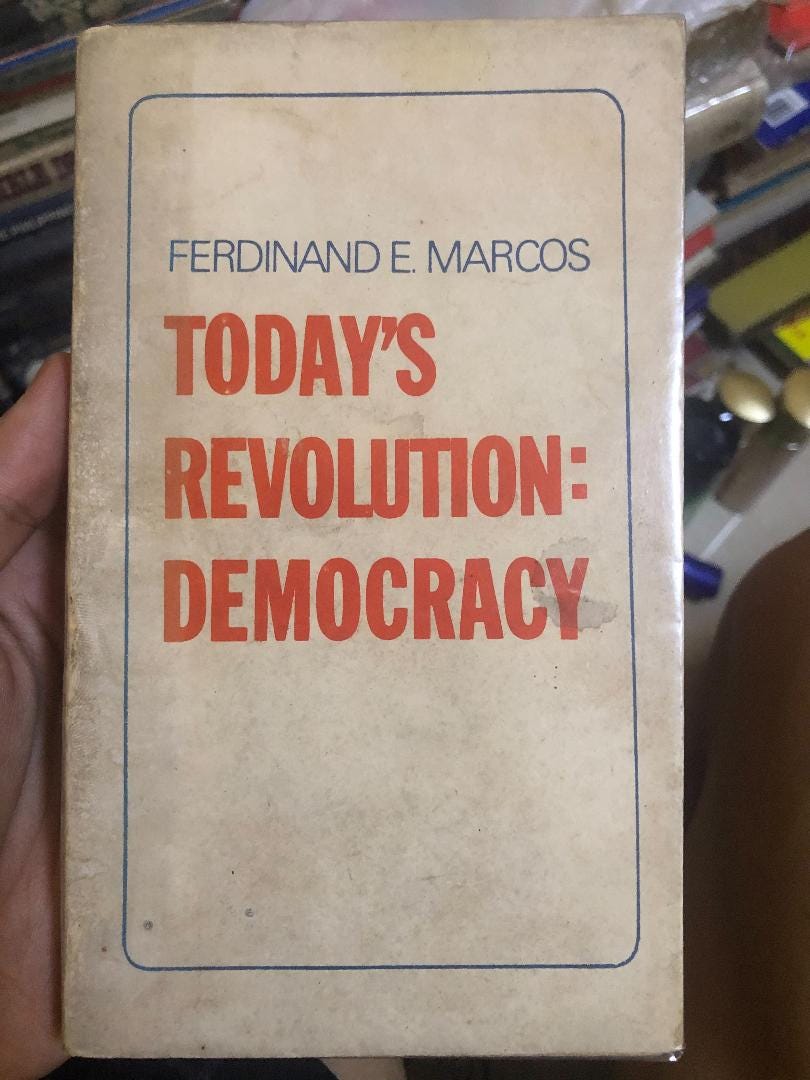
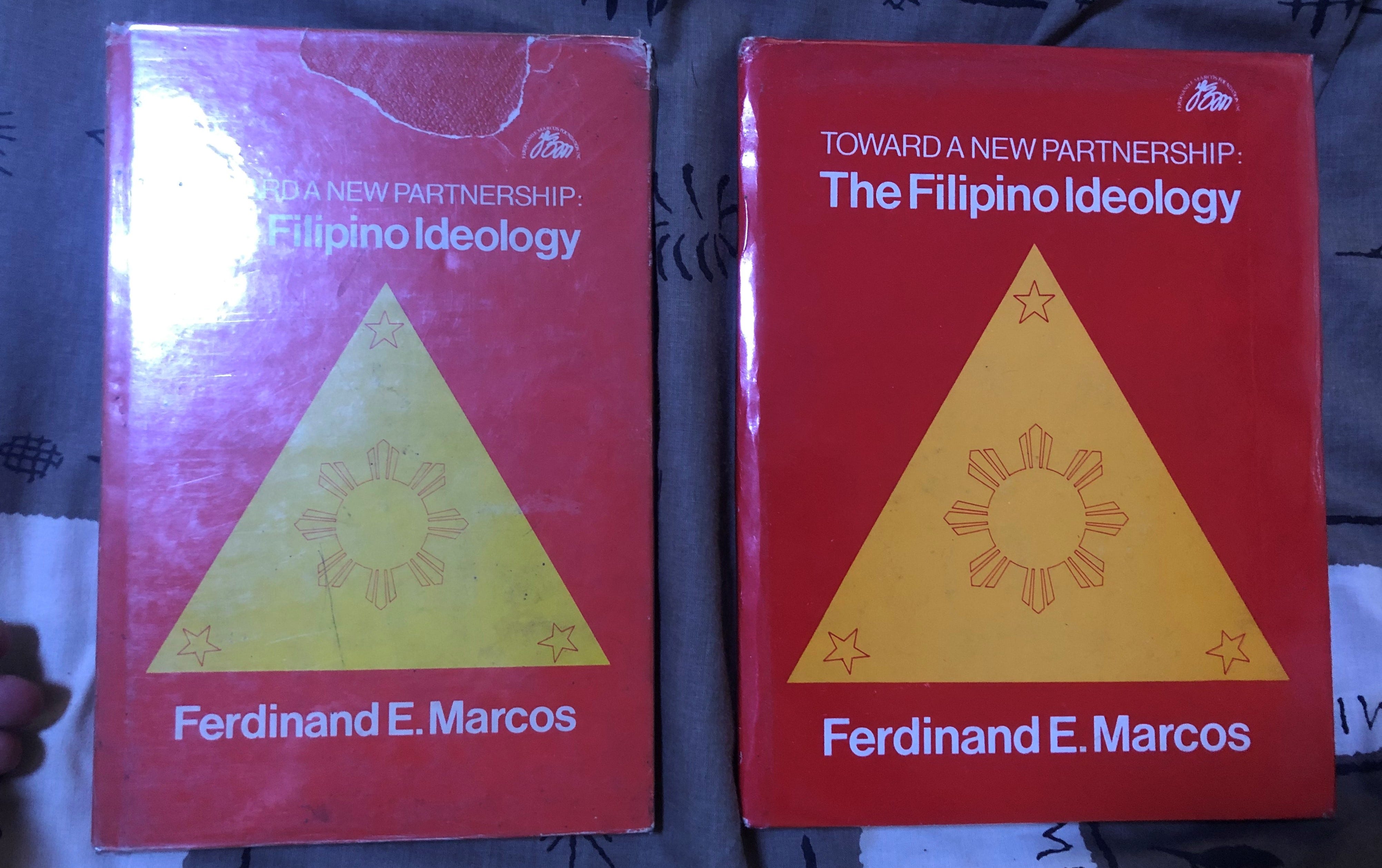
2. Today’s Revolution: Democracy
Left: Hardbound, with dust jacket; Right: Softbound
This book is the most popular and well-circulated among all his propaganda. Reyes wrote of it as one of the Marcos bibles. It was Marcos (Adrian Cristobal, really) trying to float the idea of Martial Law as a recourse to “unbridled democracy.” Marcos had, after all, used his significant political and financial capital to buy many of the members of the 1971 Constitutional Convention to side with him. The massive bribery was exposed by Eduardo Quintero, who, due to his old age, really did not have much need for money. This book simply set the tone that would recur, not only through the later published books, but throughout Marcos’s reign: Marcos would say one thing, and often do another.
The First Quarter Storm of 1970 had already adumbrated Marcos’s lust for power: when Edgar Jopson and Portia Ilagan came to Malacañang, Marcos told them that he was uninterested in a third term. However, when he was dared by them to “put that down in writing,” Marcos called Jopson “a son of a grocer.”
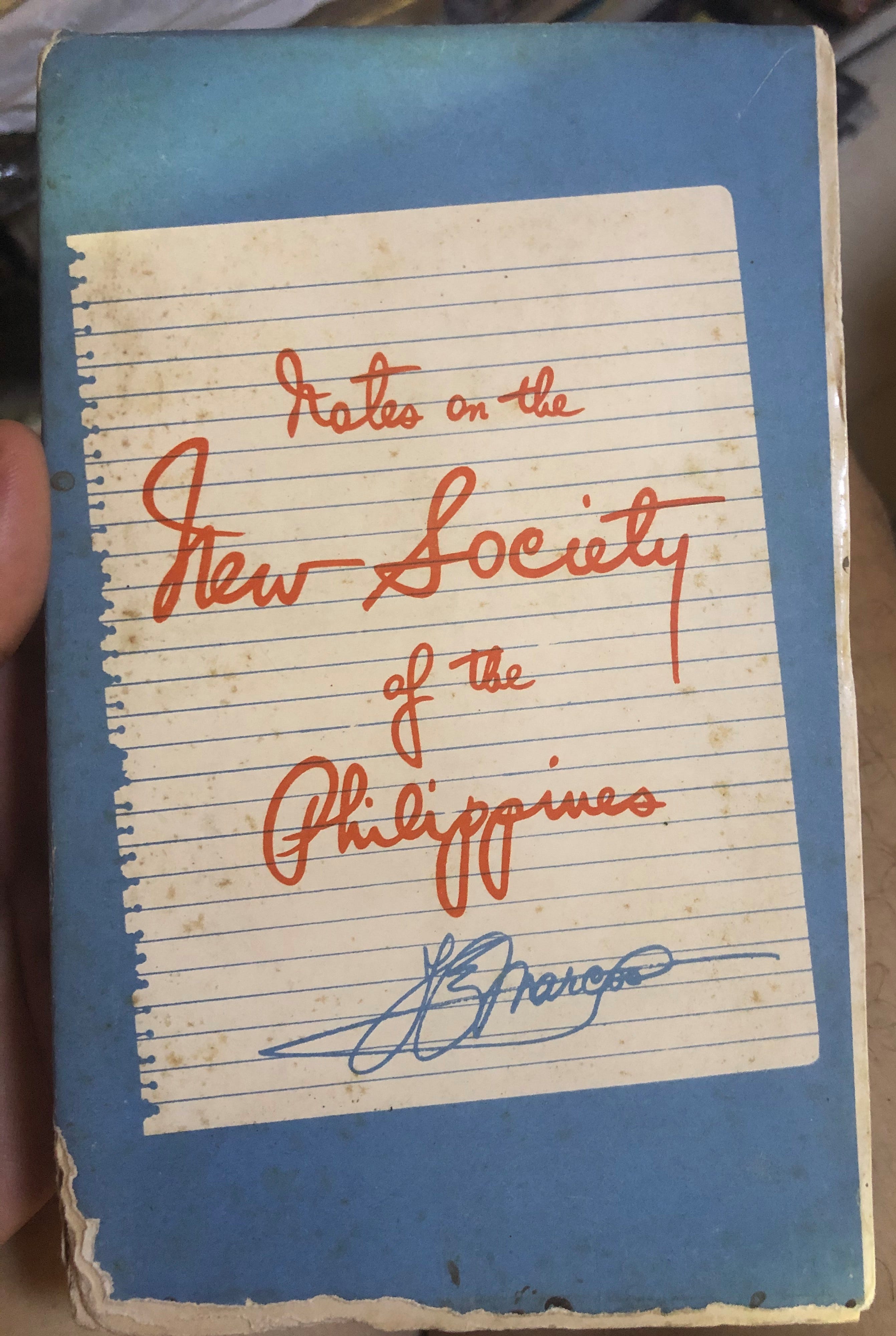
3. Notes on the New Society of the Philippines
In Notes of the New Society, “Marcos” wrote: “The old society was, in the first place, the social and political elite manipulating what I called a precarious democracy of patronage, privilege, and personal aggrandizement.”
The novelty that Marcos had implemented in the “New Society” were Citizens’ Assemblies which were a “government of the people” through a show of hands. It didn’t matter that “Are you in favor with Marcos staying in power?” was replaced with the question “Are you hungry?” as long as the answer was yes. After all, all that was recorded were a show of hands, and people were hungry. These assemblies were prone to abuse, especially with Marcos having the backing of the military.
(I didn’t include Revolution from the Center since it was a rehash of this book, and I also no longer have a copy.)
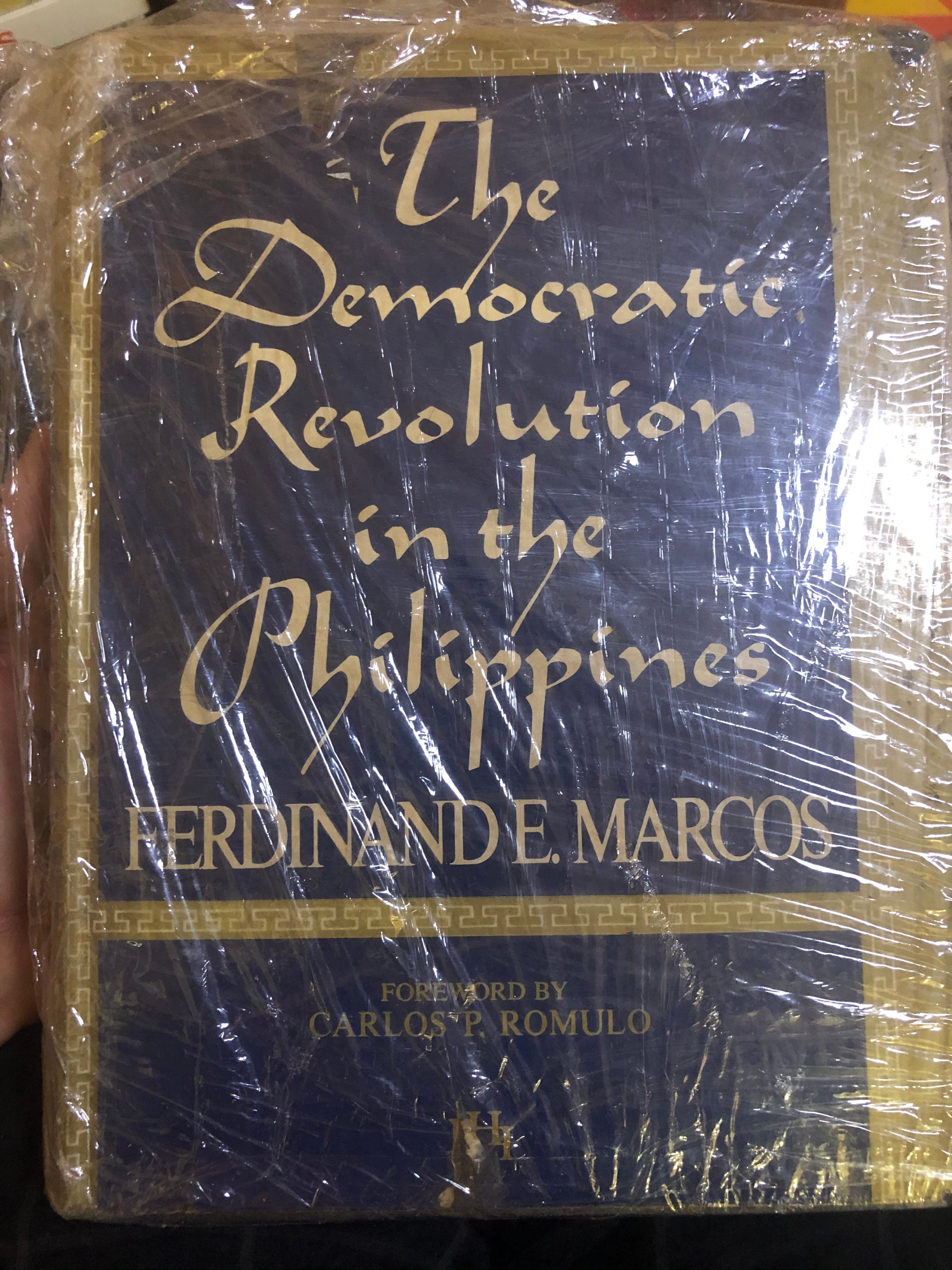
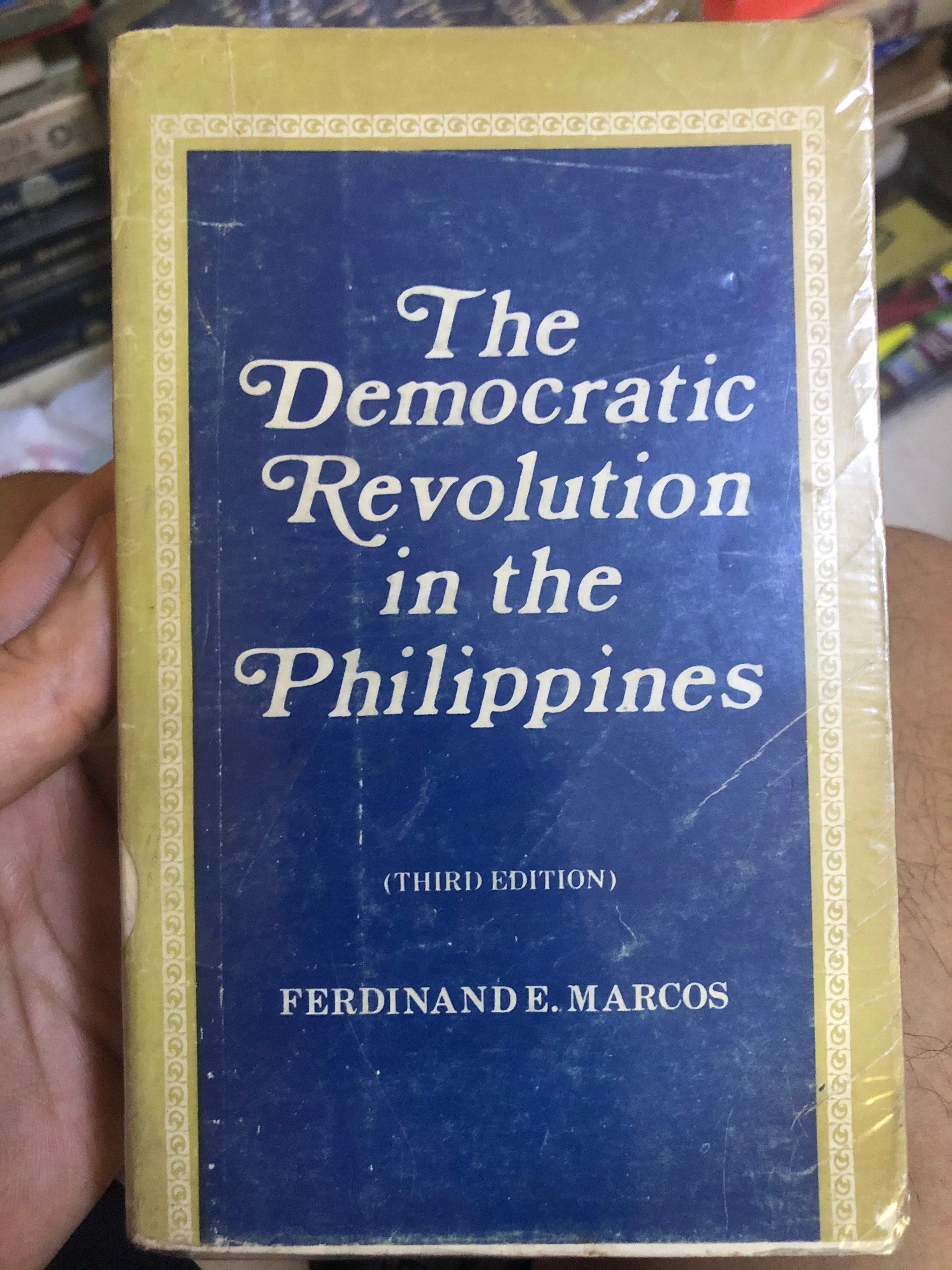
4. Democratic Revolution of the Philippines
Left: Hardbound, first edition; right: softbound, third edition
Aside from Sir Marlon Riobuya and Chris Bonoan, one of the people who supported me in my attempt to create an exegesis of Marcos’s texts was Sir Ruel Farol. He bequeathed me his first edition, hardbound copy of Democratic Revolution of the Philippines.
To my disappointment, however, the book was just a combination of what was written in Today’s Revolution and Notes of the New Society of the Philippines. This was still, clearly, Adrian Cristobal’s brainchild.
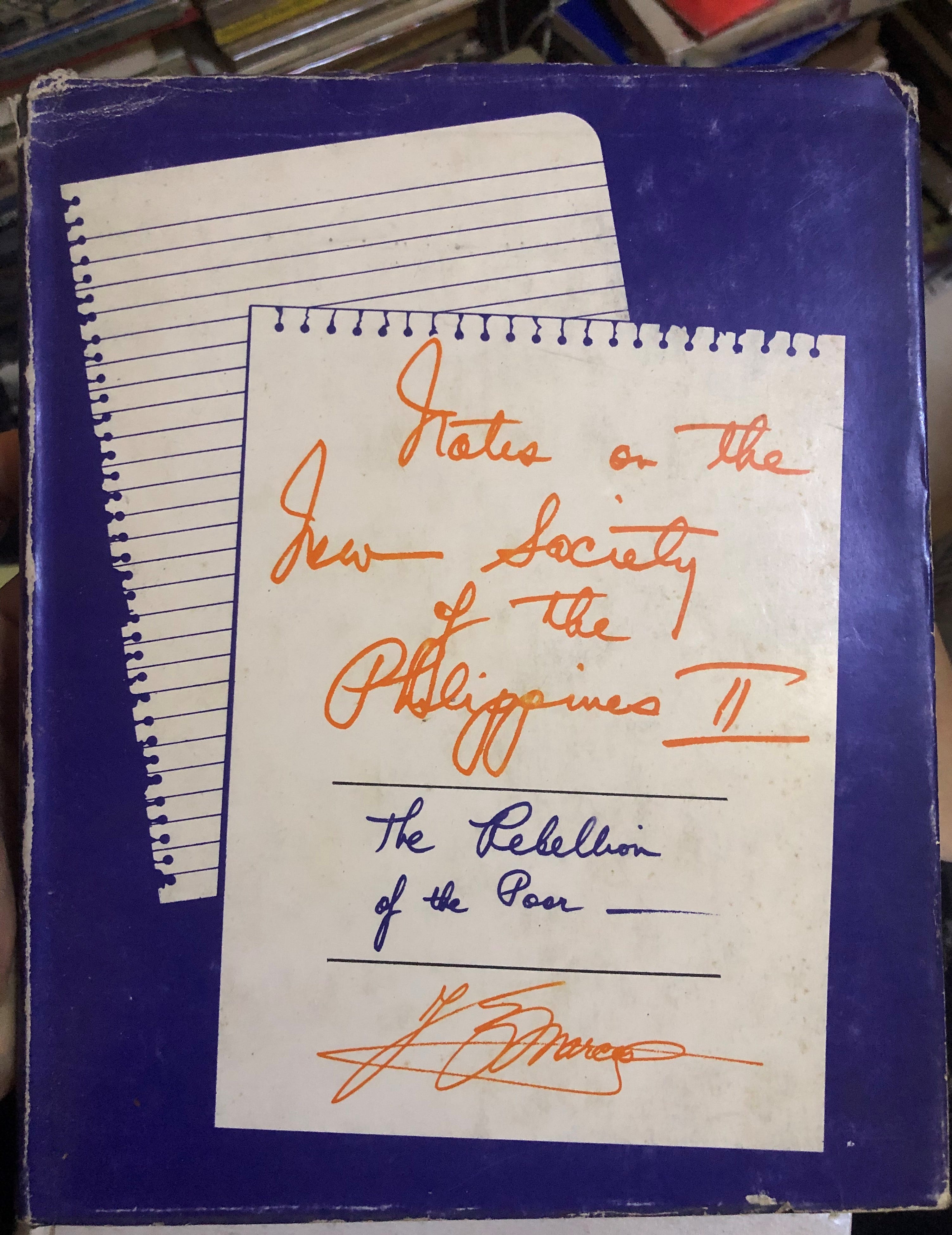
5. Notes on the New Society of the Philippines II: The Rebellion of the Poor
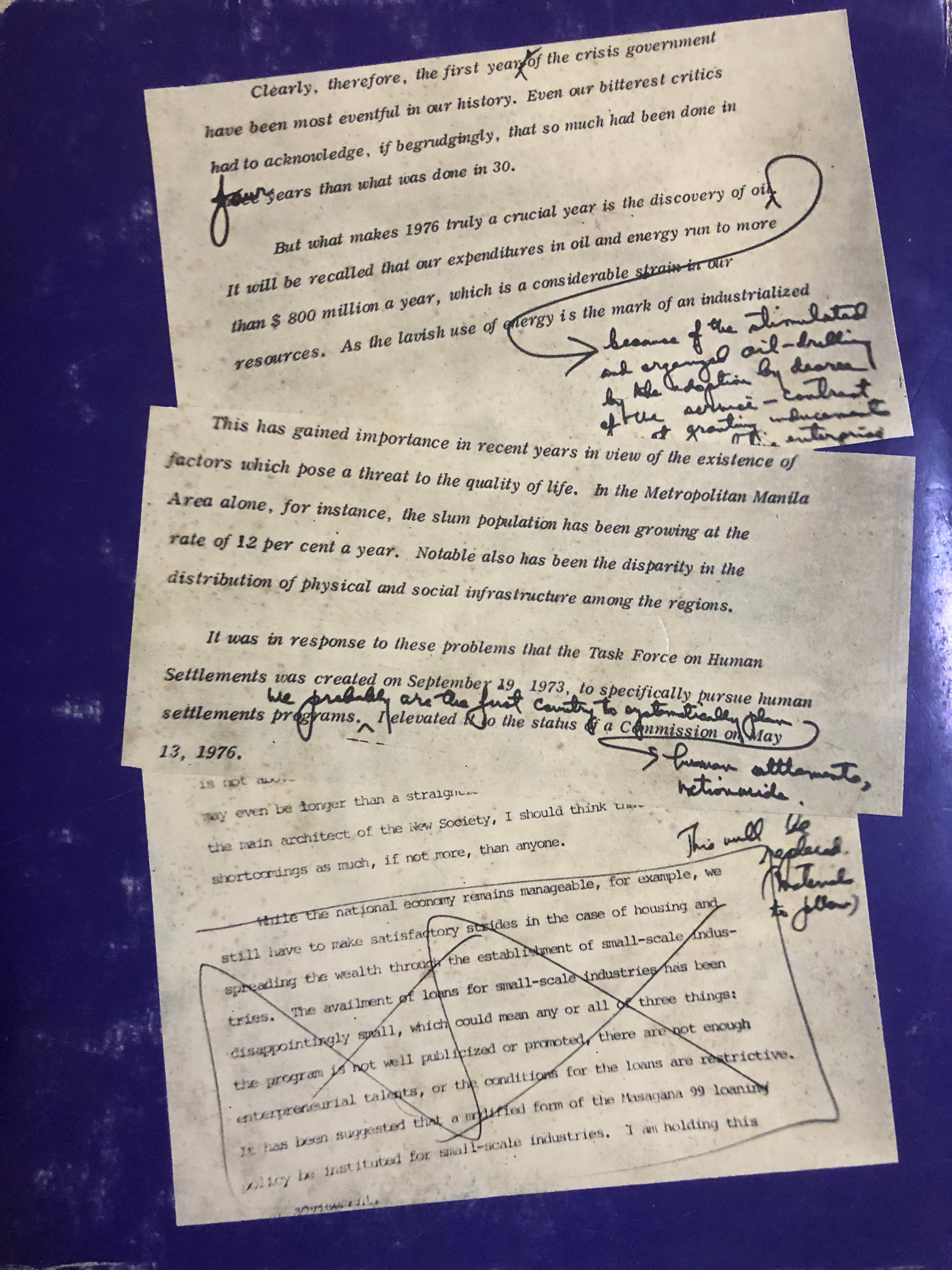
Reyes pointed out in his article one of the best examples regarding Marcos’s works being ghostwritten. After all, why would you erase your own work after it has already been typed? Further, these changes didn’t even end in the final work! If that’s not suspect, then it’s quite schizophrenic.
This book was another one of those “accomplishment bearers.” Reyes explained that it was just another one of Marcos’s re-written SONAs and attributes that Yen Makabenta was one of this book’s authors.
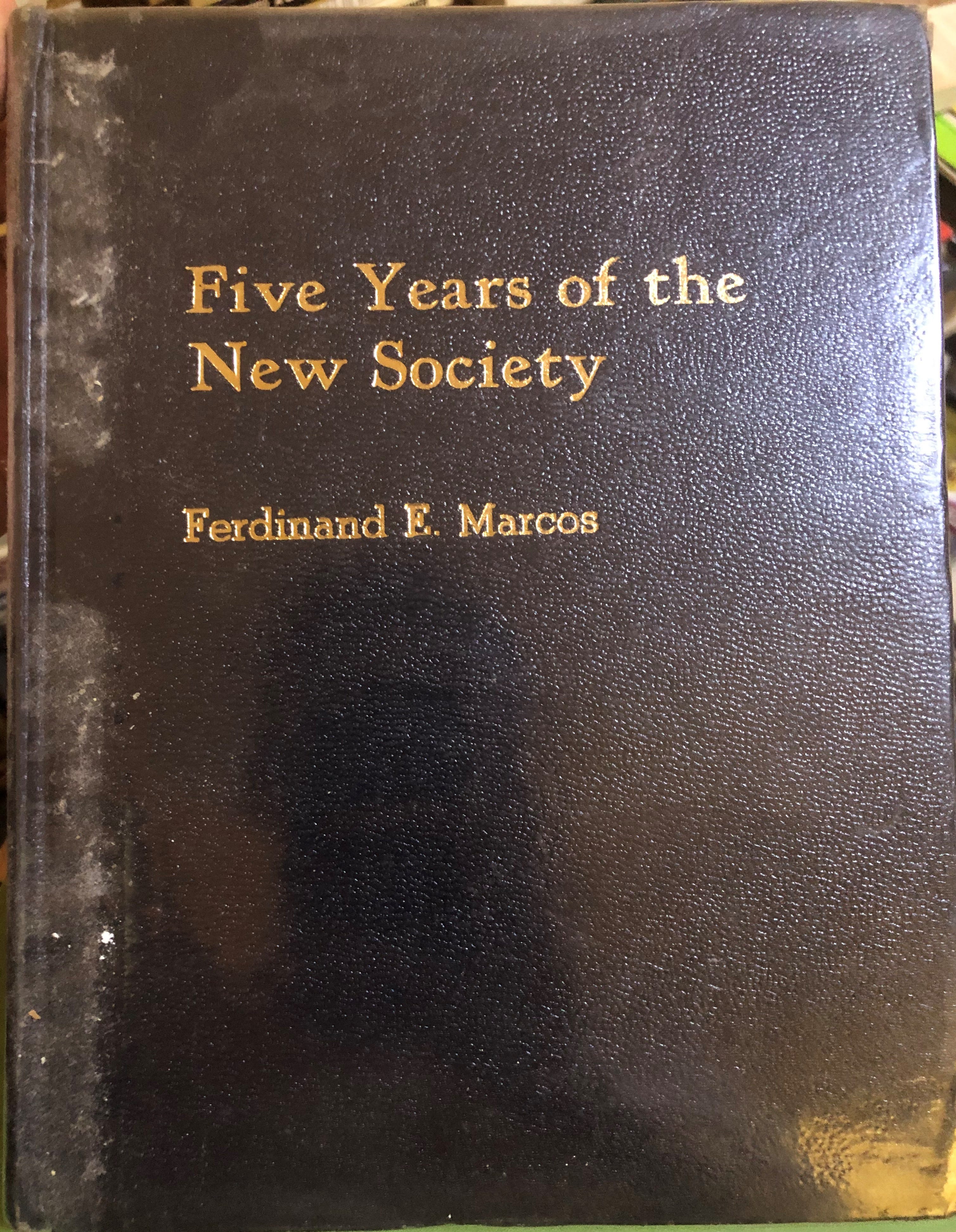
6. Five Years of the New Society
My copy didn’t have a dust jacket.
This was another one of his “accomplishment bearers” or apologias. In this book “he” wrote that: “What was promised and pledged by the presidency at the start of the crisis government — that our fundamental goal is the promotion of greater democracy and national unity — we now redeem.”
This was, of course, blatantly untrue. The Citizens’ Assemblies were a sham, and the judiciary was threatened by Marcos when he asked them to submit resignation letters. In essence, if Marcos disapproved of a judge’s decision, he could “accept” their resignation. He held the judiciary by their throats.
This book’s claim, thus, that “one of the most telling manifestations of civilian supremacy under crisis government was the continuing and independent operation of the Judiciary,” was thus a joke.
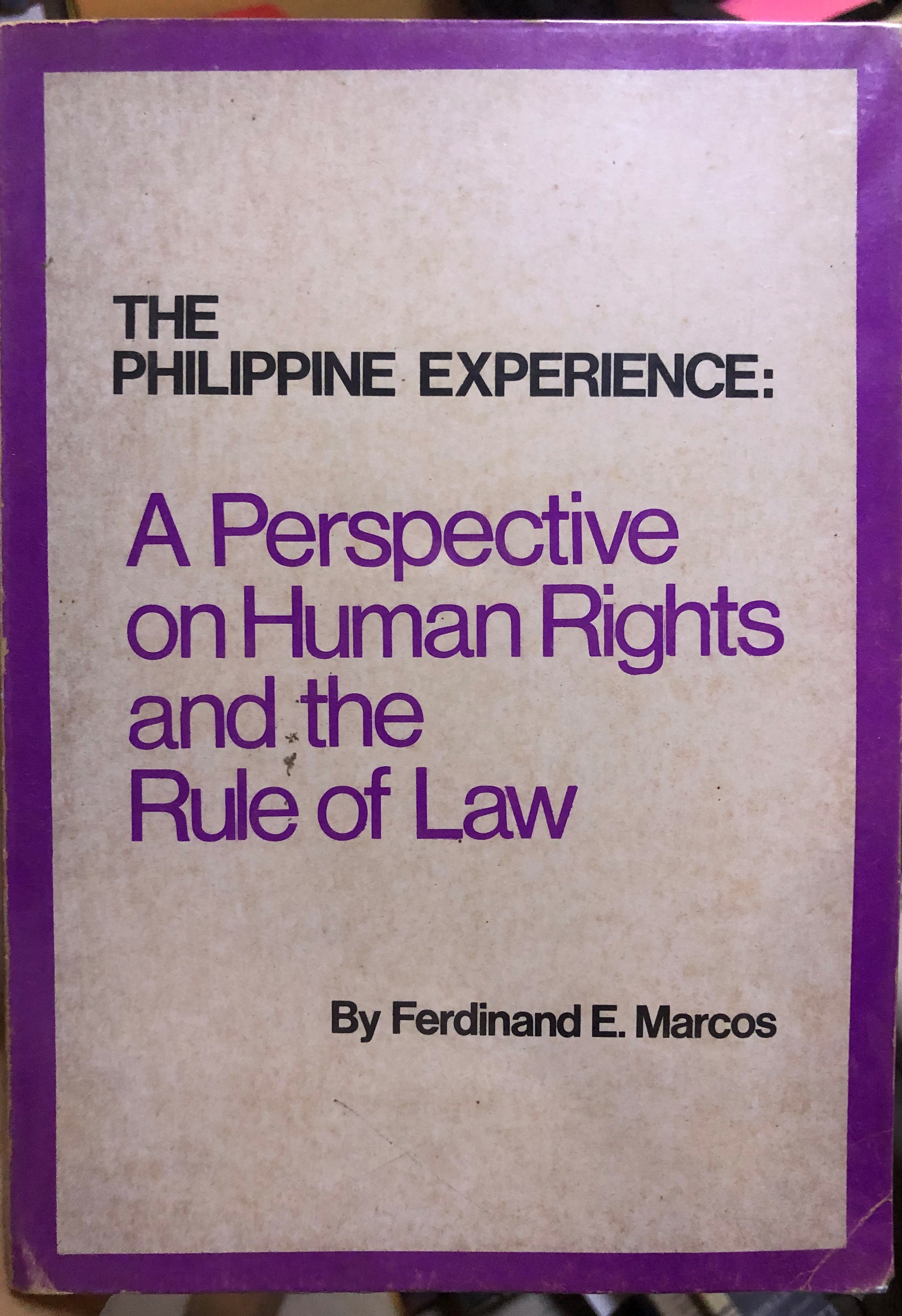
7. The Philippine Experience: A Perspective on Human Rights and the Rule of Law
This is the rarest book among the Marcosiana. I was able to obtain this because of Sir Chris Bonoan.
While this is the rarest “Marcos” book, it’s really nothing more than an extension of one chapter of Democratic Revolution in the Philippines. This was released when Jimmy Carter’s officials went to the Philippines to assess the human rights situation as there had been international complaints. Through statistics, Marcos claimed that there were little human rights violations occurring in the Philippines, and that deviant members of the police and the military were already being punished.
Reyes showed that these errant policemen rose in number through “Marcos’s” later books.
An Introduction to the Politics of Transition and The New Philippine Republic were herald works similar to this one. These works presented to the world the façade of Martial Law being progressive and productive.
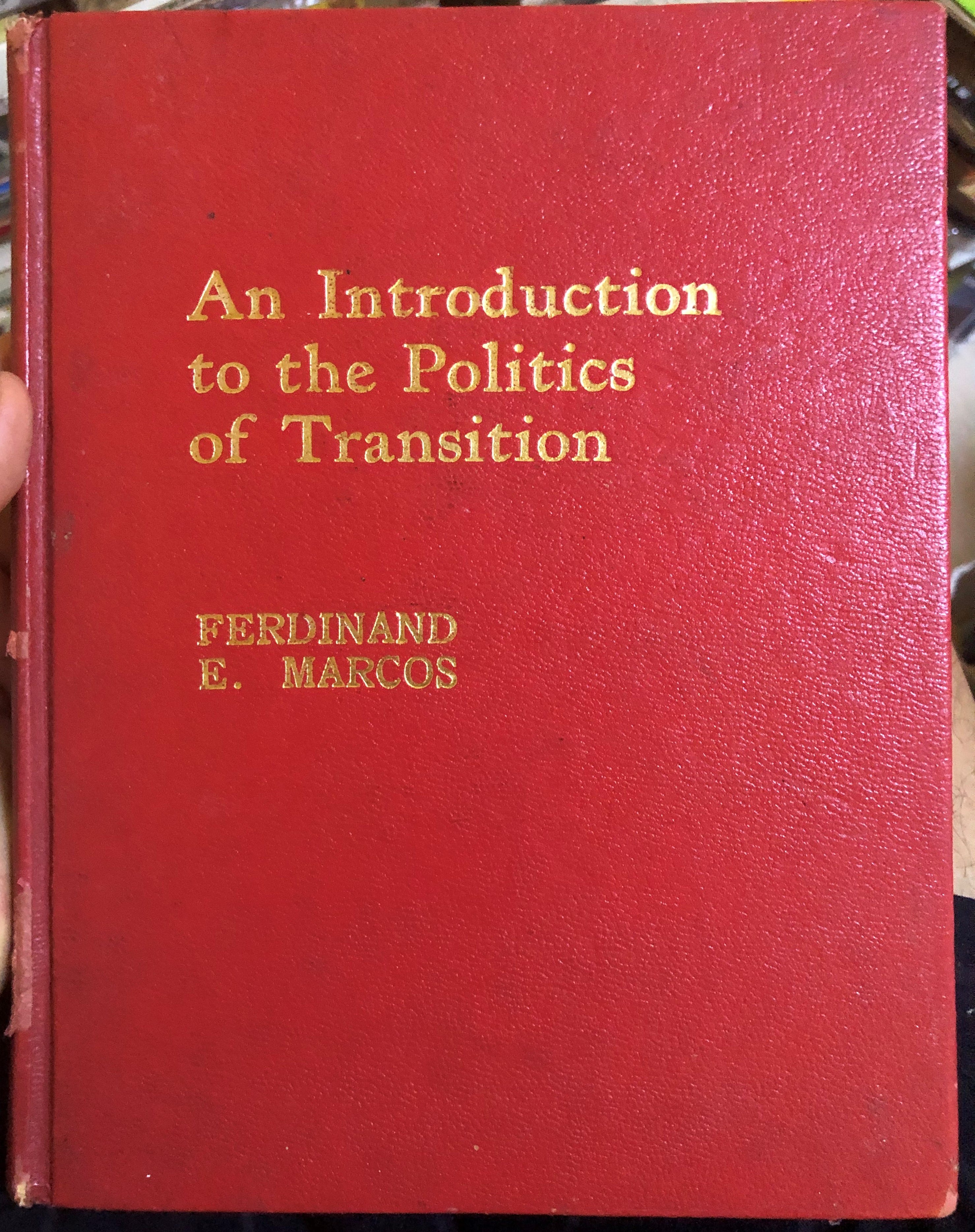
8. An Introduction to the Politics of Transition
This book was released concurrently with Marcos’s attempt at legitimizing his regime. In 1978, he allowed the elections for representatives of the Interim Batasang Pambansa, which was mandated in the 1973 Constitution he passed through his Citizen’s Assemblies. The result was expectedly rigged in favor of the Marcos’s party, the KBL.
However, Region VII (where Cebu belonged) showed promise, as it was swept by the Pusyon Bisaya party. Reuben Canoy (author of the brilliant Counterfeit Revolution in the Philippines) won one seat in Region X while representing Mindanao Alliance, and Ernesto Roldan won one seat in Region XII.
Reyes noted that this book was, outside of an introduction to parliamentary systems written by an undergraduate, made up of appendices. Personally, I liked reading portions of this book, because effort was actually made by the writer to come up with excuses for Marcos’s regime.
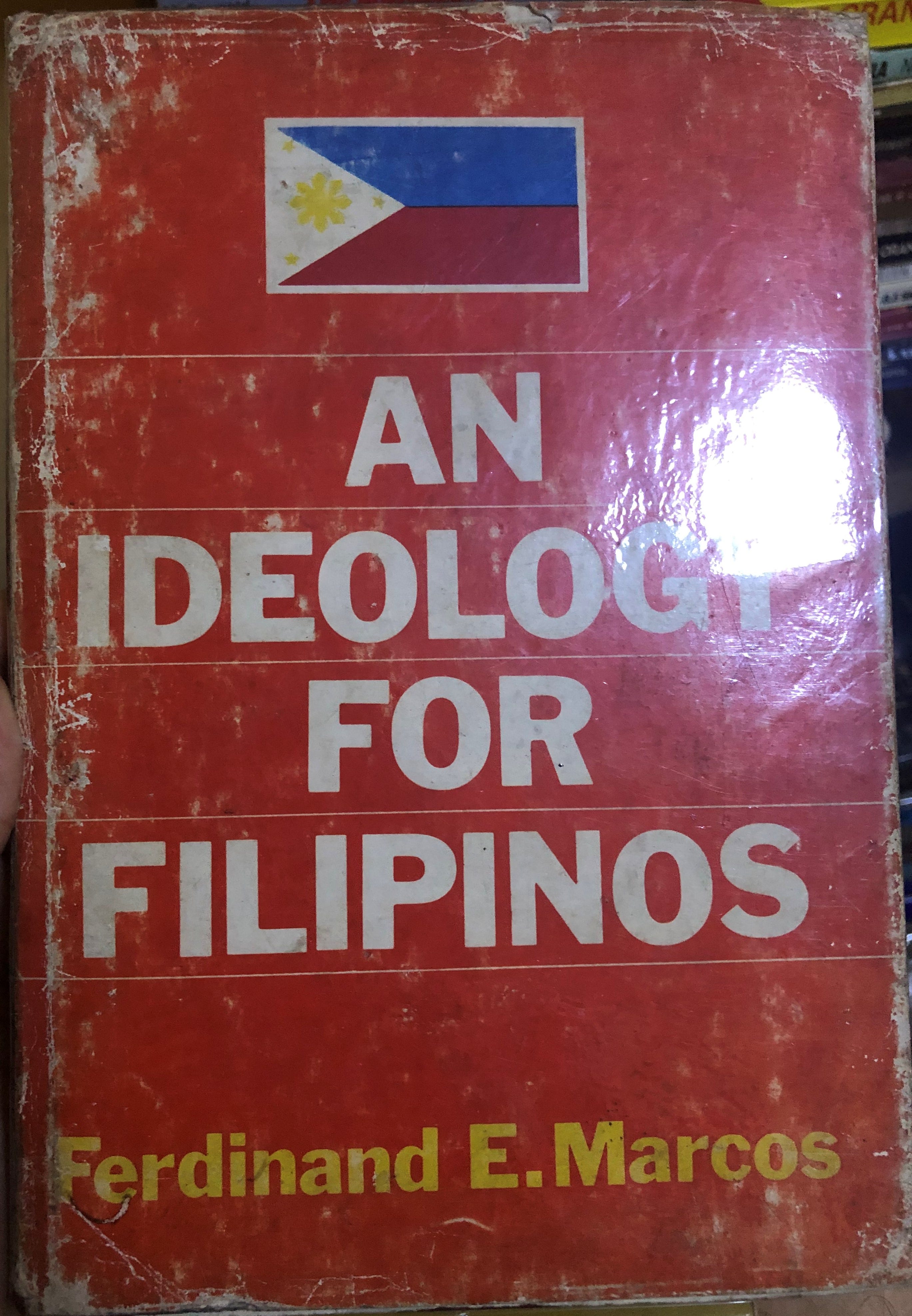
9. Towards a Filipino Ideology / An Ideology for Filipinos
These two books are almost alike. In my unpublished work, I only wrote a short chapter for both books, since An Ideology for Filipinos was merely a repackaged Towards a Filipino Ideology.
Reyes believed that these books were also Adrian Cristobal’s works. Towards a Filipino Ideology contained “Marcos’s” comments that “the right of free speech is meaningful only for the literate and the well-informed, just as the right to travel is meaningful only to those who have the means to travel.”
This was funny to me because media and the written word were heavily censored during the Martial Law regime. Celso Al. Carunungan was imprisoned because of his satirical Satanas sa Lupa. Finally, why was even such an enlightened mind as Jose Diokno not allowed free speech? Diokno was one of the people who had a higher score at the bar examinations than Marcos: he was also recognized to be a highly intelligent person. Why was he incarcerated instead?
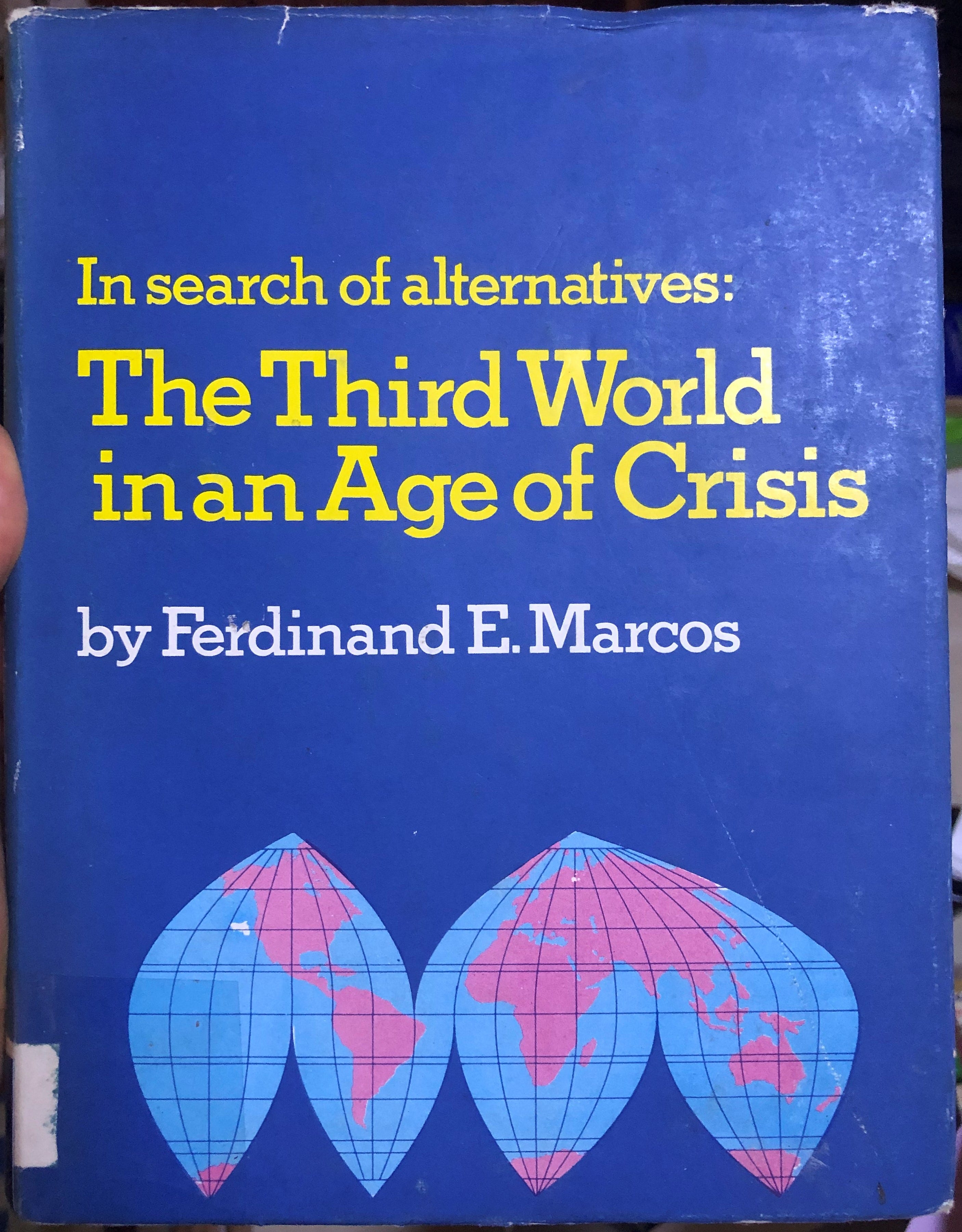
10. In Search of Alternatives: The Third World in an Age of Crisis
This book was purchased from Richard Ibanez. Thank you!
This was “Marcos’s” attempt to distance his “constitutional authoritarianism” from being recognized as a dictatorship. By the early 1980s, inflation had rapidly risen because of the institutionalized corruption led by Marcos himself. The “smiling martial law” was to be the alternative from capitalism and communism: it was to be the Philippine alternative.
“Marcos” wrote: “Ours is the only authoritarian state, the only regime under Martial Law that has allowed its policies and programs to be questioned in open court … The Supreme Court has not been suppressed or dissolved.”
I previously mentioned that the Supreme Court during the Marcos regime was a stamp-pad court. Whatever Marcos decided, his lackeys in the judiciary would follow.
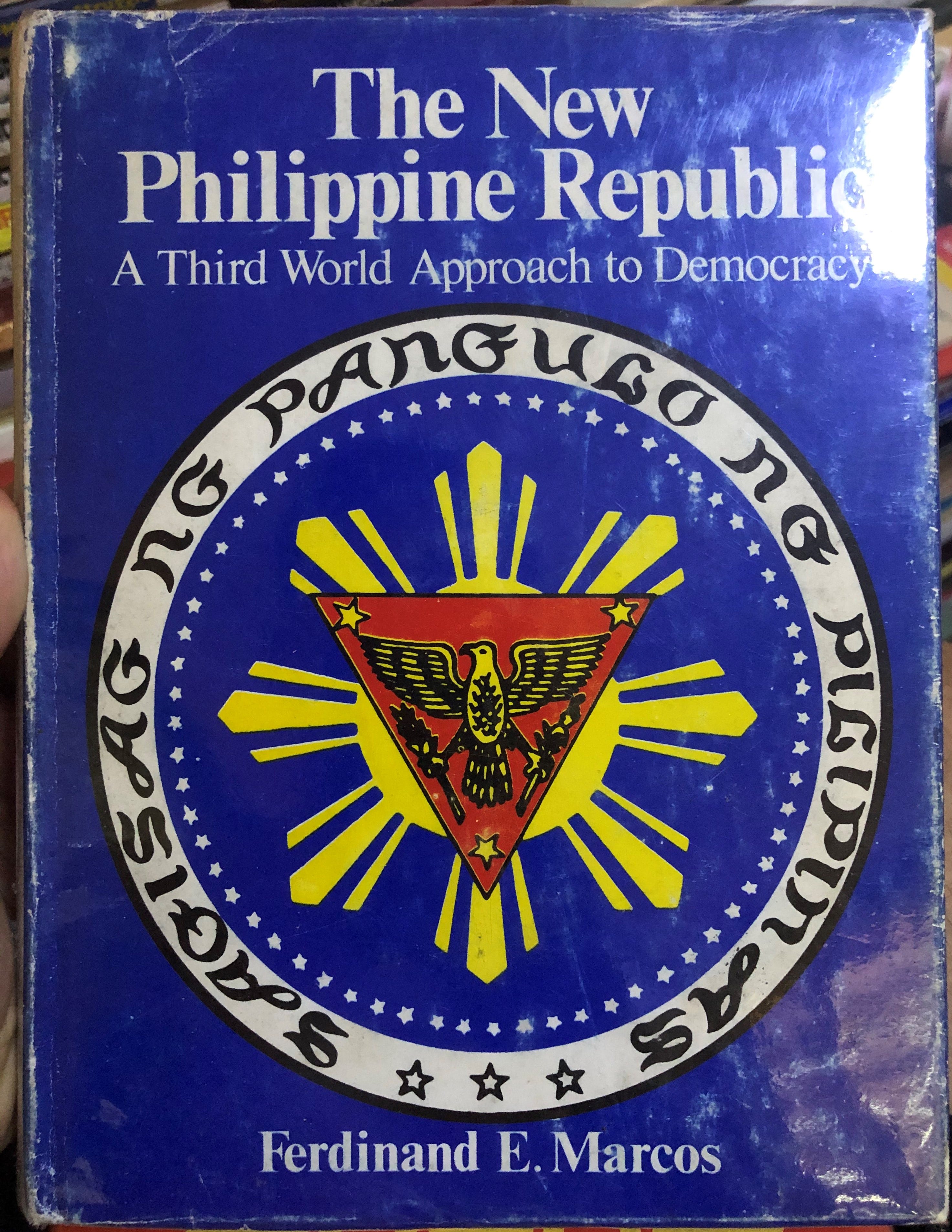
11. The New Philippine Republic: The Third World Approach to Democracy
Thank you Mariel Repil for the cleaner copy!
This was the penultimate Marcos book I obtained (I had only obtained The UN: 40 Years After one month ago). I bought this copy from Sir Danilo Meneses, who also happened to support my pursuit of Martial Law history. This was not mentioned in Reyes’s article, but I would classify both as a “herald work,” and as an “accomplishment bearer.”
In 1981, under the guise of a sham election, Ferdinand Marcos defeated a retired general, Alejo Santos. Most of the opposition boycotted the elections due to the fraudulent turnout of the 1978 Interim Batasang Pambansa elections (as mentioned in a previous paragraph, the KBL won nearly all of the seats).
Marcos actually “ended” Martial Law on January 17, 1981. He called the termination of Martial Law as the inauguration of the New Republic, but retained presidential decrees and legislative power. The writ of habeas corpus was still suspended. Like Imelda Marcos’s whitewashed walls, the termination of Martial Law was a mere charade.
Funnily, one former Marcos supporter, Simeon del Rosario (who wrote How Martial Law Saved Democracy in the Philippines) ran against Marcos in the 1981 elections. Perhaps he too was disillusioned.
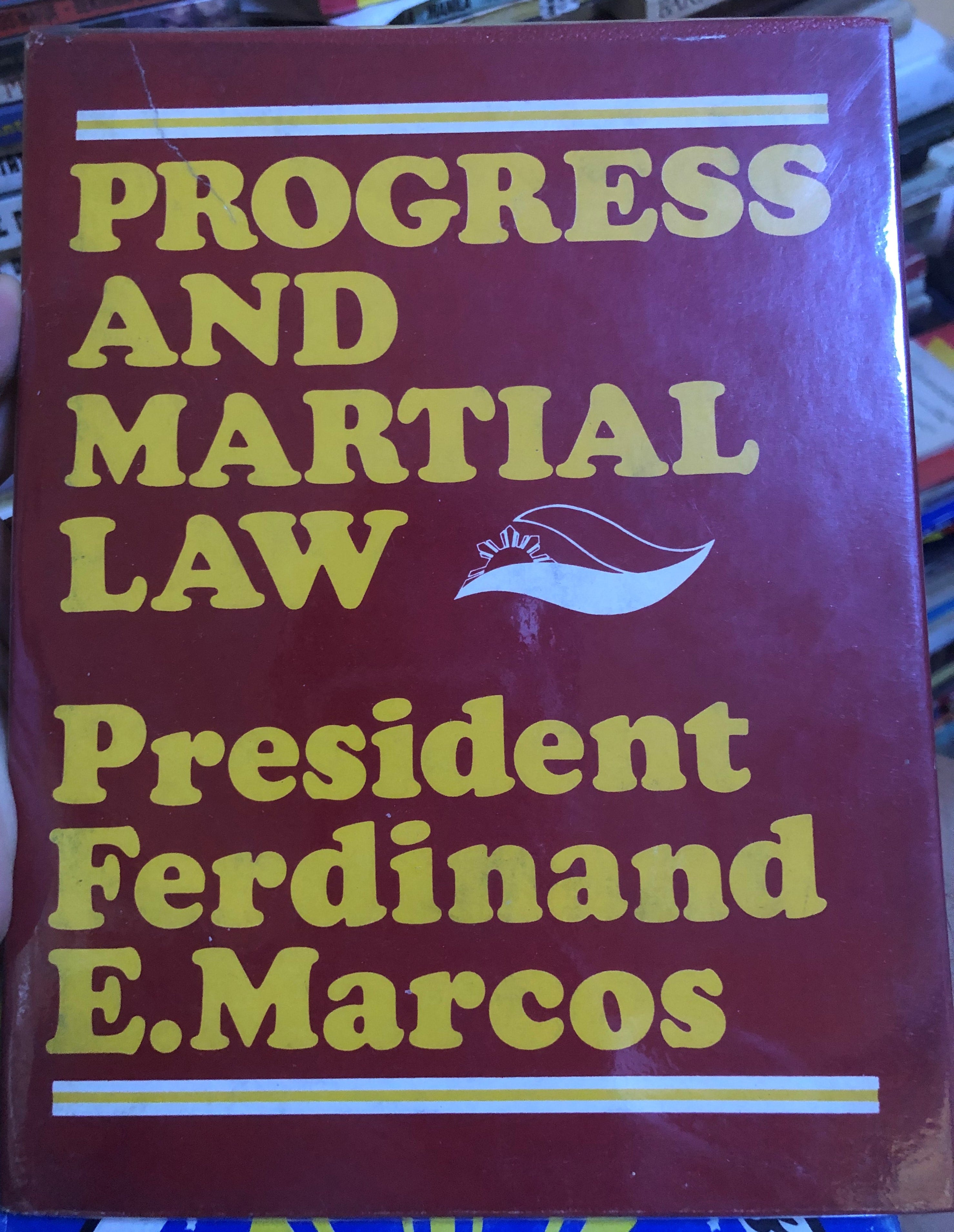
12. Progress and Martial Law
This was, among all the Marcosiana I’ve read, the one with the most amusing text.
It fabricated a reality where Aquino won in 1973 but struggled with communists and the economy — as he was not Marcos.
Like a horrible film, this book had “so bad, it’s fun” vibes. According to Reyes, this was released during the 1981 elections as supplementary campaign material.
James K. Boyce’s Political Economy of Growth and Impoverishment in the Marcos Era described the economy during the Marcos regime as creating “immiserizing growth:” basically, all infrastructure created through debt financing didn’t alleviate the suffering of the poor. In contrast, the gap between the rich and the poor got even wider.
13. Towards a Filipino Partnership: The Filipino Ideology
This book surprisingly came in different sizes. When this book was published, Ninoy Aquino had already been assassinated, and the economy suffered from massive inflation. One of the reasons was Marcos’s insistence of being inflexible with the price of copra. As a result, the world market searched for alternatives, and left the Philippines in the lurch.
I think this was Marcos’s last-ditch attempt to create legitimacy. He asks for patience, as “positive changes have already started.” The Philippines has yet to have inflation as bad as Marcos’s final years of dictatorship.
14. The Filipino Ideology
When I started writing my unpublished work, I planned to write individual chapters on each of the books I’ve read. It turned out that I had a short tract instead, because most of what “Marcos” published was recycled material. For instance, instead of writing a different chapter for Toward a New Partnership: The Filipino Ideology, I realized that there were few changes with this book to merit individual chapters.
In essence, this was just an edition of Adrian Cristobal’s work. As mentioned above, Sibyl Peña says that Nilo Tayag was an author of this edition, because her stepfather worked with Cristobal’s think tank.
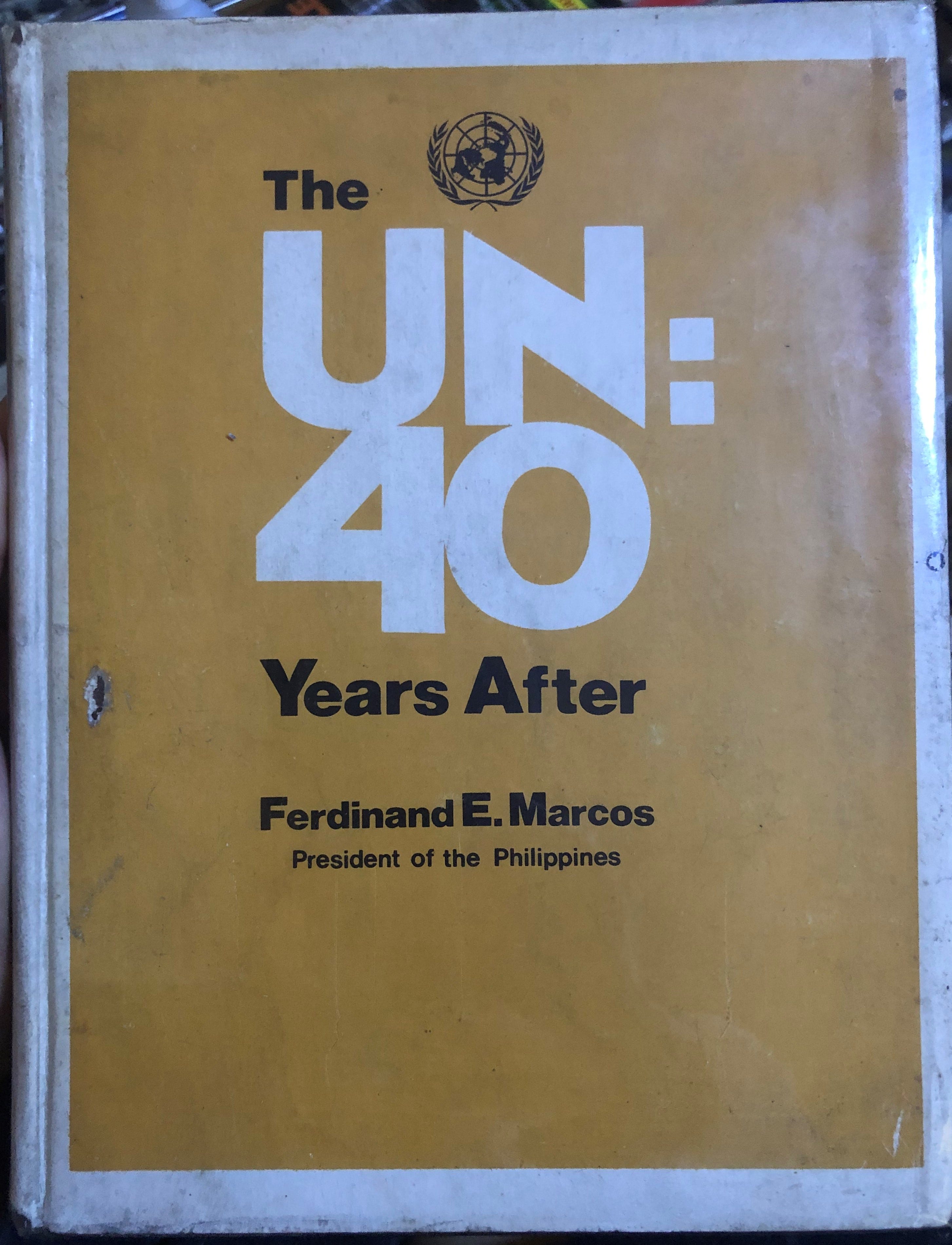
15. The UN: 40 Years After
Thank you Lester Wamil for this copy!
This book is more or less a straightforward explanation of UN’s evolution. This was not mentioned by Reyes in his article, but like most of his other works, this was definitely not written by Marcos himself. At the time this book was published (1985), Marcos was dying from lupus.
He would try to cheat one last time in the 1986 Snap Elections.
Other Books
Thank you Maria Theresa Masaganda for one volume of “Marcos’s” speeches!
I have other books that were edited by Gregorio Cendaña or Kit Tatad (The Marcos Wit), but these are more obvious examples of ghost writing.
Conclusion
I sought to write an exegesis of all works that I believed were penned by Ferdinand Marcos, and was able to complete it. (In case you’re wondering, yes, I’m quite masochistic. While I haven’t finished The UN: 40 Years After yet, and don’t think New Filipinism should be included in Martial Law literature, I did read and finish the thirteen other books).
Reyes’s article, however, was so illuminating that I realized I had given Marcos too much credit!
The works pictured here were not even written by him. It was another one of his pretensions: Marcos wanted to be seen as superhuman. He wanted people to see that he was an extremely busy yet extremely capable man: over the span of his dictatorship he’d churn out one book a year on average.
To many people, this productivity was nothing sort of prodigious. After all, he had to balance governing the Philippines with his scholarly work!
I admit, I was also fooled. In my myopia, I sought to debunk the words that “he” had written by comparing what he wrote with sources that disagreed with the rosy picture he had painted. To do this, I consulted works from many authors, both local and foreign, to congeal a picture that I felt was closer to the truth. The consistency of the reportage of these other authors made me realize that the Marcos regime was thoroughly corrupt.
“Ferdinand Marcos the scholar” was merely a fraud perpetuated by a person who wanted to be seen as a demigod. Perhaps this is the reason why it is also so easy for his offspring to lie as well. After all, parents set examples for their children to emulate.
I spent tens of thousands of pesos looking for each book in his oeuvre, and hundreds of hours reading all his works. I was, indeed, able to complete an exegesis of his books only to realize much later that he never even wrote any of them in the first place!
My premise was inherently wrong. Nevertheless, I wanted to channel the time I spent to show people that Martial Law during the Marcos era wasn’t a pleasant time to live in. Although there was indeed lesser crime during its first few months, there was also a corresponding rise in human rights abuses and a severe curtailment of freedom. The law was biased towards those who had close ties with the Marcoses, because Marcos was the law.
We have been taught in school that plagiarism should never be done, and that we should always mention our preferences. Why should a corrupt dictator be excused?
Not only was Marcos one of the world’s biggest thieves — he was also actually one of the world’s worst plagiarists!
(Thanks go to Tinky Cruz, Prof. Danton Remoto, Janice Chiongson, Katherine Soledad, Mon Castigador, Kenneth Idio, Ernest Nufuar, Eleazar Galanto, and Rechelyn Abenoja for their support. Thanks also go to my siblings and parents.