Remembering the past and upholding hard-fought freedom are the underlying themes in the commemoration of the 30th anniversary of the EDSA Revolution
epa05179471 A Filipino priest gestures while riding a tank with soldiers as they march in front of the People Power monument to re-enact the 30th anniversary of the fall of the then President Ferdinand Marcos’ dictatorship, in Quezon city, east of Manila, Philippines, 25 February 2016. The People Power Revolution (EDSA) was a bloodless citizens’ uprising that ousted late dictator Ferdinand Marcos in 1986. EPA/MARK R. CRISTINO
SALUBUNGAN. A Filipino priest gestures while riding a tank with soldiers as they march in front of the People Power monument to re-enact the 30th anniversary of the fall of the then President Ferdinand Marcos’ dictatorship, in Quezon City, February 25, 2016. Photo by Mark Cristino/EPA
MANILA, Philippines – For several hours, the traffic-clogged EDSA transformed back into the iconic 1986 highway where millions of Filipinos won back their freedom and overthrew a dictator.
A shower of yellow confetti, the iconic Laban sign, and the traditional Salubungan reenactment in front of the People Power Monument – this was how the Philippines marked the 30th anniversary of the EDSA revolution that ended the regime of the late dictator Ferdinand Marcos.
Some of those who came to EDSA brought flowers and an image of the Virgin Mary, the same symbols that were once used in the peaceful revolution 30 years ago.
But those who lived through the horrors of the martial law years fear that younger generations have forgotten what the EDSA revolution stood for and how it figures in Philippine history.
That fear of forgetting – and the plea to remember the past – is evident in this year’s commemoration activities. In the lead up to February 25, personalities involved in the bloodless uprising warned about the dangers of revising history. (READ: #NeverAgain: Martial Law stories young people need to hear)
Some also pointed to the comeback of the Marcoses in Philippine politics as a sign that Filipinos have forgotten the human rights violations that occurred under the authoritarian regime.
Worse, some say, young Filipinos do not even acknowledge that those atrocities actually happened.
Remembering the past and upholding hard-fought freedom were the underlying themes in the 30th commemoration program, with government leaders urging the youth to revisit history and remember the dark years of martial law.
In his opening remarks, Executive Secretary Paquito Ochoa Jr highlighted, in particular, the experiential museum set up in Camp Aguinaldo, which aims to attract the younger generation by using theater and visual arts to narrate recent history.
“The museum aims to inspire the youth to appreciate the freedom many of us take for granted,” he said.
It’s the same sentiment echoed by youth leaders who presented short speeches at the commemoration rites.
Khenn Arquiza, who hails from Zamboanga, said that millennials like him know only about the horrors of martial law through stories passed on from their parents.
But as their parents once fought for freedom, Arquiza said it is his generation’s responsibility to fight to keep it.
Maria Angela Magay Villa from Palawan also acknowledged how the youth have benefited from the restoration of democracy in the aftermath of EDSA.
“May karapatan akong magsalita at ipahayag ang aking saloobin nang hindi ako nangangamba sa aking buhay, na hindi natatakot na ma-raid ang bahay. Hindi pa ako pinapanganak nang kayo ay nagkapit-bisig at buong tapang na hinarap ang mga tangke,” she told the crowd.
(I have a right to speak and express myself without fear for my life, without fear of my house being raided. I wasn’t born when you banded together, crossed arms, and bravely faced the tanks.)
Villa added that the youth’s challenge now is to build on the lessons from EDSA.
“Ano ang EDSA ng mga kabataan ngayon? Ito ay may dalawang bahagi: ang panunumbalik ng dignidad ng nasyon, at ang taos-pusong paglilingkod sa kapwa nang walang kapalit,” Villa said.
(What is the EDSA of the youth today? It has two parts: the restoration of the dignity of the nation, and wholehearted service to our fellowmen without expecting anything in return.)
Shocking narratives of the martial law years
The experiential museum in Camp Aguinaldo is one attempt to remind the youth of their past.
The museum, which uses elements of theater and visual arts, features different halls that showcase various phases of the martial law years and the atrocities that occurred during that period. (IN PHOTOS: Inside the powerful EDSA 30 experiential museum)
Before entering the museum, visitors are warned about disturbing images featured in the halls.
HELPLESS. As visitors go through the Hall of Orphans, children behind barbed wire fences leap up and ask for the whereabouts of their loved ones. Rappler photo
Leonelyn dela Cruz, a teacher at Kapitolyo High School, said some of her students were shocked to see photos and videos of those who died or disappeared during the martial law years.
But Dela Cruz believes that the shock factor may be needed to drive the point home.
“The photos showed the salvage victims, those who disappeared, the innocent ones who were just suspected of wrongdoing,” she said.
“But the shock factor may be needed so that they can really relate to what happened during that time,” Dela Cruz added.
For Dela Cruz and some of her students, it was the Hall of Forgotten Martyrs that made an impression. In that hall, 4 actors portrayed activists who narrated how they stood up to the Marcos regime, and how they were brutally killed for their defiance.
“I got goosebumps hearing those 4 speak,” Dela Cruz said. “They represented the thousands who died and were killed…What happened then was truly unspeakable.”
Grade 9 students Ellen Fernando and Angelica Leyson said they could not imagine how such acts of cruelty and brutality had been part of Philippine history.
“We’re lucky that we did not have to live in such a situation,” Leyson said.
Fernando, meanwhile, saw another side to the Filipino experience during the martial law years.
“We saw the difficulties we’ve been through. But we also saw that we love our country.”
The longest Martial law in the Philippines was declared 47 years ago in Sept. 21, 1972 and it lasted for 14 years. It is annually commemorated and recollected to remind people of those years in the hope that it will never happen again. With the advent of the rapid infotech developments, the spread of fake news, and historical revisionism, it makes sense to record the actual events and realities of those times, and also to preserve lessons for the future. The University of the Philippines recently approved a three-unit subject as an elective subject for their undergraduate courses.
There were sporadic martial law declarations in the Philippines during the Spanish times when the Filipinos would revolt against authorities. Martial law was also declared for a short period during the onset of WWII, and the Japanese practically ruled the Philippines under martial law for the duration of the occupation. In more recent times, Arroyo declared martial law in Maguindanao during the search and arrest of the Ampatuans for a week, and Duterte put Mindanao under martial law last year until now.
De facto martial law also exists in Egypt, Saudi Arabia, Venezuela, Russia, China, Zimbabwe, Libya, Iran, Iraq, Turkey, and many countries in varying degrees of duration and severity. Martial law rule happens from both ends of the ideological spectrum. The communists, the socialists, and assorted rightest dictators are as prone or eager to impose martial law to stay in power.
The Philippines is among the countries that experienced an extended, severe, and brutal martial rule together with Zimbabwe, Haiti, and North Korea. The experiences in the Philippines and these countries may be representative of the socio-political effects of long-term martial rule.
The extensive restriction on civil rights and liberties, human rights abuses, lack of press freedom, suppression of social dissent, one-party dominance, no real elections, social immobility, and the unjustified imprisonment and killings are direct effects of long-term martial law. The longer martial law is in place, the more severe and brutal the abuses of the authorities.
Martial law is disastrous on the economy. The more it encroaches on the free enterprise market mechanism, the slower the economic growth, then stagnation and recession. These are currently demonstrated in Venezuela, Libya, Zimbabwe, Turkey, and some other countries.
Government dominance in the economy in the public and private sectors distorts markets/income distribution and leads to cronyism. The restricted economic liberties stifle initiative and discourage entrepreneurship. Technical and scientific innovation from within and from outside are limited due to uncertain intellectual property protection and an uneven justice system.
There is a realization of these negative consequences of long-term martial law, that many authoritarian controlled countries are moving to a softer kind of martial law which is less repressive that allows for economic freedom and a functioning market economy. The United Arab Emirates like Dubai, Qatar, and most of the Middle Eastern countries are in this direction. So are China, Russia, Vietnam, Cambodia, and many eastern European countries. The current demonstrations in Hong Kong are an example of this trend and the need to achieve a balance between authoritarianism and economic freedom. In my recent trips to China and Vietnam, the political suppression is not felt by foreigners and are only slightly imposed on the citizens, except for the high-profile dissidents. Although Beijing does exercise a heavy hand in many instances due to the hardliners in the politburo, they seem to be more even-handed in the case of Hong Kong, or they are in a quandary on how to handle the situation. It seems to me, the only answer to an abusive and extended martial law is really “People Power”.
Beyond the common perception that martial law began on September 21, 1972 – 47 years ago today — when President Ferdinand Marcos suspended the Constitution, closed down Congress, arrested opposition leaders like Sen. Benigno Aquino Jr. and Sen. Jose Diokno, along wih hundreds of other officials and newspapermen, very little is actually known as historical fact about this period in our history.
This is why we welcome the announcement that starting next semester, the University of the Philippines Diliman College of Arts and Letters will be offering a three-unit subject “Wika, Kultura, at Panitikan sa Ilalim ng Batas Militar sa Pilipinas” under Philippine Studies in the Departamento ng Pilipino at Panitikan sa Pilipinas.
It will be broad enough to include martial law as imposed during the Spanish colonial rule and during the Pacific War. But these will largely serve as background information for the crucial years of Marcos martial law that set aside the country’s democratic system of government in 1972.
The country learned of martial law on September 23, 1972, although President Marcos had signed he martial law proclamation on September 17. He publicly declared martial law as beginning on September 21 — a multiple of 7 – possibly because he liked the number seven. “TP-777” was the hull number of the presidential yacht.
On the morning of September 23, the nation woke up to find no newspapers and no radio broadcasts. In subsequent days, there were announcements of the suspension of the Constitution, the closing down of Congress, and the arrest of prominent opposition leaders and newspapermen .
In the succeeding months, the president issued presidential decrees in lieu of laws that used to be enacted by Congress. There followed rumors of arrests all over the country but there was no way to confirm such reports. To this day, we have only sketchy accounts of what was happening in the country during those years. There were official announcements of the trial by a military court of Senator Aquino, his detention for the next eight years in military camps, and his conviction to die by firing squad.
Martial law was officially lifted on January 17, 1981, but President Marcos’ “authoritarian government” continued until the People Power Revolution of 1986. Senator Aquino was allowed to seek US treatment in 1980 after he suffered a heart attack in prison. He returned on August 21, 1983, only to be shot dead at the tarmac of the Manila International Airport.
These are among the known facts about martial law but there were thousands of others who were also detained during that period. Other government officials like Senate President Gil Puyat went quietly into retirement. Their stories and those of so many others have never been written down.
Since 1986, the nation has been so relieved over the end of martial law, wishing perhaps to forget all about it that many details of what actually happened remain hazy to this day. Perhaps the new course on the Marcos martial law that will begin next semester at UP will open the door to research, to official accounts, to a recalling of actual incidents by those actually involved.
From all these sources of information that may come up in the new course at UP, we may one day have a historical account of what truly happened, as part of the lessons for all students, not just at the UP, and of the history of our nation.
Over the years, the Philippines has commemorated the declaration of Martial Law every September 21.
However, the government’s Official Gazette said the late President Ferdinand Marcos officially placed the country under Martial Law on September 23, 1972.
“President Ferdinand E. Marcos signed Proclamation No. 1081 on September 21, 1972, placing the Philippines under Martial Law. Some sources say that Marcos signed the proclamation on September 17 or on September 22—but, in either case, the document itself was dated September 21,” the Official Gazette said.
The government said Marcos officially announced the declaration of Martial Law through a television broadcast on September 23, 1972 at 7:15 p.m.
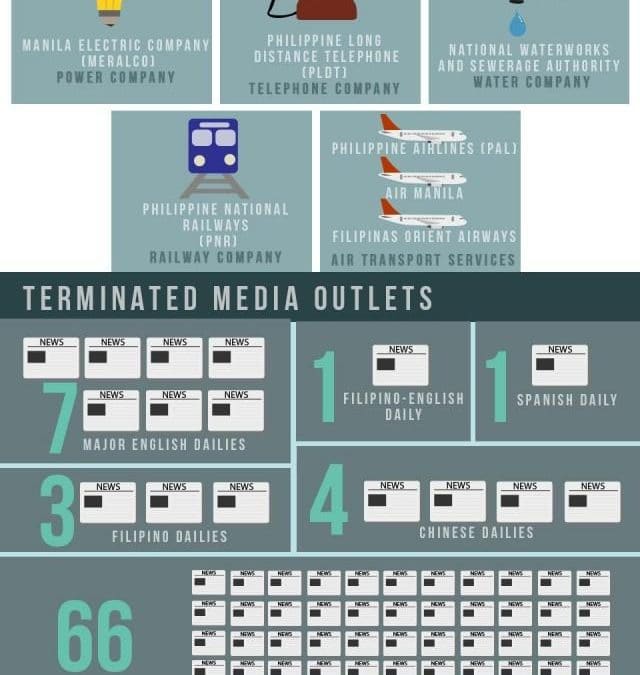
On the day Martial Law was declared, public utilities were shut down, media outlets were ordered closed, and about 8,000 personalities were arrested. See the infographic below to see the events that happened on that day.
This week, we mark the 47th anniversary of Ferdinand Marcos’ declaration of martial law. It is incredible to think how long ago that was. Our eldest son, CP, who turns 50 next year, was barely 2 years old. I doubt if he remembers anything of that fateful day in September 1972.
A phone call from my sister-in-law Dudi woke us up just before dawn. She and RC, my wife Karina’s elder brother, lived next door. In hushed tones, she told us that there were some soldiers at their front gate looking for “Daddy.” Daddy was RC’s and Karina’s father, Renato Constantino, the historian and journalist — a staunch critic of Marcos. She said that RC would stall and try to talk to the head of the arresting party, a certain Colonel Aure, to give us time to decide what to do. We called a friend, who confirmed that martial law had been declared.
RC’s foremost concern was to divert the soldiers’ attention and keep them from breaking into the main house, where we were staying. My in-laws were elsewhere, on an extended vacation. RC was aware of Karina’s active involvement in the university teachers’ movement against Marcos. The arresting party might just decide to take her. After some discussion, he offered to go with the soldiers, confirming that his name indeed was Renato Constantino. The arrest list did not say whether the order was for a Sr. or Jr.
I have vivid memories of that day, Sept. 23. Radio and television had ceased broadcasting. The newspapers for the day were not delivered. The streets were deserted. While the telephone lines remained open, they were used sparingly as we assumed they were tapped. And, of course, there was no internet yet during those years.
But all of us knew that the day we anticipated had finally come. Interestingly, we were not afraid. In theory, we knew the meaning of martial law. It meant that the president was putting on his hat as commander in chief of the armed forces in order to handle an emergency situation. It meant that he was taking full control of the powers of the state, and suspending all civil and political rights without the usual checks on these powers. It meant that the president would be calling on the armed forces to prevent or quell lawless violence resulting from an invasion, an insurrection or rebellion.
But no one knew exactly how Marcos would actually carry out martial law and for how long. Unlike the present Constitution, the 1935 Charter was not very specific about the scope and limit of these powers. Its framers obviously expected the nation’s leaders to use these emergency tools of the state with great restraint. Marcos himself thought it was necessary to make clear that martial law did not mean that the military was taking over. He assured the public that civilian authority remained in control of government, and that the armed forces were to take their orders from him as president of the country.
What Marcos, perhaps, did not anticipate was that by giving the military the power to assume functions previously exercised only by the civilian bureaucracy and elected public officials, he was effectively creating the very conditions that would later embolden the armed forces to attempt to seize political power.
Strangely enough, it came almost as a relief when, in the early evening of that day, television screens lit up. In a grainy static-filled broadcast, Marcos gravely announced that he had signed Proclamation 1081, placing the entire country under martial law in order “to save the Republic” from a supposed conspiracy of leftist and rightist elements. The entire proclamation, read by then Press Secretary Francisco Tatad, was dated Sept. 21, 1972, or two days earlier.
In the days that followed, my father-in-law Renato Constantino was arrested. He was put on indefinite house arrest and ordered to report to the military every month. The detention centers quickly filled up, and feeding the detainees was becoming a problem. My brother-in-law, RC, was released a few weeks later.
Karina and I decided that it was no longer safe for us to stay in her parents’ house. Having returned just a few weeks earlier from graduate studies abroad, I assumed I was not yet on the military radar. But it was clear to me that my wife’s life was in danger. We had received reports, a few days before martial law, that military agents were looking for her at her office in the University of the Philippines.
Declining the invitation of well-meaning friends to stay with them in underground safe houses, we moved from one relative’s house to another until we could find a small apartment far away from the academic communities of UP Diliman. The frequent moving affected our 2-year-old toddler, who was with us throughout. He had trouble sleeping. The faintest distant barking of dogs would wake him up at once.
It was during those fugitive months that our daughter Kara was conceived. When UP reopened, Karina took a maternity leave to justify her continuing absence from the university, and I went back to teaching.
Decades later, on a Navy boat that she had hitched a ride on to do a documentary on Kalayaan Island, Kara came face-to-face with the intelligence officer who had been assigned during martial law to do surveillance work on her activist mother. The man kept looking at Kara, a spitting image of the young Karina, whom he had stalked as a military agent, wondering if he was being haunted by a ghost from the past. Only later was he able to summon enough nerve to ask if Kara was related to her. He proceeded to unburden himself, telling her what he knew about her mother, the dossier he compiled on her, and — in hindsight — the pointlessness of it all.
Ang pagdeklara ng Martial Law noong Setyembre 1972 ng noo’y Pangulong Ferdinand Marcos ay itinuturing ng marami na isa sa mga madilim na bahagi ng kasaysayan ng bansa. Alamin kung bakit.
https://youtu.be/5SdE9NkqHY0
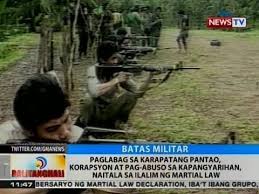
Sa ulat ni Marisol Abdurahman sa GMA News TV “Balitanghali” nitong Huwebes, sinabing Setyembre 21, 1972 nang pinirmahan ni Marcos ang Proclamation 1081, at pagkaraan ng dalawang araw ay inanunsyo niya sa telebisyon ang pagsailalim ng buong Pilipinas sa batas militar.
Ilan sa mga idinahilan niya ang banta ng komunismo, mga serye ng pambobomba gaya ng Plaza Miranda bombing, at ang umano’y nagsibling “last straw” na pananambang sa noo’y Defense Minister na si Juan Ponce Enrile.
Ngunit may mga nagsasabi na gawa-gawa lang ang naturang pananambang kay Enrile.
Sa ilalim ng batas militar, ipinatupad ang curfew mula hatinggabi hanggang alas-kwatro ng umaga. Ipinagbawal ang mga demonstrasyon, ipinasara ang ilang diyaryo at mga himpilan ng telebisyon at radyo, isa-isang inaresto ang mga kalaban sa pulitika ni Marcos.
Kabilang sa mga unang dinakip ang noo’y opposition leader na si dating Senador Benigno “Ninoy” Aquino.
a pagratipika ng 1973 Constitution habang umiiral ang batas militar, pinalawig ang pag-upo sa kapangyarihan ni Marcos, na tumagal ng 20 taon.
Batay sa datos ng Human Rights Claims Board, mahigit 75,000 ang naitalang human rights violations sa pag-iral ng martial law.
Aabot naman sa 30,000 ang biktima ng torture, marami rin ang tinawag na “desaparecidos,” o ang mga tao na dinakip, ikinulong, nawala at hindi na nakita hanggang ngayon.
Naapektuhan din maging ang ekonomiya ng bansa. Bagaman dumami ang mga naipatayong impraestruktura, nabaon naman sa utang ang bansa na umabot sa mahigit $20 bilyon.
Sa harap ng kahirapan ng maraming Pilipino, naging kapuna-puna naman ang marangyang pamumuhay ng mga Marcos, na lalo umanong nagpaugong sa hinalang nagnakaw sila at ang kanilang mga kaibigan o cronies sa kaban ng bayan.
Noong Enero 17, 1981, binawi na ni Marcos ang batas militar sa bisa ng Proclamation No 2045.
Sinasabing ginawa ito para ipakita sa Amerika na maayos na ang takbo ng Pilipinas. Nangyari ito habang bagong halal na pangulo noon ng Amerika si Ronald Reagan. Bukod dito, pinaplano noon ni Pope John Paul II ang bumisita sa bansa.