There is no more legal hurdle to the government’s plan to allow the burial of former President Ferdinand Marcos at the Libingan ng mga Bayani.
By a vote of 9-5, the 15-man SC dismissed the consolidated petitions seeking to stop the burial backed by no less than President Rodrigo Duterte, according to SC spokesman Theodore Te in a press conference.
Associate Justices Presbitero Velasco, Diosdado Peralta, Lucas Bersamin, Arturo Brion, Mariano del Castillo, Jose Perez, Jose Mendoza, Teresita Leonardo De Castro, and Estela Perlas-Bernabe gave the greenlight to the burial.
Chief Justice Maria Lourdes Sereno led the dissenters. She was joined by Senior Associate Justice Antonio Carpio, and Associate Justices Francis Jardeleza, Marvic Leonen and Alfredo Benjamin Caguioa.
Associate Justice Bienvenido Reyes, a fraternity brother of the President at the San Beda College of Law, inhibited from the deliberations due to reported close relations with a party in the case.
Te said the Court found no grave abuse of discretion on the part of Duterte in pushing for the burial of Marcos at the Libingan ng mga Bayani because this was done in the exercise of his mandate under Article VII, Section 17 of the 1987 Constitution “to ensure the faithful execution of all laws.”
There was also no law barring the transfer of Marcos’ remains to the Libingan ng mga Bayani and that Duterte was not bound by the 1992 agreement entered into by the Marcos family and then President Fidel Ramos to have the remains interred in Marcos’ hometown of Batac, Ilocos Norte.
“As the incumbent, President Duterte is free to amend, revoke, or rescind political agreements entered into by his predecessors and to determine policies which he considers, based on informed judgment and presumed wisdom, will be most effective in carrying out his mandate,” Te said.
Public funds can be used for burial
The SC also found that under the Administrative Code, the President has the power to reserve any public land for public use and for specific public purposes.
“According to the majority, the disbursement of public funds to cover the expenses incidental to the burial is granted to compensate him for valuable public services rendered,” Te said.
“In this regard, the majority also considered that the President’s determination to have Marcos’ remains interred at the Libingan ng mga Bayani was inspired by his desire for national healing and reconciliation,” he added.
The Court also shot down the petitioners’ contention that the Libingan burial was motivated by Duterte’s debt of gratitude to the Marcoses, who supported the former Davao City mayor in the May presidential election.
“As the purpose is not self-evident, petitioners have the burden of proof to establish the factual basis of their claim. They failed. Even so, this Court cannot take cognizance of factual issues since we are not a trier of facts,” stated the decision penned by Justice Peralta.
Not pure evil
Marcos may have been accused with massive human rights violations and corruption, but the SC said “it cannot deny him the right to be acknowledged based on the other positions he held or the awards he received.”
“We agree with the proposition that Marcos should be viewed and judged in his totality as a person. While he was not all good, he was not pure evil either. Certainly, just a human who erred like us,” the decision read.
The SC disagreed that Marcos had been “dishonorably discharged” following his ouster in 1986, noting Marcos was recognized by the Philippine Veterans Affairs Office as a war veteran under Republic Act 6948.
The Court added that Marcos was not convicted by final judgment of any offense involving moral turpitude.
The late strongman’s son and namesake, former Senator Ferdinand “Bongbong” Marcos Jr. was “deeply grateful,” saying the SC has once again “taken a magnanimous act to uphold the rule of law.”
The former senator also extended his gratitude to Duterte “as his unwavering commitment to this issue sustained us these past several months.”
“It is our sincerest hope that this will lead the nation towards healing as we endeavor to move the country forward to give every Filipino a better life,” the former lawmaker said in a statement.
Appeal
Petitioner and Albay Rep. Edcel Lagman, meanwhile, vowed to appeal the ruling.
“While I respect the decision of the Supreme Court, I am puzzled to no end why the majority of the High Court would allow the burial of a judicially and historically confirmed despot, plunderer and transgressor of human rights in the Libingan ng mga Bayani,” Lagman said.
“Motions for reconsideration are in order for a reversal of the majority decision,” he added.
Duterte believed Marcos should be buried at the Libingan ng mga Bayani since he was a soldier and former president.
The government also said there was no law prohibiting Marcos from being buried at the Libingan ng mga Bayani, a cemetery reserved for soldiers, former presidents, national artists and statesmen, and that it is within Duterte’s power and prerogative to allow it.
Duterte’s decision did not sit well with Martial Law victims and rights groups, who argued that only those who can serve as an inspiration and as models for emulation can be buried at the military shrine, citing Republic Act 289 as basis.
But the government clarified that the late strongman would not gain the status of a “hero” as it acknowledged the “dark pages of history during Martial Law,” during which thousands had been killed and jailed for opposing the dictatorship.
Marcos died while on exile in Hawaii in 1989, three years after he was ousted from the presidency through the People Power revolt in February 1986.
His remains, brought home in September 1993, lie inside a glass coffin and on public display at the Marcos Museum and Mausoleum in Batac, Ilocos Norte.
The only son and namesake of the late dictator Ferdinand Marcos talks about his political ‘resurgence’ a day before the Supreme Court decides on a hero’s burial for his father
‘THIS IS TEMPORARY.’ Former Senator Ferdinand ‘Bongbong’ Marcos Jr (shown here in a campaign rally in May 2016), says despite his unsuccessful vice presidential bid, he has been going around the country to thank his supporters. He vows to make a political ‘resurgence.’ File photo by Rob Reyes/Rappler
MANILA, Philippines – Former Senator Ferdinand Marcos Jr said on Monday, November 7, he had been going around the country despite his defeat in the vice presidential election, vowing to make a political comeback.
The only son and namesake of the late dictator talked about his “resurgence” in a speech at the 80th anniversary celebration of the National Bureau of Investigation (NBI), a day before the Supreme Court (SC) was to decide on petitions to prevent a hero’s burial for his father.
At the NBI event, Marcos likened himself to Senator boxer Manny Pacquiao, and borrowed the slogan of the basketball team Ginebra.
“Kumbaga sa Ginebra, ‘never say die’ dapat! ’Ika nga po ng tema ng laban ni Senator Manny Pacquiao: resurgence. Babalik po tayo. Babangon at babawing muli tayo. Marami pa tayong ibubuga. Pansamantala lamang po ito. Abangan ang susunod na kabanata!” he was quoted in the press release sent by office.
(Like what Ginebra says, ‘never say die’! If we may borrow the theme of Senator Manny Pacquiao’s recent fight: resurgence. I’ll be back. I’ll rise again and I’ll recover. There still a lot I can do. This [hiatus] is but temporary. Watch out for the next chapter!)
The press release also said Marcos “will come back stronger since he has a lot more to offer.”
Going around the country
The young Marcos’ speech also came a day before he and President Rodrigo Duterte were both set to visit Tacloban City , the home city province of Marcos’ mother Imelda Marcos, for the 3rd anniversary of Super Typhoon Yolanda (Haiyan) that almost wiped out the city. Their offices separately advised that they would be at the Holy Cross Memorial Park for a 3 pm program.
Duterte had not made a secret of his preference for Marcos Jr to become vice president, even if they were not running mates in May 2016. The Chief Executive initially refused to appoint Vice President Robredo to a Cabinet post because, “I don’t want to hurt the feelings of Bongbong Marcos. He is my friend.”
Recently, in his state visit to China where Marcos Jr was present, Duterte introduced him as the potential new vice president in the event his electoral protest prospered.
Marcos said he had been going around the country to thank those who supported his vice presidential bid.
“And so, I roam around and personally convey my appreciation of their trust in me. Kahit ako ay ‘off-duty’ nang pansamantala, ito ay aking ginagawa dahil kailangan kong tumanaw ng utang na loob sa sambayanang Pilipino. Maraming salamat po sa inyo,” he said.
(Even if I’m temporarily “off-duty,” I’m doing this to show my gratitude to the Filipino nation. I thank you all.)
Support for the NBI
Marcos Jr said he appreciated that the NBI, through Director Dante Gierran, sought him to grace their celebration. He called on the public to support the agency, amid “attempts to destabilize and defeat the good intentions of the current leadership.”
“Kailangang-kailangan po natin ang NBI, lalo na sa ating panahon ngayon na napakaraming banta sa lipunan. Maraming nanggugulo ngayon at naghahasik ng lagim sa lipunan. Gustong takutin at guluhin ang isipan ng taumbayan upang mawalan ng tiwala sa ating pamahalaan,” he is quoted in the press release.
(We badly need the NBI, especially during these times when there are a lot of threats in our society. There are a lot of trouble makers, sowing horror, wanting to frighten and confuse citizens so they will lose their trust in government.)
Another book documenting the extravagant life of the Marcoses during the dictatorship of the late strongman Ferdinand Marcos Sr. was launched on Saturday. Penned by Myles A. Garcia, “Thirty Years Later: Catching Up with the Marcos Era Crimes” describes the amoral “hoodwinking” that Marcos and his wife Imelda performed while in power.
“Hoodwinking” is too light a term, especially if you ask people who were tortured and raped during Martial Law. During the book launch, Danilo “Ka Danny” Dela Fuente recounted the physical agony he suffered.
“Hindi mababayaran ang ginawang pagpapahirap sa amin ng anumang anyo ng salapi. Pangunahin sa amin magkaroon ng katarungan. Dapat may managot,” Ka Danny said.
“Ang mga Marcos, ipinagdiwang ang birthday ni Marcos Sr. nitong September 11. Nagsalita itong si Imee. Sabi niya, magkaroon kami ng pagpapatawad. Eh bakit kami magbibigay ng patawad?” he continued. “Bakit kami kailangang magbigay ng patawad sa kanila? ‘Yun ‘yung hindi nila inaamin.”
Ka Danny was arrested in February 25, 1982. He was a labor organizer at the time and was taken from a house in Novaliches to Camp Crame along with other members of the union. Ka Danny was physically assaulted during an interrogation and was transferred to another location where he was tortured.
Like many, Ka Danny was subjected to violent electric shocks and Russian Roulette among other forms of brutality.
On September 12, it was reported that Ilocos Norte Governor Imee Marcos had spoken during a dinner in honor of her father during which she said that the late dictator was only human.
“Anuman ang kasalanan ng aking ama sapagkat hindi naman niya kailanman sinabi na siya ay hindi tao lamang na nagkakamali at nagkakasala
“Sana sa kabila nito, mahanap na rin nila ang kapatawaran sapagkat sa pagpapatawad sa aking ama, sa pagpapatawad, sana mapawi na rin ang galit nila at sila mismo ay mabigyan ng kapayapaan,” she added.
Ka Danny lamented the lack of admission, acknowledgement, and apology from the Marcoses despite statements from them asking for forgiveness.
In a separate interview with GMA News Online, leftist politician and former Bayan Muna representative Satur Ocampo concurred with Ka Danny.
“Ni walang naman silang pagpapaumanhin man lang. Wala silang pag-amin. Hindi nila sinasabing, ‘Bilang mga anak niya, humihingi kami ng paumanhin sa mga nagawang kasalanan o kakulangan o pang-aabuso sa panahon ng aming ama.’ Walang ganun eh.
“Humihingi ka ng patawad ng wala ka namang abiso, so ano ‘yung patawad na hinihingi?” he said.
He added that Governor Marcos failed to recognize the rights of the victims of Martial Law to ask for justice and reparations. According to Ocampo, what she did was generalize that it’s normal for human beings to commit errors.
“Nawawala ‘yung sense ng contrition kung gaanong kabigat ‘yung mga kasalanan,” Ocampo explained.
‘A kind of his own’
Also speaking during the book launch, Atty. Rey Cortez of the National Union of People’s Lawyers provided an update on the fight to prevent the late dictator from being buried at the Libingan ng mga Bayani.
“He was a dictator, a plunderer, and human rights violator and this is a fact. It is a judicially recognized fact,” Cortez said, repeating Chief Justice Maria Lourdes Sereno’s citation of 20 Supreme Court decisions calling Marcos a dictator and 18 other Supreme Court decisions referring to him as an authoritarian.
He underscored in particular the Marcos v Manglapus case from 1989 and reiterated that Ferdinand Emmanuel Edralin Marcos Sr. is sui generis—a kind of his own.
Cortez explained, “He should be treated differently from all of the presidents and soldiers and recipients of the medal of valor.”
What had transpired during the Martial Law was unlike anyone had ever seen and Cortez said that the 1987 Philippine Constitution recognizes the atrocities that were committed during Marcos’ rule. Words like safe houses had never been used for and were specifically written into the constitution because of the country’s collective experience under Martial Law.
Republic Act 10368 (Human Rights Victims Reparation and Recognition Act of 2013) specifies the restoration of the honor and dignity of human rights victims, Cortez said, adding, “And here you bury Marcos and give him the same honor as those who he victimized?”
Cortez stressed that Marcos is not worthy of emulation and not source of inspiration and is thus not entitled to a hero’s burial.
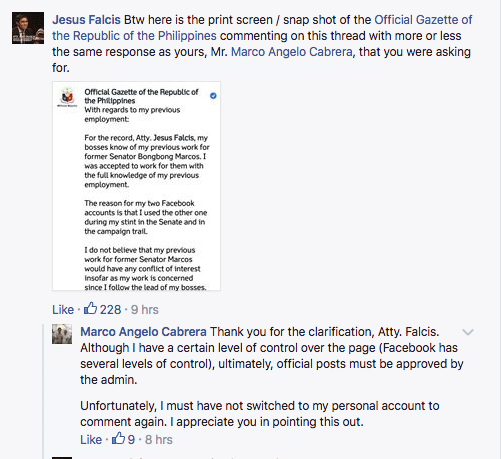
Marco Angelo Cabrera is called out online for ‘conflict of interest.’ PCO Assistant Secretary Ramon Cualoping III says Bongbong Marcos’ former campaign staff fully disclosed this to his bosses.
CONFLICT? A former campaign staff of ex-Senator Ferdinand Marcos Jr, who is now working for the Presidential Communications Office, is linked to the seemingly ‘pro-Marcos’ post of the Official Gazette.
MANILA, Philippines – A former campaign staff of Ferdinand Marcos Jr in the May elections drew flak from netizens after he was linked to the Official Gazette’s Facebook update that was widely perceived as being “pro-Marcos.”
Marco Angelo Cabrera, who now works for the Official Gazette under the Presidential Communications Office, was called out on Facebook by lawyer Jesus Falcis for the PCO page’s commemorative post on the 99th birthday of the late President Ferdinand Marcos.
The photo was captioned with bits about Marcos’ government service but initially left out the details about the Martial Law declaration in 1972 and his being ousted through the EDSA People Power Revolution in 1986. The post has been updated since. (READ: Official Gazette under fire for Marcos photo caption)
Falcis pointed out that Cabrera used to work for the son and namesake of the late strongman, as proven by another social media account under his name.
“The conflict of interest is so glaring and palpable. Multiple issues and events will require you to post on matters touching Ferdinand Marcos and his family – from the current issue on his burial at the Libingan ng mga Bayani to future commemorations of the declaration of Martial Law and the EDSA Revolution,” Falcis said.
Cabrera responded to Falcis, saying that his bosses at PCO are well aware of his employment history, which he also disclosed on his Facebook page.
“My bosses know of my previous work for former Senator Bongbong Marcos. I was accepted to work for them with the full knowledge of my previous employment. The reason for my two Facebook accounts is that I used the other one during my stint in the Senate and on the campaign trail,” Cabrera said.
He added: “I do not believe that my previous work for former Senator Marcos would have any conflict of interest insofar as my work is concerned since I follow the lead of my bosses.”
Cabrera initially posted his comment using the Official Gazette’s account. Netizens again faulted him for it.
“Although I have a certain level of control over the page (Facebook has several levels of control), ultimately, official posts must be approved by the admin. Unfortunately, I must have not switched to my personal account to comment again. I appreciate you in pointing this out,” Cabrera said.
Meanwhile, Cabrera said he will leave it to his superiors to respond on the the blunder on the Official Gazette’s Facebook page.
‘Agnostic’ gazette
PCO Assistant Secretary Ramon Cualoping III, who is managing the Official Gazette, did not confirm if Cabrera was the one who wrote the post about Marcos Sr.
Cualoping said he gave the final approval to the post.
“I’ll have to check [because] there’s a team, there’s a team handling [the] Gazette,” Cualoping told Rappler. “There is a pool of researchers, there are editorial writers and we have a pool of consultants – historian consultants. And then I give the final approval.”
Cualoping said Cabrera fully disclosed to PCO his past stint with former Senator Marcos.
“But just like in any offices, we hire on the merits of credentials as well, not because of political affiliations. Of course, political affiliations, yes. But he’s good. He’s brilliant,” he said.
On the blunder, Cualoping said he was just being “fair” when he approved the posting of the “agnostic” birthday card about Marcos – that it was devoid of political color.
“I was not thinking of the Marcos family when I gave the approval last night. It was really making it fair. We also did it for President [Ramon] Magsaysay, for President [Sergio] Osmeña, and we also did it for Senator Ninoy Aquino.”
He also said: “From our government point of view, the Gazette point of view, it should be blind in terms of political colors. But if you want to look at it in the political perspective, then you can hear it from the Presidential Communications’ page, not the Gazette page.”
Solicitor General Jose Calida on Wednesday said the government’s plan to bury the late strongman Ferdinand Marcos at the Libingan ng mga Bayani (LNMB) in Taguig will not have a negative effect on the government’s existing commitment to give reparation to the victims of human rights violation during Martial Law.
At the resumption of the oral arguments on the consolidated petitions against the government’s plan for a hero’s burial on Marcos, Supreme Court Associate Justice Alfredo Benjamin Caguioa asked Calida: “Will the burial of Marcos at the Libingan ng mga Bayani have a negative effect on the human rights obligations and reparations of the victims?”
“Definitely not, your honor,” Calida replied.
Calida pointed out that Human Rights Victims Claims Board (HRVCB) chairperson Lina Sarmiento had already admitted during the first day of the oral arguments that the awarding of compensation to the human rights violation victims is ongoing and that the planned burial of Marcos in LNMB will not affect the compensation procedure.
Caguioa, however, pointed out that also during the previous hearing, Commission of Human Rights chairman Jose Luis Martin Gascon stressed that the reparation of victims during martial law does not only involves monetary compensation but also the state’s recognition that the abuses transpired and that it will not happen again.
“The CHR chairman also said reparation also means ensuring that the victims will not be re-traumatized,” Caguioa said.
Calida, however, fired back that what was traumatizing was having the victims recount over and over the tortures they endured during martial law.
“The word re-traumatization will not apply here (Marcos’ burial). I was surprised that during the last hearing, the victims were made to recall the horrors they experienced. That was in fact re-traumatization,” Calida said.
“They should not be allowed to relieve the horrors of their past. There is a place for that but not here in the Supreme Court… I am human your honor, I can feel their pain. But making them recount their horrible experiences is a form of re-traumatizing them,” he added.
Caguiao then asked Calida on what is the “urgency” of burying Marcos at the LNMB.
“President [Rodrigo] Duterte has already stated that among his national policies are policy of reconciliation and national healing,” Calida said.
Victims of human rights violations during martial law on Wednesday recalled the torture they had endured from the police and the military under the regime of the late dictator Ferdinand Marcos.
On the first day of the oral arguments before the Supreme Court (SC) on consolidated petitions opposing the government’s plan to bury Marcos at the Libingan ng mga Bayani (LNMB), torture victims were each given a chance to air their sentiments and to recount how they were tortured during martial law.
Former Commission on Human Rights (CHR) Chairman Loretta Ann “Etta” Rosales was first to speak before the SC justices, recounting how she was sexually molested and how she was subjected to various forms of torture such as electric shock, water cure and a Russian roulette routine, wherein a gun was pointed at her while she was undergoing interrogation.
“It was just a continuing thing. I lie there for 24 hours of continuing torture, there was no eating or sleeping,” Rosales said.
Rosales, a daughter of a late soldier, said she was tortured in a police camp for two straight days and was detained for almost a month.
Her sister, Maria Cristina Pargas-Bawagan, also suffered torture in a police camp in Muñoz, Nueva Ecija.
Bawagan said she was arrested for alleged possession of illegal documents, which she knew nothing about.
“I was blind-folded, my mouth was gagged. My legs were paddled. They put sharp object over my breasts,” Bawagan said.
Bawagan said the following day, her torturers raped her by fondling her breasts and inserting a long object in her genital.
Bawagan said she was placed under solitary confinement for five day before her mother was able to find her and pick her up.
Fe Buenaventura-Mangahas, a history professor in a university during martial law, said she was subjected to mental torture as she was isolated in a dark room for days. She was interrogated by men who asked lewd questions.
She said policemen also brought her to PNP headquarters in Camp Crame and made her watch how other women were being tortured.
“I could hear women screaming,” Mangahas recounted.
Mangahas said she was only released after she had profuse bleeding.
“I did not know that I was two-month pregnant. When they were interrogating me, akala ko naihi lang ako, but then when I looked it was blood. I was rushed to the hospital and that was only when I found out that I was pregnant,” Mangahas said.
Meanwhile, Gilda Narciso, a youth activist, recounted how she was gang-raped by her torturers.
“They handcuffed and blind-folded me, and a lot of hands were all over my body. And they put their penises, one at a time in my mouth, fingered my vagina. That went on for the whole day,” Narciso said.
Land reform activist and urban poor leader Trinidad Herrera said she was about to go abroad to serve as one of the judges in an international competition on urban housing design, when policemen arrested her in April 1977 and brought her to Camp Crame.
Herrera said that during her interrogation, her breasts and fingers were electrocuted using a live telephone wires.
“Nilagyan pa ng tubig yung sahig para mas malakas ang kuryente,” Herrera said.
She said her interrogation and electrocution went on for about six hours until she passed out.
“Hanggang sa mawalan ako ng ulirat at nilipat ako sa camp Bicutan kung saan nandun yung iba pang urban poor leaders,” Herrera said.
“Nararamdaman parin ng katawan ko ang pahirap, ngayon na matanda na ako,” she added.
Meanwhile, labor leader Felix Dalisay, who is now 64 years old, said he had undergone tortures by “Fifth Session” a codename for the Fifth Unit of the Philippine Constabulary (now Philippine National Police) for almost three years under detention.
“Yung Fifth Session or the Fifth Constabulary sila yung pinaka notorious torturer nung martial law…Nandyan yung suntok, sipa, electrocution, bullets pressed between your fingers,” Dalisay said.
Dalisay said he has a hearing problem in his left ear due to the various tortures he endured.
“Masasabi niyo po bang forget about the past? Sa amin po hindi po ganun kadali yun. Hanggang sa ngayon ‘pag naaalala namin ay naiiyak parin kami, naaawa sa sarili namin,” Dalisay told the SC Justices.
“Hanggang ngayon hindi pa nakaka tanggap ng compensation ang lahat ng mga biktima ng martial law. Payagan man yan ng SC na ilibing siya (Marcos) diyan [sa Libingan ng mga Bayani], hindi po kami titigil sa pagtutol. Habang buhay po namin dadalin yan,” he added.