This week, we mark the 47th anniversary of Ferdinand Marcos’ declaration of martial law. It is incredible to think how long ago that was. Our eldest son, CP, who turns 50 next year, was barely 2 years old. I doubt if he remembers anything of that fateful day in September 1972.
A phone call from my sister-in-law Dudi woke us up just before dawn. She and RC, my wife Karina’s elder brother, lived next door. In hushed tones, she told us that there were some soldiers at their front gate looking for “Daddy.” Daddy was RC’s and Karina’s father, Renato Constantino, the historian and journalist — a staunch critic of Marcos. She said that RC would stall and try to talk to the head of the arresting party, a certain Colonel Aure, to give us time to decide what to do. We called a friend, who confirmed that martial law had been declared.
RC’s foremost concern was to divert the soldiers’ attention and keep them from breaking into the main house, where we were staying. My in-laws were elsewhere, on an extended vacation. RC was aware of Karina’s active involvement in the university teachers’ movement against Marcos. The arresting party might just decide to take her. After some discussion, he offered to go with the soldiers, confirming that his name indeed was Renato Constantino. The arrest list did not say whether the order was for a Sr. or Jr.
I have vivid memories of that day, Sept. 23. Radio and television had ceased broadcasting. The newspapers for the day were not delivered. The streets were deserted. While the telephone lines remained open, they were used sparingly as we assumed they were tapped. And, of course, there was no internet yet during those years.
But all of us knew that the day we anticipated had finally come. Interestingly, we were not afraid. In theory, we knew the meaning of martial law. It meant that the president was putting on his hat as commander in chief of the armed forces in order to handle an emergency situation. It meant that he was taking full control of the powers of the state, and suspending all civil and political rights without the usual checks on these powers. It meant that the president would be calling on the armed forces to prevent or quell lawless violence resulting from an invasion, an insurrection or rebellion.
But no one knew exactly how Marcos would actually carry out martial law and for how long. Unlike the present Constitution, the 1935 Charter was not very specific about the scope and limit of these powers. Its framers obviously expected the nation’s leaders to use these emergency tools of the state with great restraint. Marcos himself thought it was necessary to make clear that martial law did not mean that the military was taking over. He assured the public that civilian authority remained in control of government, and that the armed forces were to take their orders from him as president of the country.
What Marcos, perhaps, did not anticipate was that by giving the military the power to assume functions previously exercised only by the civilian bureaucracy and elected public officials, he was effectively creating the very conditions that would later embolden the armed forces to attempt to seize political power.
Strangely enough, it came almost as a relief when, in the early evening of that day, television screens lit up. In a grainy static-filled broadcast, Marcos gravely announced that he had signed Proclamation 1081, placing the entire country under martial law in order “to save the Republic” from a supposed conspiracy of leftist and rightist elements. The entire proclamation, read by then Press Secretary Francisco Tatad, was dated Sept. 21, 1972, or two days earlier.
In the days that followed, my father-in-law Renato Constantino was arrested. He was put on indefinite house arrest and ordered to report to the military every month. The detention centers quickly filled up, and feeding the detainees was becoming a problem. My brother-in-law, RC, was released a few weeks later.
Karina and I decided that it was no longer safe for us to stay in her parents’ house. Having returned just a few weeks earlier from graduate studies abroad, I assumed I was not yet on the military radar. But it was clear to me that my wife’s life was in danger. We had received reports, a few days before martial law, that military agents were looking for her at her office in the University of the Philippines.
Declining the invitation of well-meaning friends to stay with them in underground safe houses, we moved from one relative’s house to another until we could find a small apartment far away from the academic communities of UP Diliman. The frequent moving affected our 2-year-old toddler, who was with us throughout. He had trouble sleeping. The faintest distant barking of dogs would wake him up at once.
It was during those fugitive months that our daughter Kara was conceived. When UP reopened, Karina took a maternity leave to justify her continuing absence from the university, and I went back to teaching.
Decades later, on a Navy boat that she had hitched a ride on to do a documentary on Kalayaan Island, Kara came face-to-face with the intelligence officer who had been assigned during martial law to do surveillance work on her activist mother. The man kept looking at Kara, a spitting image of the young Karina, whom he had stalked as a military agent, wondering if he was being haunted by a ghost from the past. Only later was he able to summon enough nerve to ask if Kara was related to her. He proceeded to unburden himself, telling her what he knew about her mother, the dossier he compiled on her, and — in hindsight — the pointlessness of it all.
Ang pagdeklara ng Martial Law noong Setyembre 1972 ng noo’y Pangulong Ferdinand Marcos ay itinuturing ng marami na isa sa mga madilim na bahagi ng kasaysayan ng bansa. Alamin kung bakit.
https://youtu.be/5SdE9NkqHY0
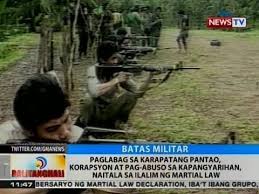
Sa ulat ni Marisol Abdurahman sa GMA News TV “Balitanghali” nitong Huwebes, sinabing Setyembre 21, 1972 nang pinirmahan ni Marcos ang Proclamation 1081, at pagkaraan ng dalawang araw ay inanunsyo niya sa telebisyon ang pagsailalim ng buong Pilipinas sa batas militar.
Ilan sa mga idinahilan niya ang banta ng komunismo, mga serye ng pambobomba gaya ng Plaza Miranda bombing, at ang umano’y nagsibling “last straw” na pananambang sa noo’y Defense Minister na si Juan Ponce Enrile.
Ngunit may mga nagsasabi na gawa-gawa lang ang naturang pananambang kay Enrile.
Sa ilalim ng batas militar, ipinatupad ang curfew mula hatinggabi hanggang alas-kwatro ng umaga. Ipinagbawal ang mga demonstrasyon, ipinasara ang ilang diyaryo at mga himpilan ng telebisyon at radyo, isa-isang inaresto ang mga kalaban sa pulitika ni Marcos.
Kabilang sa mga unang dinakip ang noo’y opposition leader na si dating Senador Benigno “Ninoy” Aquino.
a pagratipika ng 1973 Constitution habang umiiral ang batas militar, pinalawig ang pag-upo sa kapangyarihan ni Marcos, na tumagal ng 20 taon.
Batay sa datos ng Human Rights Claims Board, mahigit 75,000 ang naitalang human rights violations sa pag-iral ng martial law.
Aabot naman sa 30,000 ang biktima ng torture, marami rin ang tinawag na “desaparecidos,” o ang mga tao na dinakip, ikinulong, nawala at hindi na nakita hanggang ngayon.
Naapektuhan din maging ang ekonomiya ng bansa. Bagaman dumami ang mga naipatayong impraestruktura, nabaon naman sa utang ang bansa na umabot sa mahigit $20 bilyon.
Sa harap ng kahirapan ng maraming Pilipino, naging kapuna-puna naman ang marangyang pamumuhay ng mga Marcos, na lalo umanong nagpaugong sa hinalang nagnakaw sila at ang kanilang mga kaibigan o cronies sa kaban ng bayan.
Noong Enero 17, 1981, binawi na ni Marcos ang batas militar sa bisa ng Proclamation No 2045.
Sinasabing ginawa ito para ipakita sa Amerika na maayos na ang takbo ng Pilipinas. Nangyari ito habang bagong halal na pangulo noon ng Amerika si Ronald Reagan. Bukod dito, pinaplano noon ni Pope John Paul II ang bumisita sa bansa.
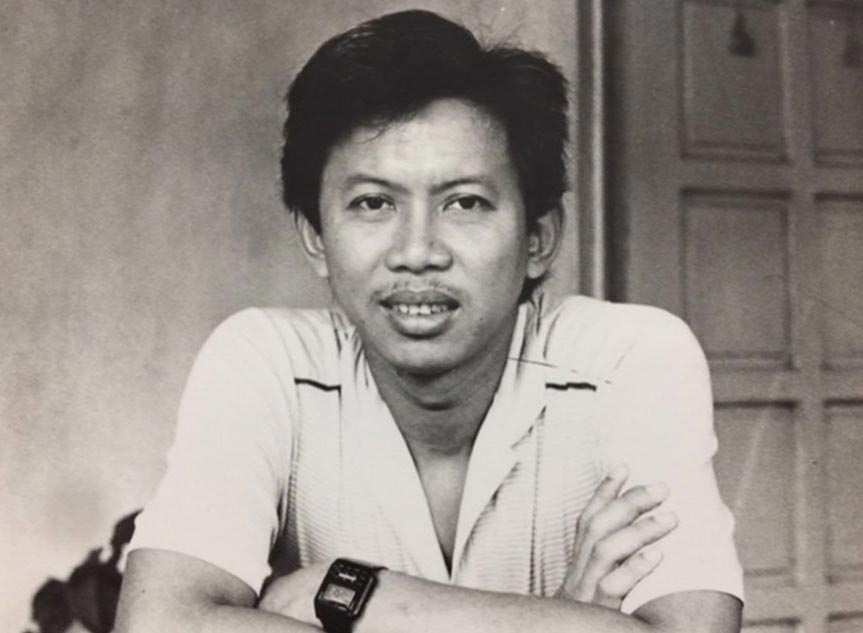
Pete Lacaba in the 70s First published in Philippine Graphic, September 1995. Updated in the author’s blog in September 2008.
When word got around a few years ago that a class suit was going to be filed against the Marcoses, I took note of it more as a news item than as a personal issue. I virtually ignored the forms that had come in the mail, asking me to recount the torture I had undergone under martial rule.
One week before the deadline for the submission of the depositions of torture victims, a friend called and asked why I hadn’t submitted mine. My friend said that if not enough depositions were submitted to the Hawaii court, the Marcoses would be proven right in their contention that they were not world-class torturers and executioners, and they would be justified in asking for a dismissal of the case.
What needed to be done, my friend pointed out, was not primarily to get financial reparation for the harm that had been done to us, but to prove to the world that the Marcos regime had indeed been guilty of widespread and systematic torture and extrajudicial executions. If the class suit said there were around 10,000 victims of human-rights violations under Marcos, then it needed to get as close to 10,000 depositions as it could.
My friend’s arguments persuaded me to write the following account, which was submitted along with the requisite forms just a few days before the deadline set by the court for the submission of depositions:
At dawn of April 25, 1974, on the second year of martial law, I was awakened by shouts of: “Open up! We are the authorities!” I looked out and saw that the house was surrounded by armed men taking cover behind jeeps and cars that had their headlights on.
As soon as I opened the door, the first man who came in shoved the barrel of his rifle into my stomach. Then somebody spun me around and forced me to lie face down on the floor. In that position, I was stepped on, kicked in the ribs, hit in the back and on the back of the head with rifle butts.
After the house had been searched and my two house companions were in custody, someone who acted as though he was in command (I would learn later that he was a first lieutenant, but not the head of the raiding party) dragged me into the bathroom and asked if there was a tunnel underneath us. I couldn’t help giving a short laugh, struck by the absurdity of the question. Angered by my response, he gave me a sudden blow in the chest with his closed fist. The lieutenant was an Arnold Schwarzenegger pumping-iron type, and at that time I was a 111-pound weakling. That single punch sent me reeling against the bathroom’s tiled wall.
The sun was up when we were taken in separate cars to Camp Crame in Quezon City, to the headquarters of the 5th Constabulary Security Unit (5CSU). After some routine questioning and filling up of forms in the office, I was taken to the back, the troops’ sleeping quarters. Constabulary officers and enlisted men–including a buck private who was himself under detention, for murder–took turns making me a punching bag.
Mostly I was pummeled with fists in the chest and the stomach. I was seated on the edge of a steel cot. My tormentors and interrogators sat in chairs or stood before me, hitting me each time a question was asked or an answer was unsatisfactory. Troopers passing by, on their way to their lockers or wherever, felt free to hit my nape or the back of my head with open palms or karate chops.
At one point I was made to half-squat with arms outstretched. One of my torturers then took a broom and slowly, methodically beat my shins with the broom’s wooden handle. Although he seemed to be hitting me with very little force, the cumulative effect of the beating caused my shins to swell and made it sore and sensitive for a few days.
At another point I was made to lie down with the back of my head resting on the edge of one steel cot, both my feet resting on the edge of another cot, my arms straight at my sides, and my stiffened body hanging in midair. This was the torture they called higa sa hangin (lying down in air), also known as the San Juanico Bridge, named after the country’s longest bridge, built during martial law and dedicated by Marcos to his wife, Imelda.
“Lying down in air” is difficult enough, since you have to contend with the pull of gravity. But even before gravity could take its toll, somebody standing close by would give me a kick in the stomach and bring my body down to the floor. The steel cot scraped skin off my nape as I slid down.
I was forced to “lie down in air” twice. The third time I simply refused to get up. I stayed crumpled on the floor and said, “You may as well just kill me. Go ahead and kill me.” That was when the torture stopped for the day.
I had been continuously tortured for about eight hours. Incredibly enough, we even had a lunch break. I forced myself to finish up the horrid prison food on the aluminum army tray that they placed before me, hoping that when they resumed hitting me in the stomach I would throw up in their faces. I never did.
I can no longer remember the exact sequence of events, but in the days that followed, during the fortnight when we were incommunicado and our families went desperately from camp to camp looking for us, I experienced various other forms of harassment and torture.
Once, while a deposition was being taken, the sergeant conducting the interrogation suddenly kicked me in the chest. We were both seated in one corner of the 5CSU office, face to face, and I insisted on answering only questions pertaining to myself, refusing to answer those that would implicate other people. After the nth “I prefer not to answer that question,” he raised his booted foot and gave me a kick in the chest that sent the chair on which I was seated skidding clear across the room. When the chair hit the wall, I fell to the floor.
On another occasion, a lieutenant reviewing my deposition made me stand in front of an air conditioner going full blast while he interrogated me. And he smiled when he saw that I was shivering uncontrollably.
“I was forced to “lie down in air” twice. The third time I simply refused to get up. I stayed crumpled on the floor and said, “You may as well just kill me. Go ahead and kill me.” That was when the torture stopped for the day.”
On still another occasion, another lieutenant ordered me to close my eyes in the course of an interrogation. A hand that I assumed to be the lieutenant’s then slapped my closed eyes and my nape repeatedly, almost rhythmically.
Once, the detained soldier who had been one of my torturers on my first day took me out of the cramped prison cell that I shared with about 30 other political prisoners. He gave me a tongue-lashing for having poked fun at his rather unusual name. While he was spewing saliva in my face, his fellow soldiers gave me a few jabs in the ribs.
One day I was led out of the small prison cell, handcuffed, and made to board a jeep with three or four of the men who had tortured me on my first day. I thought for sure this was it, they were going to take me to wherever their killing fields were and blow my brains out. Instead, we went to a military hospital, the V. Luna in Quezon City. I recognized the place because it was there that my father, a war veteran, had died of cancer about a dozen years earlier.
It now seemed to me that my torturers were humane after all, that they would have me treated for the bruises on my nape and shins. But as soon as we were inside a doctor’s clinic in one of the wards, I was blindfolded with my own snot-splattered handkerchief, made to lie down on the examination table, and injected with what I would later surmise to be a “truth serum.” In a couple of minutes I felt like I had downed half a case of beer. My head swam, and my body seemed to float. Once again the third degree began. I can remember talking drunkenly and trying to give misleading answers that would still somehow sound credible to my interrogators.
I don’t know how long the interrogation took before I finally lost consciousness. It was dark when I was roused from sleep, taken to the jeep, and brought back to my prison cell. They had to half-carry me all the way. My legs felt like jelly, and I didn’t seem to have any control over any part of my body, although I kept mumbling my own mantra: “Mind over matter, mind over matter…” The mantra didn’t work.
About two weeks after my arrest, I was taken to the office of the lieutenant who had slapped my closed eyes. He said my wife and my mother were in the other room. They had finally found my place of detention. But the lieutenant said he would only allow me to see them if I would name one name and give one address of a person involved in the underground resistance. “Have pity on your wife and your mother,” he said. “They would very much like to see you.” After a few moments of agonizing, I said I couldn’t do it. He eventually let my wife and my mother come in and talk to me for about ten minutes, but not after subjecting them for a much longer time to the mental torture of knowing I was just in the other room and fearing they would not be allowed to see me.
I was detained without charges for close to two years. In the first six months of detention, I was made to wash cars and clean the enlisted men’s incredibly filthy latrines. Halfway through my detention I experienced a recurrence of the pulmonary tuberculosis of which I had already been cured before martial law. I had to be confined for about a month at the Quezon Institute, a hospital that specializes in tuberculosis cases. Three shifts of prison guards kept me company.
On the basis of close to 10,000 depositions similar, I suppose, to the one above, the Hawaii court declared the Marcoses guilty of human rights violations and ordered them to pay a billion plus, in dollars, as reparation to the claimants in the class suit.
It was, I thought, primarily a moral victory. I joked about what I would do with the loot, but I didn’t really believe there was any way the government or the Marcoses would give a billion plus, in dollars, to victims of human-rights violations, quite a number of whom remain not only nonconformist but also active, militant, even dissident.
Today the papers tell me that a deal is being worked out: if the Marcoses and the government agree to pay 100 million dollars, the claimants will drop all charges against the Marcoses. This is supposed to be a win-win-win solution.
I don’t know what to think. I have friends among both those who defend and those who denounce the deal, and I don’t know what to think. I could be a million dollars richer, but if the Marcoses are absolved of their crimes against humanity, then what I wrote about how I was tortured would turn out to be a lie, a figment of my overheated imagination.
Most people, especially the victims of President Ferdinand Marcos’ so-called constitutional dictatorship, would remember only the evil things about Martial Law. But, if historians would be fair about it, there were also some positive things about it. The bad things, of course, include the warrantless arrests, the indefinite detention without charges, and the alleged torture, rape and other detestable abuses supposedly committed by military officials and personnel who went out of bounds. Power corrupted and absolute power corrupted absolutely.
Since most of the write-ups today would focus on the bad things that Martial Law did to their lives, businesses and careers, I am going to balance the situation by discussing some positive things about Martial Law. I am not going to revise the historical facts that were well-documented. I will not deny the truth because I too, was a victim, having been arrested as a student leader and detained without charges. But since I am a journalist and a Rotarian, I am going to tell the whole truth. And part of the truth which others prefer not to highlight is the positive side of Martial Law.
What I liked most about those Martial Law years was the discipline of both the rich and the poor. The rich, especially the oligarchs who exploited, oppressed and committed all forms of social injustices against the people, were disciplined through massive social changes and development, including agrarian reform, labor decrees including the Labor Code, and the government’s exercise of eminent domain and police power to break the monopolies by landed estates, by the ruling classes who were committing multiple unfair labor practices against their workers. Marcos decreed many social reforms especially in the form of labor laws and social legislation.
The poor were also disciplined. Curfew was imposed. The young ones did not roam around at nights like what they are doing today. The core of the curriculum was work. Pupils and students were trained to work and not to behave as spoiled brats like many are today. The young and the old were ordered to plant trees, and the government employees were required to render rural service in order to help the green revolution. People were asked to clean their surroundings, to be mindful of the community sanitation. No one was allowed to urinate or defecate anywhere. The people were made to respect the environment.
As between absolute freedom and conscientious discipline, I prefer discipline. As between unrestrained freedom to abuse, freedom to plunder the country, freedom to use and sell drugs, and freedom to ravage the environment, which are all happening today, on the one hand, and discipline, on the other hand, I would always choose discipline. Even God would destroy a new Sodom and a new Gomorrah, and would destroy us by massive floods like He did the time of Noah. This is a licentious, abusive and totally reckless and sinful generation. We need Martial Law to bring back sanity to the land. Or God will destroy us all.
The Darkest Chapter of the Philippine History or the Golden Years of the Country’s History?
September 21, 1972, President Ferdinand Marcos placed Philippines under martial law, some refer it as “The Darkest Chapter of the Philippine History”. The declaration issued suspended the civil rights and imposed military authority within the country where he abolished Congress, controlled media establishments, and order arrest to those opposition parties and leaders where he defended the declaration for needing the extra power to quench the rising violence caused by the communists to eradicate the roots of rebellion. This brings fear and hopelessness to our brothers and sisters, during these times people knew that the gravity of disorder, social injustice, youth and student activism, many vigilantes and mysterious crimes are happening we don’t about the safety around us anymore.
But during this period, it is hailed also “The Golden Years of the Philippine History” wherein there are positive effects of martial law like in economy that according to World Bank Data (1980), the Philippines’s Gross Domestic Product quadruples. Also with the active of military during this time they are decrease in crime rates such as murder, stealing and other crimes are rarely done because of armies visible everywhere. And the whole country became extremely disciplined due to the curfew observed where those who won’t obey are given disciplinary actions.
Regardless of these, we Filipinos united and learned to fight for our rights to give back our voices, power and freedom. This became one of our famous acts within the history where democracy is used for those who imprison it, where we thirst for the sweetness and positivity of freedom.
There is positivity in every negative. Without this event, we Filipinos are continued to be under their powers unable to speak out but with courage and unity we regained our freedom and forever to be influenced by this event making us where we are now even with the traumatizing events that scars the history but also nurtures it which encourages us.