In September 1972 Marcos declared martial law, claiming that it was the last defense against the rising disorder caused by increasingly violent student demonstrations, the alleged threats of communist insurgency by the new Communist Party of the Philippines (CPP), and the Muslim separatist movement of the Moro National Liberation Front (MNLF). One of his first actions was to arrest opposition politicians in Congress and the Constitutional Convention. Initial public reaction to martial law was mostly favourable except in Muslim areas of the south, where a separatist rebellion, led by the MNLF, broke out in 1973. Despite halfhearted attempts to negotiate a cease-fire, the rebellion continued to claim thousands of military and civilian casualties. Communist insurgency expanded with the creation of the National Democratic Front (NDF), an organization embracing the CPP and other communist groups.
Ferdinand E. Marcos, 1972.Slim Aarons/Getty Images
Under martial law the regime was able to reduce violent urban crime, collect unregistered firearms, and suppress communist insurgency in some areas. At the same time, a series of important new concessions were given to foreign investors, including a prohibition on strikes by organized labour, and a land-reform program was launched. In January 1973 Marcos proclaimed the ratification of a new constitution based on the parliamentary system, with himself as both president and prime minister. He did not, however, convene the interim legislature that was called for in that document.
General disillusionment with martial law and with the consolidation of political and economic control by Marcos, his family, and close associates grew during the 1970s. Despite growth in the country’s gross national product, workers’ real income dropped, few farmers benefited from land reform, and the sugar industry was in confusion. The precipitous drop in sugar prices in the early 1980s coupled with lower prices and less demand for coconuts and coconut products—traditionally the most important export commodity—added to the country’s economic woes; the government was forced to borrow large sums from the international banking community. Also troubling to the regime, reports of widespread corruption began to surface with increasing frequency.
Elections for an interim National Assembly were finally held in 1978. The opposition—of which the primary group was led by the jailed former senator Benigno S. Aquino, Jr.—produced such a bold and popular campaign that the official results, which gave Marcos’s opposition virtually no seats, were widely believed to have been illegally altered. In 1980 Aquino was allowed to go into exile in the United States, and the following year, after announcing the suspension of martial law, Marcos won a virtually uncontested election for a new six-year term.
Ferdinand Marcos waving, 1983.A1C Virgil C. Zurbruegg//U.S. Department of Defense
Sandiganbayan, the country’s anti-corruption court, has once again junked a case against the Marcoses, this time involving a P200-million forfeiture case against the family. It cited lack of evidence as the reason for the decision, according to a report by Business Mirror.
“Wherefore, premises considered, for failure of the plaintiff to prove its allegations by preponderance of evidence, the subject complaint filed against defendants Estate of Ferdinand Marcos, Imelda R. Marcos…is hearby dismissed,” read the anti-graft court’s decision. But it also acknowledged the plunder and corruption during the Marcos regime.
“On a final note, the Court acknowledges the atrocities committed during martial law under the Marcos regime and the ‘plunder’ committed on the country’s resources. However, absent sufficient evidence that may lead to the conclusion that the subject properties were indeed ill-gotten by the Marcoses,” read the decision.
“On a final note, the Court acknowledges the atrocities committed during martial law under the Marcos regime and the ‘plunder’ committed on the country’s resources. However, absent sufficient evidence that may lead to the conclusion that the subject properties were indeed ill-gotten by the Marcoses,” read the decision.
This is the fourth case against the Marcoses that the Sandiganbayan has junked this year alone.
Then, a mere two months later in October, the Sandiganbayan once again dismissed another major case against the Marcoses, involving an alleged P1.052-billion ill-gotten wealth filed in 1989. In the same month, it dismissed another P267-million ill-gotten wealth case against the Ferdinand Marcos and Imelda Marcos, citing lack of evidence.
However, in a huge victory for the prosecution, the anti-graft court also forfeited nearly P3 billion of the Marcos family’s ill-gotten wealth, according to a report by CNN. It ordered former cronies of Ferdinand Marcos to return to the government their shares in Eastern Telecommunications Philippines, Inc., which the Presidential Commission on Good Government valued at around P2.95 billion.
No whiff of historical revisionism or Martial Law denialism here: The Vice President shares the stories of the true heroes of the bloody Marcos regime.
To commemorate the 44th anniversary of the declaration of Martial Law, the social media of the Office of the Vice President have been sharing the stories of Filipinos made martyrs by Ferdinand E. Marcos’ bloody rule.
In her official statement released on the 21st, Vice President Leni Robredo—which we like to think of as one of the very few bastions of sanity and decency in the Executive Branch—called on Filipinos “to remember the 70,000 who were imprisoned, the 34,000 who were tortured, the 3,240 who were killed, and the 390 who disappeared during one of the darkest periods of our history. They were fathers and mothers. They were brothers and sisters. It is our collective responsibility to ensure that their stories are neither forgotten nor twisted for political purposes and ambitions.”
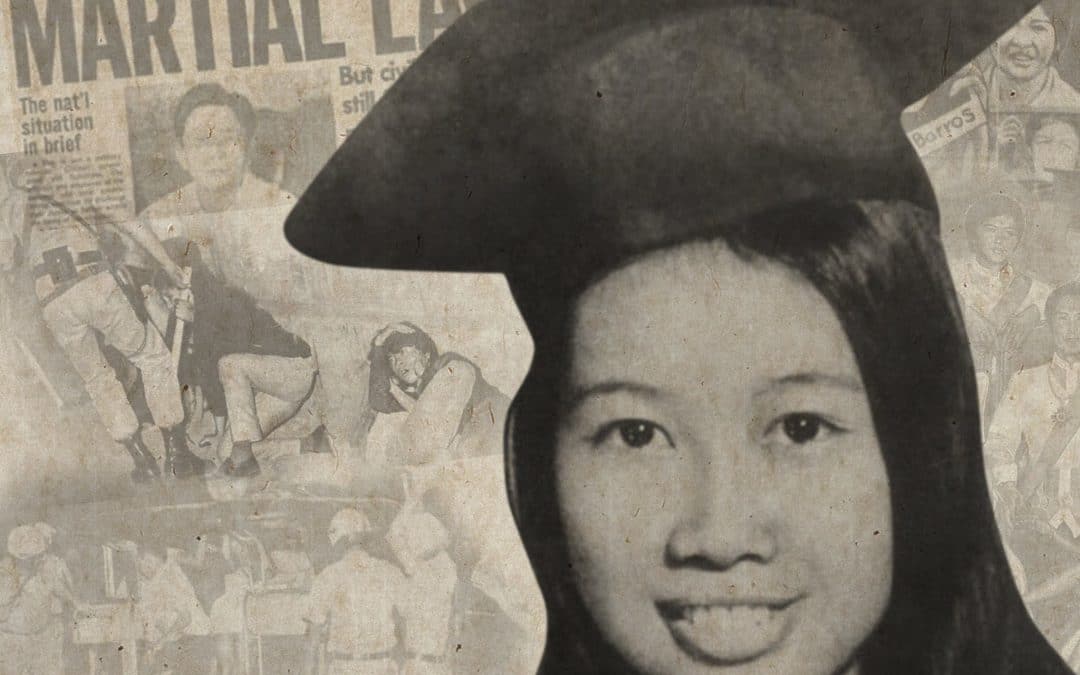
Robredo has gone beyond soundbites: Immediately following publication of her statement, her social media released unflinching biographies of the martyrs of Martial Law—those detained under the suspension of the writ of habeas corpus, those who disappeared, those who were tortured, those who were raped, those who were murdered, and often following their questioning of Marcos’ totalitarian regime.
It’s a far cry from the florid pro-Marcos historical revisionism that the official page of the government has tried to shove down the Internet’s throat for Marcos’ birth anniversary, or their terse one-liner marking the declaration of Martial Law. (For the eagle-eyed: The Official Gazette shared an article on how September 21 wasn’t the anniversary of the declaration, never mind that their caption said otherwise.)
Some of the stories that the VP’s office has shared:
Liliosa Hilao is considered to be the first female casualty and martyr of Martial Law. On April 6, 1973, she was declared dead after being detained by the authorities, when she demanded to see a warrant from the police who’d come to arrest her brother. The VP’s office shares: “According to the official report, Lilli committed suicide by drinking muriatic acid. Her autopsy said otherwise: Her face was severely swollen, her lips bore cigarette burns. Her arms had numerous injection marks, possibly from ‘truth serum,’ a torture method used on victims. Her torso was mottled with finger marks and gun-barrel marks. It was also possible she was sexually abused.” Read more.
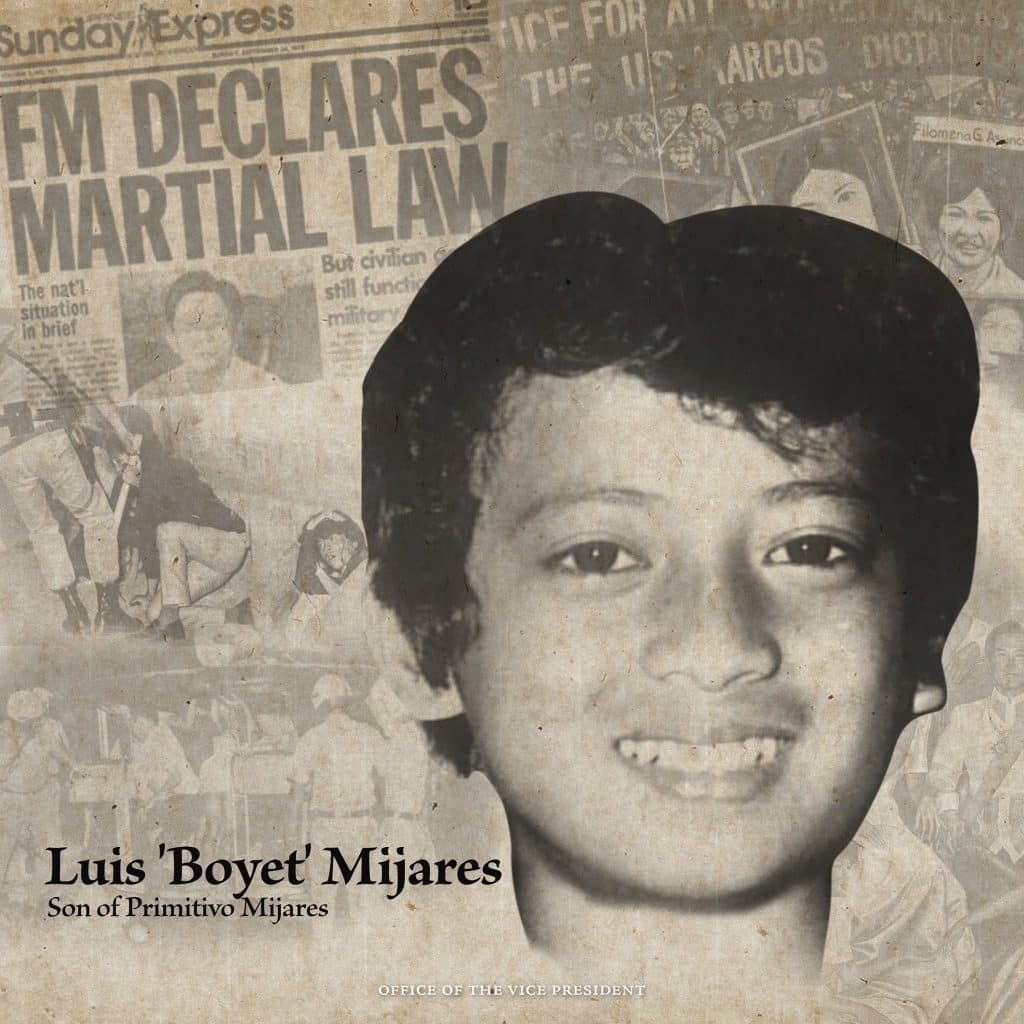
Boyet Mijares’ father Primitivo served as the chief propagandist of the Marcos government—who, during the regime, grew disenchanted with Martial Law, and testified before U.S. courts about Marcos’ human rights abuses. (Primitivo would publish The Conjugal Dictatorship, a tell-all about the Marcos’ high life.) This sealed his and his son’s fate: After a disappearance, “Boyet’s body was riddled with stab wounds, his skull bashed in. His genitals were mangled, and his eyes were protruding. Boyet’s mother, then judge of Manila, was able to obtain information that Primitivo was made to watch while men tortured his son. Primitivo has never been found.” Read more.
One of the more well-known faces of the students rights movement, Edgar Jopson would get to sit down with Ferdinand Marcos for a dialogue in the Palace. “In that meeting, Edjop demanded that Marcos promise—on a piece of paper—that he would not run for a third term. Marcos, offended at the youth’s cheekiness, snapped, ‘Who are you to tell me what to do? You’re only a son of a grocer!’ Edjop responded: ‘Honest grocer naman.'” Read more.
The 21-year-old Archimedes Trajano questioned Imee Marcos during the open forum about her father’s involvement in human rights atrocities. He also asked her: “Must the Kabataang Barangay be headed by the president’s daughter?” As the VP’s office shares: “That was the last time anyone saw Archimedes alive. His bloodied body was found on the streets of Manila. Official reports said he had gotten into a dormitory fight, but witnesses came forward saying they saw Archimedes being dragged out of the venue by Imee’s security escorts. It is believed Archimedes was tortured for 12 to 36 hours before he died.” Read more.
Metro Manila (CNN Philippines) — As days of prayer have begun in former president Ferdinand Marcos’ hometown, protesters on Wednesday vowed to continue blocking his burial at the heroes’ cemetery.
Martial law survivors in Manila said they would always retell the atrocities they experienced during the Marcos regime.
May Rodriguez, a campus journalist during martial law, said the burial issue was more than just a fight between the Marcoses and the Aquinos.
Rodriguez was referring to President Duterte’s comment that Marcos’ burial was just a fight between the two political families.
“Kami po nakipaglaban para sa bayan, sa demokrasya, para sa hustisya. Hindi para kay Ninoy,” Rodriguez said.
[Translation: “We fought for the nation, for democracy, for justice – not for Ninoy.”]
Former party-list representative Neri Colmenares, who was a student activist in the 70s, echoed Rodriguez’s sentiment.
“I think Duterte should re-recognize history and the context of martial law to explain inflamed emotions that continue to erupt until now,” Colmenares said.
He said the Marcos vs. Aquino narrative of the martial law years was “too reductionist.”
Colmenares said he and other survivors were not giving up their fight against Marcos’ burial at the Libingan ng mga Bayani, as ruled by the Supreme Court on November 8.
They have filed two petitions with the high court for a status quo ante order to prevent the Marcos camp from proceeding with burial plans.
While they respect the novena and requiem masses for the former president, the petitioners hope these do not signal definite plans — including a burial date.
CNN Philippines’ Ruth Cabal contributed to this report.
Education about history is found in how society chooses to remember, or not remember, and this social memory, rather than history per se, is what in turn shapes our actions and understanding of the past.
Editor’s note: Jose K. Tirol, Ph.D. is an assistant professor at the Department of History of the Ateneo de Manila University. The opinions expressed in this commentary are his.
(CNN Philippines Life) — The easiest way to comment about Martial Law, and Philippine history classes about Martial Law, is to describe the terrible legacy of the former, and the tepid quality of the latter. It has been three decades since the EDSA Revolution, but the tragedy is that a generation of young Filipinos remains largely ignorant of the narrative of Martial Law. These were only children during, or born after that period, and sheltered by parents who would rather not discuss what they had endured for so long.
An even greater tragedy, however, is that there are many older Filipinos who experienced Martial Law as adults and continue to support the memory of Ferdinand Marcos today. Within this category are Filipinos who either honestly do not know the extent of the excesses of the dictatorship, or even benefited from Marcos’ rule, and describe the period as the so-called Golden Era of Philippine history.
When we use the word “education,” we are referring not just to what is taught in the classroom, through our textbooks and our teachers. For most of the period after EDSA, the narrative transmitted throughout elementary and secondary school was a watered-down version of Martial Law. Abuses by the military and paramilitary units, and the plunder committed by the Marcos family and their cronies, were routinely downplayed, while emphasizing the positive accomplishments of the regime, as if it were a balance sheet.
An even greater tragedy, however, is that there are many older Filipinos who experienced Martial Law as adults and continue to support the memory of Ferdinand Marcos today.
Rather than let the teachers analyze and properly discuss Martial Law, students were encouraged to think for themselves, to come to their own conclusions. Such awful naïveté only created a generation that didn’t know the truths they needed to know, unless their parents took it upon themselves to fill in the gaps left by formal education. But this broadening of minds seems to be more the exception rather than the rule, as witnessed by many impressionable young Filipinos easily drawn into the propaganda of the Marcos faithful.
What needs to be understood about education, especially in the context of Martial Law, is the fact that what we learn about history transcends the classroom. The policies and guidelines from government offices, as fleshed out by authors, is actually only one facet of how society reinterprets and transmits narratives. Education about history is found in how society chooses to remember, or not remember, and this social memory, rather than history per se, is what in turn shapes our actions and understanding of the past.
Abuses by the military and paramilitary units, and the plunder committed by the Marcos family and their cronies, were routinely downplayed, while emphasizing the positive accomplishments of the regime, as if it were a balance sheet.
For example, we have one Martial Law museum in the entire Philippines, the Bantayog ng mga Bayani, and it was set up as a private initiative. No government has yet to provide funding for a public museum on Martial Law. The monuments we build, or do not build, express volumes about the presence, or absence, of a proper grasp of society about its history.
Notice too the scarcity of Filipino movies explicitly about the Marcos family, or any attempt to capture the larger scope of Martial Law. We only have “Imelda,” “Eskapo,” and “Dekada ‘70” — the latter of which was more of a family history rather than a national history. We can produce quality films like “Heneral Luna,” but our film industry is extremely hesitant to make a legitimate movie about that dark era in our history.
Our reluctance to properly educate our people, and not just the young, about Martial Law, is actually not the first time when Filipinos have been hesitant to confront unpleasant historical memories. We have seen it in the blank stares of young people when they hear about the brutality of the Philippine-American War. We would rather remember America giving us democracy, public school education, and eventual independence. We would rather remember America’s gifts, which were actually not as altruistic as they initially seemed.
No government has yet to provide funding for a public museum on Martial Law. The monuments we build, or do not build, express volumes about the presence, or absence, of a proper grasp of society about its history.
We have also seen it in the haste with which issues of collaboration, of Filipino betraying Filipino, were swept under the rug following the Second World War. We wanted to focus on economic reconstruction so badly that it was politically convenient to forget that not all those who worked for the Japanese were honestly pro-Filipino, but unfortunately self-serving.
And then there is Martial Law, the ghost that won’t go away, manifesting itself in the division among us over the former president’s burial. After the Marcos family fled, along with many of their cronies and associates, there was no serious effort from any Philippine president to pursue justice for the thousands of lives lost and thousands more traumatized.
To speak of a lack of education, therefore, means a return to studying social memory, to go back and study where we — parents, teachers, institutions, both private and public — have been amiss in teaching our children, and in so doing, reclaiming our responsibility to shaping our nation’s future.