Metro Manila (CNN Philippines) — Filipinos should be united in saying “never again” to any attempts to imposed martial law in the country.
Presidential Communications Secretary Herminio Coloma Jr. made this appeal on Sunday (September 20), on the eve of date on which President Ferdinand Marcos signed Proclamation No. 1081 back in 1972.
In an interview with Rey Sampang aired over state-run radio dzRB, Coloma stressed the importance of remembering the “terrible experience” of older generations during martial law, especially now that more than almost two generations had been born since then.
With younger Filipinos having had no experience of that period, he said: “Dapat lamang na maunawaan nila ito at maging kaisa nila tayo doon sa pagsasabing ‘never again’ o hindi na dapat maulit ang malagim na karanasan ng bansang Pilipinas sa ilalim ng martial law.”
[Translation: “They should understand this and be one with us in saying ‘never again,’ so that this terrible experience of the Philippines under martial law would not be repeated.”
The actual declaration of martial law was on September 23, 1972, although the document was dated September 21. Marcos himself appeared on television to make announcement, followed by Press Secretary Francisco “Kit” Tatad.
As Coloma pointed out in his interview, Marcos started implementing martial law on the night of September 22, when he had many of his perceived political enemies arrested, among them Sens. Jose Diokno and Benigno “Ninoy” Aquino Jr., the current president’s father.
[Editor’s Note: The website of the Official Gazette has a timeline of the martial law period and some of the diary entries of Marcos himself.]
Sampang asked Coloma to the state of press freedom now as compared to its state during martial law, to which the secretary gave a lengthy answer in Filipino, which in English reads:
“It’s very clear to us and to any other observer that the freedom of the press in the Philippines is one good example of how to respect and implement it in a democracy.
“If we look at other countries, there are just a few of them that have full freedom of the press.
“You see, there are many countries that have laws like the Internal Security Act that imposes restrictions on reporting. And if you remember, this is one of the issues on which President Aquino took a stand.
“Even at the height of the Luneta hostage-taking incident in 2010, the president insisted that he would not allow any form of prior restraint or suppression of freedom of the press.
“So this is one thing that we our country can be proud of — having full freedom of the press, along with freedom of assembly and freedom of expression.”
Coloma also issued a separate statement to media, the English version of which is as follows:
Tomorrow, September 21, the nation recalls the imposition or martial rule in 1972 or 43 years ago, which is probably one of the darkest chapters in the country’s history. We join our citizenry in remembering and honoring the sacrifices of the victims of martial rule.
With courage, they defied harassment, cruel punishment and fear as they asserted and fought for the recognition of basic human rights at a time when the dictatorship demolished the house of democracy in our land.
From their blood, sweat and tears, our people gathered and rebuilt their willpower and strength to mount wave upon wave of protest movements that culminated in the triumph of the EDSA People Power revolution in 1986.
Indeed, the people’s resistance and struggle against martial rule served as the foundation for rebuilding democracy in the Philippines that served as a beacon of hope and inspiration for other freedom-loving people, who overcame dictatorship and rebuilt democracy in their land.
Together with our efforts to ensure sustainable long-term growth, progress and stability that would include the active participation of all Filipinos, it is important to impart to the youth of our land the lessons learned from martial rule and the struggle to restore democracy, as our continuing legacy to all future generations of Filipinos.
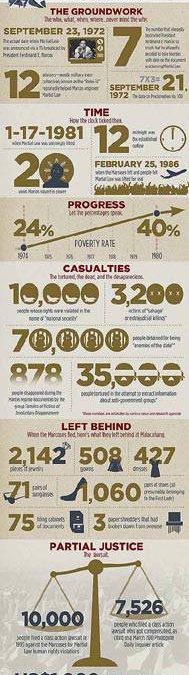
The numbers that marked the rise and fall of the New Society.
(SPOT.ph) It’s been 40 years since Martial Law was declared. But it still casts a long shadow over our collective consciousness. No long-winded history lessons from us, though: we chose some unsettling numbers to present Martial Law as it was.
For the record, when we say, “never mind the why,” we’re being ironic. There are many books written by scholars and survivors of Martial Law’s horrors that can better explain why it was declared. Yet, despite these, there are still many people who remain convinced that it was “good for the country.” (And, yes, we’ve met many people who think that way.)
As one of our commenters put it, “The numbers can flesh out the horror.” But then again, an infographic can only do so much. A substantial answer to why Martial Law happened must be sought out by those of us who still can’t wrap our minds around it.
Because 40 years is a landmark year, we decided to make this into a three-part series. First stop, this infographic. Kindly click below for a bigger view.
(SPOT.ph) In September 1972, President Ferdinand E. Marcos saw it fit to place the country under Martial Law. At the time, the government believed there were (allegedly real and some tagged as imaginary) enemies of the state everywhere.
What was it like back then? An Inquirer.net article reveals: “Journalists remember the first months of Martial Law as among the darkest. Airline flights were suspended indefinitely and overseas telephone operators refused to accept incoming calls. [At first], there was no immediate official announcement, but news about what had happened while the nation was sleeping spread like wildfire.”
If you were perceived as an enemy of the state, you were arrested. No questions asked. Many suffered unspeakable horrors while in prison, others were never seen again. It’s been 40 years since that dreadful day, but the scars remain. You don’t really move on from something like this. We’ve rounded up some sound bites from the era, to help us remember that this should never happen again.
Share
(SPOT.ph) In September 1972, President Ferdinand E. Marcos saw it fit to place the country under Martial Law. At the time, the government believed there were (allegedly real and some tagged as imaginary) enemies of the state everywhere.
What was it like back then? An Inquirer.net article reveals: “Journalists remember the first months of Martial Law as among the darkest. Airline flights were suspended indefinitely and overseas telephone operators refused to accept incoming calls. [At first], there was no immediate official announcement, but news about what had happened while the nation was sleeping spread like wildfire.”
If you were perceived as an enemy of the state, you were arrested. No questions asked. Many suffered unspeakable horrors while in prison, others were never seen again. It’s been 40 years since that dreadful day, but the scars remain. You don’t really move on from something like this. We’ve rounded up some sound bites from the era, to help us remember that this should never happen again.
“My countrymen, as of the twenty-first of this month, I signed Proclamation 1081 placing the entire Philippines under Martial Law.” –President Ferdinand E. Marcos formally announcing Martial Law in September 1972
“This building is closed and sealed and placed under military control.” -notice posted on the doors of news agencies and broadcast stations after the police stormed the premises and asked staffers to leave
“How many of our esteemed colleagues are privately ashamed of what is happening and yet praise the dictator openly and on radio and television as if he were the greatest Filipino ever born?” -former Senator Benigno “Ninoy” Aquino Jr. (1932 to 1983) in a letter addressed to fellow Senator Francisco “Soc” Rodrigo on June 19, 1973, which he wrote while he was detained at Fort Bonifacio (Rodrigo had also been incarcerated but was released earlier, while Aquino was a prisoner for seven and a half years.)
“The road less traveled by we’ve taken-/ And that has made all the difference:/ The barefoot army of the wilderness/ We all should be in time./ Awakened, the masses are Messiah./ Here among workers and peasants our lost/ Generation has found its true, its only home.” -poet-activist Emmanuel “Eman” Lacaba (1948 to 1976) in “Open Letter to the Filipino Artists,” from a segment that he wrote on January 1976 in Davao del Norte. On March 18, 1976, reports alleged that Lacaba and three others were “slain in an encounter with the Davao Del Norte Constabulary Command.” Lacaba was only 27 years old.
“Ako po si Kris Aquino. Ako’y pitong taong gulang na ngunit halos anim na taon ko nang hindi nakakapiling ang tatay kong si Ninoy Aquino. Sana’y tulungan po ninyo ako para makapiling po naman (s’ya) ng mommy ko, ng mga kapatid ko, at para makapaglingkod na rin po sa inyo (My name is Kris Aquino. I am only seven years old but I haven’t been with my dad Ninoy Aquino for six years. I hope you can help me so that he can be with my mommy and my brothers and sisters, as well as serve you).” –Kris Aquino in 1978, campaigning for her father Ninoy Aquino, who was running for senator once more
“When authoritarianism is no longer necessary to protect the welfare of the people, I will be the first to move for its dismantling. But the easy, casual wave of the hand dismissing the dangers that confront the worsening world situation and us is not for me.” –President Ferdinand E. Marcos (1917 to 1989) in a speech delivered in 1979 during the inauguration of the Philippines Columbian Association’s New Clubhouse Complex, Plaza Dilao, Manila
Consider this a “wordy crib sheet” from the tumultuous era.
(SPOT.ph) Martial Law’s impact on Philippine history and pop culture was significant, to say the least. Back then, there were acronyms and buzzwords galore for the state’s programs and tools of propaganda. Admittedly, some acronyms made people fearful, while others attempted to convince them into thinking that this was all “for our own good.” Still, there are acronyms and buzzwords that were spawned by what people saw-some of them gave hope (or whatever passed for it), while others only emphasized the gap between those in power and those who had been rendered powerless. Here, we’ve listed some of the words of that tumultuous era.
CHDF. The Civilian Home Defense Force, a group of non-professional citizen reservists organized during Martial Law and designated in rural areas to supposedly help in the government’s fight against insurgents. (Weaponized civilians? You can guess what happened.)
FQS. First Quarter Storm refers to January to March 1970, when demonstrations, protests, and marches against the Marcos government intensified. It was later cited by Nick Joaquin in his book Manila, My Manila: A History For The Young (as well as in other works) as “one of the factors leading to the declaration of Martial Law in 1972.”
KKK. No, this did not refer to the group founded by Andress Bonifacio. This was the Kilusang Kabuhayan at Kaunlaran, one of the economic reform programs of the era.
KM. Kabataang Makabayan, one of the “radical” student organizations of the era.
Masagana 99.According to a GMA News Online article, this was “the Philippine version of the international movement Green Revolution, a campaign for food self-sufficiency.” This was launched in May 1973. The GMA News Online article also noted: “However, Katherine Ellison wrote in Imelda: Steel Butterfly of the Philippines [that] some Filipinos ’angrily noted the source of the Green Revolution’s funds: two million pesos from the sale of Japanese rice donated to typhoon victims, and five million from the Department of Agriculture.’”
Metrocom. The Philippine Constabulary (PC) Metropolitan Command. The task of the group’s members was to “complement and supplement police forces within the Greater Manila Area.” Those who lived through the Martial Law era often say that the Metrocom “ruled Manila back then.” They were the guys who enforced the curfew and made sure that nobody “disturbed the peace,” so to speak.
National Thanksgiving Day. As historian Ambeth Ocampo wrote in his Philippine Daily Inquirer opinion piece, this was supposed to refer to September 21, the so-called official date of the declaration of Martial Law. President Ferdinand E. Marcos declared it in 1972 so by virtue of Proclamation No. 1180.
New Society. The brave new world envisioned by President Ferdinand Marcos. He said that Martial Law was the the prelude to this environment, where social and political values would be elevated. As such, Marcos’ political party was called Kilusang Bagong Lipunan.
Nutribun.According to a GMA News Online article, this bread was “developed in the early ’70s by local bakeries from a blend of local and donated ingredients, and distributed in elementary school feeding programs as a ready-to-eat complete meal.” The GMA News Online article noted that in her book, My 17 Years With USAID: The Good and the Bad, Nancy Dammann claimed: “During the disastrous floods in Central Luzon of 1972, bags filled with Nutribuns were stamped ’Courtesy Imelda Marcos-Tulungan project’ even though they were donations.”
Oplan Sagittarius. The supposed plan to implement Martial Law. This plan was exposed in Congress by then-Senator Ninoy Aquino earlier in September 1972. His pronoucements turned out to be true.
PC. The Philippine Constabulary. This government agency is described by history books as “one of the first of the four service commands of the country’s Armed Forces.” In other words, you didn’t want the PC knocking at your door back then.
Rolex 12. According to this Philippine Daily Inquirer article, Rolex 12 referred to “the group of military advisers who had helped Marcos plan Martial Law. Among members were the following: Gen. Fabian Ver; then Armed Forces Chief of Staff Gen. Romeo Espino; then Army chief Maj. Gen. Rafael Zagala; Maj. Gen. Ignacio Paz, head of Army intelligence; Air Force Maj. Gen. Jose Rancudo; Navy Rear Adm. Hilario Ruiz; Brig. Gen. Tomas Diaz, head of a key Constabulary unit; Brig. Gen. Alfredo Montoya, head of the Manila Metropolitan Command; Col. Romeo Gatan, commander of the constabulary in Tarlac; and, Eduardo Cojuangco, the only civilian in the group. (Other similar groups also mentioned in the Philippine Daily Inquirer article: Omega 5 and The 7 Wise Men.)
“Sa ikauunlad ng bayan, disiplina ang kailangan.” The Martial Law slogan. It means, “For the nation’s progress, discipline is needed.” There used to be an anecdote alleging that TV host Ariel Ureta made a joke about the slogan, turning it into “Sa ikauunlad ng bayan, bisikleta ang kailangan (For the nation’s progress, a bicycle is needed).” The story goes that he was “invited” to Camp Crame and was made to ride a bicycle for hours. Ureta, in a recent interview published in The Philippine Star, said that this never happened. Many people still believe the story though.
Salvage. This word meant something entirely different. But, in Philippine English, it referred to extrajudicial killings. This was what allegedly happened to “enemies of the state.” You say something bad about the government and shortly after that your body is found in a ditch somewhere.
SDK. Samahang Demokratikong Kabataan, one of the student groups tagged as “radical” during the era.
Thirty-one years after dictator Ferdinand Marcos was ousted, things are no better for the victims of his regime, while the dictator himself is buried at the Libingan ng mga Bayani.
In the ABS-CBN News article, “Time taking its toll on martial law victims,” Gerry Lirio writes, “To date, the total claims of the martial law victims on the Marcos estate, according to American human rights lawyer Robert Swift, have ballooned to $4.3 billion based on the two favorable orders Judge Manuel Real of Hawaii issued in January 1995 and January 2011 as a result of penalties and interests earned from $1.964 billion and $353.6 million, respectively. In the January 2011 ruling alone, the court pegged the penalty at $100,000 per month.”
The cost of reparation is staggering—but it is nothing compared to the slow torture that martial law victims and their families have continued to endure in their elusive quest for justice. After all, their reparation claims aren’t just for money’s sake. It serves as the acknowledgement of their suffering, something that Marcos apologists are doing their best to erase.
“The Human Rights Victims Reparation and Recognition Act of 2013 was set into motion on May 12, 2014 and it will expire on May 12, 2018,” notes Regine Cabato in her CNN Philippines report. Cabato also reveals: “There were 75,537 people who applied at the Human Rights Victims Claims Board (HRVCB), the quasi-judicial reparations body tasked with sifting through claims and granting compensations. About 40,000 of the cases have been processed, leaving over 35,000 cases left to review before its looming deadline.”
The HRVCB was formed out of Republic Act (RA) 10368, or the Human Rights Victims Reparation and Recognition Act of 2013. But, as Cabato points out, the law that enabled the HRVCB also restricted it.
For one, the HRVCB’s budget has a cap of P50 million per year. That budget is not nearly enough to sustain 155 employees. In fact, the Commission on Human Rights had to step in to help.
Apart from the budget, the HRVCB also faces the challenge of an impossible deadline. RA 10368 stipulates that the Board has to “complete its work within two (2) years from the effectivity of the [Implementing Rules and Regulations] promulgated by it.”
Already, the Board failed to meet their 2016 deadline. Congress extended it to 2018—but even that seems daunting. If the Board fails to meet next year’s deadline, then there’s a good change it will be considered “expired.”
If that happens, the martial law claimants will once again be thrown in limbo. Unfortunately, time is not on their side.
So, will Congress once again be kind enough to extend the deadline? It’s a confusing time in our country’s history and the answer isn’t really that clear. Maybe it never was.