
by MLC | Feb 28, 2018 | Martial Law Analysis
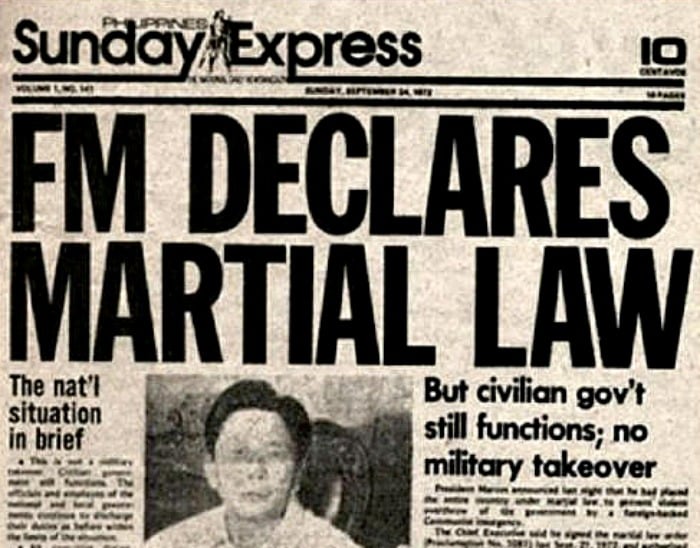
21 September of 1972 – Incumbent president that time, Ferdinand Marcos released Proclamation 1081, declaring Martial Law all over the country, the Philippines. Marcos’ claim for imposing this extreme measure was due to the alleged civil unrest occurring at the country that time.
This declaration was a shock to some as what was happening didn’t warrant an issuance of Martial Law. It was seen as an unnecessary caution as the country wasn’t that in such turmoil that time. Ironically, the country was plunged into deeper depths of trouble after Martial Law was implemented.
What does happen when Martial Law is declared anyway? Civil rights and laws are suspended and military rule is even used for civilians. However, with the Martial of 1972 – it crossed from protecting the people to actually harming the citizens.
Those in power used it as their license to do whatever they want. They have increased their power and wealth through Martial Law and never mind that people were abused and tortured along the way.
The media outlets were silenced, criticizing the government is equivalent to punishment – the people’s rights and freedom were stripped off, human rights were violated.
However, there were some Filipinos that time who bravely put themselves out there when most people were too afraid to do so.
Let’s not forget about Liliosa Hilao. Lilli, her nickname was an honor student from grade school to highschool. She then entered PLM (Pamantasang ng Lungsod ng Maynila) as a Communication Arts major. She even went on to be the editor in chief of the school’s paper, “Hasik”.
She’s also the leader of the communication arts department and a representative to the student government of PLM. Not only that, she became a secretary of the Women’s Club of Pamantasan and a member of the College Editors Guild of the Philippines.
From that, we can say she was an active student and a leader. From that point, you would have imagined that she would have a bright future ahead of her.
However, Hilao openly criticized the Marcos government that time – a practice that’s not considered as an offense. It didn’t break any laws. She was asthmatic and was not able to join the rallies but she had other means to show her opinion – through her words. And that surely caught the attention of the Marcos administration.
Not for long, Hilao was taken away from her home on April 1973 without a warrant of arrest. They illegally arrested Hilao and that would be the last time she saw her home.
The soldiers who took Hilao slapped her, handcuffed, and questioned her. And the abuse didn’t just stop at that. The following day she passed away. The report they released was – Hilao committed suicide using muriatic acid.
When they say Hilao’s body – her face was swollen, there were bruises all over her torso, she had cigarette burns on her lips, multiple injection marks, even the handcuffs made their mark against her skin.
Just because she spoke against the government – an act not worthy of this abuse. This is outright human rights violation. She was the first female who was illegally detained and died during the Martial Law.
And it didn’t end with Liliosa Hilao. A lot more deaths and tortures went on just because these brave people voiced out their opinions. Saying this Martial Law benefited the country is a stretch, a very far stretch.
Was it worth it that these people, even young people died because of the Martial Law? They certainly didn’t deserve to die at all.
Sources:
Vberni Regalado, “The young victims of Martial Law,” http://www.philstar.com/campus/2017/09/21/1741305/young-victims-martial-law, (September 21, 2017).
Kate Pedroso, Marielle Medina, “Liliosa Hilao: First Martial Law detainee killed,”
http://newsinfo.inquirer.net/718061/liliosa-hilao-first-martial-law-detainee-killed, (September 1, 2015).
by MLC | Feb 21, 2018 | Martial Law Analysis
There’s so much controversy and talk what has happened in the 1970s and why Martial Law was declared. With the muddle of information involved, sometimes it’s difficult to see the essentials.
When we really think about it, a lot of incidents happened and it’s hard to put them all in a short, single article. It’s hard to describe the totality and extent of such event in a few hundreds of words but we will try to describe Martial Law today briefly in key points.
Ferdinand Marcos was elected as president and took his oath in 1965. Prior to his presidency, he was nominated as a congressman to the house of representatives, and having served three terms he later ran for the senate. He was the Senate President prior to his presidency. He already had a long political career prior to leading the country.
In 1969, he got reelected again as President and entered the 70s as the leader of the country once again. Claiming that the Philippines was in a state of civil unrest, Marcos decided to resort to a measure known as the Martial Law.
Martial Law in brief is a state declared in an area where there is extensive civil unrest or some incidents which we don’t have control of, such as major natural disasters. When this is in place – civil rights, civil laws, habeas corpus and such are suspended. Military rule is even extended to civilians.
In Marcos’ case, he decided that the country was in such chaos that it needed such measure to control the situation.
Marcos then declared Martial law on the 21st of September, 1972 in the form of Proclamation 1081. Marcos imposed curfews, civil laws and rights suspended, and even the media’s broadcasts were watched and regulated. It actually surprised some citizens because the situation of the country that time was not in a state where Martial Law was really needed.
With the majority of the rights taken away, and no freedom to speak your opinion regarding the government, widespread censorship – things could go wrong from here. Martial Law was intended to “put order” into the society but it has just done the opposite.
The Martial Law no longer protected the people, it was supposed to but it did not serve its purpose. Martial Law was the start of a period of abuse, torture, and illegal detention of the people. The government abused what the Martial Law can do. It was a dark time for the Filipinos.
The years were long and tumultuous but the Filipino people didn’t back down without a fight. Lives were lost, sacrifices were made. It was a journey to reclaim freedom and there were Filipinos who were brave enough to go against the tides.
In 1986, a snap election was held and Marcos still wanted to be in position. However, people took action and finally got Marcos out of the presidency after 21 long years. Martial Law and the years under Marcos finally came to an end, thanks to the heroism and sacrifices made by our countrymen.
Sources:
“Declaration of Martial Law,” http://www.officialgazette.gov.ph/featured/declaration-of-martial-law/
Ellen-Rae Cachola, “The Haunting of Martial Law: Records from the Marcos Regime,” http://library.law.hawaii.edu/2017/09/07/the-haunting-of-martial-law-records-from-the-marcos-regime/, (September 7, 2017).

by MLC | Feb 14, 2018 | Martial Law Analysis
Moving on. These are only two words, simple to understand yet they carry such immense weight. Why do people insist on moving on from the Martial Law of 1972 declared by the president that time, Ferdinand Marcos?
For better context, what happened on that fateful day? It would be hard to compress all the details of what has brought this event and what the repercussions were but let’s talk about it in brief.
Marcos was first sworn to presidency in the year 1965. Then he was reelected for his second term in 1969. Entering the 70s, Marcos claimed that civil unrest were happening all over the country, prompting him to take action.
So on the 21st of September, 1972 he declared the whole country – the Philippines in a state of Martial Law or formally known as Proclamation No. 1081. It came as a shock to some because they didn’t see the country in such state of disorder and lawlessness that it warranted a Martial Law to keep matters in order.
When Martial Law is applied, there will be curfews, suspension of civil rights, civil laws, habeas corpus, and military law is used even on civilians. Technically, the intention of Martial Law is to protect the interest of the people when there is major civil unrest and/or disorder caused by a major natural disaster.
Neither incident was present in the early 70s, but still Martial Law was nonetheless implemented. It has curtailed the rights of the Filipinos, media broadcasters, activists, and such. The context of the law was abused.
It became an excuse to take away what people were holding on to, their beliefs. When the fine line between putting things into order and abuse was crossed, freedom has become a thing of the past. Suppression of opinion has become rampant and those who didn’t agree with the government were questioned.
It was the start of the years of oppression, torture, and abuse of the Filipino people. Sadly, while Marcos continued to be the president, the abuse went on. The oppression increased as his power increased.
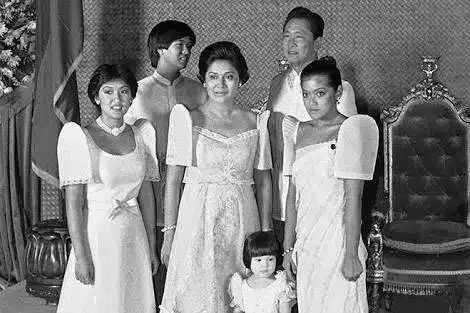
Along with this power, his properties, acquisitions and other stolen wealth expanded as well. It’s not just the president who flourished that time, his wife Imelda Marcos and children Bongbong and Imee rose with him.
After a long hard fight and lots of bravery from the Filipino people, the Marcos rule ended in 1986. That’s fourteen, long years no one can ever take back. The human rights violations committed can never be undone.
For those fortunate ones who have survived those dark years, they went back to what’s left of their lives. It’s their right to live and carry on with their lives. However, when people insist to just move on and deny the abuse – that’s a whole matter different altogether.
Moving on with the routine of life is different from moving on and forgetting the horrors of the past. You have to live your life but it doesn’t mean you should forget. When you move on to erase what has happened in those long, difficult years – it is disrespecting the memory of those who sacrificed for us.
We have reclaimed democracy in 1986 because of their heroism. Let’s not put their sacrifices into waste. May we never forget what happened during the Martial Law declared in 1972. May we never forget the men and women who fought for us. Let us respect their sacrifices and their memories.
Sources:
“Declaration of Martial Law,” http://www.officialgazette.gov.ph/featured/declaration-of-martial-law/
Ellen-Rae Cachola, “The Haunting of Martial Law: Records from the Marcos Regime,” http://library.law.hawaii.edu/2017/09/07/the-haunting-of-martial-law-records-from-the-marcos-regime/, (September 7, 2017).
by MLC | Feb 7, 2018 | Martial Law Analysis
Some people find it more difficult to imagine things in words. True enough, some statements are prone to interpretation. However, when words fail – we can count on numbers. We can rely on figures.
Numbers present situation in a different picture. It actualizes more the extent of the event. It answers how many times, when, how much, and how many. Numbers make it clearer and more real.
So today, let’s present the numbers related to Ferdinand Marcos and his family.
- Marcos was number 1 at the bar exam of 1939.
- Marcos was twice elected to the Philippine Congress as representative of the 1st district of Ilocos Norte from 1949 to 1959.
- Marcos also ran for the senate and he was a senator from December 30, 1959 to 30 December 30, 1965.
- He was the President of the Philippines for 3 terms. First voted in 1965, reelected in 1969, the last was in 1981. He attempted to be the president once again in 1986 but the People Power revolution took place.
- Ferdinand Marcos’ salary was reported to not have exceeded $13,500 annually.
- According to the PCGG (Presidential Commission on Good Government), Marcos’ accumulated ill-gotten wealth is at $10 billion from 1965 to 1986.
- Imelda Marcos owned over 2000 pairs of shoes, over 760 pieces of jewelry which included a Bulgari bracelet valued at $1 Million in 1986 and a Cartier bracelet worth about $200,000, over 500 pieces of long gowns, 15 mink coats, more than 800 pieces of handbag.
- Regarding abuse during the Martial Law, the following statistics were recorded by the Task Force Detainees of the Philippines: 2,668 incidents of arrests, 398 disappearances, 1,338 salvagings, 128 frustrated salvagings, and 1,499 killed or wounded in massacres.
- And here is Amnesty International’s tally of abuse: 70,000 imprisoned, 34,000 tortured, and 3,240 killed.
- Marcos took over 3 large industries for monopoly: banana, coconuts, and tobacco. He also took the sugar and manufacturing industries under his control.
- The Marcoses bought about 304 paintings which were masterpieces and were highly-coveted because of their value. Included in their collection is a Claude Monet painting.
- After the snap elections and the People Power revolution of 1986, the Marcoses and their closest allies fled away from the Philippines to Hawaii but not without taking the following with them: 23 wooden crates, 12 bags and suitcases (clothes that can occupy 67 racks), 413 jewelry pieces, 24 gold bricks (Imelda’s gift to Ferdinand, “To my husband on our 24th anniversary” was impressed on the bricks), and PHP 27 million in cash.
- Ferdinand Marcos died on September 28, 1989 in Honolulu, Hawaii as his heart, lungs, and kidneys failed.
These are just a few of the figures and dates relevant to the Marcos regime. The figures can be astonishing and quite a shock. As earlier said, presenting the numbers make the situation easier to imagine.
Persuasion can come in many different forms, including in the form of numbers and statistics. If you can’t rely on words alone, look at the hard-hitting figures. Ask yourself what these numbers make you feel.
Sources:
Ana Roa, “Regime of Marcoses, cronies, kleptocracy,” http://newsinfo.inquirer.net/641277/regime-of-marcoses-cronies-kleptocracy, (September 29, 2014).
Nick Davies, “The $10bn question: what happened to the Marcos millions?,” https://www.theguardian.com/world/2016/may/07/10bn-dollar-question-marcos-millions-nick-davies, (May 7, 2016).

by MLC | Jan 31, 2018 | Martial Law Analysis
During Ferdinand Marcos’ time as president, his reported salary was never more than $13,500 annually. It should have been given that his family would live with this amount accordingly. However, when you look at Imelda Marcos’ lifestyle alone (not considering the president and the children’s expenses yet) – it does not really figure.
During the years of his rule in the Philippines, Imelda had a lifestyle that was larger than life. Observing her tastes, purchases, and lifestyle – one can say that she loves beautiful, luxurious, and lavish things. She has accustomed herself to a lifestyle that’s not befitting to a husband who does not make more than $13,500 a year. How is that so?
Let’s start with her infamous love for shoes – a passion she didn’t even bother to conceal. She had over a thousand shoes and are from international luxury brands and local as well. The more expensive shoes were from Dior, Gucci, Givenchy, Ferragamo, and Bally to name a few. She loved her designer footwear a bit too much it made her famous for it.
She also has a penchant for expensive and branded jewelry as well. Imelda owned a Bulgari bracelet valued at about USD 1 million in 1986. And as if that’s not enough, she dropped a whopping USD 200,000 for a Cartier bracelet.
The Philippine government was able to take back 760 pieces of jewelry, the estimated total value is at USD 6 million. Later on, Imelda would even argue that she should have her jewelry back.
Imelda liked to party with an international crowd which of course entailed more spending not just on jewelry but on clothes as well. She spent around USD 200,000 worth of clothes once at Emmanuel Ungaro alone during a shopping spree.
And the end of their ruling era, she collected about 500 pieces of long gowns, 15 mink coats, more than 800 pieces of handbags and let’s not even forget about her infamous collection of shoes.
Her love for beautiful things isn’t limited to clothes, shoes, and jewelry. She was into collecting rare and highly coveted art pieces also. She acquired artworks from Michelangelo, Picasso, Monet, and such.
When they left Malacañang Palace, they took the paintings with them too. Even the masterpieces in their New York home were carted away days after they fled the Philippines.
When the Marcos family left the Philippines in 1986, included in their cargo were 24 gold bricks engraved with “To my husband on our 24th anniversary”. And that’s not all, they had 413 pieces of assorted jewelry with them and 27 million worth of Philippine money. On their exile alone, the value of the money and properties they carried with them amounted to fifteen million US dollars.
Clearly her expenses amounted to more than $13,500 annually. If she wanted it, she bought it –never mind that it’s not within her husband’s income. If she spent more than her late husband’s salary per year (and much, much more than that)? Who paid for that excess? How could she have afforded all of those? Go figure.
Sources:
Nick Davies, “The $10bn question: what happened to the Marcos millions?,” https://www.theguardian.com/world/2016/may/07/10bn-dollar-question-marcos-millions-nick-davies, (May 7, 2016).
“Imelda Marcos’s shoe collection gathers mould after years of neglect,” https://www.theguardian.com/world/2012/sep/23/imelda-marcos-shoe-collection-mould, (September 23, 2012)
by MLC | Jan 24, 2018 | Martial Law Analysis
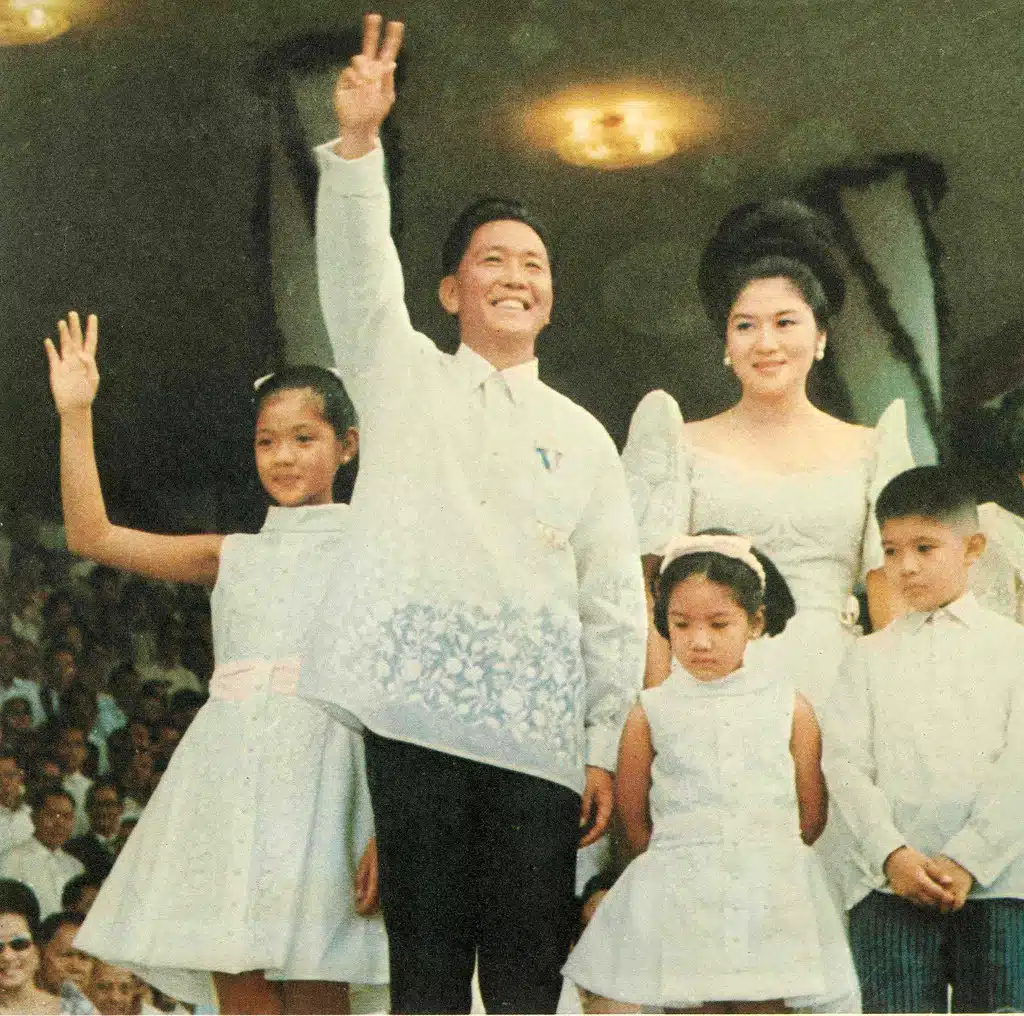
The Marcos’ family wealth is infamous. Its source has been debated for years even though proof has been presented on how they were acquired. How did Marcos acquire his wealth in the first place? Let’s go back in time and check his beginnings.
Ferdinand Marcos was not really poor to begin with but he showed intelligence early on. He entered the University of the Philippines College of Law and graduated with honors, Cum Laude. He even topped the 1939 Philippine Bar Examinations as well. His score remains one of the highest given to this day.
Marcos didn’t start his political career right away as it was a time when World War 2 happened. His military career is still up for debate and deserves a separate discussion.
Years later, he started he finally started his journey in politics. He served three terms in the House of Representatives for the 2nd District of Ilocos Norte – this went through the course of 10 years from 1949 to 1959.
After serving his third and final term in the Philippine Congress, he ran for the Senate. He won and became the minority floor leader in 1960 and finally the Senate President from 1963 to 1965.
Marcos finally ran for Presidency and took his oath in 1965. This was the start of his long rule in the Philippines. In 1969, he got reelected again as the President of the Philippines. The country entered the 70s with what they called First Quarter Storm where Marcos claimed the country was in a civil unrest status.
To put things into order according to Marcos, he declared Martial on the 21st of September, 1972. And Marcos used his proclamation to his advantage. With Martial Law asserted, civil rights and laws were suspended and military rule was in place. Marcos used Martial Law not just to gain power but wealth.
Marcos didn’t want the paperwork trailing back to him so he used his allies, relatives, and forming dummy companies to represent him in his takeovers and investments. He saw potential in the coconut and sugar industries. He assigned his cronies to direct the monopolies in these industries.
They have collected funds from coconut farmers in the 70s and used these funds to purchase stocks in San Miguel Corporation. The funding Marcos stole, was reinvested in several companies for shares.
Marcos even bought real estate through his allies. There were properties acquired and bought under other people’s names. Not only that, the other funds were deposited in Swiss bank accounts.
Marcos and his wife, Imelda also collected art, and not just ordinary art – masterpieces and highly valued work such as a painting from Claude Monet. These artworks were investments themselves as they fetch high prices in the market when sold.
Imelda also invested in jewelry, included branded ones from Bulgari and the total value of the known jewelries that was collected was estimated at 8 million US dollars.
Marcos just didn’t stop at increasing his wealth in bank accounts. He invested in several sectors and properties all throughout his rule. He didn’t put his eggs in one basket and he used his cronies and dummy companies to go around his investments.
Martial Law extended his rule giving him more time and more ways to acquire more. He didn’t stop and his greed became his downfall. Then the People Power Revolution of 1986 happened.
How unfortunate that such intelligence was used to the disadvantage of the Filipino people. Up to this day, the stolen wealth has not been completely retrieved. We have yet to see the day where this stolen wealth will finally find its way home where it belongs – to the Filipino people.
Sources:
Ana Roa, “Regime of Marcoses, cronies, kleptocracy,” http://newsinfo.inquirer.net/641277/regime-of-marcoses-cronies-kleptocracy, (September 29, 2014).
Nick Davies, “The $10bn question: what happened to the Marcos millions?,” https://www.theguardian.com/world/2016/may/07/10bn-dollar-question-marcos-millions-nick-davies, (May 7, 2016).
