I had been making excuses all week but I knew the time had come to make up my mind. The Philippines Ambassador, the former anti-Marcos journalist J.V. Cruz, had warned me about the impending arrival of the Philippines’ first daughter for some time. Imee Marcos, my old nemesis from Manila, was going to be in London along with her new husband, Tommy Manotoc, as part of their round the world tour.
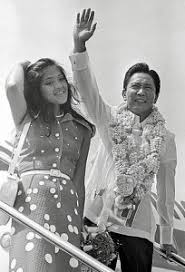
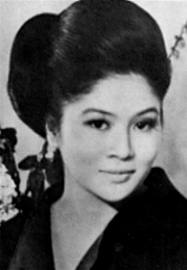
Imee and father, President Ferdinand Marcos
JV had been an outspoken anti-Marcos columnist on the Manila Times when I first met him in the late 60’s, But, like so many other prominent journalists, he had eventually been seduced by Marcos’s offers of money, power and position. In JV’s case, his loyalty had been bought first by an Ambassadorship to Germany and then, when he had proved his loyalty, to the Court of St. James. Even JV’s younger brother, Jun, had benefited from Marcos’s largesse towards his new Ambassador. First Jun Cruz was made Minister of Finance and then he was nominated head of the GSIS, the Government Service Insurance System. But, like all other favours the Marcoses dispensed, there was a price to be paid. Imelda expected her cut. In this case it was the GSIS that she used as her own private bank to finance many of her multi-million dollar projects. And both Jun and JV had to look the other way. I had known JV from my Café Indios Bravos days. He would drop by occasionally to receive or share the latest political and social gossip, to down a glass or two of whiskey and to cast a jaded eye around for any pretty, available girl. But now, in 1983, he was the essence of civility, his normal casual attire abandoned for a Savile Row pinstriped suit. And, instead of being content with a simple roof over his head he was now living in the vast Philippine Embassy residence on London’s exclusive Kensington Palace Gardens, known locally as millionaires’ row.
Imee Marcos and Tommy Manotoc
“I’ve got strict instructions from Imelda,” JV told me over the phone, “not to let Imee and Tommy out of my sight while they’re in London. They’re my responsibility. I’ve arranged a week of parties, theatres and sightseeing. But,” he hesitated, “there’s one night I just can’t be with them. Please can you and Ben take them off my hands that night for me, please.” JV was pleading. Although Ben proved fairly easy to convince when I discussed it with him later, I was extremely reluctant. Ten years earlier I had crossed swords with Imee on Philippine television. And, like her mother, I knew she was unlikely to have forgotten the exchange. Imee had arrived at the Channel 3 studio that night with an arm encrusted in vast uncut emeralds, the like of which I had never seen before. It seemed an extraordinary coincidence at the time because there was a story doing the rounds in Manila that several Andean miners had lost their lives excavating the world’s largest flawless emeralds intended for the First Lady of the Philippines, Imelda Romualdez Marcos. I couldn’t take my eyes off the huge green rocks circling Imee’s wrist. And, being in a playful mood, I just couldn’t resist the temptation to remark on them. Live on air I asked: “Those are the most magnificent emeralds I’ve ever seen, Imee. Did you ever find out exactly how many men died digging them out of the Colombian mountains?” Flustered Imee hurriedly tried to
The famous Catherine the Great emerald in the collection of Imelda Marcos
obscure the offending jewels by covering them with her other arm. I could see she was uncomfortable but I had started, so I persisted. “I heard your mother has yet to pay the bill, is that right?” The presenter, Elvira Manahan, who was one of Imelda’s coterie of “blue ladies”, pulled one of her characteristic Phyllis-Diller-type expressions and let out a nervous giggle. Her husband Dr. Manahan, Manila’s top gynaecologist, had delivered Imee and the other two Marcos children so I realized this must have been acutely embarrassing for her. I waited for an answer but Imee looked straight through me. For once the bright, intelligent First Daughter, who was being groomed to succeed her father, didn’t have a ready answer. Elvira coughed and tried to change the subject. But I knew my friends would expect me to pursue the subject until I got an answer. And youthful arrogance got the better of me. Besides, I was enjoying myself. “How much do you think they’re worth – $50 million, $100 million? What would you say, Imee?” Composing herself, Elvira reprimanded me: “Now, Caroline, that’s an unfair question. Imee wouldn’t have any idea. They were gifts from her mother.” While I was wondering how Elvira knew that for a fact, she turned to Imee:“
TV Host Elvira Manahan
Now tell me about your life, Imee, are you planning to continue at Princeton in the Fall?” I was tempted to say, “If the Philippines can afford the bill!” for it was well known that funds to educate the Marcos children were extracted not from Marcos’s modest presidential salary of $6500 per annum but from the Philippines treasury. Like everything else in his life, Marcos automatically expected his political dynasty to be paid for by the people. I was also tempted to ask Imee about the rhinestone-encrusted jeans she had been reported wearing during a recent summer barbeque in Long Island. Except that, another guest reliably informed me, they weren’t actually rhinestones at all but real diamonds. Sadly, at this point, my instinct for self-preservation got the better of me. I had almost been deported once, Betsy, Henry and many of my friends had been jailed and now I had my own children’s safety to consider. So I let it go and we twittered on about innocuous subjects that required little soul-searching, little animosity and zero confrontation. I had not spoken to Imee since then. And now JV was asking me to look after her and her basketball coach husband, Tommy, for a whole evening. “Come on, Caroline,” Ben coaxed me, “it won’t be that bad.” So, very reluctantly I agreed. My brother-in-law, Elliott Kastner, had a new musical,
Programme for musical, “Marilyn!”
“Marilyn”, about the life of Marilyn Monroe running at the Adelphi Theatre on the Strand so I reckoned I could invite Imee and Tommy to that. By going to the theatre I imagined, we could keep the conversation to a minimum thus avoiding dredging over old animosities. I called Elliott, explained the situation and he reserved some complimentary tickets at the box office for us. He suggested I call the manager of the theatre to warn him that I would be bringing the daughter of Ferdinand and Imelda Marcos. The manager was extremely courteous and offered to make all the necessary security arrangements, take us into the private VIP bar during the interval and arrange for us to meet the actors backstage at the end of the show. I knew two of the main actors, Stephanie Lawrence, playing Marilyn and Judith Bruce, playing Marilyn’s mother, so I called them to say we would be dropping in after the performance. Everything was in place. “Sorted”, I thought, almost looking forward to the evening. But how wrong I was. I should have known that nothing involving any member of the Marcos family is ever that simple.
Stephanie Lawrence as Marilyn Monroe
I spoke to Imee the day before the event. I gave her the name and address of the Adelphi Theatre and told her exactly what time we should meet there. In order to avoid misunderstandings I asked her to write it all down. “Everything’s clear,” she told me. “And please make sure you’re there ten minutes before curtain‘s up!” I said as politely as I could. And then, more pointedly, “Theatre starts on time in England.” “Sure, no problem!” she replied and put the phone down. At the allotted time, Ben, the theatre manager and I were waiting patiently in the lobby. Five, ten, fifteen minutes – half an hour – passed and still no sign of Imee. Yet again, just as it always did in Manila, the theatre curtain was forced to wait for a member of the Marcos family. As the audience inside began to hiss and boo, the red-faced manager could wait no longer. He gave the nod for the show to begin. My heart sank. I visualized Ben and me waiting in the lobby all night. I was indignant. This was discourteous not only to the management but also to the actors and the audience. Finally, after what seemed like an eternity, seven stretch black limousines rolled up outside the theatre. Doors flung wide open and uniformed men, carrying armalites, spilled out onto the pavementt. I watched in horror as some of the armed minders rushed inside and others surrounded the perimeter, effecting a cordon sanitaire around the theatre. And, when they decided the venue was safe, they snapped their fingers, whispered into their walkie-talkies and nodded the go-ahead for Imee and Tommy to emerge.
Adelphi Theatre in the Strand
By this time people in the street had stopped dead in their tracks. They stared incredulously, probably wondering who on earth deserved such a massive security operation. I, too, couldn’t believe my eyes. This was like finding myself in a cheap gangster movie. I couldn’t help thinking that nobody in London would even recognise Imee Marcos, let alone care who she was or what happened to her. Nobody in London was ever likely to threaten her physical harm or kidnap her. Well, nobody that is, except, of course, her own parents who had already proved they were more than capable since they managed to “kidnap” the hapless Tommy Manotoc following their daughter’s hasty marriage to him. And all for the simple reason that Imelda didn’t approve of him. When the scared young man was finally “released” from a month in his secret mountain cave and when his supposed captors, the NPA Communist guerrillas, had been suitably “punished”, Tommy emerged into daylight for the benefit of the television cameras looking healthier and more robust than he did before he “disappeared”. But nobody was about to drag Imee off the streets of London and hold her against her will. Nobody was about to make an attempt on her life. Nobody was going to hold her for ransom. This was exhibitionism at its most vulgar. This was simply a very successful attempt at drawing attention to herself. And, whether it was her own idea of making a dramatic entrance or “Daddy’s” orders for protecting his anointed heir, I never did find out. But seven decoy cars and nine armed bodyguards seemed, in my opinion, definitely excessive. By now the manager was at his wits’ end. Armed guards were illegal in London and with them posted inside and outside the theatre so flagrantly he felt he was bound to get into serious trouble with the law. “Can’t you ask her to get rid of them?” he whispered to me, as Imee swept into the lobby. “I doubt it,” I replied, “the Marcoses are a law unto themselves. Nobody tells them what to do!
That’s tantamount to suicide where they come from!” I greeted the newlyweds and introduced them to the manager. There were no apologies but then I didn’t expect there to be. There was more hissing and booing from the audience as we were escorted into the theatre in the middle of Scene 2 and blindly groped our way in the dark towards our seats in the middle of the front stalls. I cringed as people making space for us to pass, were forced to stand up, dropping their bags, coats and boxes of chocolates, their seats swinging shut with loud thuds. Feeling no guilt at all, Imee then whispered to me: ”What’s going on? What’s the story so far?” Trying to keep my voice as low as possible I whispered back. I could feel the glares in my direction as I explained the plot. I desperately wanted to leave, preferably in the dark, so no one could see me and point the finger. In the interval, as promised, the manager led us around to the private bar. He offered us drinks and then left. I started to make small talk. Where had they visited, who had they met on their travels, that sort of thing. I finally plucked up the courage to ask Imee the question that had really been on my lips. “Didn’t you feel really bad leaving your baby behind?” “Oh, yes, I miss him terribly,” Imee replied. “Surely you could have brought him with you, I mean with a yaya (nanny) so you could still have gone out and enjoyed yourselves?” “Yes, but Daddy wanted me to leave him. He thought it would be safer.” “But,” I persisted, “I heard you were breastfeeding. Did you have to stop, just like that?”
Tim Rice and Elaine Paige
I was really dying to know the answer to this. But, before Imee had a chance to reply, the composer Tim Rice and the actress Elaine Paige turned round to talk to us. More introductions and more pleasantries and then the bell rang and it was time to return to our seats. When the play was over, I escorted Imee and Tommy backstage. Imee was at her sparkling best. She talked, she laughed and, like her mother, she turned on the charm – but, if I or the actors were hoping for an apology for her late arrival, we were destined to be disappointed. Judith Bruce turned to me and whispered, “Well, Caroline, I’ve known you a long, long time but you always manage to surprise me with the people you know! Who on earth will you show up with next?” Graciously, like a well-rehearsed politician, Imee made her excuses to leave. Ben and I walked her back to the lobby where the theatre manager was waiting patiently. As soon as they spotted her the bodyguards sprang into action, raised their armalites, swivelled their eyes to scan the lobby and the street outside and fell into step behind her. She shook hands with the manager, thanked him for his arrangements and made her way through the glass doors out onto the Strand. The seven cars were waiting, engines revving. As she stepped into one of them, the minders piled themselves into the others and, with horns blaring and screeching tyres, they were off down the Strand. Ben and I stood, beleaguered, on the pavement. There had been no goodbyes for us, no thanks for arranging the evening and, despite the seven stretch limos, no offer of a lift home.
Irene Marcos
Later that same summer I found myself sitting on a sofa next to Imee’s younger sister, Irene. She and her new husband, Greg Araneta, were visiting London on their honeymoon. I now had a perfect opportunity to ask Irene why Imee had left her baby Ferdinand at home. “Daddy thought it was safer for him to stay in Manila,” Irene replied. “But I think I heard her saying she was still breastfeeding…” “Yes, she was.” Irene sounded bored. But I was intrigued. “How on earth did she continue to do that when she was travelling around Europe?” I persisted.” Irene glanced at me as though I was stupid. “Simple, Caroline!” she laughed. “She just expressed her milk everyday and then Daddy sent a Philippine Airlines plane to wherever she was and it would bring the milk back!” Irene shrugged her shoulders as if to say – isn’t that what every mother does when she’s away from her newborn baby for several weeks? Now I understood why all my friends had been complaining during that time that all the Philippine Airlines flights to Europe had either been delayed or cancelled. The solution was obvious. The presidential dairy run was abducting the planes and flying Imee’s precious breast milk back to Manila. This is when it really dawned on me that the Marcoses lived on a totally different planet to the rest of us.
One remark you might hear from supporters of Ferdinand “Bongbong” Marcos Jr. is that we shouldn’t blame the son for the sins of the father. Even Satur Ocampo said something to this effect when he defended his decision to run alongside the dictator’s offspring in 2010.
Ocampo even added that “the guy was sincere to us.”
Ocampo, it seems, forgot that Bongbong Marcos had called human rights victims like himself greedy back in February 24, 1999, during the 13th year celebration of the Edsa 1 People Power. Bongbong Marcos insulted all his father’s human rights victims whom he noted were squabbling among themselves because:
Basta’t may pag-asang magkapera, nagaaway-away na sila” (As long as there’s a chance of making money, they’ll fight among themselves).
I am posting at the end in full the news item entitled – Bongbong: Apology? They only want money
In reviving his political career, Bongbong Marcos has successfully detached himself from the sins of his father.
Today I’m offering readers the proof why Filipino voters shouldn’t let him do that. Because the truth is, Sen. Bongbong Marcos colluded with his father then to hide the family’s ill-gotten wealth and he continues to this day to hide this from the Filipino people.
And the proof came from what Sen. Bongbong Marcos himself told me in a public forum held by the Foreign Correspondents Association of the Philippines (FOCAP) last year, just before the 25th anniversary of Edsa 1 People Power.
Sen. Ferdinand “Bongbong” Marcos seems to have trouble with his tie. Behind him to the right is businessman Lance Gokongwei – PHOTO by Raissa Robles
I wrote about this last year for my newspaper South China Morning Post. Now I’d like to share with you the answers that Sen. Bongbong Marcos gave to my questions during the FOCAP forum.
I took pictures of him, too.
First, a brief background
When Sen. Bongbong Marcos fled from Malacañang Palace with his family, their loot hidden worldwide was estimated to run from US$2 billion to up to US$10 billion. Only a fraction of that has been recovered by the Philippine government.
I intentionally use the word “loot” because no less than the Swiss Federal Supreme Court used the phrase “of criminal origin” to describe the Marcos Swiss deposits in Credit Suisse bank when it issued a ruling to award this money to the Philippine government.
Here’s how the Swiss Federal Department of Justice and Police website explained the Swiss court ruling on the Marcoses’ deposits in Credit Suisse:
The Marcos case began in 1986 when the Federal Council ordered bank accounts to be frozen. In 1990, the Swiss Federal Supreme Court approved the handover to the Philippines of bank documents relating to the Marcos family, but ruled that the actual return of assets would be conditional upon a final and absolute judgment by a Philippine court. In 1997, the Court established that the majority of the Marcos foundation assets were of criminal origin and permitted their transfer to a escrow account in Manila, even though no Philippine court ruling had yet been issued.
It is the same Credit Suisse deposits that I had asked Sen. Bongbong Marcos about last year during the FOCAP forum. I asked him whether he had a direct hand in trying to withdraw US$213 million dollars from Credit Suisse.
The forum was well attended and had as other forum speakers Supreme Court Chief Justice Renato Corona, Supreme Court administrator Midas Marquez, Cebu Pacific CEO Lance Gokongwei, Pete Troilo (executive director of the private think tank Pacific Strategies and Assessments), senior businessmen and diplomats from various embassies.
I wrote an article on the matter last year for my newspaper SCMP but didn’t get around to writing one for my blog because it is such a complicated story. I will try to tell it now as simply as I can.
Why am I raking up an incident of 26 years ago?
It’s a legitimate question.
Here are my answers.
First, Sen. Bongbong Marcos told me during the FOCAP forum that he still intends to pursue a compromise settlement with the present government of Benigno Aquino III:
We’ve been pursuing a compromise settlement since 1986. We will continue to do so.
Second, he knows where other Marcos deposits are hidden outside the country. Why else would his Statement of Assets, Liabilities and Net Worth (SALN) and that of his mother skyrocket so much even if the family has no business empire like the Gokongwei or Sy tycoons.
Third, Sen. Bongbong Marcos and his two other siblings were named the “beneficiaries” of various foreign deposit accounts held by dummy foundations set up by their parents. Unfortunately for them, this mode of hiding the loot was discovered because they left some of the bank documents in Malacañang Palace when they fled. Others were later turned over by the Swiss Federal Court to the Philippine government.
Still, the Philippine government has no idea how many more foreign deposit accounts are still out there.
And fourth, Sen. Bongbong Marcos’ mother Imelda really wants to put another Ferdinand Marcos inside Malacañang Palace. Given all these, they seem to have the money to bankroll a presidential campaign.
Just think, in the last election, the family funded three electoral campaigns.
My Q & A with Sen. Bongbong Marcos
It was during the the FOCAP forum when Sen. Bongbong Marcos confirmed to me that he was not an innocent abroad but was as much a part of the plot to hide the loot.
Senator Ferdinand “Bongbong” Marcos replies to my questions during the January 2011 FOCAP prospects forum. Beside him is Supreme Court Chief Justice Renato Corona – PHOTO by Raissa Robles
I asked him about the events that occurred shortly after his family fled Manila in February 1986 and ended up exiled in Hickam Air Base, Hawaii.
What happened in Hawaii in 1986
After the Marcoses fled and the new government of President Corazon Aquino found papers in Malacañang Palace pointing to the Marcoses’ Swiss bank deposits, two men took it upon themselves to try a sting operation on the ousted dictator. They wanted to get a portion of the Swiss assets without going the complicated legal route.
The two men were then Colonel Jose “JoeAl” Almonte and Micheal Cesar de Guzman or Mike – a Filipino who had acquired a small bank in Austria called the Export-Finanzierungsbank or EFBA. Mike, according to an affidavit he executed afterward, personally knew Bongbong Marcos.
Mike had been Bongbong Marcos’ tour guide during the latter’s 1982 visit in Vienna and had proven he could deliver. Mike had personally facilitated the purchase of two expensive Austrian cars for Bongbong Marcos and his sister Irene.
retired Gen. Jose Almonte
According to President Cory Aquino’s government and to Jovito Salonga, the first chairman of the Presidential Commission on Good Government (PCGG), It was Almonte and Mike’s failed attempt to withdraw the Marcos loot which prompted the Swiss government to unilaterally freeze Marcos’ Swiss bank assets in 1986.
Sen. Bongbong Marcos, however, told me that was not the case. He said he blamed the United States government for the unilateral freeze on their Swiss deposits.
Sen. Bongbong Marcos confirmed to me during the FOCAP forum that on March 22, 1986 or weeks after the family fled Manila, Mike visited them in their quarters at Hickam Air Base. They were de facto prisoners on the island since the US government barred them from leaving Hawaii.
This is how I asked Sen. Bongbong about the events that transpired then between Mike and him. I taped my Q and & with Sen. Bongbong Marcos on a digital recorder and have transcribed them below:
RR: If I close my eyes I hear your father. The timbre of your voice is the same. And your father’s voice was a very good voice. .
Bongbong Marcos:
Well, thank you.
RR: Sen. Marcos I would appeal to you to clear the air at this point. We are again going to celebrate Edsa next month (in February 2011). So I thought I would ask you about something that has intrigued me and bothered me all these years.
I’m talking about March 22, 1986. You were in Hawaii and there was a person who visited you. His name was Michael De Guzman. He owned a small bank in Vienna. It was called the Export Finanzierungsbank. And he went to you and you gave him two separate powers of attorney from your parents to withdraw US$213 million from Credit Suisse to transfer to his Exportfinanzireungsbank.
The reason why I know is that Michael de Guzman executed an affidavit afterward. You even scribbled De Guzman a farewell note saying ‘we all feel that you are being a real friend. Since the goods won’t be in your bank for too long, please feel free to charge what handling fees you feel are appropriate.’
So De Guzman went to Switzerland and he happened to be accompanied by Gen. Almonte. But you didn’t know that because he (Almonte) was in the background.
They were going to do actually a sting operation on the Marcoses. They were going to get the money that you were supposed to put it in his (Mike’s) bank, but they were going to get it for the Philippine government, allegedly.
Anyway, De Guzman attempted to withdraw that amount using the powers of attorney he got from you. That’s what triggered Switzerland to freeze the assets held in your family’s name. At least that’s what he said in his affidavit. At least that’s what Jovito Salonga kept telling us reporters.
At this point, Sen. Bongbong Marcos said “No” that was not what triggered the freeze. I can’t give you the exact quote because it’s obscured by ambient noise on my digital recording.
RR: Okay, you’re saying no to that. Just the particular specific point that his actions were what triggered the freezing of the supposed Marcos accounts in Switzerland that was initially from the Swiss government rather than what Mike did?
Sen. Bongbong Marcos:
What happened there is the first of what has become a procession of people coming to the family saying that we have identified Marcos funds in a certain bank and we can release it if you give us a power of attorney.
There has been…the family gets one of those at least once every one month or two months where people come to us and they say – just sign this special power of attorney. We will take the special power of attorney. We will take it to the bank. And we have identified assets that belong to the Marcoses. We will then withdraw it in your favor and then we will take our handling fee.
And speaking of a handling fee these people will ask of us by Mike.
And he (Mike) did not come to see me. He came to see my parents. But he went through me because he was a close friend of, with Irwin Ver. And it was Irwin Ver who came to us and said Mike wants to come because he thinks he can help. He says he has identified an amount of money in a certain bank and he feels if he is given the necessary authority – the legal authority – he can withdraw it again in your favor and he will take his handling fee.
And so that was a general situation and it was as I said, it was the first. We still continue to receive offers of this nature. And although we have learned our lessons since then and we do not issue these special powers of attorney quite so easily anymore.
Again it is only remarkable in the fact that it was the first.
It was a precursor of what has been happening to us for the last 20 odd years. And as I said we get this constant offers of help, supposed help. And it would always take the same form: If you give us the power of attorney we would withdraw the amount for, if you give us money we need that money, we would use that money to be able to … shake the money loose from some bank.
RR: So Senator, you did have US$200 million in Credit Suisse?
Sen. Bongbong Marcos:
That’s what Mike said.
RR: Your parents gave him a power of attorney.
Sen. Bongbong Marcos:
What happened is it was not money that the family identified. It is a – let us say, Juan de la Cruz comes to us… and says we found some in the banks of London, Hong Kong, China, Switzerland, Luxembourg. Always and the amounts are mind boggling in millions of dollars.
RR: Would you confirm because I’ve seen documents that came from Malacanang that your family left behind. Some of these documents pertain to foundations. And among the beneficiaries of these foundations are all the three of you – you and your two sisters. Would you confirm that you were beneficiaries of these investment accounts?
Sen. Bongbong Marcos:
I cannot confirm because I haven’t seen or read them. We – I don’t know. I cannot – I cannot say that I know. Definitely the Swiss money were there. Or are there now. It’s for us – again this constant – that people are saying – more and more participating in that —
RR: In the next six years would you vigorously pursue a compromise settlement with the Philippine government over the Marcos assets?
Sen. Bongbong Marcos:
We’ve been pursuing a compromise settlement since 1986. We will continue to do so.
Just a note – Michael de Guzman had a different take on the story. Under oath, he told a Philippine congressional probe – the House Special Committee on Public Accountability – on July 10, 1989 that it was the young Bongbong Marcos who gave him the name Ernest Scheller as the contact inside Credit Suisse. Scheller was the senior Vice-president of Credit Suissse then.
Mike also executed an affidavit narrating his version of the events when he returned to Austria. I obtained a copy of this affidavit a long time ago.
The same amount that the Marcoses tried to have withdrawn from Credit Suisse with Mike’s help was part of the money awarded to the Philippine government by the Swiss Federal Court in 2003. By then, it had grown to US$683 million due to interest earnings.
The Marcoses are fond of saying that neither Ferdinand Marcos nor Imelda Marcos has ever been convicted of any crime.
The truth is that Ferdinand Marcos avoided any court suit by pleading ill health.
The reason why the anti-racketeering case in New York never prospered against Ferdinand and Imelda Marcos was that they successfully blocked at that time the release of documents from Swiss banks showing the money trail.
Later, the Philippine government obtained these documents and used them to build a civil forfeiture case against the Marcoses. It was Associate Justice Renato Corona who issued the landmark decision on this case where he traced the money trail from Manila to Switzerland.
I am providing below the text taken from the Swiss Federal Department of Justice and Police calling the Marcos money “of criminal origin”.
Meaning – stolen wealth from the Filipino people.
If you see Sen. Bongbong Marcos, please ask him about this.
In 1995, Sen. Bongbong Marcos tried to push a “universal settlement” with Fidel Ramos’ government that would have allowed the Marcoses to keep a fourth of the wealth “net of taxes” and all their civil forfeiture cases dropped. But the Supreme Court struck it down as unconstitutional.
Today, Congresswoman Imelda Marcos continues to tantalize the poor with the promise that once a settlement is reached with the Philippine government they would be the direct beneficiaries.
But why wait for that? If Imelda Marcos is really sincere, she would simply waive any claims to all those contested assets here and abroad in behalf of the nation’s poor. That would instantly place her forever in the nation’s heart.
There is a saying that goes, “those who do not know history are doomed to repeat it,” and truer words have never been said, especially when talking about the Marcos era of Philippine history. It’s cool to play history revisionist.
It’s cool to look at things that happened, and take a different viewpoint and interpretation of these events, and come away with a different understanding of what has happened. This is not what millennials are doing when it comes to the Marcos era, unfortunately: what they’re doing is ignoring very troubling issues wholesale in favor of some nifty sound bites that make our current situation look pathetic in comparison.
I’m sure if Marcos had you taken without a warrant and then summarily executed for criticizing him, he did it in a “mahinahon” way.
Let’s look at some of these claims about the Marcos era.
8. Ferdinand Marcos would have been perfect if not for Imelda.
The Assertion: While it’s true that there were some issues with the Marcos presidency, none of it would have happened if not for Imelda. She’s the reason why the whole thing ended up the way it did!
The Reality: First of all, way to understate what happened by just calling it “some issues.” Secondly, are we seriously going to go with the Adam and Eve defense for the guy who was supposed to be the most powerful man in the country? You mean to tell me that this great, awesome man turned out to be such a softy for his wife that he couldn’t resist her when she asked for a little violation of human rights. 107,240 times.
Let’s turn back the clock even further. Long before Ferdinand Marcos even met Imelda he was already convicted with murder, and was the guy who supposedly pulled the trigger on his own dad’s political rival. The story goes that he studied law, and even while incarcerated, easily topped the Bar Exams, and then represented himself in an appeal to the Supreme Court, who overturned his death penalty conviction. Impressive? Yes. But aren’t we also the same guys who look at really good lawyers with disdain because they let people get away with murder? Why are we suddenly getting wet over Marcos doing it now?
Let’s look at his vaunted military service more, where he earned a ridiculous amount of medals for his service during World War II. Impressive, right? Right, except an overwhelming majority of those medals were lies. If he can make a lie this brazen, are we seriously going to take every other claim about his legacy without a hefty pinch of salt?
7. The Peso was 1.50 to a Dollar
The Assertion: The Peso was practically on equal footing with the dollar back in the day. Surely, this was a sign that we were a prosperous country under his time!
This graph, though, suggests how we feel about what the Marcoses did to us.
The Reality: The exchange rate alone isn’t enough of an indicator as to whether or not a country is prospering. Just ask Japan.
While it was true that the Peso and the Dollar were close to each other during the beginning of the Marcos era, let’s not forget that by the time Macapagal was president, the Peso already sank to 3.70 to a Dollar, and during the first quarter storm in 1970, the Peso went from 4.00 to 6.00 to a Dollar. It was not 1.50 or 1:1 during Marcos’s time. This did not happen.In fact, if you look at this graph, it’s clear that from the 3.70 Marcos began with, he managed the dubious feat of sinking the Peso to 20 to a dollar. That’s a devaluation of almost 600%, which, when compared to the devaluation of the Peso in the ‘90s, where it went from 26 to 41 to a dollar, seemed pretty ridiculous.
Apropos of nothing, the “nakaraang administrasyon” who actually uncoupled the Peso from the Dollar, no longer allowing it to be 2:1 by default, was none other than Diosdado Macapagal. Makes you wonder if Marcos spent his first few SONA’s railing against the guy.
6. Marcos was the Lee Kwan Yu of the Philippines
The Assertion: Lee Kwan Yu was also a dictator in Singapore, but look where his country is now! It’s first-world, it’s first-class, and it’s everything you could ever hope for in a strong Asian nation! Marcos was doing the same thing for us, and we kicked him out!
Bring on the Lee Kwan Yu!
The Reality: No. No, he wasn’t. And even if it were true, the only reason you don’t hear people badmouthing LKY nearly as much in Singapore is that doing shit like that gets you in trouble over there. Or have we forgotten that Singapore isn’t exactly a democracy, really?
The biggest difference between Marcos and Lee Kwan Yu was that for Marcos, propaganda was the end. For LKY, it was a means to accomplishing the things he wanted to do. Does that justify his own litany of human rights violations? Of course not. But this distinction is what allowed LKY to hold onto power for 50 years, almost thrice as long as Marcos did, to the point where Lee Kwan Yu was able to relinquish the position, yet Singapore still remains as prosperous as it had been when the man left the highest office of the land.
Neither did Lee Kwan Yu send Singapore into crippling national debt thanks to his attempts at modernization.
5. The International community supported the Marcos administration, thus legitimizing it.
The Assertion: If the Marcos regime was so bad, why did the US tolerate it for as long as it did? Why did the international community at large just let it run its course? Surely, they saw something there that those of us too close to the matter didn’t.
You have to admit, Marcos was pretty good at Foreign Affairs.
The Reality: People don’t just get to change a government just because they don’t think they like it, especially if it’s not their own government. Otherwise, do you really think the United States would have allowed Fidel Castro or Kim Jong Il or even Saddam Hussein to stick around for as long as they did?
There’s also the little matter that the U.S. stood to gain much more if it let Marcos stay in power, particularly because he helped them establish a military presence in Asia (they had this war to fight or something in Vietnam, right?), and he was also a staunch ally against Communism, which was America’s agenda at the time. Speaking of which…
4. Marcos fought against Communism.
The Assertion: Marcos was a Commie-fighter, while every administration after him pretty much just tolerates Communism! They’re a threat to our democracy and freedom!
The Reality: How exactly did Marcos “protect” our democracy and freedom against Communism if he took both of these things away from us to “protect” us from Communism?!? Do you see the complete lack of logic in saying this?!? Martial law meant we were not free. He was practically running unopposed in his subsequent elections during the Martial Law era. If we were so afraid that the Communists were going to take our freedom away, why did we let Marcos do it for us instead?
The Assertion: Marcos was better because some of the best buildings and roads we use to this very day were built over the course of his 20-year regime. We were on the road to progress!
We might have misheard what we needed for this progress, though…
The Reality: We were also on the road to debilitating national debt, to the tune of $28.5 Billion when he left power. It’s really easy to build roads, buildings, and all sorts of infrastructural projects when, in abolishing Congress, you have complete control over the country’s coffers, and you have twenty years to do them.
Think of it this way: the greatest cultural landmarks of some of the greatest countries in the planet were built on the back of slaves: Egypt and their pyramids, for example. When you look at how we’re still paying for Marcos’s debts all the way ‘til 2025, you realize who the slaves in this analogy happen to be: us. Yes, even you, millennial who wasn’t even a glimmer in his dad’s eye while Marcos was president.
2. Bongbong Marcos doesn’t need to show remorse over his father’s regime.
The Assertion: Why do we need to shame Bongbong to apologize on behalf of his dad? It was his dad. For all we know, he could be even better as president! Marcos 2016!!!
The Reality: Because if he refuses to acknowledge what his father did, then there is something fundamentally broken in Senator Marcos’s understanding of what his family has done to this nation. None of those roads, none of those schools, none of those edifices could ever bring back the lives snuffed out by Martial Law, but a simple apology, a simple acknowledgment to not let these things ever happen again would go a long way towards healing the pain.
Oh, of course not. Doing that might make his family legally liable, so best keep your mouth shut and pretend these things were just a small part of the era, right?
1. Martial Law was a safer time.
The Assertion: Martial Law may have taken a few liberties here and there, but it was a great time for the country, because everyone was disciplined. People were nicer. Crime rates were low.
Pictured: The only Marshall Law that should be legally allowed to kick ass.
The Reality: And if it were Martial Law today, we wouldn’t have the ability to debate its merits on the internet. I mean, seriously. We can complain about every single president who came after Marcos and say we wish we had better days, but when people complained about Marcos and wished for better days back in their time, they disappeared. For good. Just ask Liliosa Hilao. Oh, right. You can’t, because she was raped, tortured, and murdered for the “crime” of being the editor of the campus paper for Pamantasan ng Maynila and a staunch critic of Martial Law.
Normally, when we criticize people, we get a sassy retort as a comeback, or maybe a string of four-letter words. Not rape, torture, and murder. If those three things sound a bit like an overreaction to you, that’s probably because they totally are.
The period between 1972 and 1981 arguably stands as one of the most memorable moments in Philippine history, mainly because of President Ferdinand Marcos’ imposition of martial law during that time.
Nowadays, different Filipinos have different views on martial law, with some saying that it made the Philippines better while others say it practically destroyed the country.
While we won’t take part in the endless debates, we instead present in this article some lesser-known pics taken during the martial law years with very interesting backstories.
1. Lim Seng’s execution.
The picture depicts infamous Chinese drug lord Lim Seng shortly before his public execution by firing squad at a lot behind the Libingan ng mga Bayani in Fort Bonifacio on January 15, 1973.
A struggling restaurant owner in the 1960s, he later became one of the top heroin pushers in Manila and even exported his product as far as the United States. After martial law was declared, Lim was arrested and underwent a trial before a military tribunal where he was given the death penalty.
Up until the very end, he thought he could buy his way out and even joked with the soldiers as he was being tied up for execution. Little did he know, he would end up as the fitting candidate for President Marcos to affirm his tough stance on crime.
A popular urban legend goes that after the soldiers fired at him, some Assumption schoolgirls rushed to Lim’s body and dipped their hankies in his blood to show off to their classmates.
2. Ninoy was barely able to walk.
Source: ninoyaquino.ph
With the declaration of martial law, Ninoy Aquino became one of the first critics to be rounded and imprisoned. Facing a military tribunal for murder, subversion, and illegal possession of firearms, Ninoy refused to recognize their jurisdiction and so started a 40-day hunger strike on April 4, 1975, while in prison.
As evidenced by this photo taken in one of his court appearances in which he was forced to attend daily, the normally plump Ninoy dropped several kilos (54 to 36) and had to be helped with his walking. He would have continued his suicidal hunger strike too, were it not for his family and friends who successfully convinced him to stop by pointing out that even Jesus fasted for only 40 days.
3. Ninoy’s death sentence.
Shown together with the New People’s Army (NPA) founder Bernabe Buscayno and Victor Corpuz (the AFP lieutenant who made headlines when he defected to the NPA and raided the armory of the Philippine Military Academy on December 29, 1970) is Ninoy, bowing his head and looking somber after the military tribunal sentenced all three men to death by firing squad on November 25, 1977.
Throughout his trial, Ninoy refused to recognize their jurisdiction, saying that to do so would also give legitimacy to Marcos’ regime. Fortunately for him, the sentence was never carried out due to increasing international pressure over its human rights track record. Ninoy would live for at least another six years before his fateful demise on that airport tarmac.
4. The first ever PBA basket toss.
Founded on April 9, 1975, the Philippine Basketball Association is Asia’s first professional basketball league and the second oldest in the world (the NBA is first).
This photo, showing Ms. PBA Mia Montemayor in a ceremonial ball toss between Mariwasa’s Cisco Oliver and Concepcion’s Ramon Lucindo, officially marked the start of the league. Incidentally, this decade marked the greatest rivalry in local basketball ever—that of the Crispa Redmanizers and the Toyota Tamaraws.
5. First Lady Imelda playing chess with Bobby Fischer.
This photo, taken sometime in 1973, shows First Lady Imelda playing the black piece against renowned American chess prodigy Bobby Fischer while President Marcos looks on in their match.
Fischer, as we all know, was a very brilliant yet eccentric genius. At one point, he renounced his American citizenship and openly flouted his anti-Semitism. However, he loved the Philippines because he was treated like a celebrity, with even the president obliging him in a chess game. He settled in Baguio for a while and sired a love child with a Filipina before finally transferring to Iceland shortly a few years before his death.
6. The student who dared to question Imee Marcos.
The photo shows Archimedes Trajano, a student of Mapua Institute of Technology who unfortunately met his end in the hands of Imee Marcos’ henchmen.
During an open forum at the Pamantasan ng Lungsod ng Maynila, the then-21-year-old questioned Imee on her capability to lead the youth and told her that she only became the head of the Kabataang Barangay because she was the president’s daughter. He also questioned her on the human rights abuses being committed by her father.
On September 2, 1977, his crumpled body was strewn on the streets of Manila. The official explanation was that he had died in a frat rumble inside his dormitory. Witnesses, however, said that Imee’s security dragged him away from the open forum. Trajano’s family successfully sued Marcos for civil damages in a Hawaii court; however, the local Supreme Court overturned it in 2006 due to a technicality committed by a lower court in trying to implement the prior verdict.
7. Muhammad Ali and Joe Frazier’s presscon at Malacañang Palace.
On Sept 18, 1975—less than two weeks before they would fight the last of their epic trilogy in the ‘Thrilla in Manila’—Muhammad Ali and Joe Frazier paid a courtesy visit to the Palace and met President Marcos and First Lady Imelda.
As usual, the tension was kept high due to Ali’s penchant to mock his opponents before fights. Wearing barong Tagalogs, both men engaged in a duel of witty remarks, with the president acting as their referee.
8. Hiroo Onoda surrenders sword to President Marcos.
The picture shows Japanese lieutenant Hiroo Onoda formally surrendering his sword to President Marcos on March 11, 1974, at Malacañang Palace.
As we’ve pointed out before, Onoda was one of the longest-remaining Japanese holdouts ever, continuing to fight for 29 years in the island of Lubang because he had no idea that World War II had already ended. In fact, his old commander had to be personally flown in from Japan to persuade him to surrender.
After Onoda was indeed convinced, he surrendered peacefully. In this same ceremony, Marcos gave Onoda a full pardon for the Filipinos he killed during his holdout, considering the fact that he thought he had been at war during that time. The president also returned his sword.
9. Cory’s first political speech.
In a bid to legitimize his continuing grip on power, President Marcos ordered the interim Batasang Pambansa elections in 1978. Ninoy, still languishing in his cell at this time, was allowed to run but could not campaign. Instead, he had to rely on Cory to speak to his supporters.
Although preferring to remain in her husband’s shadow for most of her life, Cory obliged and rose to the challenge, delivering her first-ever political speech in this undated photo. Their daughter Kris, then six or seven years old, also displayed her gift of gab by frequently speaking in front of various audiences during the campaign period.
Did you know Cory had to use tranquilizers to keep herself from crying in public when her husband was imprisoned? All this and more in: 9 Things You May Not Know About Cory Aquino
10. A padlocked Congress.
After President Marcos declared the 1973 Constitution, ratified and effective by virtue of the Citizens’ Assemblies on January 10-15, he ordered Congress to be padlocked.
The 7th Congress had been set to open its second regular session on January 22. The photo depicts Senators Doy Laurel, Eva Estrada Kalaw, Ramon Mitra, and Jovito Salonga posing in front of the Senate session hall which had been padlocked, a stark symbol of power held by a single man.
Leaving the Philippines, in 1984, for what seemed like the final time saddened me. I had spent almost two decades there, on and off, and had assimilated myself so much into its history, its culture and its people that many locals referred to me as their country’s favourite “honorary Filipina”. The advantages were that I could now, from a distance, take a step back and view those two decades objectively. I had always told myself “one day I would write truthfully about the Marcos era” and now here I was in an unique position to do just that.
I had arrived in Manila almost by accident in 1968 and remained there on and off for the next sixteen years. My first decade there turned out to be, perhaps, the most bizarre in my entire life. During that short period I went through more incarnations than most people do in a lifetime.
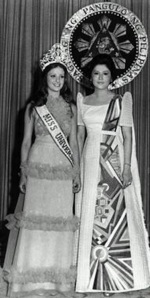
Imelda Marcos with Amparo Munoz, Miss Universe 1974
In those few years I was transformed from budding writer and radio producer, to weekly columnist, to singer, to actress, to TV presenter, to disc jockey, to comic strip heroine, to film star and, finally, ending up annointed as a true “Living Goddess” among a former headhunting tribe in the Philippine’s remote Mountain Province.
The years I spent in the Philippines coincided almost exactly with the years in power of Ferdinand and Imelda Marcos. So, as a journalist, I was able to observe and write about them at firsthand. It was hard, in fact, to ignore them. They dominated every aspect of Philippine life, particularly since the imposition of martial law in 1972. There was nowhere you could look in Manila without seeing their larger than life posters on giant hoardings. There was nowhere you could go without overhearing endless conversations about them and ambitious plots being forged against them. And there was nowhere you could hide without feeling that your every move was being closely monitored by them or their cohorts. Theirs was an all-pervasive presence, neither benign nor compassionate. On the contrary, theirs was a destructive, intimidating and, for the Filipino nation as a whole, an ultimately catastrophic presence.
I spent much of my time in the Philippines chronicling the excesses of Imelda Romualdez Marcos. I think there has been nobody in contemporary history that has so aptly illustrated the saying that:
“Power corrupts and absolute power corrupts absolutely.”
Imelda always liked to compare herself with Eva Peron. In fact she took it as a compliment if anyone pointed out any similarities between her and the former First Lady of Argentina. But, despite Eva Peron’s excesses – and there were many – at least she did, in part, help her “decamisados” as the Argentine’s poor were referred to. But, in twenty-one years as First Lady of the Philippines, Imelda Romualdez Marcos did nothing for the destitute in her country.
At the time of my arrival in the Philippines the Marcoses had been in power for only three years and so I was able to see and document their rise, from fairly humble beginnings, to what has been dubbed their “conjugal dictatorship”, outlasting as they did so, four US presidents and three British prime ministers until their final ignominious defeat in February 1986.
I suppose the image that springs to most peoples’ minds when they hear the name Imelda Marcos is shoes. This is hardly surprising since it is now known she owned at least 3000 pairs of them. And it is hard to forget the TV news film, in February 1986, showing row upon row of them left behind in the Palace when she fled to exile in Hawaii.
“Three thousand?“ Imelda protested at the time, “That’s nonsense! I only had 1006!”
Imelda’s shoes have, perhaps, become the very symbol of her excesses. They are currently housed in the Imelda Marcos Museum in Manila, a museum dedicated solely to her greed, her ostentatious lifestyle and her extravagances.
Imelda may have left behind all those pairs of shoes for us to marvel at but many of us probably harbour a secret admiration for what she and her husband, the late President Ferdinand Marcos, did manage to bring with them into the United States under the term “household effects”. The official customs list drawn up when they arrived into exile in Hawaii reads like pure fantasy.
22 Crates of Cash valued at $717 million dollars
300 crates of assorted jewellery Value undetermined.
$4 million dollars worth of unset precious gems contained in Pampers diaper boxes.
$7.7 million dollars worth of jewellery, including a gold crown encrusted with diamonds, three tiaras, 65 Seiko and Cartier watches
A box, measuring 12 feet by 4 feet, crammed full of real pearls.
A 3 foot solid gold statue covered in diamonds and other precious stones.
$200,000 dollars in gold bullion and nearly $1 million dollars in Philippine pesos
Discovered among their luggage too were deposit slips worth $124 million dollars for banks in the US, Switzerland and the Cayman Islands.
A week ahead of their departure 2000 tons of gold, worth $22 billion dollars, had been dispatched to Australia but, on a tip off, was intercepted by the vigilant Australian Customs. Weekly shuttle flights, transporting crates containing money, period furniture, antiques and Old Master paintings were reported to have flown to Hong Kong during the six months prior to their downfall in February 1986.
A further $250 million dollars worth of jewellery was also confiscated from a friend of Imelda’s who was caught smuggling them out of the country for her.
And this was probably just the beginning. Over two decades later the Philippines government is still trying to locate all the Marcos assets. Imelda has not helped them. She has claimed the Fifth Ammendment. She has obfuscated. She has bribed. And she has lied. She told the Philippines commission charged with retrieving the stolen funds:
“If you know how rich you are, you aren’t rich. I have no idea how rich I am!”
Following a request from the Philippines government, the Swiss government, for the first time ever in its history of secret banking, froze all assets they suspected of belonging to any member of the Marcos family. In the past five years the Swiss government revealed the existence of yet another Marcos account, holding almost $20 billion! And so it seems quite possible that one day we might actually find out just how rich the Marcoses were.
After my arrival in the Philippines, just three years into her husband’s first presidential term, I became fascinated by Imelda Marcos and proceeded to write about her often, mainly in very unflattering terms. My best friend Betsy Romualdez, a writer and poet, happened to be Imelda’s niece and so I was fortunate to have access to many inside stories about the First Lady, more so than most Filipino journalists at the time.
Imelda Marcos with Amparo Munoz, Miss Universe 1974
I was still living in Manila in 1974 when Imelda was hosting the 23rd Miss Universe contest. On the night of the main event the beauties and the foreign Press were lined up for hours in the lobby of Imelda’s brand new Cultural Centre building waiting for the First Lady to show up. Eventually her limousine swept up the driveway and Imelda regally stepped out. As she passed down the line of girls, a bit like royalty, she stopped occasionally to shake hands with them and share a few words.
When she reached Miss South Africa she asked, “What does your father do?” The nervous young woman replied, “Daddy? Oh, he’s in the mining business!”
“That’s a coincidence ! “ Imelda immediately retorted, sweeping her arms around the magnificent lobby of her new Cultural Centre, “I’m in the mining business too! That’s mine, that’s mine and that’s mine. In fact everything you see here is mine!”
This may have been Imelda’s cynical attempt at a joke, and a handful of journalists among our group giggled politely, but it had a portentous ring. For less than 15 years later, Imelda, her husband and their cronies, would own an estimated 85% of the nation’s wealth, commerce, land, produce, dollar and gold reserves. By their departure in 1986, the country would be left reeling, bankrupt and riddled by foreign debt from which it is still recovering today.
Although Marcos had taught Imelda how to play dirty politics, her drive and ambition were entirely her own. As she succeeded in winning votes for him so he rewarded her with jewellery. She, in turn, would tell journalists and friends that these jewels were Romualdez family heirlooms she had inherited along with a palatial home, priceless antiques, paintings and a silver collection.
In the early days, during the 1965 presidential campaign, Marcos was able not only to switch from being the leader of the Liberal Party to being the leader of the Nacionalista Party but also to clinch the election. But political pundits and colleagues agreed it was Imelda who influenced the result. Marcos was a brilliant tactician, they said, but it was Imelda’s charm, persuasion and sweet singing voice that ultimately won him the presidency.
“It’s not an exaggeration to say,” a political aide told me, “that Imelda used plane, motorboat, banca and literally crawled on her hands and knees to reach each delegate who had a vote. She then swayed them with her voice, her tears and her beauty.”
For his part, Marcos wined and dined his supporters at the opulent Manila Hotel, filled their pockets with 100 peso bills and took them to expensive nightclubs. Following their inauguration, Imelda sent US presidential candidate, Hubert Humphrey, some personal advice on how to win an election:
“You’ve got to control the site of the convention,” she wrote, “you’ve got to have your people everywhere. We had the bellhops. We had the waiters. We had the elevator boys. We had the desk clerks. We had everybody talking about Marcos. But the most important thing was that we had all the telephone operators so the other side never received their telephone calls!”
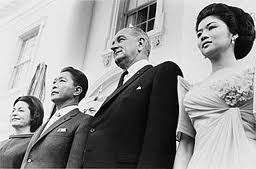
The presidential election of 1963 had been the costliest, dirtiest and most vicious campaign in the country’s history, “a year long propaganda orgy” as the American Embassy in Manila discreetly described it. But the foreign press were already referring to the Philippines as the “new Camelot” and to the beautiful, young First Lady as the “Asian Jackie Kennedy.” And a few months after the election the Marcoses paid the customary state visit to America. Imelda took the States by storm. “A photographer’s delight” the newspapers called her as she sang a Filipino love song to a bemused President Johnson at a gala dinner. Washington was mesmerized. Politicians and press alike were seduced by her beauty and her charm. For the first time Imelda witnessed the power of her own personal magnetism.
The newspapers quoted her on her return to Manila saying:
“The Metropolitan Opera House – it was fabulous – those chandeliers, those paintings…My God, the Rockefellers, the Duponts, the Fords, the Magnins, the Lindsays, the painter Marc Chagall – you know he wanted to paint me. And the jewels the women were wearing… strands and strands of diamonds around their necks!….Wow, in America when they’re rich, they’re really rich!”
Squatters in Manila
Back home Imelda set to work to create her own opulent environment worthy of entertaining her new super-rich friends. She began a massive building programme that, in time, came to be known as her “edifice complex” – not to house the poor and the dispossessed – but to forward her aims of making Manila into the cultural and financial capital of Asia. Neither she nor Marcos cared for the underprivileged. If the squatters’ huts presented an eyesore to her or her foreign guests, she had them obliterated with a bulldozer. She had once been poor herself and she never wanted to be reminded of the fact.
And the sad truth is that Marcos, too, cared little for the majority of his people. During his rule as president graft and corruption flourished, rural poverty became more crushing, the gap between rich and poor widened and these conditions were exploited by the emerging Communist Party. This was painful to the U.S. because the Philippines was the country America had tried to model after its own democratic image. It was where, in 1899, the Americans had fought their first counter-insurgency war in the name of protecting freedom and defeating what they saw as the growing threat of communism.
On his election to the presidency Marcos had promised a redistribution of the country’s wealth – on that he certainly delivered. But he redistributed the wealth from the poor to his business colleagues, his Army generals, his friends and his own family. Overall, by the mid-1970’s seven out of ten Filipinos were worse off economically. Real wages for workers had fallen about 30% while consumer prices had tripled. Two out of every three Filipinos were surviving below the poverty line and a staggering 40%, 21 million Filipinos, were homeless.
The per capita calorie intake, too, was less in 1976 than it had been in 1960. This, despite the fact the U.S. had provided the Philippines with more than $300 million under the Food for Peace Programme. In the 1950s Filipinos had probably been the best fed people in Asia. Now people in India, Indonesia and, perhaps, even Bangladesh were eating better than they were. 40% of all the nation’s deaths were caused by malnutrition. An American journalist visiting the Visayas Islands (near Imelda’s birthplace) in 1979 reported:
“The young patients I saw in the hospitals there seem to have been transplanted from the famines in Bangladesh and the sub-Sahara earlier in the decade. Big eyes staring from skeletal heads, matchstick limbs and bloated bellies. But they were the fortunate ones. They were receiving treatment.”
Impervious to any such domestic problems, Imelda started her infamous shopping sprees in
Imelda Marcos off on a shopping spree
Rome, Paris, New York and London – at Bulgari, Harry Winston, Tiffany’s and Cartier. On October 13 1977 she parted with $384,000 for diamonds. Two weeks later on November 2 she spent over $1 million for more diamonds. In July 1978, after her third visit to the Soviet Union, nine days of spartan communism had, apparently, proved too restricting for her and she flew directly to New York for a retail therapy binge. On her first full morning there she paid out $194,000 for antiques and the following week in a one-day spree she spent over $2 million on more diamonds and emeralds. And all this on her husband’s official presidential salary of just $6500 a year!
Nothing and no one would get in her way. When the world press criticized her for being profligate, she would answer that she was only carrying out the wishes of her people.
“They want me to shine like a star in their midst. Who am I not to carry out their wishes?” she asked.
When hauled before a U.S. Congressional Committee of outraged congressmen, her charm no longer seduced them. They demanded to know where her money came from and threatened to cut off aid to her country if she continued to spend so lavishly. Back home she referred to them as “barbarians.” She compared them to the Spanish Inquisition:
“I have been to Peking. I have been to Moscow. I have been to Libya,” she fumed, “and nobody ever treated me so rudely!”
Her husband pacified her with a gift of the world’s largest blue diamond, the notorious “Idol’s Eye”, said then to be worth $5 million.
The following year while her Ferdinand Marcos was negotiating the renewal of the U.S. bases agreement and promising a massive austerity campaign at home because of the spiraling inflation and a huge foreign overseas debt, Imelda again went on a shopping spree in the US. She bought a multi-million dollar estate in Long Island, named Lindenmere. She shelled out $328,000 on more diamonds, $717,000 on a house in Hawaii, $5.3 million on a hotel in San Francisco, $1 million on another house in Hawaii and, on August 25, 1981, she bought a heart-shaped diamond for over $1million and two necklaces for $400,000.
Two days later she spent another $616,000 on antiques and, in September of that same year, she bought the Fan Fox Samuels estate on Long Island for almost $6 million. In that period too she acquired a townhouse on 66th Street and Madison in Manhattan and she negotiated the purchase of one of New York’s most famous landmarks, the Crown Building, on 57th Street and Fifth Avenue. In her personal collection too, I was told by my friend, Jun Gonzalez her private art restorer, she owned Old Master paintings and sculptures worth in excess of $20 million. Jun told me Imelda had invited him to the Palace to see a 12 foot X 12 foot painting by Holbein. He asked if I would like accompany him.
“How could she have bought a Holbein?” I was incredulous. “Surely, the whole world would know when a Holbein had been purchased on the international art market ? Where had it come from ? Who had sold it to her – or had she been duped – yet again?”
That was not all she owned, Jun told me. In her collection I would see Canalettos, Chagalls, El Grecos, Rubens, Rembrandts and Titians, to name just a few.
At the time of these infamous shopping sprees it was estimated that 30% of the population were struggling on barely $200 a year, not enough to afford the barest necessities of life, such as food, shelter, clothing and medicine – the very things that Imelda, in her new capacity as Minister for Human Settlements, was expected to provide.
In their 21 years in power, it has now been established, the Marcoses salted away between $18 and $30 billion, most of it intended for aid programmes but much of it from personal “donations” Imelda had successfully extracted from intimidated local businessmen. There is no doubt the Marcoses certainly robbed in style, particularly Imelda.
Many of my wealthier friends were constantly receiving visits from the Manila Metrocom, Imelda’s own private police force, with a personal note saying,
“Congratulations! You will be delighted to hear you have been selected to appear at the Palace with a cheque for $10,000, (or shares in your company or deeds to your properties) to donate to my favourite charity.” and it was signed, Imelda Romualdez Marcos.
It was a novel kind of reverse lottery.If they refused to cooperate they would automatically receive a visit from the Bureau of Internal Revenue. If this tactic still failed to convince them then their businesses were taken over by one of Imelda’s friends or family.
But, with an armed police escort, threats of imprisonment and promises of in-depth investigations into their business affairs by the tax authorities, few dared to refuse such a subtle and seductive invitation. In fact one of my friends said he received so many of these “congratulation notes” that he wallpapered his entire downstairs bathroom with them.
Parrying questions by American journalists about her extravagances, she explained:
“I must confess that once upon a time Marcos’s family and mine were oligarchs. But we are reformed oligarchs. The Romualdez family has been in office for many years and thank God there is a family who is willing to serve our country. Thank God they know how to make money. Otherwise if Marcos did not know how to make money before, what experience would he have to make his country prosper? The United States is ashamed that it is rich. Why should we be ashamed? We have some gifted members in our family. Good. They want to serve our people. Wonderful!”
She left the reporters as perplexed with this explanation as she did a group of scientists from the august National Academy of Sciences whom she invited to Malacanan Palace to discuss energy conservation. When they arrived she said energy conservation bored her and she really wanted to talk to them about love, truth, justice and beauty. She then entertained them with folk songs, beautiful women, local celebrities, a banquet dinner and dancing.
After the sumptuous meal she took them upstairs and spoke to them for three hours. She told them about her project of giving each prisoner a rabbit, a dog or a plant to love. She then drew a circle on a blackboard representing the universe. She made a hole in the circle and drew some lines. She explained that this represented where cosmic forces entered the Philippines:
“And my scientists tell me,” she said, “that these forces are so powerful that we can use them to protect you – our American friends – against Soviet missiles!”
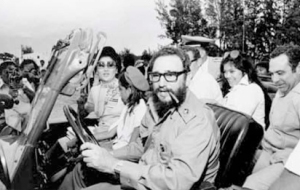
Fidel Castro and Imelda Marcos
Imelda’s forays onto the world political stage were equally successful in grabbing the international headlines and she was dubbed, “The Iron Butterfly”. A typical trip abroad might include a visit to Tripoli to dissuade Colonel Gaddafi from financing the Moslem rebellion in the Southern Philippines (for which she later campaigned to receive the Nobel Peace Prize), a short stay in Moscow with the intention of sending shivers down the spines of the domino-theorists in the State Department, an exhaustive tour of Cuba accompanied by Fidel Castro, who fell for her charms. And then, homeward-bound, with a final stopover for an audience with the Pope, to remind him that even an impoverished, developing nation like the Philippines can be the fifth largest contributor to the Vatican coffers.
Muhammad Ali and Smoking Joe Frazier fight in the Thrilla in Manila
To prevent boredom at home she pursued her “edifice complex” with a vengeance. Perhaps, like the Pharaohs, she intended to leave the world monuments to remember her by. She built the Cultural Centre in 90 days as a venue for the Miss Universe contest, then came the International Convention Centre to give a forum for overseas investors and businessmen, a Folk Arts Centre, ready in time to accommodate the Ali-Frazier “Thrilla in Manila” world heavyweight fight, a fortress-like Metropolitan Museum to house her personal collection of paintings, a University of Life, a Heart Centre for Asia, a Lung Centre, fourteen luxury hotels and a coconut palace to accommodate her jet-setting guests and to permanently display – although not to the general public – her priceless collection of jewels and Russian icons.
Opening of the Cultural Center
But the building that tops them all is the Parthenon-like structure dominating the center of Manila Bay and housing her Film Centre, built for an international film festival, conceived by her to rival Cannes.
I watched mesmerized as the mammoth building was constructed in 90 days by literally thousands of underpaid workers struggling day and night to make sure it was completed on time.
A week or two before the grand opening a catastrophe happened. A huge section of the native bamboo scaffolding collapsed resulting in hundreds of workers plummeting headlong into the quick-drying cement. And as their fellow workers scrambled desperately to free the victims, the order came from Imelda that there was no time to dig them out, work must continue otherwise the opening deadline would have to be postponed and her foreign guests would be “disappointed”.
Offending legs and arms that were not completely buried by the cement were ordered to be chopped off and destroyed while the widows and families started assembling at the scene for an impromptu candlelight vigil which was to last for several months.
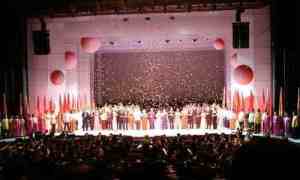
The opening was a surreal event. Cocteau himself could not have dreamt up a more grotesque one. Despite violent police attempts to remove the grieving families, the vigil outside defiantly continued. As hundreds of demonstrators were forcibly removed, hundreds more arrived to take their place – a never-ending stream of wailing mourners.
Meanwhile I watched as minor celebrities from the United States and ex-royalty from Europe began arriving at the Centre in their stretch limos, ignorant of the disaster and unaware of the grim reception committee that awaited them.
Despite last-minute threats and financial inducements by Imelda to the hostile workers to finish the building on time, the roof was incomplete on the opening night. And, despite the fact that the rainy season was long over, that particular night, of course, it chose to rain. Journalists huddled to keep dry outside as guests were ushered inside to their seats. Some seats that were exposed to the open roof were already soaked, but there was nothing Imelda could do. That night there was no let up. It seemed to those of us watching the event that heaven was resolved to mourn its dead that night.
Imelda was, as usual, the last to arrive. On stage a chorus of hastily assembled patients from her Heart Centre began to sing as she entered the hall and swept down the aisle. They sang The Hallelujah Chorus from Handel’s Messiah, “And he shall reign for ever and ever!” Except they replaced the word “he” with the word “she”.
At the end of their song, to the disbelief of the audience, each one stepped off the stage, bared their chests and walked among the front rows of the stalls displaying vivid purple scars from recent heart operations. Shocked gasps were followed by an embarrassed silence. People didn’t know which way to look. The emcee on stage proudly announced that these people had all received their operations at the new Imelda Romualdez Marcos Heart Centre.
At this point, of course, the audience was expected to burst into rapturous applause. But, by this time, the persistent wailing from the mourners outside echoed eerily through the hall as rumours of the disaster began to spread. The bizarre ceremony on stage made the audience uneasy and most gave hasty excuses and left.
By now Imelda’s regular guests included Cristina Ford, the ex wife of the American auto magnate, Henry Ford II, the actor George Hamilton, the pianist Van Cliburn, the chess grandmaster Bobby Fischer and Jack Valenti, President of the American Motion Picture Board. These people she referred to as “my gang” and, given a moment’s notice, they were ready to fly to her side anywhere in the world.
Imelda’s most notorious junket with her “gang” in tow was her trip to Kathmandu in March 1975 to attend the coronation and wedding of King Birendra. Before her flight to Nepal she was entertaining her “gang” and others, including the heart surgeon, Dr. Christian Barnard and the actress Gina Lollobrigida, at Malacanan Palace. But instead of ending the party when it was time for her to leave for the Himalayan capital, Imelda decided to take the party with her – without a thought for foreign protocol or expense.
She commandeered four Philippine Airlines planes, one for food, just in case the Nepalese food failed to please her friends’ palates, one for her entourage, which included six hairdressers, manicurists and medical personnel and two for herself, her family and friends. The trip was scandalous by any standards. A former classmate of the King recalled the dismay at court when, upon her arrival, Imelda walked straight up to the King, completely ignoring protocol and the waiting reception line, which included the King’s mother. According to the classmate, the Nepalese Royal Family was furious as word of Imelda holding her own court in Katmandhu and issuing her own invitations spread through Himalayan kingdom and abroad. But she was only repeating what she had done a few years previously at the Shah of Iran’s party in Persepolis.
During the next few days of festivities Imelda kept close to Prince Charles, whom she realized
Imelda Marcos with Prince Charles
would attract most of the media attention. By placing herself at his side she could guarantee she would end up on every television screen and on the front pages of every magazine and newspaper the world over. The plan worked and, although the Prince of Wales remained impervious to her charms and refused Imelda’s invitation to visit Manila, another member of the British Royal Family would accept later the same year.
Imelda had been hatching plans to play host to a member of the British Royal Family for almost three years. And the fact that she had been refused by both the Queen and Prince Charles did not dull her determination but she also came to realize she would have to settle for something less. Imelda knew Princess Margaret’s weakness for attending extravagant parties and she planned to create the biggest party of all, one that the jet-setting Princess could not possibly refuse. She employed an Italian art dealer, Mario Durso, an acquaintance of the Princess, to convince, coerce or inveigle the Princess to visit Manila.
Finally, towards the end of 1975, her opportunity arose. Princess Margaret was due to fly to Papua New Guinea to represent the Queen at the Independence Day ceremony. The Princess asked Durso to inform Imelda she would be prepared to visit Manila on her return journey. This was the moment the First Lady had been waiting for. This was the time for her to pull out all the stops. She pleaded with Durso to insist that the Princess arrive in Manila on a Sunday so she could command all Manila’s schoolchildren to line the streets from the International Airport to Malacanan Palace waving British flags.
Plans forged ahead at full steam. No expense was to be spared. Imelda’s coterie of blue-frocked girlfriends, known as the “Blue Ladies”, were dragooned into preparing bacchanalian feasts for the Princess, at least one for every night of her visit. A suite of rooms in Malacanan was hastily redecorated to the Princess’s taste and Imelda’s international celebrity friends were invited, all expenses paid, to come to Manila to join in the fun. Manila was festooned with Union Jacks for almost a month. For the first time British television shows outplayed American ones on local television stations. And shops, such as Rustans Department store, owned by Imelda’s best friend Glessie Tantoco, were inundated by British goods, British fashions and British food.
Bulldozers were hastily put to work razing squatters’ huts on the route from the airport to the Palace. However, as had so often happened before, no sooner had the shanty homes been demolished and the squatters driven out, than the cardboard and corrugated tin houses went back up again. This scenario occurred every time Imelda expected a visit from a celebrity, foreign dignitary or overseas businessman. The result was always the same. Imelda would have a high white-washed wall erected around the whole area so that nobody could see in and the squatters couldn’t get out. Inevitably, the hapless residents inside would be forced to hack their way through the wall so it ended up looking like a giant honeycomb.
But, despite all these preparations, all did not go according to plan. The Princess fell sick with flu in New Guinea and informed the British Ambassador, Sir John Addis, that her arrival would be delayed by a few days.
Sir John, who had become a good friend and travelling companion of mine, later told me:
“I dreaded telling Imelda that the Princess would not be arriving on Sunday as planned but, most likely, on the following Tuesday or Wednesday.” I could tell Sir John was relishing this story. “You can imagine Imelda‘s reaction,” he smiled, “She was not amused. All her plans had to be rescheduled.”
I could visualize the scenario. But even Sir John who was a diplomat of the old school, a quiet scholarly man, a world-respected authority on China and Chinese porcelain, became almost apoplectic whenever he discussed Imelda.
“What about the schoolchildren?” I asked.
“Ah, yes, the schoolchildren!” Sir John grinned, “You see I wasn’t able to give Imelda the exact day Her Highness would be arriving in Manila. And well, even
she couldn’t declare a national holiday for a whole week, could she?”
“So who waved all those thousands of imported British flags?” I asked.
I had heard rumours about this incident but I was eager to know from Sir John what really happened the day the Princess arrived. Sir John laughed. Despite a distinguished career in the Foreign Service and, as such, trained to be tactful at all times, he could never resist gossiping with me about Imelda. We were sitting beside the lake at his magnificent garden in Kent and, as he had many times during our long friendship, Sir John was prepared to let his guard down.
“Well, there was an argument as to whose car the Princess would travel in. Imelda obviously wanted to meet her at the airport and take her in her own car back to the Palace. However, I had to explain to her that technically the Princess was a guest of the Embassy and, as the Queen’s representative in the Philippines, I would be expected to meet her at the airport.”
I giggled. I could imagine the scene.
“Imelda must have exploded!” I said, “She’d been planning this for years!”
“She was definitely not happy.” Sir John chuckled. “I tried to cater to her vanity by saying that, as First Lady, protocol dictated that she and the President should wait and greet the Princess at the Palace. Eventually, she relented but not without a struggle. So off I went to the airport followed by a phalanx of limousines. I noticed that Imelda had been hard at work because the route was lined with thousands of men in grey overalls holding the British flag.”
Intrigued I asked, “Who were they?”
“Well, deprived of the schoolchildren, Imelda had replaced them with inmates from all the prisons around Luzon! Sir John giggled. “And, wait for this, Caroline, just in case the prisoners decided to make a communal bid for freedom she had sharpshooters from the Army and the Manila Metrocom hanging out of windows and suspended in the branches of trees above with rifles aimed at the them.”
“What was the Princess’s reaction to all these men in identical outfits?” I asked, “Did she realise who they were?”
Again Sir John laughed. “She looked amazed and then turned to me and in her very upper crust voice, asked, “Tell me, Sir John, are they all civil servants?””
“And what was your answer?”
Still chuckling from the memory, Sir John replied, “Well I said, “In a manner of speaking, Ma’am, yes they are!”
In 1986, during the “Peoples’ Revolution”, as it came to be called, newsreels and photographs
Overthrow of Ferdinand Marcos 1986
emerged from Manila’s presidential palace, Malacanan, that filled viewers with a mixture of fascination and horror. There were the rows upon rows of discarded shoes, the obscene mountains of unused cosmetics, the 3000 bras and panties, leading most observers to ask themselves, who was this woman who called herself the “Goddess of all the Arts” and the “Star and Saviour” of the 54 million Filipino people?
Imelda never expected to be forced into exile. She had lived with delusions of her own infallibility for twenty-one years – and the US government was, in most part, to blame. While Imelda “shopped till she dropped” and her husband imprisoned, tortured or killed any dissenter, agitator or critic, successive US Presidents went out of their way to praise and support them both.
In 1980 former President Nixon called Imelda “our Angel of Asia.” In 1981, after a blatantly corrupt election, Vice President George Bush Sr told the couple:
“We just love your adherence to democratic principles and the democratic process!”
And, during the Marcoses state visit to Washington a year later, President Reagan heralded their dedication to “improving the living standards for all their countrymen” and called them, “Nancy’s and my greatest friends and America’s greatest allies in Asia.”
It seemed then the couple could do no wrong in the eyes of each United States government, convulsed as it was in the aftermath of Vietnam and ever fearful of Henry Kissinger’s “domino theory”, a theory that never stood up to serious scrutiny even then.
In fact Marcos and Imelda never even considered themselves mortal. In one issue of Playboy magazine, recorded during the Marcoses exile in Hawaii, they were asked the question:
“Do you think of yourselves as Gods?”
To which Imelda’s immediate reply was:
“Yes, because we are on a divine mission to return to the Philippines and reclaim our destiny.”
The ex President then chipped in:
“We are part of the achievement of being a God. That is what we are about now. An ordinary mortal would not be able to stand it. All of our statements now have to prove that we have not gone back to being ordinary mortals.”
But robbed of her personal fiefdom and her bottomless Treasury, with her own Swiss bank accounts frozen and nowhere to display her priceless jewels, Imelda Marcos presented a pathetic figure, hardly that of a deity. The Iron Butterfly’s wings had been severely clipped and, with it, her freedom to jet around the world at will. Her hard-earned memberships to the exclusive playgrounds of the privileged few had been withdrawn. Doors, once open by the rich, titled and powerful had been firmly slammed in her face. She complained that in Hawaii her telephone never rang and friends were always out when she called. The “enchanted fairytale” as Imelda once described her life, was over but, according to the Playboy interview, she saw it only as a “temporary intermission.”
When her husband died in exile, Imelda’s only dream for herself was a triumphant return to Manila. Forty years ago she had arrived in Manila with a beautiful young face, a dream in her head and five pesos in her pocket. Again she would arrive in Manila, this time broken but unbowed. She vowed she would seek the Presidency “for all those supporters who have anxiously awaited for my return.”
From her exile in Hawaii she made this promise to them. “I’ll go back with only five pesos and I’ll make billions and billions of dollars, because what I do comes from the heart and the brain – and I’ve got both!”
But the support she expected had evaporated in her absence. The Philippines had moved on. Ferdinand’s corpse, she was told, would not be welcome, his body would have to remain in Hawaii. The housewife, Cory Aquino, who had become President by default negotiated Imelda’s return in exchange for access to some of the stolen money.
So Imelda bided her time, staging her political comeback to coincide with the inauguration of her former friend, the actor-turned politician, Joseph Estrada, an alcoholic womaniser who abused his position to such an extent that he, too, was toppled within his second year. And, despite, crawling down the aisle of Manila’s Cathedral on her knees to beg God’s assistance in returning her to power, Imelda has reluctantly had to give up all ideas of obtaining the Presidency and setting in motion the family dynasty that was her husband’s dying wish.
Later, when asked about this, and other similar, tactics by Fortune magazine, Imelda simply shrugged:
“I’m like Robin Hood. I rob the rich to make my projects come alive. It’s not really robbing. I do it with a smile !”
Her projects included literally hundreds of buildings. Palatial homes all over the world for her and her family, luxury condiminiums and office blocks, larger-than-life monuments of herself and her husband, numerous “love bridges”, health centres and art centres and a string of shopping malls and five-star hotels.
Imelda’s response to accusations of extravagance was simple:
“In the material world,” she explained coyly, “where everything is valued, when you commit yourself to God, beauty and love, it can be mistaken for extravagance ! But I have never been a material girl. My father always told me never to love anything that cannot love you back!”
Imelda Marcos reclining with her memories
And these words from a simple girl who went out of her way to obtain the world’s largest uncut diamond from Harry Winston, obviously so it could love her back, and not so she could outshine Elizabeth Taylor !
Imelda’s extravagance knew no bounds. She grabbed everything, bought everything, hoarded everything. Her excuse was that she was doing it for her “little people”. Like the “meek” in the Bible, she assured us, they would inherit it all.
“Everything I have is theirs,” she informed us journalists one day:
“I am their star and their slave. No matter how poor they are, whenever they see me they smile and they are happy!”
POSTSCRIPT: Just thought I would add this as it strikes me as funny – and, typically, Imelda.
Another postscript by Rappler. Following the outrage by ex-alumni of Ateneo inviting Imelda to the Universitiy recently. The photograph of her with the alumni went viral and many wrote in to protest. “Did the alumni remember those students who died during the Marcos regime?” I understood their anger. I knew Eman Lacaba, the young poet, very well. He even wrote a poem dedicated to me. He was hauled away to Camp Crame one day never to be seen again. Shame on Ateneo. The alumni has since issued a statement. You can read the full story here:
Yet another postscript: An off-Broadway musical, “Here Lies Love” about the love affair and conjugal Presidency of the Marcoses is getting a rerun at The Public Theater in New York.
In the 21 years Ferdinand Marcos ran the Philippines, billions went missing. As his son stands for vice-president, will the stolen fortune ever be recovered?
The content that this network circulated included numerous claims that sought to alter public perception of the Marcoses by either downplaying or outrightly denying kleptocracy and human rights violations during the Martial Law years, exaggerating Marcos achievements, and vilifying critics, rivals, and mainstream media.
In the early hours of a February morning in 1986, Ferdinand and Imelda Marcos flew into exile. After 21 years as president of the Philippines, Marcos had rigged one too many elections. The army had turned against him, and the people had come out on to the streets in their thousands. The Marcoses had seen the crisis coming and been able to prepare their escape, so when they landed that morning at the Hickham USAF base in Hawaii, they brought plenty of possessions with them.
The official US customs record runs to 23 pages. In the two C-141 transport planes that carried them, they had packed: 23 wooden crates; 12 suitcases and bags, and various boxes, whose contents included enough clothes to fill 67 racks; 413 pieces of jewellery, including 70 pairs of jewel-studded cufflinks; an ivory statue of the infant Jesus with a silver mantle and a diamond necklace; 24 gold bricks, inscribed “To my husband on our 24th anniversary”; and more than 27m Philippine pesos in freshly-printed notes. The total value was $15m.
This was a fortune by any standards, easily enough to see the couple through the rest of their lives. Yet the new government of the Philippines knew this was only a very small part of the Marcoses’ wealth. The reality, they discovered, was that Ferdinand Marcos had amassed a fortune up to 650 times greater. According to a subsequent estimate by the Philippine supreme court, he had accumulated up to $10bn while in office.
Since his official salary had never risen above $13,500 a year, it was blazingly clear this was stolen wealth on the most spectacular scale. Some of his closest allies also stole billions. As their victim was a nation in which 40% of the people survive on less than $2 a day, the Republic of the Philippines decided urgently to try to retrieve its money.
Even amid the chaos of the revolution, the very first executive order issued by the new president, Cory Aquino, established the Presidential Commission on Good Government, the PCGG. It was to recover “all ill-gotten wealth accumulated by former president Ferdinand Marcos, his immediate family, relatives, subordinates and close associates” and given the power to sequester any assets believed to be the proceeds of crime.
Thirty years later, the PCGG is still working, its 94 lawyers, researchers and administrators housed proudly in a building recovered from the Marcos family. The government gives it an annual budget of $2.2m. Its staff have traced money through jurisdictions all over the world and fought their way through hundreds of court cases. And yet something has gone terribly wrong: to date, the PCGG has recovered only a fraction of what was stolen by the Marcos network; no one has served a prison sentence for their part in the crime.
Bongbong Marcos campaigns for the vice-presidency. Photograph: Erik de Castro
Now, with its task still far from complete, its survival is threatened by a political development that would never have been anticipated by the crowds who swelled the streets in triumph as Marcos fled. The former president’s son, Ferdinand Marcos Jr, generally known as “Bongbong”, is a frontrunner to become vice-president in the national elections on 9 May. If he wins, he would have the power to shut down the PCGG, as political allies of his family have tried to do in the past. The world’s biggest thief will have won.
Last month I was given unrestricted access to the enormous archive the PCGG has assembled in its years of global detective work: the president’s handwritten diary, frequently puffed with self-regard; the notepaper headed “From the office of the president”, with scribbled sums endlessly totting up his cash; minutes of company meetings with his comments scrawled in the margins; contracts; “side agreements”; records of multiple bank accounts; hundreds of share certificates; private investigators’ reports; and tens of thousands of pages of court judgments.
It needs to be said that this is not about Imelda Marcos and her infamous collection of shoes, although her shopping habit is real. She bought perfume not by the ounce but by the gallon. She hoarded old masters; at one point, she tried to buy Tiffany & Co. But in this particular circus she was only a clown, her crazy consumption deflecting attention from the big beast that was out of its cage.
The PCGG archive tells the inside story of the biggest theft in history, and of the master criminal who organised it: skilful, arrogant, cruel. It also opens a door into the offshore world revealed by the Panama Papers. Marcos was one of the first to exploit the rats’ nest of secret jurisdictions and hidden ownership then in the early stages of being built beneath the floorboards of public life.
But what is most important about Marcos is that he committed his crimes as a politician. His career starts with a cynicism that now seems familiar – manipulating electorates, using money to buy power and power to make money. But he went one big step further in merging politics and finance, converting the instruments of government into one vast cash machine. A handful of other autocrats were also busy stealing from their people in that era – in Haiti, Nicaragua, Iran – but Marcos stole more and he stole better. Ultimately, he emerges as a laboratory specimen from the early stages of a contemporary epidemic: the global contagion of corruption that has since spread through Africa and South America, the Middle East and parts of Asia. Marcos was a model of the politician as thief.
A single document in the Manila archive marks the start of the detective story. In a sworn deposition, a young civil servant named Chito Roque describes how, on the night the Marcoses flew into exile, he worked his way through the crowds outside the presidential palace to the gates where anxious soldiers were posted. He was with his boss, a senior official in the new government, and they eventually found their way into the inner sanctum, the Marcoses’ private living quarters. There, they could see the signs of hasty flight: food still warm on the dining table, empty boxes, papers scattered on the floor, shredding machines stuffed with more paper.
His boss went home, but Chito wandered into the bedroom of the deposed president, where “I saw a filing cabinet and I opened the first drawer and I saw a safe inside and there were numbers, a combination that was pasted on the door, so I followed the combination and opened the safe.” Inside, he found records of bank accounts in Switzerland and Canada, share certificates and several letters signed by Marcos.
Those documents now sit in the offices of the PCGG, along with thousands more retrieved from the palace and the 50 or so other properties the Marcoses and their allies owned in the Philippines, and from homes and offices in the US. As the years have gone by, hundreds of thousands of pages have been added from other sources, all now sitting, neatly ordered, in a white, two-storey building near the centre of Manila. Outside, a six-lane highway is jammed with traffic, bellowing and belching fumes. Inside, all is calm and cool. A notice asks visitors kindly to leave their firearms at reception.
Ferdinand Marcos with Richard Nixon after a meeting at the White House in 1969. Photograph: Getty Images
In the early years, the PCGG documents suggest, Marcos was naive in his crime. With sacks of cash from rich backers and help from the CIA, the bright young lawyer won elections to congress, then the senate, but he was nothing special, just another “Mr Ten Per Cent” selling his political influence. After he became President Ten Per Cent in 1965, his income from kickbacks for government contracts increased, but his guile went no further than stashing $215,000 in a New York bank in his own name. As far as the records show, he and Imelda took their first steps to real secrecy on 20 March 1968, when they used false names to deposit $950,000 in four accounts with Credit Suisse, he as William Saunders (he practised his new signature on the headed paper), she as Jane Ryan. By February 1970, the Swiss accounts were so loaded, the couple added an extra layer of concealment, transferring their ownership to foundations registered in Liechtenstein. Then Marcos started to get really clever.
On 21 September 1972, he declared martial law. As his diary records, the Nixon administration consented as he shut down congress, arrested his political opponents, took control of the media and courts, and suspended all civil rights. On the same day – as a PCGG worker pointed out to me with some passion – he took time off to open another Swiss bank account. In his diary a week later, reflecting on his “reforms”, Marcos wrote: “The legitimate use of force on chosen targets is the incontestable secret of the reform movement.”
Over the following nine years, an estimated 34,000 trade unionists, student leaders, writers and politicians were tortured with electric shocks, heated irons and rape; 3,240 men and women were dumped dead in public places; 398 others simply disappeared. With total power over politics, the president closed in on the country’s wealth.
This was no longer just about kickbacks. Marcos started to steal whole companies, using the crude tactics of a gangster. He wanted the nation’s electricity company, Meralco, owned by Eugenio Lopez, patriarch of one of the families who had run the country for centuries. He had Lopez’s son charged with plotting to assassinate him, which carried the death penalty. The old oligarch handed over his company for $220 (it was worth $400m). To have gunmen is a gangster’s requirement; to have gunmen in uniforms, with all the power of the state behind them, is a gangster’s dream.
Yet most of Marcos’s takeovers involved no violence. Martial law allowed him, literally, to write his own law: his decrees passed straight on to the statute book. When he wanted to take over the sugar industry, he set up companies and then issued decrees that allowed them to dominate the planting, milling and international marketing of Philippine sugar, which accounted for 27% of export earnings. He then created a Philippine Exchange Company, decreed it should handle all foreign sugar sales and used its monopoly position to buy from farmers at rock-bottom prices and sell at vast profit. This allowed him to buy Northern Lines, which had the contract to ship the sugar overseas. Finally, he decreed that the sugar industry be exempt from minimum-wage law, with the result that 500,000 labourers saw their income fall to less than $1 a day, making even more profit.
Marcos’s scribbled sums counting his stolen millions. Photograph: Nick Davies
The PCGG archive shows how, in the same way, Marcos used his own companies to take over the three other key areas of agriculture: coconuts, tobacco and bananas. Granting himself government contracts, monopoly deals and tax exemptions, he levered his way into dominating industries across the whole economy – logging and paper, meat, oil, insurance, shipping and airlines, beer and cigarettes, textiles, hotels and casinos, newspapers, radio and TV. His was an early and particularly rapacious version of privatisation.
Crucially, he saw his crime through a lawyer’s eyes. Of course people would observe that the Marcoses were suddenly very wealthy – they could live with that. What mattered was to ensure that there was no evidence. Repeatedly, he set up his companies so that outwardly they belonged to other people. Marcos deployed dozens of cronies: relatives, golf partners, political allies, anybody who shared his greed. The crony would sign a deed transferring ownership of most of the business – usually 60% – but would leave a blank space for the name. Marcos would hold the deed and leave the space blank. There was no “evidence” that he owned the 60%.
Marcos stole, then stole more. The Japanese paid reparations for the second world war; he skimmed it and put the profit into his Swiss accounts. He stole international aid money, gold from the Central Bank, loans from international banks and military aid from the US. He decreed that more than a million impoverished coconut farmers must pay a levy, supposedly to improve the industry, amounting to $216m. He had already issued decrees to gift most of the coconut trade to one of his own companies; now he stole great chunks of the levy fund, all the while taking kickbacks on government contracts.
All this theft created a logistical problem: how to handle the tidal flow of money. The PCGG archive shows how Marcos set up his own banking system, using cronies to buy private banks and others to control the state banks. These were useful for stealing more money, in loans that would never be repaid, and for accessing foreign currency – although eventually he set up his own specialist bank to trade currency on the black market.
Above all, the banks acted like a network of dykes receiving his ocean of income. Bank staff would make regular – sometimes weekly – trips to the palace, to pick up cheques and bundles of cash, which were then deposited in dozens of accounts. The millions were then channelled into Marcos’s expanding reservoir of offshore accounts (he had 69 in Switzerland alone). Then all he and Imelda had to do was turn on the taps anywhere in the world and cash would come pouring out; cash that had been washed clean of its connection to crime.
For all its craziness, the gorging on consumer goods that followed now seems a natural progression. There were multiple houses for the extended family, a $5.5m yacht, private planes, helicopters and dozens of Mercedes-Benzes. When their youngest daughter was married in June 1983, they built a new runway and hotel, renovated a 200-year-old church, demolished nearby houses and rebuilt them in traditional style, imported carriages from Austria and horses from Morocco. Advertisement
The men and women who work at the PCGG are driven by an anger. Each day they discover more detail of this crime, while its victims sleep on the pavements and in the slums around them. They are well aware of what the money could do for the impoverished people of the Philippines: if Marcos stole $10bn, this would have paid for the entire government budget for his last year in power three times over. And so they want not only to retrieve the stolen money, but to restore it. It is not easy. The Marcoses, with their money and their connections, have always been in the lead.
***
Consider the saga of the missing paintings. When the PCGG searched the president’s palace after he fled, they found that the walls of the ballroom displayed 23 pale patches where once there had been masterpieces. The Marcoses had a town house on East 66th Street in New York, where Imelda held many parties. Neighbours told investigators that they had seen two 18-wheel trailers pull up a few days after the couple went into exile: they had been loaded up with antiques and paintings, and driven away. By the time the house was searched a few weeks later, there were only brass plaques boasting of treasures that had once occupied its walls: the Madonna And Child by Michelangelo, the Marquesa de Santa Cruz by Goya, a couple of Monets, two Braques, a Pissarro, a Manet.
The vast PCGG archive of documents in Manila. Photograph: Rolex Dela Pena/EPA/Corbis
Paperwork retrieved from their various homes revealed that the Marcoses had bought at least 304 valuable paintings. Almost all were now missing. The Philippine investigators were left with a few dozen inferior works abandoned in some of the Philippine homes, and one Henri Fantin-Latour found wrapped in a blanket under a maid’s bed in one of their New York apartments, apparently an attempt to thieve from the thief. They got a judge to order galleries and auction houses not to sell anything that might have come from the Marcoses. There was not much else they could do. Advertisement
During their first year, the PCGG received a little help from several former Marcos staff and allies. A financial aide, Rolando Gapud, gave them details of five Swiss bank accounts. By Marcos standards, they did not contain very much (only $356m) and the banks refused to hand it over. All the PCGG could do was persuade a Swiss court to freeze the accounts. Gapud and others began to disclose the scale of Marcos’s ownership of the Philippine economy. In Manila, the government set up an “anti-graft” court; by the end of 1986, the PCGG was opening cases against Marcos and his network.
One of those who came forward was Oscar Cariño, former manager of the New York branch of the Philippine National Bank. In a sworn statement, he claimed he had created accounts for two fictitious companies to conceal the Marcos millions. It emerged that the paintings had changed hands with the help of some powerful connections. The court heard that some part had been played by Adnan Khashoggi, the notorious Saudi arms dealer. An Australian TV programme claimed that dozens of Marcos paintings had been flown out of the US on a private plane; 38 others had been shipped from Hawaii. Acting on a request from the PCGG, French police raided two of Khashoggi’s apartments and found paperwork confirming that many of the masterpieces were now in his hands.
Khashoggi argued that he had made bona fide purchases from the couple, of the paintings and of four Manhattan skyscrapers. But the US authorities claimed that the documents he produced to support this had been backdated, and formally accused him of obstructing the course of justice.
Khashoggi was arrested in Switzerland and extradited to New York, where he joined Marcos, Imelda and a network of others indicted under anti-racketeering law. But Ferdinand Marcos died in September 1989, before the case came to trial; he was 72 and had been in a hospital in Honolulu for months. Without Marcos, some evidence became inadmissible. There were reports that the White House was leaning on the prosecutors to go soft, that there was too much potential embarrassment for the last five US presidents. Imelda told the court she was “a poor widow who knew nothing about her husband’s activities”. Khashoggi protested his innocence and was acquitted of any offence. The transcript of the trial runs to thousands of pages. It ended in July 1990, with all the defendants declared not guilty on all counts.
The US authorities agreed to take no further legal action if Khashoggi surrendered the paintings and the skyscrapers. But when the skyscrapers were finally sold, it turned out they had been mortgaged to the hilt by the Marcoses. The city demanded unpaid property taxes. Though the buildings’ total sale price was $50m, the Philippine people received only $5.7m. Most of the dozens of paintings Khashoggi is believed to have handled were no longer in his possession. The PCGG retrieved just 26. Advertisement
For the investigators, this was a frustrating journey. Aquino’s government, which had launched the commission in the heat of revolution, rapidly stepped on the brake. Her supporters say there was no option: Marcos and his cronies owned so much of the economy that to seize their assets would crash the banks. Her critics, meanwhile, argue that her government was always compromised: the Aquinos were one of the wealthiest families in the country; the old oligarchy was back in power. Whatever the motive, the PCGG was ordered to seize nothing, but instead to work through the courts. Over the following few years, it became clear that this had handed the initiative to the Marcoses, who had the money to hire the very best lawyers. Soon, dozens of cases were sidetracked by endless technical argument.
Just as Marcos’s wealth was too great to seize, so his political influence was too big to beat. Two weeks after the revolution, a source in New York had shown the PCGG a report revealing that, even before he was deposed, his allies in US intelligence were aware that he had stolen up to $10bn. But the CIA refused to disclose what they knew. The Japanese government made it clear to Aquino that they were not going to hand over information, and aid packages could be in jeopardy if the PCGG pushed too hard. In the UK, Margaret Thatcher’s government said it was “not our business”.
Ronald Reagan dances with Imelda Marcos, while President Marcos dances with Nancy, during a state visit to Manila in 1969. Photograph: Getty Images
The problem for these governments was that they had turned a blind eye while their companies had waded into the muck alongside Marcos – taking his money without asking where it came from. In some cases, Marcos, in turn, had paid bribes to senior politicians and made illegal contributions to election campaigns, including those of US presidents Jimmy Carter and Ronald Reagan. (When this surfaced in 1986, they said they had not known where the money came from.) Advertisement
A PCGG veteran of nearly 30 years has a special frustration with the US. He says they have never handed over all the paperwork seized from Marcos when he arrived in Hawaii, and he flicks through the copies he has: “See? Some pages which are blank, some inventory pages which are blank. We think they have redacted transactions involving US organisations. They were partners in theft.” And he pauses to consider how the US would react if some other nation seized evidence of their most prolific criminal and handed it over in redacted form.
***
By the autumn of 1991, Imelda Marcos was feeling sufficiently safe to go back to the Philippines with her three adult children. In New York, the PCGG picked up rumours that some of the paintings were still there and being sold by a professional dealer. They hired a firm of private investigators, IGI, to watch the dealer, and established that he had some of the Marcos collection, including Goya’s portrait of the Marquesa de Santa Cruz.
Early in June 1992, the investigators discovered the dealer had been warned that they were on to him. The next morning, they watched as five men and women “of Filipino appearance” turned up outside the dealer’s apartment in two vans, loaded up boxes and large blue suitcases, and drove out to JFK airport, where all five checked in as first-class passengers along with their unusual cargo. With no legal power to intervene, the investigators could only watch as they flew off to Manila.
The pattern of impunity was set. In Seattle in December 1989, a jury found that the Marcoses were implicated in a plot to murder two Filipino union activists who had been shot there in 1981. The jury ordered them to pay $15.1m compensation to the victims’ families. The money has not been paid. In Hawaii in 1995, a court found the regime had abused the human rights of thousands who’d been tortured and killed, and ordered that Ferdinand’s estate pay nearly $2bn compensation. Less than 1% of that has been paid. Having returned to Manila, in September 1993 Imelda was convicted of personally defrauding the state in a land deal while Marcos was still in power. She was sentenced to 18 years in prison but bailed while she lodged an appeal. Five years later the supreme court threw out her conviction on technical grounds.
Soon, the PCGG was running into more problems, as Marcos allies found their way back into power and argued that the failure to retrieve more stolen money proved the commission was pointless and should be closed. Worse, the PCGG was tainted by the corruption it was trying to expose. Some officials were caught exploiting empty Marcos properties and pocketing “excessive” expenses. Twice the weakened PCGG made compromise agreements with the Marcos family that were so generous, the Philippine courts blocked them.
By the late 1990s, Imelda had been elected to the Philippine House of Representatives and was emboldened to give provocative interviews in which she declared “there is more money the government is not yet aware of” and “we own practically everything in the Philippines”. Increasingly secure, her confidence got the better of her. In 2007, she gave more interviews and posed for photographs that clearly showed eight of the missing paintings gleaming on her walls, including Goya’s portrait. Another old master hung on the wall of her office in the House of Representatives.
The PCGG went to court for an order to recover them. But with the Marcoses opposing every move, the case took six years. When they finally raided Imelda’s office and four of her homes in October 2014, they again found only pale patches on the walls where the eight paintings had once hung and “Imelda crying into her handkerchief”.
Imelda’s diamond and pearl tiara. Photograph: Joel Nito/AFP/Getty Images
Even so, the PCGG has dragged some victories out of the swamp. In 2004, they finally retrieved the money from the five Swiss accounts. At an even slower pace, they seized the assets of half a dozen crony companies and recovered most of the coconut levy. They auctioned paintings, jewellery, silver and dozens of houses.
In total, the PCGG has succeeded in retrieving $3.7bn. That amounts to less than half the top estimate for what was taken by Marcos alone. In spite of their efforts, they have watched his associates retire to a life of self-indulgence with most of their fortunes intact. They have dozens of cases still bogged down in the courts, including 22 that started in 1987 or earlier.
The head of the PCGG, Richard Amurao, is a conspicuously decent lawyer, aged 41, who spent five years as a commissioner before becoming chairman last year. He points out how a single piece of Imelda’s jewellery could have paid for 2,000 young Filipinos to go through college. He is not giving up, yet reflects that it has been exhausting, and hard to see how they can win. “It is like the traffic jams in Manila. You begin to accept that it just is this way.”
Deep in the vaults of the Central Bank, he says, there is a large collection of Imelda’s jewellery, due to be auctioned next month. It includes most of what was seized 30 years ago by US customs, another stash found in the palace, and a third intercepted at Manila airport as a friend of Imelda’s attempted to fly out of the country. Last year, Christie’s valued the collection; they identified treasures that had previously been missed, including a tiara with 25 pearls in a diamond frame seized from the Russian tsar’s family in the 1918 revolution. It is estimated to be worth more than $4m. Amurao’s workers have invented their own word to describe anybody who is extravagantly greedy: “Imeldific”.
What will happen if Bongbong Marcos is elected vice-president? Will he allow his mother access to the vaults to retrieve the jewellery she insists is hers? Will he kill the PCGG entirely? Bongbong, 58, started his political career before his family was exiled, becoming vice-governor of Ilocos Norte province in 1981, aged 23. Six years after exile, he returned to become a congressman. He recently denied any involvement in the legal moves that have blocked so much of the PCGG’s work. In February, Amurao issued a tough response, saying his claim was “belied by court records which show his involvement”. He listed cases in which Bongbong and his mother are still laying claim to what the PCGG says is ill-gotten wealth. Imelda is now 86, and actively campaigning for her son.
“The work is not finished,” Amurao says. “There is no statute of limitation on seeking justice. But the passing of time makes it more and more difficult to find new leads. Time is an ally for those who want us to forget. And if Bongbong wins, we don’t really see how we can do our work – not with the son of the former president only a heartbeat away from the presidency.”