SAN FRANCISCO — You’ve been hearing a lot about the date – September 21, 1972 — and the event — the day martial law was imposed on our country, the day the Marcos dictatorship was born.
That was 40 years ago.
This may not mean much to you who grew up after the nightmare finally ended, after Filipinos rallied to oust one of the most despicable leaders in world history.
You’ve probably heard about him. If you travel north, you might even see his corpse in a glass case. You might also see remnants of a giant bust carved on the side of a mountain.
You know how shameless Filipino politicians show off by putting up big posters with their photos in public places? Well, try to imagine living under a leader who actually thought that he was so great he should have his face carved on a gigantic rock for all to see.
Think about it.
Someone blew up that bust many years ago — which is really a shame. It was hideous, but still, it could have served as a reminder of what we went through. What your parents and grandparents went through under Ferdinand Marcos.
You probably heard about the debates on whether he should be buried with our other heroes at the Libingan ng mga Bayani. You probably heard his son, now a senator, defending his record, claiming that had Marcos not been overthrown, the country would have turned into another Singapore.
It’s a bizarre claim. And I never get tired of pointing this out: Bongbong is essentially arguing that the Philippines would have become another Singapore, known as one of the least corrupt nations in the world, under a president considered one of the most corrupt leaders in history. (Google “most corrupt leaders” and you’ll understand why Bongbong is bonkers.)
You’ve probably also heard the dictator’s supporters remember those years as the good ‘ol days. The country was more peaceful, and people were happier, they’d say.
You know what, in some ways, they were right.
I was eight years old when martial law was declared, and I remember being so happy that day. Classes were suspended, and there was nothing to watch on TV but cartoons.
Our neighbors and even my parents were glad to see an end to the student demonstrations. People were lining up to ride a jeepney. To some, it certainly looked like an entirely different country.
And it was.
But these were not the changes that most people, especially the middle class, thought were actually taking place.
For in those early months and years, middle class and upper class families welcomed Marcos’s version of “peace and order,” the orderly queues and the empty streets where activists once voiced their opposition to corruption and injustice. But behind the scenes, unknown to many, the stealing, the torture, the killing had begun.
It had grown quiet all of sudden, because those who had the guts to speak out had been silenced. Imprisoned. Tortured. Co-opted. Murdered.
Actually, back then, the term Marcos’s goons used was “salvage.” Yes, salvage, as in “to save” or “to rescue.” For that was how Marcos and his allies imposed “peace and order.” They saved the regime’s critics and opponents – by killing them.
Later on, even the phrase “peace and order” morphed into a sick joke. My father enjoyed telling it.
“Peace and order? Ah, that actually means, ‘I want a piece of this. I want a piece of that. And that’s an order.’”
Remember that the next time you hear of Imelda’s jewels or shoes, of news about some mansion or bank account linked to the Marcoses.
Then there’s the argument that goes like this: ‘What was the point of getting rid of Marcos? Look at how there’s still so much corruption and injustice in Philippine society after all these years.’
Good point.
But one thing you need to remember, and perhaps we need to remind ourselves about this too, those of us who joined the uprising to get rid of Marcos — We didn’t march thinking we would suddenly live in paradise. We didn’t face riot police and the security forces thinking that the country’s problems– the corruption, the poverty, the abuse of power — would suddenly disappear.
We joined the fight to get rid of a tyrant. And guess what – we won. And you won.
I know it’s hard to believe, especially given all the news of corruption and abuse and of people dying and disappearing.
But trust me: it was much, much worse back then. It was a much scarier, more violent time, when even the mildest criticism of government, of Marcos, of Imelda, could land you in jail or even get you killed.
Look at it this way. Some of you don’t like the current president. And you probably even joined the fad of Noynoying, making fun of the guy, calling him all sorts of names. You know what would have happened to you if you had tried a stunt like that during the Marcos years?
Marcos’s allies want you to forget that. They want you to see the long struggle against dictatorship, and the uprising that finally brought it down as wasted effort.
Which is really an absurd view if you think about it. It’s like telling our heroes and those who waged past struggles in our history that everything that happened, everything they did was a waste.
It’s like telling Jose Rizal, “You know those novels and essays and poems you wrote, including that last one you composed shortly before you were shot to death by the Spaniards, all that was a waste of time. For look at how messed up the country is right now.”
It’s like telling my own father, “Papa, joining the guerrillas was a stupid idea, given how the country whose freedom you defended against the Japanese has turned out.”
Fighting Marcos was worth it. For we took on a bully and we won.
This is not to downplay or dismiss the problems the country faces today.
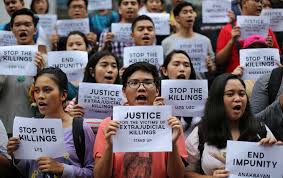
And you should speak out about them. You should complain and protest. You should demand that things should be better, and you should go out there to try to make them better. It is perfectly all right for you to march, to picket and even to go Noynoying.
Just don’t believe those who say it was much better before.
You’ll hear it from Marcos’s old allies.
You’ll hear it from those who simply don’t like democracy, who find it inconvenient because it keeps them from acquiring more wealth and more power.
You’ll hear from those who just can’t stand ideas they don’t agree with, who arrogantly think they have all the answers and must therefore have all the power.
They’ll present themselves as the nation’s saviors based on twisted claims. Some would point to their military discipline and experience. Others would claim to have the correct political line base on historical truths. Some would claim to have god on their side.
Don’t trust the liars and the bullies. Democracy can be messy and chaotic. But the alternatives are even messier. They create a false, deceptive sense of “peace and order.”
A delusion.
Like the cartoon shows I watched the day Marcos’s dictatorship began its reign of destruction.
THERE has never been a more opportune—or important— time to read about Martial Law. Between the current discussion on emergency powers or the debate over the possible burial of former President Ferdinand Marcos at the Libingan ng mga Bayani, there has never been a greater need for explanatory reportage on what happened beginning in September of 1972 when Filipinos first heard of Proclamation No. 1081.
Perhaps this is also because there is a noticeable wave of denials about the human rights violations committed by the Marcos regime. Perhaps it is because even Malacañang’s online gazette—whether intentionally or not—initially omitted references to Martial Law and Marcos’ subsequent exile.
So there has never been a better time to read “Marcos Martial Law: Never Again” by Raissa Robles, edited by Alan Robles (Filipinos For A Better Philippines, Quezon City, 2016, 268 pages).
This oversized book has an outsized purpose. “This is merely a short and compact introduction to the atrocities and torture committed by the Martial Law regime,” the journalist Robles writes in her introduction. “It is not a detailed history of Martial Law nor is it a biography of Ferdinand Marcos. Those elements are mentioned in order to put the atrocities in context.”
Yet “Never Again” is extremely detailed in its chronicle of the Marcos machine’s brutality during that particular period in time. The “Never Again” part of the title clearly establishes how the author feels about martial law, but that never gets in the way of her reportage.
That does not dull the bloodletting conclusions: “Marcos’ regime was a grisly one-stop butcher shop for human rights abuses, a system that swiftly turned citizens into victims by dispensing with inconvenient requirements such as constitutional protections, basic rights, due process and evidence.”
Tortured and abused
Relentlessly and precisely, Robles tells the stories of those who were tortured and otherwise abused by the authorities during the Marcos years. This includes the ones whom we may already know about and those we don’t. It includes those who survived (Pete Lacaba,
Hilda Narciso) and those who didn’t (Eman Lacaba, Luis Manuel Mijares). It is proof that Proclamation 1081 is not a mere announcement but a turn of the screw that was spelled out with lost lives and scarred futures.
Robles surveys the twisted landscape of the particularly chilling is Robles’ explanation of the various techniques employed by interrogators—some with illustrations or photographs—such as the “San Juanico Bridge,” “Pompyang” and “Wet Submarine.” This is complemented by a recollection of the centuries-old tradition of torture in Philippine society, as well as the legacy of such actions, stretching into the post-Marcos years.
This isn’t hysterical all-caps polemical yelling. This is a logical and exhaustive presentation of the facts dealing with arrests and torture during Martial Law, backed, literally by 40 pages of notes, sworn statement, evidence and affidavits at the end of “Never Again.” There are many sub stories told virtually in the victims’ own words, or those of the activists and investigators.
While dealing out the horrifying truth, “Never Again” is masterfully designed by Felix Mago Miguel and features an illuminating foreword by Rene Saguisag.
While those who grew up and lived during martial law will find answers in “Never Again,” it is those who didn’t have to live through Martial Law, those who were born after it, who should consider this book a must-read. Any credible reflection on what martial law really was requires a reading of “Never Again.”
While physically big, “Marcos Martial Law: Never Again” is also figuratively the big book of Martial Law, standing as a definitive chronicle of this terrible time in Philippine history, especially for those who will inherit its consequences.
(SPOT.ph) Editor’s Note: This is a repost of Mr. Pete Lacaba’s September 1995 column for the Philippine Graphic. Mr. Lacaba is a journalist, scriptwriter, poet, and editor. He is a University of the Philippines Gawad Plaridel awardee, and has received a Carlos Palanca Memorial Award for Poetry in Filipino.
***
I wrote the following memories of martial law for a column I used to write for Philippine Graphic weekly magazine. It came out in a September 1995 issue. If memory serves, the unnamed friend mentioned in this column is lawyer Rene Saguisag.
***
When word got around a few years ago that a class suit was going to be filed against the Marcoses, I took note of it more as a news item than as a personal issue. I virtually ignored the forms that had come in the mail, asking me to recount the torture I had undergone under martial rule.
One week before the deadline for the submission of the depositions of torture victims, a friend called and asked why I hadn’t submitted mine. My friend said that, if not enough depositions were submitted to the Hawaii court, the Marcoses would be proven right in their contention that they were not world-class torturers and executioners, and they would be justified in asking for a dismissal of the case.
What needed to be done, my friend pointed out, was not primarily to get financial reparation for the harm that had been done to us, but to prove to the world that the Marcos regime had indeed been guilty of widespread and systematic torture and extrajudicial executions. If the class suit said there were around 10,000 victims of human-rights violations under Marcos, then it needed to get as close to 10,000 depositions as it could.
My friend’s arguments persuaded me to write the following account, which was submitted along with the requisite forms just a few days before the deadline set by the court for the submission of depositions:
***
At dawn of April 25, 1974, on the second year of martial law, I was awakened by shouts of: “Open up! We are the authorities!” I looked out and saw that the house was surrounded by armed men taking cover behind jeeps and cars that had their headlights on.
As soon as I opened the door, the first man who came in shoved the barrel of his rifle into my stomach. Then somebody spun me around and forced me to lie face down on the floor. In that position, I was stepped on, kicked in the ribs, hit in the back and on the back of the head with rifle butts.
After the house had been searched and my two house companions were in custody, someone who acted as though he was in command (I would learn later that he was a first lieutenant, but not the head of the raiding party) dragged me into the bathroom and asked if there was a tunnel underneath us. I couldn’t help giving a short laugh, struck by the absurdity of the question. Angered by my response, he gave me a sudden blow in the chest with his closed fist. The lieutenant was an Arnold Schwarzenegger pumping-iron type, and at that time I was a 111-pound weakling. That single punch sent me reeling against the bathroom’s tiled wall.
The sun was up when we were taken in separate cars to Camp Crame in Quezon City, to the headquarters of the 5th Constabulary Security Unit (5CSU). After some routine questioning and filling up of forms in the office, I was taken to the back, the troops’ sleeping quarters. Constabulary officers and enlisted men—including a buck private who was himself under detention, for murder—took turns making me a punching bag.
Mostly I was pummelled with fists in the chest and the stomach. I was seated on the edge of a steel cot. My tormentors and interrogators sat in chairs or stood before me, hitting me each time a question was asked or an answer was unsatisfactory. Troopers passing by, on their way to their lockers or wherever, felt free to hit my nape or the back of my head with open palms or karate chops.
At one point I was made to half-squat with arms outstretched. One of my torturers then took a broom and slowly, methodically beat my shins with the broom’s wooden handle. Although he seemed to be hitting me with very little force, the cumulative effect of the beating caused my shins to swell and made it sore and sensitive for a few days.
At another point I was made to lie down with the back of my head resting on the edge of one steel cot, both my feet resting on the edge of another cot, my arms straight at my sides, and my stiffened body hanging in midair. This was the torture they called higa sa hangin (lying down in air), also known as the San Juanico Bridge, named after the country’s longest bridge, built during martial law and dedicated by Marcos to his wife Imelda.
“Lying down in air” is difficult enough, since you have to contend with the pull of gravity. But even before gravity could take its toll, somebody standing close by would give me a kick in the stomach and bring my body down to the floor. The steel cot scraped skin off my nape as I slid down.
I was forced to “lie down in air” twice. The third time I simply refused to get up. I stayed crumpled on the floor and said, “You may as well just kill me. Go ahead and kill me.” That was when the torture stopped for the day.
I had been continuously tortured for about eight hours. Incredibly enough, we even had a lunch break. I forced myself to finish up the horrid prison food on the aluminum army tray that they placed before me, hoping that when they resumed hitting me in the stomach I would throw up in their faces. I never did.
I can no longer remember the exact sequence of events, but in the days that followed, during the fortnight when we were incommunicado and our families went desperately from camp to camp looking for us, I experienced various other forms of harassment and torture.
Once, while a deposition was being taken, the sergeant conducting the interrogation suddenly kicked me in the chest. We were both seated in one corner of the 5CSU office, face to face, and I insisted on answering only questions pertaining to myself, refusing to answer those that would implicate other people. After the nth “I prefer not to answer that question,” he raised his booted foot and gave me a kick in the chest that sent the chair on which I was seated skidding clear across the room. When the chair hit the wall, I fell to the floor.
On another occasion, a lieutenant reviewing my deposition made me stand in front of an air conditioner going full blast while he interrogated me. And he smiled when he saw that I was shivering uncontrollably.
On still another occasion, another lieutenant ordered me to close my eyes in the course of an interrogation. A hand that I assumed to be the lieutenant’s then slapped my closed eyes and my nape repeatedly, almost rhythmically.
Once, the detained soldier who had been one of my torturers on my first day took me out of the cramped prison cell that I shared with about 30 other political prisoners. He gave me a tongue-lashing for having poked fun at his rather unusual name. While he was spewing saliva in my face, his fellow soldiers gave me a few jabs in the ribs.
One day I was led out of the small prison cell, handcuffed, and made to board a jeep with three or four of the men who had tortured me on my first day. I thought for sure this was it, they were going to take me to wherever their killing fields were and blow my brains out. Instead, we went to a military hospital, the V. Luna in Quezon City. I recognized the place because it was there that my father, a war veteran, had died of cancer about a dozen years earlier.
It now seemed to me that my torturers were humane after all, that they would have me treated for the bruises on my nape and shins. But as soon as we were inside a doctor’s clinic in one of the wards, I was blindfolded with my own snot-splattered handkerchief, made to lie down on the examination table, and injected with what I would later surmise to be a “truth serum.” In a couple of minutes I felt like I had downed half a case of beer. My head swam, and my body seemed to float. Once again the third degree began. I can remember talking drunkenly and trying to give misleading answers that would still somehow sound credible to my interrogators.
I don’t know how long the interrogation took before I finally lost consciousness. It was dark when I was roused from sleep, taken to the jeep, and brought back to my prison cell. They had to half-carry me all the way. My legs felt like jelly, and I didn’t seem to have any control over any part of my body, although I kept mumbling my own mantra: “Mind over matter, mind over matter…” The mantra didn’t work.
About two weeks after my arrest, I was taken to the office of the lieutenant who had slapped my closed eyes. He said my wife and my mother were in the other room. They had finally found my place of detention. But the lieutenant said he would only allow me to see them if I would name one name and give one address of a person involved in the underground resistance. “Have pity on your wife and your mother,” he said. “They would very much like to see you.” After a few moments of agonizing, I said I couldn’t do it. He eventually let my wife and my mother come in and talk to me for about 10 minutes, but not after subjecting them for a much longer time to the mental torture of knowing I was just in the other room and fearing they would not be allowed to see me.
I was detained without charges for close to two years. In the first six months of detention, I was made to wash cars and clean the enlisted men’s incredibly filthy latrines. Halfway through my detention I experienced a recurrence of the pulmonary tuberculosis of which I had already been cured before martial law. I had to be confined for about a month at the Quezon Institute, a hospital that specializes in tuberculosis cases. Three shifts of prison guards kept me company.
***
On the basis of close to 10,000 depositions similar, I suppose, to the one above, the Hawaii court declared the Marcoses guilty of human rights violations and ordered them to pay a billion plus, in dollars, as reparation to the claimants in the class suit.
It was, I thought, primarily a moral victory. I joked about what I would do with the loot, but I didn’t really believe there was any way the government or the Marcoses would give a billion plus, in dollars, to victims of human-rights violations, quite a number of whom remain not only nonconformist but also active, militant, even dissident.
Today the papers tell me that a deal is being worked out: if the Marcoses and the government agree to pay 100 million dollars, the claimants will drop all charges against the Marcoses. This is supposed to be a win-win-win solution.
I don’t know what to think. I have friends among both those who defend and those who denounce the deal, and I don’t know what to think. I could be a million dollars richer, but if the Marcoses are absolved of their crimes against humanity, then what I wrote about how I was tortured would turn out to be a lie, a figment of my overheated imagination.
By the numbers: Extrajudicial killings, human rights violations, impunity, corruption, the squandering of our economic dynamism. For the aggrandizement of one family.
Denying Martial Law is a denial of the pain and suffering of victims and their families. Blood money will not assuage that, though it will help the victims. It is a recognition of their suffering, of all they went through, small though it may be. Each check given, each peso dispensed, is a repudiation of Martial Law. It is an acknowledgement of Never Again.
When contemplating Martial Law we almost always begin with the numbers.
They are a good place to begin, but also perhaps not the best place to begin. They are staggering, almost unfathomably so. Looking at them, evaluating them in a vacuum or without contextualizing narratives, almost leaves a person cold to what they represent. The economic costs, on a very high-level, represent almost overwhelming personal loss and ground-level tragedies. The Marcos regime, by the numbers, by the stories and historical context, stands apart in the variety of its depredations: From extra-judicial killings, to corruption, to government-sanctioned policies that turned Filipinos into commodities, to the sheer breadth of institutional and social deconstruction, to the tallies of impunity. An entire social, political, historical, cultural [1], and political order was up-ended, deconstructed, and re-established with one overriding consideration in mind: The aggrandizement of a family.
The Marcos regime, by the numbers, by the stories and historical context, stands apart in the variety of its depredations: From extra-judicial killings, to corruption, to government-sanctioned policies that turned Filipinos into commodities, to the sheer breadth of institutional and social deconstruction, to the tallies of impunity.
This was not some simplistic dichotomy of bayan o sarili. No. The Marcos Era was of a nation subverted to support the whims and wishes of one family. It was the Marcos family appropriating Philippine nationhood. All others, outside of a select coterie of hangers-on, were viewed as vassals. Those who disagreed were treated as refuse; discarded by the sides of roads as grisly warnings against countervailing opinion and perceived “disorder.”
The basic tally of human rights violations usually covers the following [2]:
— During Martial Law, there were 3,275 extra-judicial killings, a number higher than the 2,115 under Pinochet in Chile;
— The military (and the Philippine National Police) tortured 35,000 and jailed 70,000 for any minor “infraction” they deemed;
— 77% of the victims, 2,520, were purposefully “salvaged;” left by roadsides, bloodied, beaten, dismembered, mutilated. They were savage reminders from a repressive regime to anyone who dared speak up or step out of line: This will be you. Fear was Marcos’s currency. The bodies were the tallies.
Behind these numbers were state-sanctioned and created ‘task forces” led by men such as General Fabian Ver or General Fidel Ramos [3] which carried out the policies of terror and state terrorism embraced by Ferdinand Marcos. These roving sanctioned squads (death, torture, and kidnap squads if you will) eventually degenerated from discipline and order maintaining police and military groups into terror wielding mechanisms for oppression and control.
The centralization of power was a critical feature during Martial Law. Undergirding that centralization were carefully cultivated tools wielded by men loyal to Marcos. These weapons were utilized to ensure power was retained by Marcos and his loyalists: Power and control at the expense of civil society and its attendant rights, under the guise of “discipline” and order [4]. History has the ability to give us insight into the present.
What those numbers also represent was an initial willingness on the part of civil society to surrender their hard-won democratic rights for the nominal appearance of “order” and a suspect assertion of broader social “discipline.”
We should not overlook that, on the whole, civil society, for a variety of reasons, was relieved when Martial Law was declared. We were complicit, at least initially, in the establishment of Martial Law and willingly allowed Marcos to begin rapidly consolidating and centralizing power. A Faustian bargain if there ever was one, as Alfred McCoy called the early collaboration of civil society with Marcos’s Martial Law.
Perhaps that complicity somehow still weighs on our collective conscience. Perhaps that guilt still, subconsciously, informs our collective denialism and forgetfulness.
Many of those victims, the 35,000 tortured, the 70,000 imprisoned, have only recently been awarded financial compensation; despite a more than one legal case being awarded in their favor.
Many of those victims, the 35,000 tortured, the 70,000 imprisoned, have only recently been awarded financial compensation; despite a more than one legal case being awarded in their favor [5]. This dereliction of duty on the part of the Philippine government in the intervening years is another collective stain on our conscience. While they have received compensation, they, and we, are still awaiting closure [6]. We will not find closure and reconciliation without acceptance and understanding, without a reckoning.
For years, at the behest of men like Ramos, we were denied that reckoning, that truth. Denying Martial Law is a denial of the pain and suffering of victims and their families. Blood money will not assuage that, though it will help the victims. It is a recognition of their suffering, of all they went through, small though it may be. Each check given, each peso dispensed, is a repudiation of Martial Law. It is an acknowledgement of Never Again.
There was a darkness that overshadowed Martial Law under the Marcos regime. It is a darkness that continues to haunt us today [7]. One day, we will need to reconcile with the Marcos family and Martial Law. But, reconciliation requires atonement. It demands recognition of faults, flaws, and failings from all sides, as well as an apology and acceptance of what was taken, what we lost. That is the only way to banish the darkness.
One day, we will need to reconcile with the Marcos family and Martial Law. But, reconciliation requires atonement. It demands recognition of faults, flaws, and failings from all sides, as well as an apology and acceptance of what was taken, what we lost.
To the count above, we must also include the scope of loss in Mindanao. We often remember the sheer savagery, the betrayal, of the Jabidah Massacre. However, we do not remember the overwhelming cost that came after Jabidah, when Marcos began to prosecute a campaign of suppression in Mindanao reminiscent of the United State massacres a half century earlier. The count includes 60,000-80,000 Filipinos dead within a seven year period (1965-1976), hundreds of thousands displaced, and billions of dollars in estimated economic loss [8]. Those are staggering numbers by any measure. When they are combined with the traditionally counted tally of human rights violations it speaks to an almost overwhelmingly destructive period in our history. Much like the aftermath of the Spanish-American War or the Japanese Occupation, the end of the Marcos era saw the loss of a generation of leaders and activists. We are still paying for those losses today.
Estimates are the Marcoses alone plundered around ten billion dollars, this does not include assets or companies confiscated and entrusted to others. Of that, the Philippine government has identified and reclaimed approximately four billion dollars worth of assets and bank accounts. But, again, more is still being discovered.
The most pointed public criticism of the Marcos regime, even more than the voluminous human rights violations, is usually reserved for the sheer breadth of plundering that took place during Martial Law. Corporations where confiscated under the guise of nationalization and entrusted in the hands of cronies and hangers on. More than one of those cronies, who acted as guardians of Marcos wealth, are among the wealthiest in the Philippines. Imelda Marcos has admitted, nay bragged, about how they owned and controlled all corporations in the Philippines [9]. This did not occur by happenstance, nor did their wealth and control of these companies exist prior to 1972. But, because of our relatively benighted historical sense, many actually believe these obfuscations and verbal chicanery. More stunningly, new ‘fruits’ of corruption continue to be found today. For example, Imelda’s former secretary was recently indicted in the United States for holding missing artwork, ostensibly part of the fabled Marcos loot [10]. Estimates are the Marcoses alone plundered around ten billion dollars, this does not include assets or companies confiscated and entrusted to others. Of that, the Philippine government has identified and reclaimed approximately four billion dollars worth of assets and bank accounts. But, again, more is still being discovered. Just two years ago, Imee Marcos was linked to hidden offshore trust accounts, which likely hold more of the lost wealth [11
Far from a Golden Age, a number of economists have aptly demonstrated that the Marcos regime witnessed the dissolution of the Philippines as an economic power in the region. Growth was very shallow, in fact any growth was marked by further impoverishment during the Marcos Era.
The common riposte to discussing Marcos plunder and wealth is either to deny it ever occurred or imply the plunder is excusable because of the accomplishments of Marcos as president [12]. With regards to the accumulation of vast quantities of wealth, it is illuminating to contextualize what was happening in the Philippine economy on a macro-level during his reign. Far from a Golden Age, a number of economists have aptly demonstrated that the Marcos regime witnessed the dissolution of the Philippines as an economic power in the region. Growth was very shallow, in fact any growth was marked by further impoverishment during the Marcos Era. For example, in 1962 the GDP per capita was $495, by 1986 it was $540; a minimal uptick, almost statistically insignificant. Our neighbors witnessed far more explosive and consistent growth across the board; as a matter of fact, we were the only major Asian economy to experience such limited growth, in reality decline in real terms.
Marcos squandered our economic dynamism and turned us into a cesspool of inequality and a country undone by poverty.
Thailand’s GDP per capita grew from $345 (1962) to $760 (1986) [13]. Taiwan’s expanded from $505 to $3,790 over the same period, while South Korea saw phenomenal growth from $330 to $2,345. Marcos squandered our economic dynamism and turned us into a cesspool of inequality and a country undone by poverty. From the same source, as above, our debt by 1986 was $27.2 billion. Compared to the countries above, Thailand’s was $18.7 billion, Taiwan’s $12.7 billion, and South Korea was $54.5 billion. However, debt-to-GDP was: 0.90 for the Philippines, 0.47 for Thailand, 0.17 for Taiwan, and 0.56 for South Korea. Finally, it is worthwhile discussing poverty briefly. In 1965, national poverty incidence was rated at 41%, by 1971 it was 43.8%, and in 1975 it was 51.5%. 1985 estimates were 58.9%. In 1983, Mangahas estimated poverty incidence at around 55% [24].
If that is the Golden Age to which the Marcoses and their loyalists wish to return us, then the historical denialism runs deeper than originally thought.
This is the second of a three-part series outlining our contemporary remembrance of Martial Law, released to mark the 44th anniversary of its declaration. The first in the series, “Why has Marcos’ propaganda lived on?” examines the effects of Martial Law denialism, perhaps best manifested in the Marcos clan’s continued rise in political power. The close of this series will be released tomorrow.
FOOTNOTES
[1] “Socio-economic failure, national fragmentation, civic inaction and indifference can be traced to the Filipinos’ lack of consciousness for Philippine history and culture, the core of national identity. While the Aquino government may not have bequeathed substantial subsidy for culture, it has provided five years of freedom. Artists and cultural managers no longer need fear imprisonment for criticizing or differing with the government. People Power and Aquino’s government have assured the right to have an opinion and make it known.” – Felice Sta. Maria, November 17, 1991.
[3] Side note: Of course, Ramos went on to become President of the Philippines. However, relatively unremarked in evaluating his presidency is Ramos’s complicity in upholding the impunity that occurred during Martial Law, and by his hand. He moved to offer absolute amnesty of torturers, many of them were his men. He raised instruments of impunity to high positions within his government. Ramos even went so far as to stymy the awarding of sequestered Swiss accounts owned by the Marcos family to human rights victims. It was only recently, under the Aquino administration, that finally Marcos human rights victims were awarded any compensation.
4] “Over the longer term, however, the regime’s reliance on this police power for covert control harbored a fatal contradiction. Along with his imposition of order Marcos created constabulatory antisubversion squads, arming them with both formal decrees and informal impunity to suppress pro-democracy dissidents. After five years of ‘constitutional authoritarianism,’ Marcos’s security squads shifted from formal mass arrests to extrajudicial operations. At his [Marcos] regime’s celebrated ‘discipline’ degenerated into systemic state terror and conspicuous corruption, citizens sense the failure of their Faustian bargain with dictatorship, swapping democracy for stability, and slowly withdrew their support. Marcos’s legitimacy faded, opposition grew, and in the end his massive police and military apparatus retreated before a million outraged citizens massed on Manila’s streets. Law and order were central to the regime’s early acceptance, but this legitimacy was undermined over time by the same police apparatus that had been used to impose order.” pg. 397-398, “Policing America’s Empire” by Alfred W. McCoy.
[5] The World Bank’s Stole Asset Recovery Initiative has an excellent summary of the various cases against Ferdinand and Imelda Marcos and the history of the Swiss Marcos account saga: “The Marcos case began in 1986 when the Federal Council ordered bank accounts to be frozen. In 1990, the Swiss Federal Supreme Court approved the handover to the Phillippines [sic] of bank documents relating to the Marcos family, but ruled that the actual return of assets would be conditional upon a final and absolute judgment by a Phillippine [sic] court. In 1997, the Court established that the majority of the Marcos foundation assets were of criminal origin and permitted their transfer to a escrow account in Manila, even though no Phillippine [sic] court ruling had yet been issued.”
[6] It is worth noting that the decision on the part of the Swiss government to allow the Philippine government to use the Marcos Swiss accounts to compensate human rights victims demonstrates that the funds were ill-gotten. As a matter of fact, they specifically said so in their decision. A recent post by SWI titled “Political Will guides Marcos case in the Philippines” discusses this, and how the Marcos case has become a model for the restitution of stolen fund: “The freezing of Marcos’ Swiss bank deposits in 1986 was the first time the Swiss government set out to return such funds to their rightful owners…The $685 million that the Swiss blocked in Marcos’ accounts is “one of the largest sums ever returned by any government to a country formerly ruled by a kleptocratic regime”, Swiss foreign ministry spokesman Stefan von Below told swissinfo.ch.”
[7] This darkness is not just a shadow, but a purposeful continuing obscuration of what occurred, aided and abetted by the Marcos family. The sole purpose of the Marcos family political ambitions, from the lips of Imelda Marcos and Bongbong Marcos, is to redeem their family and resurrect their version of history. Each vote for a Marcos is seen by them as another step towards redemption. “This is part of the family’s plan to change history and make sure that the public, particularly the new generation of Filipinos, will not know about what transpired in the past,” said political analyst Ramon Casiple of the Institute for Political and Electoral Reform in Manila,” quoted in Al Jazeera’s “Philippines hunts for Marcos’ plundered art”.
[9] “We practically own everything in the Philippines—from electricity, telecommunications, airline, banking, beer and tobacco, newspaper publishing, television stations, shipping, oil and mining, hotels and beach resorts, down to coconut milling, small farms, real estate and insurance,” said Imelda Marcos, talking to the Inquirer in 1998 while she disclosed her plan to file an intervention suit against the cronies of her husband,” from “Regime of Marcoses, cronies, and kleptocracy”by Ana Roa, Philippine Inquirer.
[10] “The issue came to the fore again late last year, when Mrs Marcos’ former aide, Vilma Bautista, appeared in a New York court charged with illegally selling a Monet painting,” quote from “What happened to the Marcos fortune?”by Kate McGeown.
[11] “The hardworking and popular provincial governor — widely known as Imee Marcos — is one of the beneficiaries of the Sintra Trust, which financial records uncovered by the International Consortium of Investigative Journalists show to have been formed in June 2002 in the British Virgin Islands. Other beneficiaries are Imee Marcos’ adult sons with estranged husband Tomas Manotoc: Ferdinand Richard Michael Marcos Manotoc, Matthew Joseph Marcos Manotoc, and Fernando Martin Marcos Manotoc.” – PCIJ “Ferdinand Marcos’s daughter tied to offshore trust in the Caribbean”
[12] I will just discuss one example of the wayward misguided priorities of Marcos infrastructure projects in this footnote. One of the key projects noted in defending Marcos are his ‘health’ initiatives, namely the Philippine Heart Center for Asia, the Kidney Foundation of the Philippines, and the Lung Center of the Philippines. Combined these three projects cost the Philippine government $229 million in subsidies. The total Philippine government funding for primary care, at that time was $45 million (Boyce). Imagine how many poor and impoverished Filipinos could have been saved, how far the infant mortality rate could have dropped or malnutrition addressed, if that $229 million was funneled into broader healthcare initiatives. The focus of the Philippine government on providing healthcare for the elite, at the cost of the poor, aptly demonstrates their preferences and loyalties.
[13] Source: “The Political Economy of Growth and Impoverishment in the Marcos Era” by James K. Boyce.
[14] Boyce, in the book cited above, has a long involved discussion of poverty ratings and the various idiosyncratic methods utilized for estimating poverty. The discussion takes place from pages 45 to 50. His conclusion though, is that poverty exploded during the Marcos regime: “But there can be little doubt that many poor families experienced drastic declines in real income,” pg. 53.
IMAGE The Philippines Free Press Magazine via The Presidential Museum and Library
In the years leading up to Ferdinand Marcos’ declaration of Martial Law, The Philippines Free Press was one among a handful of publications that were unrelenting in their critique of his administration. The Free Press published articles about social, political, and economic issues that helped its readers form a dissenting opinion about Marcos and the path down which he was leading our country—which of course meant that by the fateful evening of September 22, 1972, it was among the publications that were shut down.
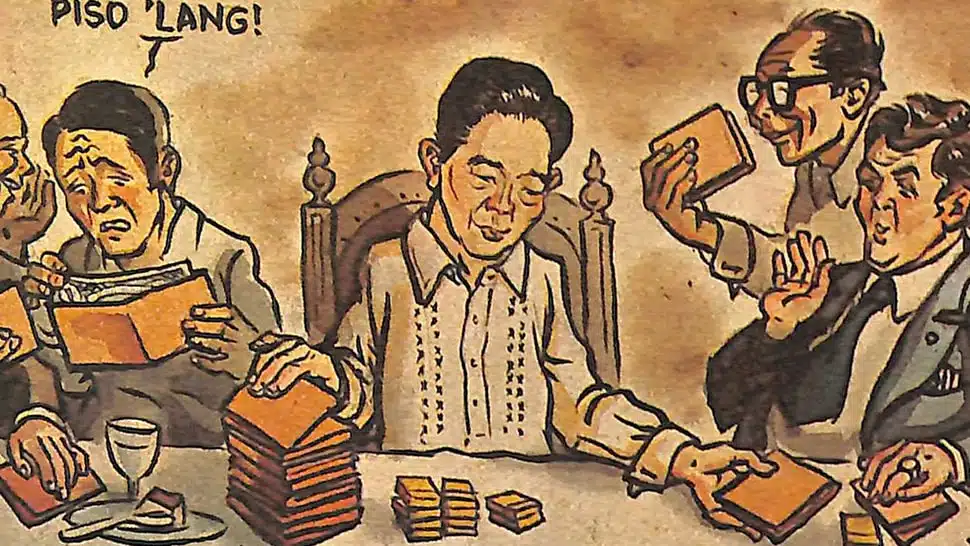
Among the ways that the Free Press expressed its views was through editorial cartoons. Today, it’s a somewhat forgotten art that’s been supplanted by political memes, but in a time before the internet, editorial cartoons were a great visual method for expressing a political opinion. The Free Press published many that were highly critical of the Marcos administration, of which some are uploaded in the public Flickr account of the 2010-2016 Presidential Museum and Library. Here are some of the best ones:
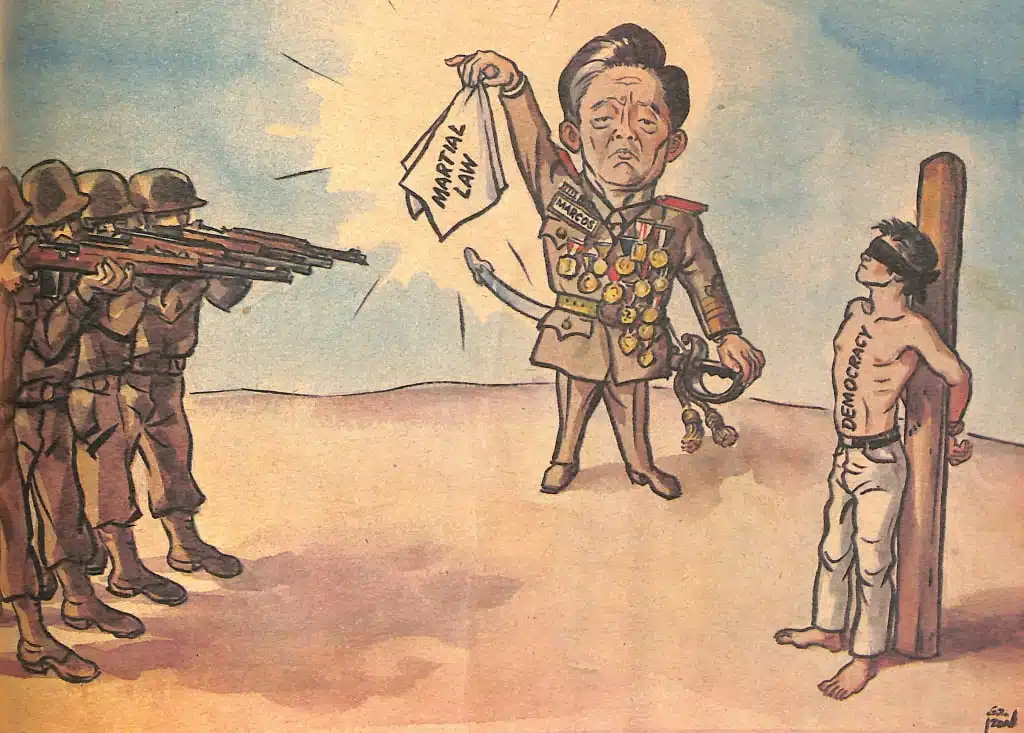
Martial law was the white cloth that a heavily-bemedalled Marcos had only to drop to seal democracy’s death by firing squad.
IMAGE The Philippines Free Press Magazine via The Presidential Museum and Library
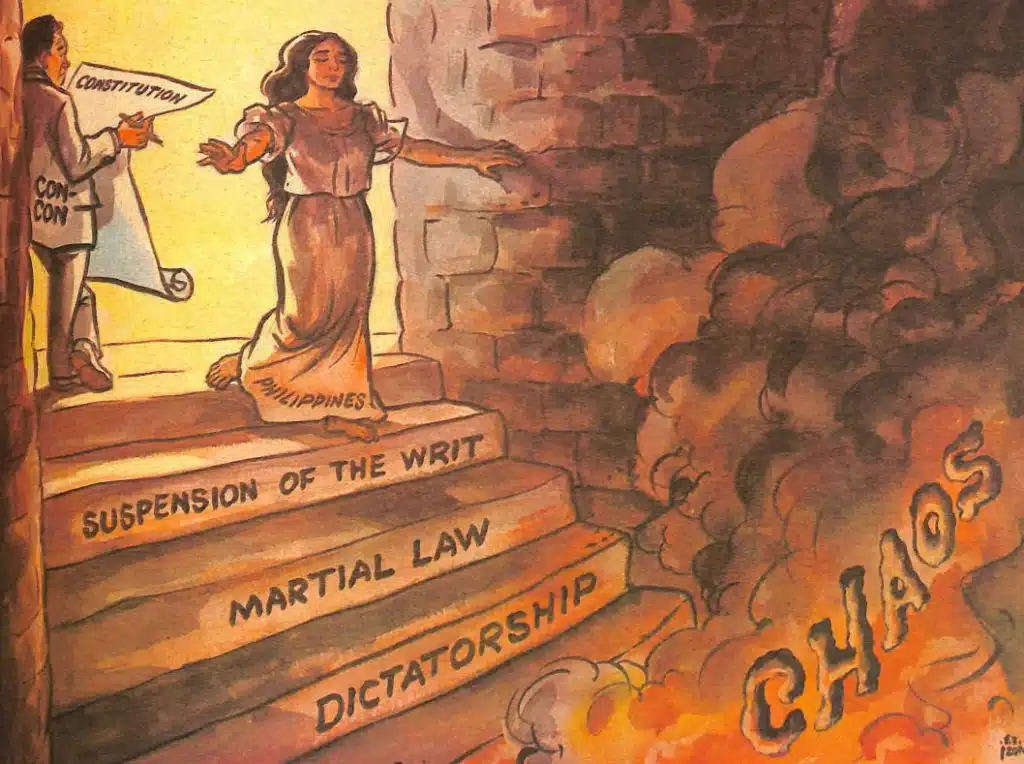
Many of the Free Press’ editorial cartoons portrayed the Philippines as a woman, seen here descending blindly into chaos, step by step, as the delegates of the 1970 Constitutional Convention—which would eventually draft the 1973 Constitution that would keep Marcos in power—just watched on apathetically.
MAGE The Philippines Free Press Magazine via The Presidential Museum and Library
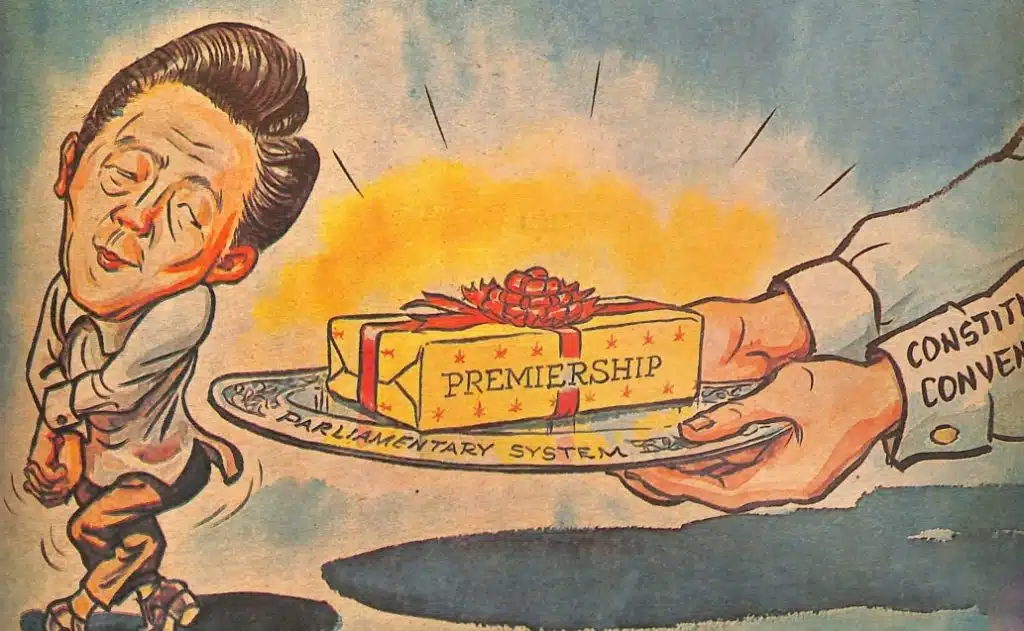
The Free Press knew that the Constitutional Convention was going to hand Marcos everything he wanted on a silver platter.
IMAGE The Philippines Free Press Magazine via The Presidential Museum and Library
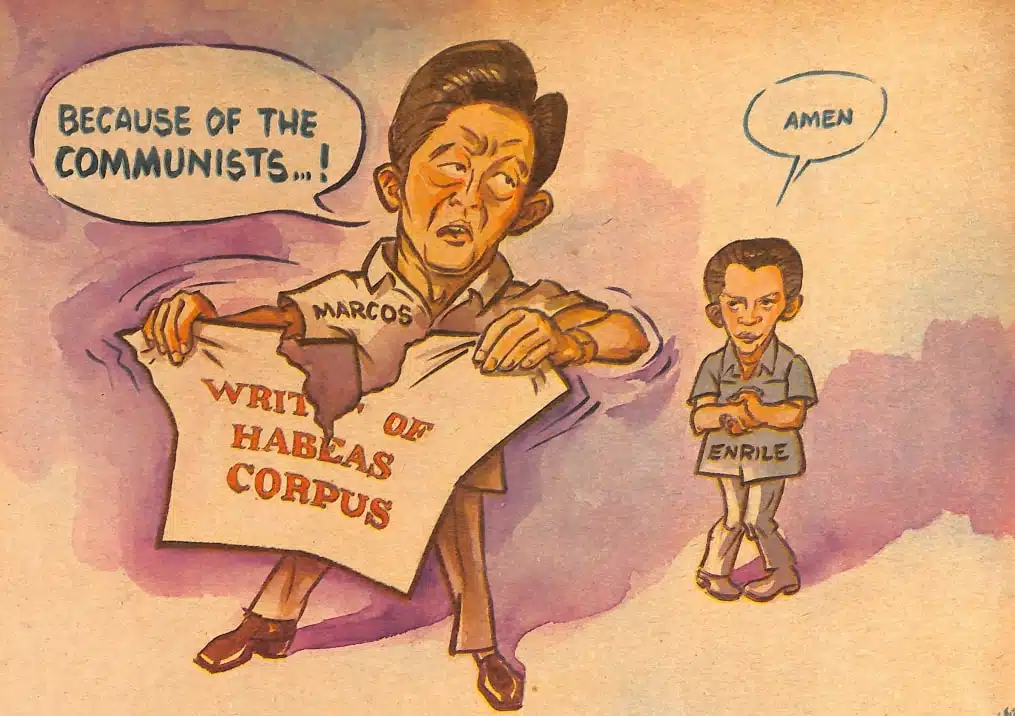
Like many strongmen before him, Ferdinand Marcos used the looming threat of Communism to wrest power, first by suspending the writ of habeas corpus.
IMAGE The Philippines Free Press Magazine via The Presidential Museum and Library
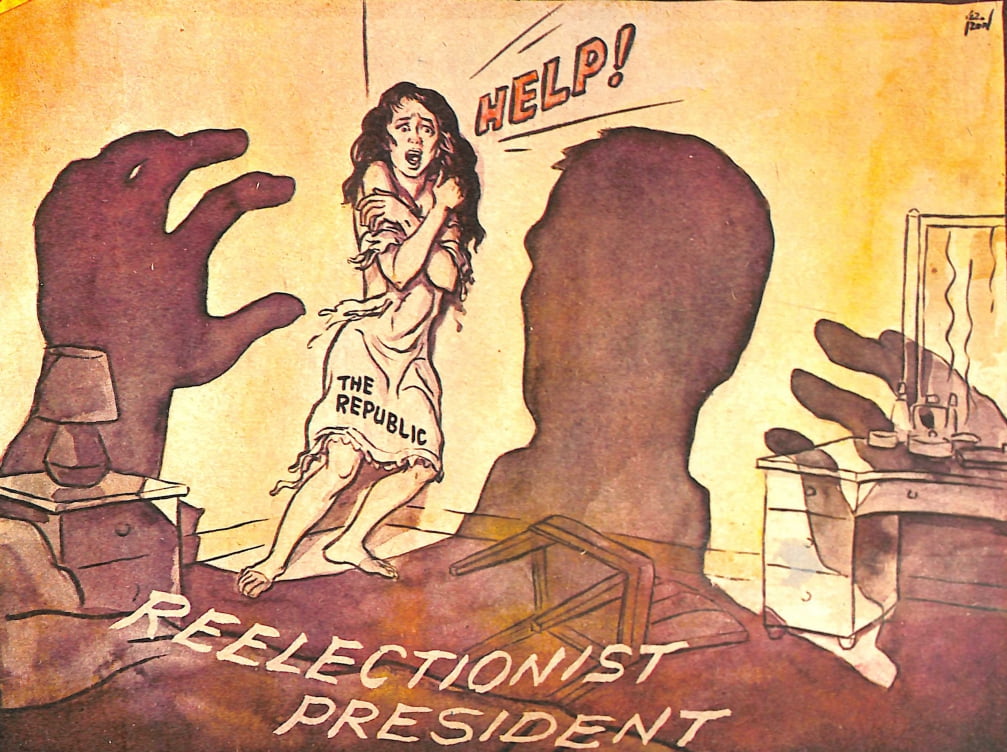
In another cartoon that depicts the Philippines as a woman, a power-hungry president who was looking to extend his term is depicted as a rapist.
IMAGE The Philippines Free Press Magazine via The Presidential Museum and Library
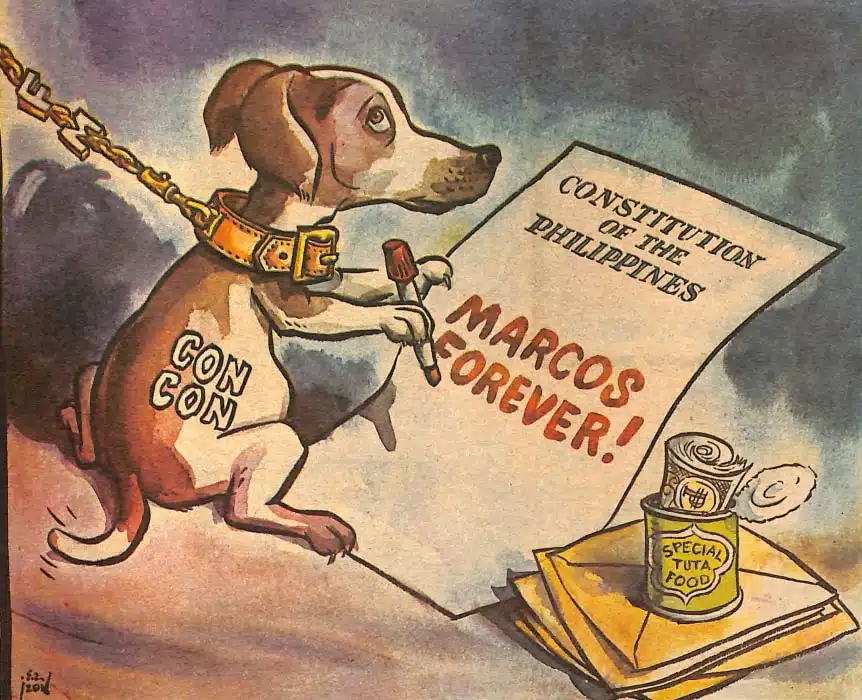
Many of the editorial cartoons depicted the delegates of the constitutional convention as dogs: tuta ni Marcos, as they say. It’s almost a cute cartoon—a dog drafting the constitution with some “Special Tuta Food” on the side—until you realize that this effectively made Marcos a dictator.
IMAGE The Philippines Free Press Magazine via The Presidential Museum and Library
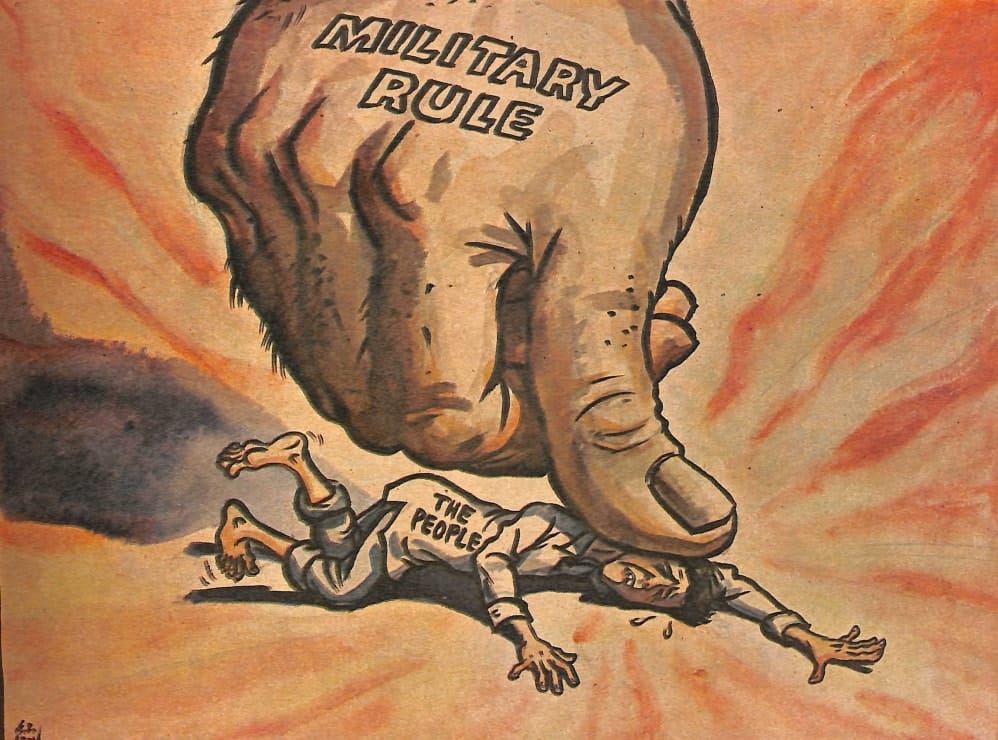
Here’s a straightforward one that’s just as true as the rest: military rule was a large hand that pinned people down on their heads.
IMAGE The Philippines Free Press Magazine via The Presidential Museum and Library
In the years leading up to Ferdinand Marcos’ declaration of Martial Law, The Philippines Free Press was one among a handful of publications that were unrelenting in their critique of his administration. The Free Press published articles about social, political, and economic issues that helped its readers form a dissenting opinion about Marcos and the path down which he was leading our country—which of course meant that by the fateful evening of September 22, 1972, it was among the publications that were shut down.
Among the ways that the Free Press expressed its views was through editorial cartoons. Today, it’s a somewhat forgotten art that’s been supplanted by political memes, but in a time before the internet, editorial cartoons were a great visual method for expressing a political opinion. The Free Press published many that were highly critical of the Marcos administration, of which some are uploaded in the public Flickr account of the 2010-2016 Presidential Museum and Library. Here are some of the best ones: ADVERTISEMENT – CONTINUE READING BELOW
Martial law was the white cloth that a heavily-bemedalled Marcos had only to drop to seal democracy’s death by firing squad.
IMAGE The Philippines Free Press Magazine via The Presidential Museum and Library
Many of the Free Press’ editorial cartoons portrayed the Philippines as a woman, seen here descending blindly into chaos, step by step, as the delegates of the 1970 Constitutional Convention—which would eventually draft the 1973 Constitution that would keep Marcos in power—just watched on apathetically. ADVERTISEMENT – CONTINUE READING BELOW
IMAGE The Philippines Free Press Magazine via The Presidential Museum and Library
The Free Press knew that the Constitutional Convention was going to hand Marcos everything he wanted on a silver platter.
IMAGE The Philippines Free Press Magazine via The Presidential Museum and Library
Like many strongmen before him, Ferdinand Marcos used the looming threat of Communism to wrest power, first by suspending the writ of habeas corpus.
IMAGE The Philippines Free Press Magazine via The Presidential Museum and Library
In another cartoon that depicts the Philippines as a woman, a power-hungry president who was looking to extend his term is depicted as a rapist. ADVERTISEMENT – CONTINUE READING BELOW
IMAGE The Philippines Free Press Magazine via The Presidential Museum and Library
Many of the editorial cartoons depicted the delegates of the constitutional convention as dogs: tuta ni Marcos, as they say. It’s almost a cute cartoon—a dog drafting the constitution with some “Special Tuta Food” on the side—until you realize that this effectively made Marcos a dictator. ADVERTISEMENT – CONTINUE READING BELOW
IMAGE The Philippines Free Press Magazine via The Presidential Museum and Library
Here’s a straightforward one that’s just as true as the rest: military rule was a large hand that pinned people down on their heads.
MAGE The Philippines Free Press Magazine via The Presidential Museum and Library
When the Con-Con delegates weren’t drawn as dogs, they were drawn as buwaya, or crocodiles—still a common animal used to refer to authorities who can be bought off. This particular cartoon shows the luxury that they bought with the freedom of our country.
IMAGE The Philippines Free Press Magazine via The Presidential Museum and Library
This cartoon shows how Marcos enacted his tyranny: by targeting the oligarchs who would oppose him, and assembling a new elite who would back him. Meanwhile, someone who looks like Mad Magazine’s Alfred E. Neuman, an American icon, just sits back and watches.
IMAGE The Philippines Free Press Magazine via The Presidential Museum and Library
And this one shows how Marcos earned the allegiance of the military: by filling their pockets with the people’s money, which he would siphon using his “juggling techniques.”
MAGE The Philippines Free Press Magazine via The Presidential Museum and Library
The story takes place during one of the most tumultuous periods in our national history—it is therefore a complex one, with a degree of subjectivity to its beginning and end. Today it is the stuff of literary lore—cunning trumps censure—and like many legendary accounts, it is polished now from all the reverent handling.
One version of this story has us begin in 1973, a year after Proclamation 1081 was announced, placing the entire country under martial law, to the relief of citizens desperate for discipline. Crime was on the wane; peace was prime. Manila mornings were bright under Ferdinand Marcos’ Bagong Lipunan, the reverent, mannerly new order keeping at bay the country’s negative elements: hippies and pinkoes looking to make trouble, godless and lawless and just plain gross. At night, the city curled up under curfew with a justified willingness; if you were out late at night, after all, weren’t you up to no good?
There was no opposition party to rock the boat, no independent judicial body to hamper the now free wheels of justice. Even the media muckrakers were in the sewers with the filth. Proper writers wrote for the government now, in proper consultancy positions, with the Army Office of Civil Relations making sure their work aligned with the Bagong Lipunan vision, from title to final full stop.
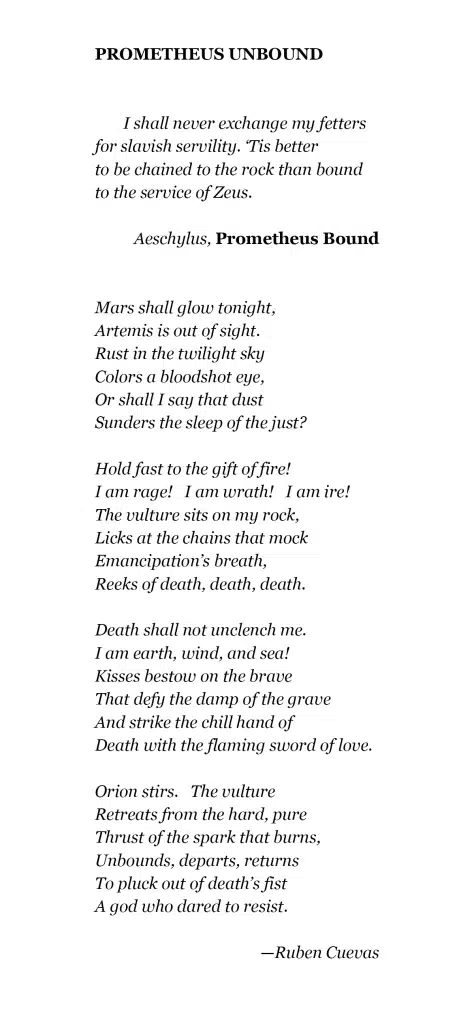
Which was exactly how state-allied editors found the poem “Prometheus Unbound”. Written by one Ruben Cuevas and published by Focus Magazine, it was the myth of Prometheus picked up where Percy Bysshe Shelley left off. His avian tormentors about him, the titan finally escapes from the chains that bind him. Prometheus the populist, triumphant in the freedom previously denied him as the patron of craftsmen, the giver of fire to mortals.
With a classic motif, a politically moderate subject, elaborate rhyming couplés, and iambs as martial as goose steps in the grandstand, “Prometheus Unbound” represented all that was estimable under Marcosian poetics, the literary equivalent of crew cut hair and home by 21:00.
Sometime later, however, Focus staff were alerted to an alarming thing: “Prometheus Unbound” turned out to be an acrostic, in which the first letters of each line, when read downwards, spelled out a message different from that of the rest of the poem. The magazine’s editor-in-chief was summoned for a reprimand by the press secretary himself as some sources recall; the literary editor was promptly sacked. The identity of Ruben Cuevas was investigated. And men in uniform rushed from newsstand to newsstand, pulling any remaining copies of Focus, that Marcos-allied publication which now carried the opposition’s favorite slogan, chanted and printed alike at lighting rallies and on contraband manifestos, “Marcos Hitler Diktador Tuta”.
The Switch
Our story’s other version has us begin on January, 1970. Students and activists in Manila and the country’s other urban areas were protesting a myriad of issues, from rights civil and human to women and worker. They decried the encroachment of the United States on the Philippines as a colonial influence, the continuing manipulation by a small oligarchy of the country’s political and economic affairs. Tensions rose, and in what is now known as the First Quarter Storm, clashes between protesters and the constabulary began in earnest.
At the front lines was a journalist named Jose Maria Flores Lacaba, known simply as Pete. The eldest of six children, Lacaba is Cagayan de Oro-born and Pateros-raised. A fan of local radio, Tagalog komiks, and the weekly Balagtasan, Lacaba’s class consciousness was tempered at an early age as a disadvantaged scholar surrounded by the rich students of Ateneo de Manila—a school he was forced to drop out of when his finances finally gave. “I was just 19 when I started writing for the Free Press, handling culture and the arts,” he recounts to Esquire. It was the only job available to someone without a college degree. The brutal dispersals he witnessed in the skirmishes of January 26 and 30 edged Lacaba ever closer to a critical stance against the regime and the system it perpetuated. A younger brother, Emmanuel, known to friends and family as Eman, would share with the elder Lacaba this political coming of age.
“In 1971, I began to take an active role in union organizing. When we lost our union’s certification election, the whole Free Press staff resigned en masse.” Lacaba, along with Free Press veterans Nick Joaquin and Gregorio Brillantes, started a new magazine, the Asia Philippines Reader. “We did our best to be balanced, but becoming politicized was unavoidable, especially after the Plaza Miranda incident,” in which a Liberal Party campaign rally was bombed, killing nine and injuring 95 others.
Shortly after martial law was declared, Lacaba heard from relatives that a military unit had been looking for him at their family home in Pateros, a lucky break brought about by outdated intelligence, for Lacaba had since moved to Quezon City. Knowing that he was now a hunted man, Lacaba joined the underground press.
“Our publication was called Taliba ng Bayan,” he says. It began as a monthly, mimeographed publication before the staff eventually found a sympathetic printing press. As a wanted man, Lacaba’s movements were limited to the Taliba’s various underground houses—his younger colleagues, mostly members of the College Editors Guild of the Philippines, served as stringers. At length, one of these stringers told Lacaba that The Varsitarian, the student paper of the University of Santo Tomas, was interested in publishing his work, as long as it wasn’t too radical.
“I thought about writing an acrostic, as I had written some of those before, for girls,” he laughs. “A lot of anti-government acrostics were being published at the time too, in Tagalog. So I decided to do the same.” Still on the move from one underground house to another, Lacaba composed “Prometheus Unbound”.
Game With High Stakes
The poem makes multiple references, primarily the plays of Greek tragedian Aeschylus and English Romantic poet Percy Bysshe Shelley. “I also wanted to refer to the famous painting by [Flemish artist] Peter Paul Rubens, hence my choice of pen name.” Cuevas, on the other hand, was Lacaba’s nod to the Philippine folk hero Bernardo Carpio, himself a titan, cursed by a shaman to be wedged under the mountains of Montalban, whose mere shrug of his mighty shoulders caused the earth to shake, and whose freedom will coincide with the liberation of the Filipino race.
“Laro lang,” Lacaba says of the poem’s composition. “The first line is a pun on ‘Martial Law tonight’. And Mars isn’t even a Greek god,” he laughs.
Lacaba understood the risks that came with publishing the poem, however. Martial Law, after all, was just a little over a year old, and fear hung heavy in the air like a firearm’s report in the small of dawn. When Lacaba sent the poem to The Varsitarian, he told the stringer to make the acrostic clear to the publication’s editors. “The editors backed out,” Lacaba says. “That’s when I thought to send it to Focus. If memory serves, they were the only government-sanctioned magazine publishing literary works at the time. At nakalusot naman.”
“The first line is a pun on ‘Martial Law tonight’. And Mars isn’t even a Greek god,” Pete Lacaba laughs.
At What Price, Freedom
In April of 1974, Lacaba was finally captured, and was held at Camp Crame where he was routinely tortured. When his childhood pulmonary tuberculosis recurred, he was confined under heavy guard. He joined many other writers imprisoned by the state in camps all over the country, political captives whose biggest crime was to assume the responsibility of check and balance in a subdued society, who had absolutely no recourse for release while the writ of habeas corpus was suspended. They included Bienvenido Lumbera, Jose Y. Dalisay Jr., Ricardo Lee, Lilia Quindoza, Ed Maranan, Luis Teodoro, and Ninotchka Rosca, among many others. The list is long— and shameful.
That same year, Pete was visited by his younger brother, Eman, by then a celebrated poet himself. “Hindi na ako makakadalaw,” Eman said to Pete, who understood at once that his younger brother was about to go underground as well.
Lacaba was set free in 1976, after the intercession of Nick Joaquin, who had made the release a condition following his acceptance of the National Artist award. “As Nick told it, he approached [Juan Ponce] Enrile during the awards ceremony. While they were talking, Marcos overheard them, and assured them of my release. Sure enough, two days after, I was summoned by the head of the constabulary, Fidel Ramos,” Lacaba says. Lacaba was given a conditional release; he was required to report weekly to Camp Crame as proof that he was still above ground and in Manila. “And if I wanted to write, it had to be apolitical.”
It was during the meeting with Ramos that Lacaba was asked if he was related to a certain Manuel Lacaba, who was currently missing in Davao. “I told Ramos that there are many Lacabas in Mindanao. Pero alam ko nang si Eman iyon.” Eman was later found with three others in a shallow grave, his dead body bound and bearing signs of both summary execution and post-mortem mistreatment. His face was so disfigured that his mother would not have recognized him if not for his unique cluster of moles. One of Pete’s first acts as a free man, therefore, was to wait for the corpse of his murdered brother.
One of Pete’s first acts as a free man, therefore, was to wait for the corpse of his murdered brother.
Fetters Over Servility
There are a number of ways to end this story as well. One is to recount that Lacaba moved on to write one master-crafted movie after another, most sounding off on social injustice at varying volumes. His screenwriting credits include Jaguar, Boatman, and Sister Stella L. Lacaba has written other seminal poems, as well, such as the seriously droll “Ang Pagkain ng Paksiw na Ayungin,” which walks the reader through a serving of sour broth fish.
Lacaba finally admitted to having written “Prometheus Unbound”, but well after Marcos was overthrown and Corazon Aquino took over. In that new, just, and free space, celebrated globally as the triumph of democratic will over ruthless suppression, Lacaba teamed with the formidable Lino Brocka to make Orapronobis. It is an emotional cauldron of a film, depicting a post-Marcos life in which change is slow to come for those on the fringes of Philippine society. Orapronobis was promptly censored. It was never commercially screened while Aquino was president. And Lacaba will never write another English poem.
Another way to end this story is to note that “Prometheus Unbound” is one of the earliest, and in the context of legal media, among the most resounding, psychological defeats ever handed to Ferdinand Marcos and his regime under Martial Law. Ruben Cuevas/Pete Lacaba and “Prometheus Unbound” prove that the dictator is fallible, his goons myopic, their strength and balance wanting on the uneven ground upon which a propaganda war is always waged.
“Prometheus Unbound” is a proud part of a century-old tradition of Philippine protest writing, which critics call the literature of circumvention. The practice goes back to the Propaganda Movement during the latter part of Spanish rule in the late 19th century, through the American Commonwealth era, and directly leads to the late Sixties and the early Seventies with the rise of activism, up to the present. It is a tradition of wit and irony, allusion and allegory, satire and spoof: the go-to weapons in the arsenal of the unarmed.
“Prometheus Unbound” is one of the earliest, and in the context of legal media, among the most resounding, psychological defeats ever handed to Ferdinand Marcos and his regime under Martial Law.
“Prometheus Unbound” joins Bonifacio’s “Pag-ibig sa Tinubuang Lupa” and Mabini’s “Perlas Kong Mahal,” Claro M. Recto’s scorching nationalist polemics. The poem is in great recent company, too, from Linda Ty Casper’s novel “Wings of Stone”, which recounts the events that follow Ninoy Aquino’s Assassination; Jose Dalisay’s “Killing Time in a Warm Place”, a fictionalized account of activism during the Martial Law years; to F. Sionil Jose’s “Viajero”, an allegory of a society in crisis. Great company that forms one unbroken line, from Jess Santiago in 1970s, Bobby Balingit of The Wuds in 1990s, to the more recent firebrands of Einstein Chakras. The list is long, and, in the vibrant colloquial in which protest literature is spoken, agit.
This article was originally published in the September 2015 issue of Esquire Philippines. Minor edits have been made by the Esquiremag.ph editors.