Ramon C. Sunico talks about how the bestselling book, Some are Smarter Than Others: A History of Marcos’ Crony Capitalism, was made under everyone’s noses.
The eyes of publishers and printers light up before any impending election. Besides prospects of multiple print runs of posters, flyers and sample ballots, there are ghost-written (and usually revisionist) biographies commissioned by candidates, published just before the campaign season kicks in then donated as “gifts” and given prominence on store shelves to facilitate recall. Which candidate after all can spurn the gravitas, commissioned or not, that a book can bestow?
It’s not all just gravitas, however. In recent memory, there are the two joke anthologies by Miriam Defensor Santiago, Stupid is Forever and Stupid is Forever More, both published by ABS-CBN. Traditional publishers wrung their hands in envy when these books broke records as copies flew off the shelves. This prompted the country’s biggest bookstore chain to buy whole print runs, effectively removing that monkey on every publisher’s back: risk.
The eyes of publishers and printers light up before any impending election. Which candidate after all can spurn the gravitas, commissioned or not, that a book can bestow?
The books themselves are descendants of sorts of Eraption: How to Speak English Without Really Trial (1994) credited to authors Emil P. Jurado and Reli L. German and editors Ben Medina and Bert Florentino, Jr. The book, a collection of what used to be called moron jokes, sought to turn criticism about eventual President Joseph Estrada’s fractured English and challenged intelligence on its head, turning the candidate from an object of scorn into one of affection.
Outside of joke books and utilitarian memoirs, however, there are few election-related titles that enjoy both critical and commercial success: exemplars of truth-telling that capture both the imagination and intellectual curiosity of a public more at home with political discourse that is one part gossip and one part insult.
Looking back at my late and sometimes lamented publishing career, I am grateful for being involved in two projects that came close to this difficult ideal. The most recent one might not even count, since it was published after an election. Ambition, Destiny, Victory: Stories from a Presidential Election (2011) by Chay F. Hofileña and Miriam Grace A. Go told backstories of the campaigns of the presidential and vice-presidential candidates during the election that saw Mar Roxas giving way to Noynoy Aquino. The backstories provided both expert and passerby with entry points into how and why presidential campaigns are run, how and why they succeed, how and why they fail. The first print run sold out quickly even as academics, political analysts and PR operatives praised the research and narrative style of Hofileña and Go.
The other project is less well-known, lost in time and the convenient amnesia with which we love to berate ourselves.
It began just before the 1992 general election, the first “regular” election since the Snap Election of 1986, the rejection of which results for fraud would quickly lead to the expulsion of Marcos the dictator. (How ironic that Marcos’s beau geste before the American TV public would bring about the end of his rule.)
By 1992, the “new” Commission on Elections included such people as Haydee Yorac and Christian Monsod. That such upstanding, competent and intelligent citizens were now Comelec commissioners underlined how important this election was seen to be. For many, it was the first step towards political normalcy and a judgment that the past decades since the 1969 elections—comprising the subsequent declaration of Martial Law and EDSA—were a bizzaro version of how Filipinos really “did democracy” whose long-reaching after-effects still had to be addressed and righted. This election then represented the end of the morality/miracle play about Satan and the Saint who replaced him. The end of the age of Sauron, so to speak, and the beginning of the age of men.
The enthusiasm for normalcy in the aftermath of great deeds was reflected in the list of candidates for president. Fidel V. Ramos of Lakas–NUCD (People Power–National Union of Christian Democrats) and Ramon Mitra, Jr. of Laban ng Demokratikong Pilipino were associated with the EDSA uprising and President Cory Aquino. Jovito Salonga of the Liberal Party and Salvador Laurel of the Nacionalista Party represented the old two-party system that held sway before Marcos’s Bagong Lipunan. And, speaking of Marcos and our extraordinarily forgiving culture, both Eduardo Cojuangco, Jr. of the Nationalist People’s Coalition and Imelda Marcos of the Kilusang Bagong Lipunan were able to run in probably the last chance then for the restoration of said Lipunan. But there was one more candidate whose roots could not be traced to traditional politics. This was the articulate and charismatic Miriam Defensor-Santiago of the People’s Reform Party whose campaign would electrify school auditoriums all over the country.
The biggest fear, at least for those who had rejected Marcos, was the re-emergence of the old apparatus the dictator had erected and had presumably over two decades to sink its black roots deep into the body politic and hide the wealth it had amassed—wealth that could now be used for a second day of reckoning.
Political pundits eagerly indulged in an orgy of analysis. They quickly took note of the novelty of a free election with so many candidates, coming as it did after the mano a mano of 1986 and the absolutism of the ’70s and ’80s. The biggest desire was to build on the democratic space EDSA had opened. The biggest fear, at least for those who had rejected Marcos, was the re-emergence of the old apparatus the dictator had erected and (with the disappointing performance of the Presidential Commission on Good Government) that had presumably over two decades to sink its black roots deep into the body politic and hide the wealth it had amassed, wealth that could now be used for a second day of reckoning.
It was an almost Dickensian scenario: the best and the worst. The old and the new. Hope for the future and fear of the past. But “almost” is not “is”. Where Dickens drew such drama from dual states and dual ends, the Filipinos now faced a turo-turo of choices. Journalists and statisticians wondered aloud about how the Marcos forces could benefit from the lack of a united front and a common candidate. What, for example, if Imelda endorsed Danding, a candidate who not only had a coalition of politicians behind him, but also one of the country’s biggest corporations with the logistical chops to reach every sari-sari store in the archipelago? Clearly, the next president would come to power from winning a plurality of votes, not an absolute majority.
During these interesting times, I was working in a publishing house that specialized in children’s books. Having left teaching for making books in 1983, I had gotten to know quite a few printing presses. I had seen how in 1986, during the Snap Election, printing presses long marooned in the doldrums of Marcosian censorship, suddenly rang with print jobs for the 45-day campaign period. I saw how they ran Marcos posters in the dayshift and got paid with bayongs of cash, even as they printed Cory posters (with mere promises of payment) late in the night. The windfalls did not flag, as books, newspapers, and periodicals multiplied like so many fish and loaves of bread in the wave of protests after the elections.
It was some months before the 1992 election then when an old friend from school walked into the office we were renting from a printing press. He was a curious sight: wearing a plain white T-shirt, nondescript pants and black sandals, Ric Manapat, whom we had teased about his height (or lack thereof) since high school, had one arm barely managing to wrap itself around an old Mac Plus. In his other hand was a bag with an external drive as wide as the Mac itself. Greeting me with a grin, he put his load on a table and said, “Pare, may papakita ako sa iyo.” Then, he proceeded to plug in the Mac and hard drive. A few minutes later, I would see the manuscript of the book that would change his life. It had the title, Some Are Smarter Than Others.
People who were around at that time knew where the title was supposed to have come from. It was a statement credited to Imelda Marcos, when asked by the journalist Roy Rowan about the unexplained wealth of the Marcos cronies, she was supposed to have made the blithe reply, “Sometimes you have smart relatives who can make it. My dear, there are always people who are just a little faster, more brilliant and more aggressive.” Its subtitle was, “The History of Marcos’ Crony Capitalism.” But it was another quote from another widow of another politician that caught my eye: “Beware of history, for no secret can be hidden from her,” from Gregoria de Jesus, widow of Andres Bonifacio, in Mga Tala ng Aking Buhay at mga Ulat ng Katipunan (1932).
To be sure, this was not the first time I had heard of the book. An earlier edition, no more than a pamphlet really, started to circulate by the end of 1979. But 1979 under Marcos was a different world from 1992 under Cory Aquino. Inspired by the research and writings of John Doherty, S.J. on the Philippine economy, interlocking corporate directorships and the cronies of Marcos, the 40-page monograph was produced following the Russian samizdat (a self-publishing house) model, but more commonly called Xerox journalism in later years.
In spite of the great risks and the financial difficulties accompanying its publication, the pamphlet was successfully reproduced and distributed by the Kasapi (Kapulungan ng mga Sandigan ng Pilipinas), a political group active since the late 1960’s. Using a dilapidated mimeographing machine and donated supplies, volunteers were sequestered for two weeks at the residence of Renato Tañada and were not permitted to leave until they had reproduced and collated 2,000 copies of the pamphlet. Members of the Kasapi as well as other friends took care of the distribution. As a safety precaution for the two authors of the original study, a disinformation tactic was employed and a note was added that the pamphlet was the product of company researches on the status of its business competitors. The aim was to mislead the Martial Law regime into looking for the corporate research arm of a leading company rather than an underground political group.
The anonymous pamphlet, sometimes called “The Octopus” because of the striking illustration that adorned it, would become a legend in universities and among the forces that resisted the Marcos regime, one of the early documents in an underground movement that would eventually see photocopied articles, cassette tapes and Betamax/VHS video cartridges being passed around not just in schools and the safehouses of activists but also in the subdivisions of the middle class as well as the posh villages of the very rich. As the editor who asked me to write this article rightly saw, if some were smarter than others, there were also those on the opposite side who were at least as smart, and clearly, braver than others.
I remember thinking of not just an octopus but also of a subtle, supple spider’s web wrapped invisibly around the boardrooms of the country, blurring the lines between theft and privilege.
By the time Ric walked into my office over a decade later, the 40 pages had grown into what would be over 600 pages of a proper 7×10-inch book. He also felt confident enough to add his name to the book, although he did recount that he had done early research for it with a colegiala in a house that ironically stood along the same street as that of Danding Cojuangco. In that decade, Ric had taken refuge in Queens, New York, after being implicated in the bombing of the PICC, and used the greater access to information in the States and post-Marcos Philippines to fill in the gaps and shortcomings of “The Octopus,” filling in the descriptions of the cronies and a short history of theft, plunder, and cronyism in government that he traced as far back as the Philippine Revolution against Spain.
He walked in to ask me for help in getting the book made before the coming general election. A look at the Mac Plus showed me how much more extensive the research had become. If one added, I thought, the media companies and utilities the Martial Law regime had taken over “to protect the security” of the nation to this massive tree of interlocking corporations coerced, co-opted and controlled by the proxies and subalterns of the dictator, one could imagine Marcos’s breathtaking hold over and access to the national economy. I remember thinking of not just an octopus but also of a subtle, supple spider’s web wrapped invisibly around the boardrooms of the country, blurring the lines between theft and privilege.
The manuscript was more or less finished. After a cursory scan, I helped finalize the layout of the inside pages and designed the cover following Ric’s instructions to use the illustration of the octopus he provided. To simplify printing, I designed a cover that would be printed in just two colors, red and black (with white providing the illusion of a third color).
To get the book printed, I first had to explain what the book was about to the manager of the one of the presses I used most often. The manager was personally sympathetic to the project (his wife belonged to a group that supported Cory) but as manager, he had the twin tasks of 1) protecting the press from lawsuits and acts of sabotage and 2) ensuring that the press made at least some money from it. It was a commercial press after all. He would consult both a lawyer and then the owner of the press. Eventually, I wound up talking to the owner of the press as well. We all eventually agreed on a simple arrangement. The book would be accepted as a regular, commercial print job (After all, we are free now, the owner would say). But the book, upon printing, would be delivered directly to a place of Ric’s choosing.
It was clear that even then, we were all aware of how powerful still the Marcos side could be and how easily books could be destroyed by fire or the water used to put out the fire. Finally, the manager agreed to talk to Ric directly, emphasizing that this would be a strict printing (rather than a publishing) job. He took one look at the white T-shirt and sandals though and worried whether Ric would be able to pay for the job. I reassured him and vouched for Ric yet again. The 50 percent deposit was paid and production began. But even a thousand copies of a 600-page book would take some time to print, collate, and bind.
As an extra layer of security, we hid the identity of the press and made up the name of a publisher based in New York. Ric used the Greek word for truth, aletheia. It was one of the favorite words of Ateneo’s Philosophy Club of which we were once both members. After all, we thought, echoing the words of a slogan that appeared in many T-shirts at the time, the fact that you’re paranoid does not mean they are not out to get you. Weeks later, as the book began to take Manila by secret storm, we would get inadvertent help from the late Max Soliven, who in praising the book, also vouched for the quality of the publisher. Chuckling to ourselves, we speculated that he had mistaken our ghost publisher for the very real Athenaeum Press in Cambridge, Massachusetts.
In the meantime, Ric asked for help in marketing the book. I advised that he publish two editions, one in bookpaper and another in cheaper newsprint to make sure that people could buy one if not the other. I helped him price both as well. Finally, I advised him not to offer the book to any of the bookstore chains first. On one hand, I felt that this would protect the interests of the bookstores and on the other hand, I also felt that using unconventional outlets could add to the romance of a book that was full of mind-numbing facts and figures.
In truth, I did not know how much money Ric had or didn’t have. I was to learn later that he was ready to sell his beat-up car once the balance came due. He had 30 days after full delivery to make good on his debt. Before that happened though, he had arranged a quiet meeting in a condominium in Makati. It was with a small group of journalists and business people that included Teddy Benigno and an Aboitiz. To them, he handed out complimentary “review” copies after explaining what the book was about. The silence that ensued as people thumbed over their copies was unforgettable. The meeting ended soon after that.
Ric would make arrangements to sell the book at sari-sari stores near Morato Ave. and the Asian Center in UP. After that, all we could do was wait. The press manager was getting antsy about getting paid. In one conversation about payment, he and Ric almost came to fisticuffs in full view of the press, so I hustled them into my office after making them aware that all the machine operators were looking at them. The two cooled down after a while.
That was a good thing. A few days later, according to Ric, the camp of Fidel Ramos bought the balance of the first print run and placed an order for another run. Word quickly got around after that. And soon, through Anvil’s manager Karina Bolasco, who also knew Ric from school, National Bookstore placed their considerable orders. Within a week, the book became the hottest bestseller around and the press was hard put to keep up with the demand. Columnists wrote about it and the lessons to be learned from history. Trying to remember what happened then, I reckon Ric became a millionaire in a month. The threat of a Marcos or a Cojuangco victory receded.
Was the book the reason for this? Who knows? The book stopped selling within a week of election day. And Ric stopped visiting my office. But after Fidel Ramos became president, Ric was appointed director of the National Archives. Never easy to get along with, he would launch his Smart Files series of pamphlets that would earn the ire of quite a number of people, some of whom were also my friends, even as he brought in donations for the modernization of the Archives. Much later, he would become embroiled in the tawdry citizenship case against Fernando Poe, Jr. After that, he would leave the public eye, dying in his sleep of a myocardial infarction in 2008.
Why can I write all this? Well, if you still have a copy of the book, you can read his introduction. There he thanks the people who helped him, including one Mr X.
When I was asked to give my thoughts on the state of affairs in the country today, I knew it would be a formidable task. Every new administration is elected by the people in the hope of a better future. We would do well to examine how far we have come to achieving the dreams that we aspired to four years ago. Some believe we have come far. Others would disagree. What is inevitable though, is that our politic al cycle will bring a new le adership two years from now.
THE POLITICAL INSTITUTIONS
Any societal system, be it political, financial, or otherwise, depends on its institutions in order that it be stable, functional and efficient. These institutions form the bedrock upon which any system functions and therefore they must be robust—and strong in the face of all the challenges they will inevitably face.
The State depends on its political system to provide a framework within which the citizenry can build their lives and within which the task of nation building can prosper. Events in the previous years have affected our political institutions in many profound and important ways.
The impeachment of Chief Justice Corona called into question the independence of the Judiciary. It would seem that the equality between the three branches of Government—the Judiciary, the Legislature, and the Executive, upon which all our principles of governance derive, appear to many to no longer apply.
The so-called PDAF scandal, which has turned into a witchhunt aimed primarily at legislators, has not only severely impaired the work of Congress but also damaged Congress as an institution. Legislators, whether guilty or not, have now all been made suspect in the public’s eye. Members of Congress spend their time defending themselves against the multitude of accusations made against them, rather than fulfilling their primary duties of crafting legislation and exercising oversight over government entities.
The legality of the Disbursement Acceleration Program [DAP] has also brought suspicion upon high officials in the President’s official family. This is certainly damaging—especially for an Administration that claims to be following the “Tuwid na Daan” principle of government. Even the Executive’s credibility is steadily being corroded.
It can clearly be seen that all three pillars of our government, the institutions on which we are dependent upon for the orderly and progressive conduct of governance, have not only been damaged but, in many ways, have been brought to a standstill.
We cannot move forward until we repair the damage that has been inflicted. We need to rebuild these institutions so that they may once more fulfill their function of being the bedrock upon which we build a vibrant, engaged, and unified society.
How do we now build back our government so it is strong and dignified, so that it can once again provide vision and leadership to the country? We must allow those institutions to fulfill their functions and, like Caesar’s wife, be seen to be fulfilling those functions.
In the matter of the PDAF scandals, let us allow the Department of Justice [DOJ] to finalize their investigations and, once these are completed, forward their findings and recommendations to the Courts for them to dispose of. We should give the Courts a chance to weigh the evidence presented and, in the end, punish those who are deemed culpable and clear those who are deemed innocent.
With regard to the legality of the DAP, let us allow the Supreme Court to decide on the matter, without interference or influence from any quarter, thus restoring to some measure its independence and its position as a co-equal branch of government.
The Executive, for its part, must abide by the decisions of an untrammelled High Court and should be rigorous in its efforts to put right any weaknesses and abuses within its own ranks. The President must take the lead in punishing those that have strayed from the “Daang Matuwid.” The much-needed reforms should start from within the Executive so that these nefarious practices are neither tolerated nor possible.
I am firm in my belief that should we do this, then our sacred institutions may be restored—as will, in time, the people’s trust in its leaders.
THE ECONOMY
Our economy has shown growth because of the strength of consumer spending brought about by the large remittances from our overseas work force. This has triggered vigorous private construction projects which have, in turn, pulled up the finance and manufacturing sectors.
In the face of this as well as large government expenditures on social programs—particularly the program on conditional cash transfers, [CCT], poverty levels remain high at 19.7 percent (NSCB). Unemployment per latest NSO data is 7.5 percent with underemployment at 19.5 percent. The SWS findings put unemployment at 27.5 percent—which, sad to say, represents 12 million workers. Clearly, with CCT expenditures at more than Php 60 billion, we have gone past the point of diminishing returns, especially with the high level of administrative cost and leakages. Furthermore, since it is a transfer payment, the CCT has ingrained a “dole-out” mentality among our poor. Worse, it is now being used as a political tool.
Our GDP growth of around 7 percent has not been inclusive. Growth in our agricultural sector has been dismal at around 1 percent. This accounts for the persistent high poverty rates because 70 percent of our poor are from the rural and agricultural areas. There is an immediate need to overhaul the Department of Agriculture [DA] in the light of this poor record in agricultural sector growth, the low levels of farmer and fisherfolk incomes, the corruption in the National Food Authority [NFA], the rice smuggling scandals, and the DA involvement in the PDAF scandal.
The government must put in place support infrastructure for the agricultural sector by investing in irrigation (irrigation coverage today is less than it was in its peak in 1986), post-harvest facilities, farm to market roads, research and development [R&D] into new farming and fishing techniques and strategies, modern hybrid varieties as well as farm mechanization.
A credit system is needed for the provision of production loans for the inputs needed at the beginning of the season with possibly the provision of payment in produce after harvest. Mangrove replanting and fish sanctuaries have been documented as tripling a fisherman’s daily catch. Mariculture is also seen by many to be the future for fisherfolk with rapidly diminishing fish stocks due to uncontrolled overfishing in our seas.
Government, in cooperation with international agencies such as the World Bank, ADB, and IFC can encourage large Philippine corporations to make their business design more inclusive to make the poor part of their value chain (as suppliers, contractors, hired labor, and as clients and customers). As we have seen in India, Indonesia, and Latin America, inclusive business operations have successfully improved the incomes and lowered the cost of living of the poor.
With the fiscal deficit at 1.9 percent of GDP, there is still fiscal space for more productive government spending, particularly in infrastructure. Our international reserves of about $80 billion (thanks again to OFW remittances and fast-growing BPO and call center revenues) to guard against volatilities in imports and debt service, is way above prescribed levels. We must accelerate productive infrastructure spending to bring it to at least 5 percent of GDP (or about Php 600 billion) or higher.
Considering the better access of government to cheaper financing, we should fast track spending on potential Public- Private Partnership [PPP] projects by undertaking the financing and construction of the project at the early stages and present the project for public bidding as the project is completed or at a more advanced stage where risks to the bidder will be seen to be more manageable.
We also need to generate more employment by encouraging greater investments in the country. We have one of the lowest levels of Foreign Direct Investments [FDI] in ASEAN. This indicates our low desirability as a direct investment destination.
The problems facing prospective investors are the high cost and unreliability of power supplies, poor infrastructure, inflexible labor policies, and instability in our financial institutions, to name a few. Again, government must refocus its public investment plan to improve the situation in our basic infrastructure (especially transport and communication) as well as build up traditional power production capacity together with identifying new power sources from geothermal, hydro, solar, and other so-called alternative sources. Reforms in our financial institutions are called for and a stable and long-term policy toward financial activities in the country must be adopted.
There is a need to train our local government units [LGUs] to support national efforts through the training of farmers and non-farm workers. They must also be more open to legitimate business investors who have identified good projects in their areas. By way of example, we should learn from the proposed Hanjin shipyard in Cagayan de Oro as well as the XStrata Mine (US$ 6 billion investment) in South Cotabato, both of which would have hired at least 5,000 workers. Unfortunately, these prospective investors pulled out because of prohibitive bureaucratic requirements and political interference.
DISASTER RESILIENCE AND PREPAREDNESS
Government must undertake a widespread program to address the increasing threat of natural calamities as was seen by the overwhelming destruction wrought by typhoon Yolanda. We must simplify, waive, or otherwise reconfigure government procurement procedures that induce bureaucratic paralysis, for emergency cases such as disaster recovery.
Our country is composed of many fragile eco-systems. Recognizing this, we must undertake massive reforestation of our mountains and construct water catchments to mitigate the onset of flooding. We must replant our mangroves and restore the coral reefs and designate fish sanctuaries in cooperation with local communities to preserve our islands’ farm and marine productivity.
Massive urban re-planning has become an imperative in the light of recurring floods and other natural disasters, especially because 65 percent of the Philippine population now live in urbanized areas. Green building practices must be instituted to reduce levels of pollution and the effects of urban centers on the environment. We should further expand and improve our urban transport systems to lessen our dependence on private and public vehicles, with their damaging internal combustion engines spewing carbon dioxide and other greenhouse gases into our atmosphere.
FOREIGN POLICY
In the last few years, our foreign policy has been dominated by our worsening relations with China and the increasingly belligerent rhetoric from both sides of the West Philippine Sea. These last years, the Philippines has made a staunch and clear declaration of our position concerning the disputing claims of the two countries. The policy of conflict and isolation has served its purpose.
With our national position well-known to all, it is now time to find a way forward to resolve these issues and move from further posturing and confrontation to one of engagement, eventual resolution, and hopefully even cooperation. We must engage China in substantive discussions on the problem, especially since they have declared their intention not to participate in or recognize any international arbitration.
Being in the middle of and a somewhat unwilling participant in the redrawing of the global power structure, I believe that the key concept for the Philippines should be one of balance.
Because of the emergence of China as a global economic (and to a lesser extent, military) power and because of the continuing desire of the United States to maintain a strong presence in Asia, it is not surprising that both countries have very active agendas in the Asia-Pacific region.
For a smaller nation such as the Philippines, aligning with one side or the other does not bring any advantage to our position as a sovereign nation in the international community. Therefore, since the Cold War is over, such a simplistic approach is no longer relevant, considering the much more complicated forces that all nations are subject to in the modern world. The key guide in understanding such a situation is a clear understanding of our national interest.
It cannot possibly be in our national interest for us to have such poor relations with a large and powerful neighbor so close to our shores. We must, of course, defend our national sovereignty by any means against any threat. We must defend with force, if need be. However, to actively seek such a conflict is misguided and not the right path forward.
We must exhaust all possible diplomatic means before considering any other options. We should explore each and every line of communication and seek to resolve the points of disagreement. Since the disagreement is between China and the Philippines, then it is only between our two countries that an agreement can ever be reached. This can only happen as a result of bilateral talks between China and the Philippines. Only when China and the Philippines are signatories to such an agreement will a true and lasting solution be found.
NATIONAL UNITY
It is clearly time for us to seriously re-examine the part played in our political life of partisan politics. We must always separate partisan political interest from the national interest. They are almost never compatible.
In my view, it must be clear to all in government and to the people that the promotion of the national interest is the primary concern of all of us in public service.
Our nation cannot prosper if we are factionalized; if we are fractured. It must be the aim of all in the political leadership to unite the nation behind a vision for our country, fueled by an abiding nationalism and love of country.
I see no lack of that nationalism and love of country in average Filipinos. I fear that it is in the ranks of our elected officials and of others in high office that that there has been a weakening in resolve and commitment to that principle.
The exercise of leadership must be one that seeks to galvanize the entire country behind a common goal, a common vision, a shared ideal for the Philippines. Only then will we be able to muster the strengths, talents, and industry that can be richly found in our countrymen and apply it to the service of nation building.
Partisan politics has its place in our system of government. In my view, it is there to allow the expression of different ideas and advocacies to be expressed in public debate. Then, as the political cycle comes around, the voters can decide which of the different ideas and principles that have been espoused they favor, vote to support them, and thus create a consensus as expressed by the majority.
Once the electoral process is over, the elected political leadership must rally a unified citizenry in order to work to achieve the goals of the manifested consensus.
We cannot allow the interests of partisan politics to divide and fragment the country into political factions defined by political color that continue to act solely for partisan interests. We have gone down that road before and this is why our progress is stalled.
Political forces are working at cross-purposes rather than in service of a shared vision. It is a mindset that must change.
Only when we have begun to do the things that directly address the structural deficiencies in our economy and the gridlock of political life can we say that the country is strong and that the state of the nation is sound.
Thiry-three years since the People Power revolution that toppled the dictatorship of former President Ferdinand Marcos, the family of the late strongman has managed to stay in the limelight despite their continuing notoriety.
Once dismissed as a fallen dynasty, the Marcos family has regained power and influence over the years, most recently after Marcos’ eldest daughter, Imee Marcos, was elected Senator of the Republic. Despite the backlash and corruption cases the family continues to face, the clan matriarch remains as unyielding and unapologetic as ever.
In the Showtime documentary The Kingmaker, Imelda Marcos takes center stage as the documentary analyzes and examines her lavish lifestyle. It’s a never-before-seen intimate look at Imelda’s psyche, which rewrites history according to her own narrative.
In her own words, “Perception is real, and the truth is not.”
It’s a comeback story no one expected or hoped for, told from the words of the Madame herself. And from the looks of the trailer, it’s Imelda Marcos who exposes Imelda Marcos.
Shots cut from Imelda’s gold-encrusted living room to the slums of Manila, followed by the former first lady saying, “I have to dress up and make myself beautiful because the poor always look for a star in the dark of the night.” To her, her excessiveness—which includes 3,000 pairs of shoes, imported African animals, Picassos, and Michelangelos—is “mothering.”
Other shocking moments from the trailer include her defense against accusations that she had anything to do with Ninoy Aquino’s assassination. To that, she said, “Why would I do that? I have nothing against him. Except he talked too much.”
While the title, The Kingmaker, refers to Imelda, the kings in question are none other than former President Ferdinand Marcos and current President Rodrigo Duterte, who the Marcos family backed during the 2016 elections. The Kingmaker sets itself apart from other Marcos documentaries by placing the first lady in the context of the divisive political climate we see today. It’s a curious angle, but one we’re excited to see.
The documentary is directed by Lauren Greenfield, who is best known for her work on Generation Wealth and The Queen of Versailles, both of which also explored the exorbitant wealth of individuals. The Kingmaker premiered at the Venice International Film Festival and has already garnered nominations for the Grierson Award at the London Film Festival and the Checkpoints Award at the Bergen International Film Festival. There’s even buzz that it could be a frontrunner for the best documentary at the Academy Awards 2020.
The reviews are already in, and most are positive, so this is definitely on our to-watch list. The Kingmaker is currently slated for a two-city theater release on November 8 in New York City and Los Angeles, with plans to air on television in 2020.
Another documentary on Imelda Marcos was released in 2003 and received critical acclaim locally and abroad. The former first lady attempted to have it banned, but when the injuction was lifted, the film became a smash hit in theaters.
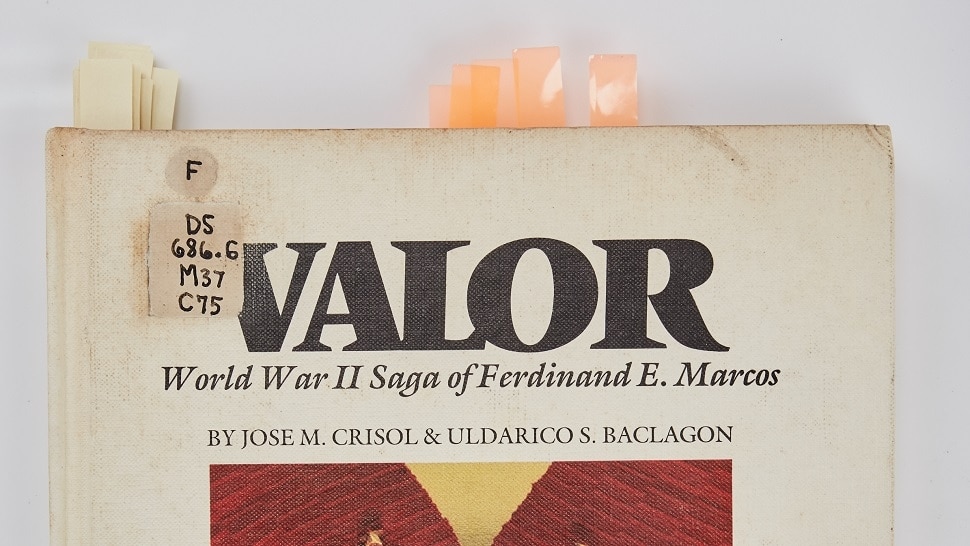
The copyright page puts its year of publication at 1983; as far as we can tell, the book was ordered destroyed before the People Power Revolution of 1986.
These photos are from a book missing from our libraries. The copyright page of Valor: World War II Saga of Ferdinand E. Marcos puts its year of publication at 1983. As far as we can tell, the book was ordered destroyed before the People Power Revolution of 1986. Only a few copies survived.
The text below is an excerpt from museum director John Silva’s writing about the historical records that exist about Marcos’ controversial claims of heroism.
Marcos spun such a fanciful story that, had there been no other WWII history books about, you’d believe he singlehandedly wiped out the enemy and brought democracy back to our shores.
Among the files found and scanned by Marie [Vallejo] and her crew were documents on the attempts in 1945 by a Captain Ferdinand Marcos to get recognition and compensation for his Ang Maharlika unit. His narrative of the fighting bravery of his unit was found to be pure fantasy and must have elicited guffaws the headquarters.
His 39-page narrative starts: “Ang Mga Maharlika was spawned from the dragging pain and ignominy of the Death March and the filth and disease of Concentration Camp in Capas.” Marcos spun such a fanciful story that, had there been no other WWII history books about, you’d believe he singlehandedly wiped out the enemy and brought democracy back to our shores.
In 1945, he sent this fairytale to the US military and was rejected as having no facts to substantiate his claims. Undeterred, he would file again in 1948 and by this time a stern and “…final irrevocable proposal” was handed down stating that his request “…failed conclusively to reveal any material which justify further consideration of this unit.” The US military found no fighting unit called Ang Maharlika, that the unit in fact only gathered information and did not see combat and Marcos had only a desk job and was nowhere to be found in the Bataan Death March or in the torture chambers of Fort Santiago as he poetically reminisces. The majority of the 32 war medals he brandished were dubious, many caste himself. In addition, it was found that some in his unit had committed “atrocities” against civilians and were involved in selling contraband to the enemy.
The majority of the 32 war medals [Ferdinand E. Marcos] brandished were dubious, many cast himself. In addition, it was found that some in his unit had committed “atrocities” against civilians and were involved in selling contraband to the enemy.
Even after the rejection, Marcos still had the chutzpah to ask for over $500,000 to replace the livestock and animals of his unit destroyed in the war. By that time the investigators had concluded “criminal activity” by Marcos’ persistence in submitting fraudulent documents.
Previously, the only time we heard of these records was from a brave local news magazine called We Forum that cited these records in 1984 (Marcos would close it down and arrest the publisher) and a later New York Times article by researcher Al McCoy circa 1986, about the time the People Power revolution was occurring.
But what is most amazing today is that those same records, only excerpted and cited in the past are now here, fully scanned, in the Third World Studies Center (TWSC) at the University of the Philippines. How it got there was through Marie’s efforts by handing over documents to our eminent historian Rico Jose who in turn gave it to the TWSC for electronic dissemination. I invite readers to download and go through the documents and read for yourselves how Marcos fabricated and lied about his WWII exploits, and how most of his medals are deemed fake.
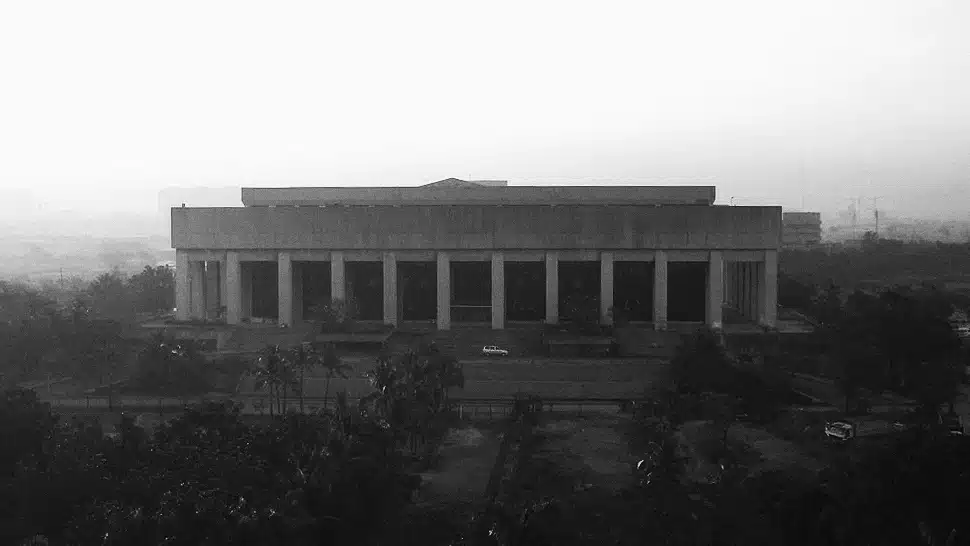
Haunted infrastructure is often believed to bear a tragic past and
the Manila Film Center is no exception. Located in Manila near the
Cultural Center of the Philippines, it was supposed to be the
centerpiece of the Manila International Film Festival, the Asian
equivalent of the Cannes Film Festival in France.
Then disaster struck.
Manila Film Center: Delusions
It started with a dream and that dream was to make Manila the cultural center of the East, a city that could compete with France and its Cannes Film Festival.
In 1981, First Lady Imelda Marcos
wanted her ambition realized. And, at that time, whatever she wanted,
she got. Like when she wanted a spectacular theater to host the Miss Universe Pageant 1974. The Folk Arts Theater, designed by National Artist for Architecture Leandro Locsin, was completed in a record 77 days.
For Imelda, the Philippines was in a strategic position to be an international marketplace for films. It made sense to have a Manila International Film Festival.
Manila International Film Festival’s pièce de résistance was going to
be the Film Center, designed by Froilan Hong and conceptualized by
Ramon M. Ignacio, former senior technology officer at the Technical
Resource Center. The inspiration for the building was the Parthenon in
Athens, a temple to honor the goddess Athena.
There was a grand plan for the building, but it was eventually redesigned to house only an auditorium, a film lab, and film archives. For the latter’s design, the team requested the assistance of experts from UNESCO, who gladly lent their help in 1981.
With three months to go before the scheduled January event and a budget of $25 million (supposedly allocated for a new wing of the PGH), it was predictably a disaster waiting to happen. Nevertheless, around 4,000 laborers were hired and they rotated among three shifts across 24 hours.
Haunted infrastructure is often believed to bear a tragic past and
the Manila Film Center is no exception. Located in Manila near the
Cultural Center of the Philippines, it was supposed to be the
centerpiece of the Manila International Film Festival, the Asian
equivalent of the Cannes Film Festival in France.
Then disaster struck.
It started with a dream and that dream was to make Manila the
cultural center of the East, a city that could compete with France and
its Cannes Film Festival.
In 1981, First Lady Imelda Marcos
wanted her ambition realized. And, at that time, whatever she wanted,
she got. Like when she wanted a spectacular theater to host the Miss Universe Pageant 1974. The Folk Arts Theater, designed by National Artist for Architecture Leandro Locsin, was completed in a record 77 days.
For Imelda, the Philippines was in a strategic position to be an international marketplace for films. It made sense to have a Manila International Film Festival.
Manila International Film Festival’s pièce de résistance was going to
be the Film Center, designed by Froilan Hong and conceptualized by
Ramon M. Ignacio, former senior technology officer at the Technical
Resource Center. The inspiration for the building was the Parthenon in
Athens, a temple to honor the goddess Athena.
There was a grand plan for the
building, but it was eventually redesigned to house only an auditorium, a
film lab, and film archives. For the latter’s design, the team
requested the assistance of experts from UNESCO, who gladly lent their help in 1981.
With three months to go before the scheduled January event and a budget of $25 million (supposedly allocated for a new wing of the PGH), it was predictably a disaster waiting to happen. Nevertheless, around 4,000 laborers were hired and they rotated among three shifts across 24 hours.
With a more sensible time frame, the grand lobby would need six weeks. For the center, 1,000 workers finished it in 72 hours.
Manila Film Center: Entombed
On November 17, 1981, at around 3 a.m., scaffolding on the fourth floor collapsed and workers were trapped in the quick-drying cement. The problem started when quick-drying cement was poured on each floor without waiting for the layers to dry. Due to the rush and the endless hours of working, too much was poured, resulting in the disaster.
Haunted infrastructure is often believed to bear a tragic past and
the Manila Film Center is no exception. Located in Manila near the
Cultural Center of the Philippines, it was supposed to be the
centerpiece of the Manila International Film Festival, the Asian
equivalent of the Cannes Film Festival in France.
Then disaster struck.
Nena Benigno, former public relations
officer for The Experimental Cinema of the Philippines and the Manila
International Film Festival, saw the immediate aftermath of the
accident. Benigno was also the daughter of former press secretary and
columnist, Teddy Benigno, who was then working for Agence France Presse.
Teddy wanted to write a story about it and he told Nena that she should
rush to the site.
“From a distance I could see people in stretchers being carried out, frozen in cement. When I got there, they were still digging out people; [the cement] was not completely hard. And there was a guy that they were trying [to] keep from going into shock,” she said in an interview.
“Half of his body was buried. He was alive, but half buried. I don’t know what it was, but to keep him awake, alert, not to go into a coma or shock, they kept him singing Christmas songs. I was watching this,” she added.
For fear that the accident would
cause a scandal, there was a media blackout. Responders were only
allowed access to the site nine hours after the incident. By that time,
at least 168 workers already died or were buried in the cement, which
already hardened.
Jackhammers were employed hours
later. There was a gruesome view of bodies sticking out of the
pavement. The exposed parts had to be tapered off and built over. The
rule was they had to meet the deadline, no matter what happened.
It was Betty Benitez, wife of assistant minister Jose Conrado Benitez, who apparently gave this order to and continue construction as if nothing had happened. The hauntings and strange happenings began that day.
Manila Film Center: Haunted
According to rumors, a fortune-teller allegedly told first daughter Imee Marcos that she would die if she stepped foot in the building. Whether or not this was true, no effort was spared to “cleanse” the place. There were exorcism rites, pagan rites, Catholic rites, and Chinese rites. Officers were given anting-antings or amulets to ward off evil spirits.
On the morning of the opening,
January 18, as early as 5 a.m. several Igorots performed another ritual,
telling any lingering spirit that they must cross over to the
afterlife. Pigs and chickens were killed for sacrifice and those
attending the ritual, including the anxious Imee, needed to consume
them.
Benigno remembered Imee saying that she asked Via Mare to cater, but that the Igorots could eat the dead animals.
Despite these efforts, those preparing for the festival had their share of strange experiences. The usherettes who came from exclusive girls’ schools started smelling something odd backstage. Almost all of them felt something cold blowing on their skin. Their skin tingled at a strange presence.
According to other stories, the deceased workers showed themselves to their colleagues or even to the guests.
A few months later, Benitez died in a freak car accident. Many alleged that it was the victims taking revenge. A medium who was sent to Manila Film Center supposedly claimed that the spirits said, “Betty is with us.”
When the date of the festival finally
arrived, the accident seemed forgotten. The cement was allegedly not
completely dry. It didn’t matter; international press raved about the
event.
The New York Timescalled
it “All-Out Spectacular” and went on to narrate a non-stop party for
more than 300 guests, including George Hamilton, Peter Ustinov,
Priscilla Presley, Jeremy Irons, and Brooke Shields.
Imelda threw parties at Malacañang, where guests were treated to $100 bottles of Champagne. There was another party at Fort Santiago where the first lady was literally dazzling in diamond earrings, bracelets, and necklace. For the opening night itself, she was dressed in a black and emerald green terno, which was decorated with several layers of peacock feathers from India.
Unbeknownst to the visitors, the wet cement was staining the hems of their clothes and the bottoms of their shoes. They were also stepping on the remains of hundreds of Filipino workers who were entombed in a cursed building.
Manila Film Center: Aftermath
The Manila Film Center showed films from 39 countries, including Norway, New Zealand, India, Mexico, Egypt, Hungary, and Argentina. India’s 36 Chowrighee Lane won Best Picture; Lumila Gurchenko and Bruno Lawrence were named Best Actress and Actor, respectively. Goran Markovic of Yugoslavia won Best Director for Majstori, Majstori!
By the festival’s end, 30 Filipino films worth $500,000 were sold through distribution deals in West Germany, Malaysia, and France. One of them was a movie featuring Pinoy actor Weng Weng.
Despite this success, a curse seemingly hung in the building and the festival itself. Moving forward, it suffered a financial setback. The $5 million subsidy allotted for the festival was disapproved by then Prime Minister Cesar Virata.
So that the center could survive,
Imelda created an agency that would later be the Movie and Television
Review and Classification Board. As stated in Presidential Decree 1986,
the board allowed films that were close to soft porn to be shown in the
center. The law also exempted all films to be shown during the festival
from censorship, opening wide the doors for pornography. Droves of men
were said to have lined up, almost destroying the doors for films like Virgin Forest.
However, earnings from these films were not enough to pay for all the debts incurred. After the Marcoses were thrown out, Rustan’s took back all of its paintings and furniture.
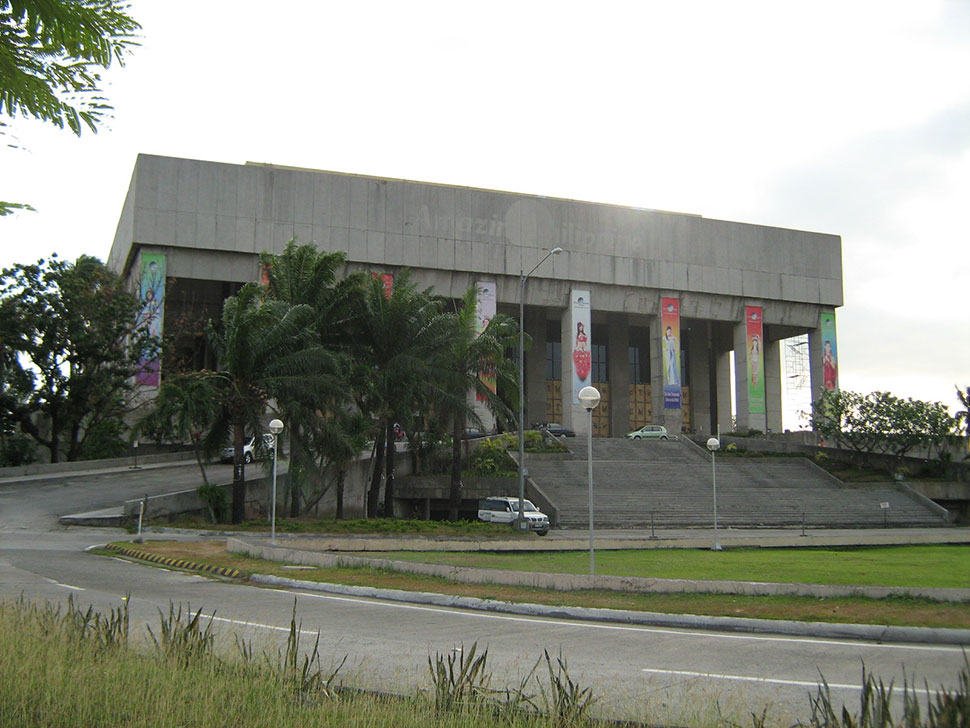
When the 1990 earthquake happened,
the center was abandoned after it was declared unstable. It was
rehabilitated for P300 million and leased in December 2001 to Amazing
Philippines Theater producers of The Amazing Show.
In the late ’90s, there was gossip
that one of the performers of the show was murdered and her body dumped
on the steps. The ghost of the performer reportedly joined the ghosts
that started haunting the area decades earlier.
The Amazing Show’s lease expired in 2009 and for a time, the Philippine Senate considered moving there, but this never happened.
In November 2012, the Amazing
Philippines Theater regained its lease, but another series of
unexplainable accidents occurred. On February 19, 2013, a three-hour fire caused damage, amounting to P1.2 million, to the building
The building continues to be a source of inspiration for horror writers and a destination for ghost hunters. For some, it was a reminder of a glorious time when Filipino films took center stage. For others, it is a symbol of the Marcos dictatorship. But as it stands, the ghosts of Manila Film Center continue to live.
A new documentary makes it clear: It was more than just the shoes.
It was the 1980s and Imelda Marcos, wife of Philippines’ dictator Ferdinand Marcos, was in New York City to do some holiday shopping. “One day, Madame Marcos said to me, ‘I want you to go with me to Cartier, I want to pick out some Christmas presents,’” her friend, Nikki Haskell, recalls to T&C. “She said, ‘Please come to the hotel.’”
Although the Marcoses owned a lavishly-appointed townhouse on East 66th Street, Imelda used that mansion only for parties. When visiting the city, she preferred to stay at the Waldorf Astoria.
I said, “Madame Marcos, why do you have all those pearls on the bed?” And she said, “It brings me good luck.”
“I got to the hotel, and she has one of these big, huge suites,” Haskell says. Wrapped around the carved wooden headboard of Imelda’s king size bed, “there were 100 strands of 30-millimeter pearls that went from black to white, in every shade. I said, ‘Madame Marcos, why do you have all those pearls on the bed?’ And she said, ‘It brings me good luck.’”
Those pearls seems to have worked—at least in part. Marcos—who was famous for her high-flying lifestyle, endless socializing, and taste for designer clothes—spent more than two decades as the First Lady of the Philippines, during which time she and her husband are said to have illegally amassed a fortune of close to $10 billion. Her luck changed in 1986, when a revolution in the Philippines forced the Marcoses into exile in Hawaii.
Ferdinand died in 1989, and Imelda was allowed back into the country—where she proceeded to win four elections to the House of Representatives, though the years since have also been marked by a series of lawsuits and convictions on corruption charges. The recent political resurgence of her family in the Philippines (her son Bong Bong Marcos is currently contesting a loss in the country’s 2016 vice presidential election) suggests her fortunes may once again be on the upswing.
Now 90, Imelda is the subject of The Kingmaker, a new documentary which traces her journey from beauty pageant winner to first lady and now matriarch of a powerful political dynasty. The film, which opens November 8, it is the work of filmmaker Lauren Greenfield, whose previous explorations of over-privilege include The Queen of Versailles and Generation Wealth.
For many, Imelda will forever be known as the ostentatious dictator’s wife whose dressing room—when it was overrun by revolutionaries in 1986—was found to contain 1,200 pairs of shoes. Her fall at home came at the peak of her fame overseas, where she liked to portray herself as an intimate of movie stars, heads of state, and even the Pope. One of the most fascinating parts of the documentary is how, despite the political turmoil the Marcos regime brought about, Imelda became a regular on the international party circuit, spending time with royals, titans of industry, movie stars, and more. Something about the dictator’s wife seemed to make her an irresistible companion for some of the world’s most visible personalities.
Haskell met Imelda around 1981 at a party to promote the nascent Manila Film Festival at the Carlton Hotel in Cannes. The event was organized by Ira von Furstenberg, a glittering international socialite with the jet-set connections that Imelda so desperately craved.
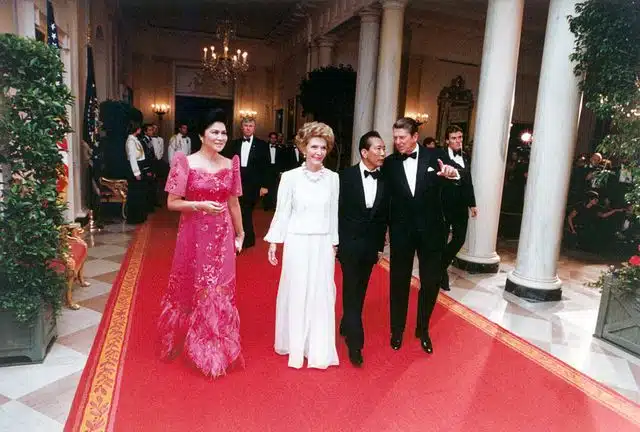
Imelda Marcos, Nancy Reagan, Ferdinand Marcos, and President Ronald Reagan in Washington, D.C. in 1982. HistoricalGetty Images
Not only was Ira daughter to a German noble and, on her mother’s side, the niece of Fiat chairman Gianni Agnelli, but she was also a sister-in-law of New York designer Diane von Furstenberg through her brother, Prince Egon. She was also close to the Italian designer Valentino Gravani, whom she advised on public relations, and a rumored paramour of Monaco’s widowed Prince Rainier III.
Imelda’s appearance at Ira’s party was emblematic of her evolving social status. Until then, Imelda suffered from a reputation on the international circuit as an unwelcome arriviste. U.S. diplomatic cables published by Wikileaks note how she “invited herself” to the inauguration of President Richard Nixon, as well as the dedication of the Sydney Opera House in Australia, where she “made an effort to upstage” Queen Elizabeth II.
Imelda may have grown up the sixth child of an obscure Manila lawyer, but through well-funded social climbing exercises like the party in Cannes, she was soon rubbing her signature butterfly sleeves with the Western elite.
Andy Warhol and Imelda Marcos in 1976. Ron GalellaGetty Images
In New York, Gloria Vanderbilt visited Imelda’s townhouse to look at her jewels. At the Waldorf, she attended parties with the Queen of Thailand, Paloma Picasso, and Clare Boothe Luce. Malcolm Forbes threw her a bash on his yacht, where guests included Lee Radziwill and Andy Warhol, who recorded in his diary that she sang 12 songs after dinner.
“Everybody said that once Imelda gets started partying, you can’t stop her, that she’s always the last to leave,” Warhol wrote. “And it’s true.”
Warhol also attended the state dinner President and Nancy Reagan threw the Marcoses in the White House garden. There, guests included Oscar de la Renta, Arlene Dahl, the count and countess de Romanones of Spain, Margot Fonteyn, John and Patricia Kluge, Diane Sawyer, and Jerry Zipkin. That night, Warhol told a Washington Post party reporter it was the “best thing I have ever been to in my life.”
“Everybody said that once Imelda gets started partying, you can’t stop her, that she’s always the last to leave.” —Andy Warhol
Imelda’s jet-setting didn’t impress everyone, however. Critics likened her to the late Argentine first lady, Eva Peron, who had been the international face of her husband’s fascist regime. “She didn’t like being compared to Eva Peron at all,” says Haskell. “And she wasn’t too thrilled about the ‘Iron Butterfly’ nickname, either.”
Imelda felt that Jaqueline Kennedy was a more apt comparison. Her biographer, Katherine Ellison, tells T&C: “When Marcos was elected in 1965, they consciously styled themselves after the Kennedys. They were going to be the Philippines’ Camelot, and she was going to be Jackie.”
Marla Maples, Joey Adams, Donald Trump, and Imelda Marcos in 1991. Time & Life PicturesGetty Images
In addition to writing Imelda: Steel Butterfly of the Philippines, Ellison shared a 1986 Pulitzer Prize for her work tracing billions of dollars the Marcoses are accused of looting from their country. That money allegedly went to fund multiple New York real estate purchases, as well as lavish parties thrown at their townhouse.
“She was a really free spender, so any time you were in her orbit, there was a lot of fun to be had,” Ellison says.
The New York Times reported the mansion contained “Persian carpets, a 1763 harpsichord [and] gold bathroom fixtures,” as well as “works by Picasso, van Gogh, and Brueghel the Younger.” Haskell, who attended several parties there, says the top floor was a dance space complete with disco ball, where guests often included Franco Rossellini, the Italian filmmaker; Adnan Khashoggi, the Saudi billionaire; and Van Cliburn, the pianist.
Imelda Marcos at the Metropolitan Museum of Art in 1976. Ron GalellaGetty Images
But even that luxury paled in comparison to what Imelda could stage on her home turf. The Manila Film Festival was the perfect pretext to entice movie stars like Tony Curtis, Brooke Shields, Jeremy Irons, and Michael York to her kingdom.
Haskell covered the event two years in a row for her ‘80s celebrity interview program, The Nikki Haskell Show, which now streams on Amazon. She remembers accompanying the actor George Hamilton to a party aboard the Marcos’ presidential yacht, circa 1982.
Imedla Marcos and Doris Duke at a Hawaiian dance festival in 1989. BettmannGetty Images
“It was decorated like a French chateau, and against the wall there were two gigantic Limoges urns, six or seven feet high. There were two guys on step ladders with oil drums, filled with caviar, pouring it into the urns,” she says. “It was the coolest thing I ever saw.”
Four years later, the Marcoses were chased out of the Philippines, setting off decades of court action which continue to this day. Cindy Adams, the longtime New York Post columnist, recalled visiting Imelda at the Waldorf in 1988 during her trial on federal racketeering charges.
“I was hiding in the bathroom when Doris Duke came over to give her the five million dollars she needed to make bail,” Adams tells T&C. “She didn’t know I was listening on the other side of the door.”
Marcos in an image from The Kingmaker. Lauren Greenfield
Imelda has always denied wrongdoing, and continues to do so in Greenfield’s documentary. Her latest arrest warrant was issued in November last year, after the film wrapped, on charges of failing to appear in a Philippine court for yet another corruption trial.
Ellison, the biographer and investigative reporter, even had a chance to ask her about the missing money directly, during a two-hour interview at the presidential palace in 1985. “My conscience is clear,” Imelda told her calmly. “If I were corrupt, it would show on my face.”
Ben Widdicombe Contributing Editor Contributing Editor Ben Widdicombe reports for T&C on the nexus of privilege and power, and the bad—and occasionally good—behavior of the very rich.