Today marks the 52nd anniversary of the Manila Hotel demonstration of October 24. The protest was a turning point in Philippine politics. To commemorate the event I am making available a portion of a draft chapter from my rewriting of my dissertation for publication as a book. This is still a work in progress. Sources are available in my dissertation itself [Crisis of Revolutionary Leadership: Martial Law and the Communist Parties of the Philippines, 1959-1974]
The great currents of the past year — the blood-dimmed tides of war and dictatorship and the turbid undertow of social unrest — met in awful confluence on October 24 1966. The sediment of social resentment, deposited over the course of a half decade of declining living standards, social inequality, and political rot, was dislodged by the Vietnam war and brought to the surface by Johnson’s visit in an upwelling gyre of outrage. It remained as yet a particulate anger, its banners and placards diffuse, but it was strident and growing. The Manila Summit demonstration marked a sea-change in Philippine history.
The immensity of Washington’s war in Vietnam, the rapidity of its growth, and the brutality of its conduct were breathtaking. By December 1965 the United States had already deployed 185,000 soldiers to the former French colony, yet commanding General William Westmoreland stated that at least 443,000 combat troops would be needed by the end of 1966. Operation Rolling Thunder unleashed an incessant rain of death on North Vietnam, dropping over 250,000 tons in its first nine months, including the widespread use of napalm. In June, B-52s began taking off from Guam to carry out the saturation bombing of South Vietnam and within a year they had carried out 350 raids and dropped 70,000 tons of explosives.
These numbers only increased in 1966 and by December, 637,000 tons of bombs had fallen on Vietnam, almost equal to the total tonnage dropped in the Pacific theater during the Second World War. Explosives were not the only payload, however; by the end of 1966, the aerial spraying of Agent Orange had produced a million acres of poisoned desert. The violence spilled into Laos as Washington launched a secret campaign that left the country the most heavily bombed per capita in history. An implacable escalatory logic governed the imperialist war. In the middle of the year, the Joint Chiefs of Staff insistently informed Defense Secretary Robert McNamara that an invasion of North Vietnam, Laos and Cambodia needed to be prepared and that it might require the use of nuclear weapons against southern China.
The bloodshed required political cover. Johnson cast Washington’s war as part of a broad international response to the needs of a stable democratic government in South Vietnam, and to shore up the pretense turned to the regimes in Seoul, Bangkok, and Manila, cobbling together the best regional support that money could buy. As early as the middle of 1964, before the Gulf of Tonkin incident, the White House was already in an advanced stage of negotiations with both the Macapagal and Park Chung-hee governments for the deployment of forces to South Vietnam.
Significant sums of money were on offer and Macapagal moved with alacrity to supply Filipino troops. Then Senate President Ferdinand Marcos derailed Macapagal’s support for Washington in 1965, and secured the support of the PKP and its new youth wing, the KM, in harnessing the popular outrage over the war to his bid for Malacañang. Thus, as Marcos took office at the beginning of 1966, two thousand South Korean troops arrived in South Vietnam while Manila had not yet commited any Filipino forces to Johnson’s manufactured multilateralism.
Marcos had no interest in defying the United States but he was politically savvy. Having brokered his opposition to the deployment of troops into a presidential election victory, he now sought to truck his support for the highest possible price. US Vice President Hubert Humphrey attended the inauguration, feeling out Washington’s new man in Manila, and on December 31 he sent an eyes-only despatch to Johnson, then in Texas for the holidays, stating that “Marcos’ response on discussion additional commitments South Vietnam strongly encouraging. … However, Marcos obviously has ticklish Parliamentary situation …” Jack Valenti, then special assistant to the President, was traveling with Humphrey and, upon playing a round of golf with Marcos, wrote a memo to Johnson on January 4.
We need Asians to take the lead in Asian affairs. Best asset to US is strong Asian leader … Suggest we bet on Ferdinand Marcos of the Philippines … Let Asians take up the burden we have been carrying … Equip two or more Korean divisions, and send them to Vietnam. They could easily take the place of 30–40,000 Americans … The price we pay for this is cheap … I suspect [Marcos] wants to be a great president, and is willing to do unpalatable things in order to achieve that greatness … Marcos has the gifts of brain and courage to do those things that need to be done, but which need an Asian cover to be done.
Johnson followed Humphrey’s advice, and on February 25 secretly sent a personal invitation to Marcos to visit Washington, routing the letter as eyes-only traffic through Ambassador Blair in Manila. Marcos negotiated, seeking arms to suppress the central Luzon Huk rivals of his ally Sumulong; funding to supply ten domestic engineering batallions; and payment for the costs of the Filipino troops deployed to Vietnam. The money, he insisted, should not be earmarked but sent in a direct and unaccountable fashion as he intended to place a significant chunk of it in his increasingly capacious pockets.
Throughout the summer of ’66 Washington and Manila haggled over the price of Filipino mercenaries. In the end, the White House spent as much as was necessary to fabricate a guise for its war. As Marcos pushed through the PHILCAG legislation and prepared to visit Washington, Special Assistant for National Security Affairs Walt Rostow summed up the perspective of the Johnson administration, “… Marcos has really put his political neck on the block in backing our Vietnam position and in sending military forces there. But he did it.” Johnson commmitted to supply Marcos’ engineering batallions and to pay $39 million in discretionary money to the Philippine President from the US Department of Defense budget, thus circumventing legislative oversight of the deal. Marcos’ tour of the United States was turned into an ego trip. At his request, Marcos was granted an honorary doctorate from the University of Michigan and spoke before the joint House of Congress.
They bartered in backrooms and paid under the table. The true character of the deployment of Filipino troops to Vietnam — that PHILCAG was the mercenary hireling of Manila’s former colonial master — only emerged during the inquiries conducted by the Senate Foreign Affairs subcommittee under Stuart Symington in 1969. The White House posed its actors in a geopolitical tableau sharply at odds with reality: South Korea, Thailand and the Philippines all shared Washington’s desire to provide aid to the embattled, democratic government in Saigon.
The props purchased and the blocking well-rehearsed, all that lacked was an Asian proscenium. On September 21, during the midst of Marcos’ state visit, the Johnson administration drafted its proposal to hold a summit in Manila in late October. In a display of imperial hubris, Johnson invited Harold Holt and Keith Holyoake, the Prime Ministers of Australia and New Zealand, and only upon securing their agreement did he inform the Philippine President of the impending gathering he was expected to host.
The theme of the drama was multilateralism, however, and the idea was thus presented to journalists as having originated with Marcos. The Philippines Free Press accurately summed up the whole staged affair, “the entire firepower of the American delegation during the Summit was concentrated on changing the complexion of the war in Vietnam from an American war to a war of, by and for Asians.”
On October 23, in the grande dame of American colonialism, the Manila Hotel, on the Dewey Boulevard waterfront — of late made over as Roxas — Johnson assembled his Summit. That morning an American freighter, insisting on its right of way, collided amidships with a Philippine passenger vessel, the Pioneer Leyte, off the breakwaters of Manila Bay.
The Leyte, a American Freight and Supply vessel sold as surplus at the end of the Second World War, foundered and sank in five minutes. Scores of dead bodies, including pregnant women and children, floated for days in the bay outside the floor-to-ceiling windows of Johnson’s MacArthur Suite. A coterie of State Department grey men and RAND corporation drones stalked the hallways, supervising the event. Holt and Holyoake quietly staged their cameos while the gathered Asian leadership adopted a pose of regional concern.
Nguyen Cao Ky, given to openly fascistic sympathies and installed as Prime Minister by military coup; Park Chung-hee, put in office by a military junta in 1961; Thanom Kittikachorn, military dictator of Thailand; and Ferdinand Marcos, the only democratically elected figure in the bunch — all fixed their signatures to a joint declaration of support for South Vietnam which Johnson had drawn up for the occasion.
The vast Texan shadow of the American president — shrewd, vulgar, and utterly dominant — loomed over the gathering. The evening before the summit, he met privately with the Vietnamese delegation and coached Ky, “lean as far away as you can from the ‘imperialist’ Johnson, from the hard-liner Rusk, and that fellow with stars on his shoulders, Westmoreland. You just hold the Bible in your hand tomorrow. You be a man of good will; love your neighbor.” As the summit opened the next morning, Johnson praised Marcos’ work in preparing the event and, to the Philippine President’s enduring embarrassment, described him as his “right-hand in Asia.”
The summit closed on October 25 with the signing of a joint communiqué committing the assembled powers to the military defense of Saigon, and a “Declaration of Peace and Progress in Asia.” That evening Westmoreland contacted Johnson through Rostow calling for dramatically expanding the bombing of North Vietnam. Johnson ordered the US Navy to begin shelling the Vietnamese coastline. Between late October and the end of 1966, the US military launched more than 500,000 shells at the Vietnamese people, a number which exceeded the total it had fired during the entirety of the Second World War. The joint declaration of peace in his pocket, Johnson departed the next morning for Cam Ranh Bay, where he reviewed the troops.
The Manila Summit was quickly forgotten, its posturing and declarations were at best a historical footnote, crêpe flooring over a widening quagmire. The developments immediately outside the Manila Hotel were of far greater significance.
A week before Johnson arrived, Voltaire Garcia chaired a “tumultuous meeting” of the UP Student Council, securing by a narrow margin a resolution to stage a protest of the Manila Summit.
Manila Chief of Police Ricardo Papa refused to grant a permit for the protest, so Ignacio Lacsina appealed to Manila Mayor Villegas and was issued a permit for a protest to be held in front of the US Embassy, several blocks removed from the Manila Hotel. UP students traveled in eighteen buses from Diliman toward the arranged meeting point of Agrifina Circle where students from UE, Lyceum, and members of LM were already gathered, but police stopped the UP buses at the Quezon City-Manila border in Sta. Mesa and demanded to see the students’ protest permit. Garcia or Violeta Calvo, at the head of the student delegation, explained that the protest permit was with the advance group already at the circle.
The police refused to allow the buses to enter Manila and the students walked the remaining five kilometers. Bored with waiting, the protestors at Agrifina circle broke out a guitar and began singing “folk-songs” in a circle and “[t]he spirit of a hootenanny took away some of the boredom.” When the UP contingent arrived, the rally marched from Agrifina Circle to the Embassy, where they demonstrated for an hour. Each speaker stood on top of a jeep to address the crowd: Voltaire Garcia and Orly Mercado spoke on behalf of the UP Student Council and Lacsina on behalf of LM, distributing copies of his statement to news crews.
Manila Times, 25 Oct 1966, 12-A
At this point accounts conflict. According to Ninotchka Rosca, the idea to move the rally from the Embassy to the Manila Hotel arose spontaneously from the crowd, and added that “an officer suggested that the leader’s jeep follow the crowd to pacify them and Carlos del Rosario, secretary of the Kabataang Makabayan, agreed to this.” Violeta Calvo testified that it was Ignacio Lacsina who instructed the students to go to the Hotel rather than remain at the Embassy.
Contemporary accounts record that there were two thousand protestors present, but in 2004, with her usual sense of inflation, Rosca claimed that five thousand marched to the Manila Hotel, apparently forgetting that in 1966 she had estimated that the protest involved “2,000-odd workers and students.” When the protestors arrived at the Manila Hotel, Manila Deputy Chief of Police, Major James Barbers, instructed them to disperse because their permit was for the Embassy not the Hotel.
Tensions mounted as the protestors refused to disperse in the face of the riot-gear clad police. A number of contemporary reports state that Americans in suits were standing behind and circulating among the Manila police; the police attacked the protestors when an American shouted “Go get ’em!” The protestors fled in the face of the violent dispersal.
The police beat students with rattan batons and fired shots in the air. At some point during the dispersal, a police officer aimed and fired at a fleeing student named Prudencio Tan, shooting him in the neck. Rosca reported that “doctors had to open a hole at the base of his neck to enable him to breathe: his windpipe had been punctured.” As the police attacked the protestors, members of the foreign press were also injured and reporters and cameramen for UPI, Washington Post, CBC and ABC were hurt in the dispersal. The police arrested and filed charges against five people.
Blood darkened the Manila Hotel pavement. The youths of October 24 marched against war, colliding with the state and its bodies of armed men. With earnest voices and hand-drawn placards they strained forward against the police line but behind the rattan shields was a gaze blank and pitiless. They were shot, beaten, and arrested. Outrage rapidly displaced shock, and the conduct of Manila’s police became the focus of all ire.
For more than a year, Washington had monitored the seismic tremors of social unrest. A Secret National Intelligence Estimate, completed on 17 February 1966, revealed the tensions mounting on the fault lines of Philippine society. “The key problem is a deep and growing economic cleavage between upper and lower classes” and should Marcos prove incapable of dealing with this in the next four years, “Philippine political stability and democratic institutions could be seriously undermined.”
In the urban areas, the major problem is unemployment. There are an estimated 750,000 unemployed and at least two million underemployed in the country’s work force of 11.5 million. Each year an additional 375,000, including 25,000 college graduates, seek employment, normally exceeding the number of new jobs being created. In the cities, the pressure of a large unproductive manpower pool is manifested in low wages, poor working and living conditions, high crime rates, and other serious social problems. Among the educated unemployed, radical causes tend to flourish. … Although Philippine real national income per capita generally rises slightly each year, the gains tend to accrue to the wealthy, while among the rural and urban poor, real wages and living standards usually decline. In Manila, real wages for skilled and unskilled industrial workers have declined about 20 percent over the past decade, and the luxury consumption of the wealthy contrasts most markedly with the extreme poverty of the general population.
On 7 September 1965, David Bell, head of the Agency for International Development (AID) wrote a letter, classified Secret, to John McNaughton, Undersecretary of Defense for International Security Affairs, outlining Washington’s response to these volcanic rumblings. The fundamental task was not economic reform, but rather “the principal aim of our assistance to the Philippines should be toward internal security.
We also agree with the proposal that MAP [Military Assistance Progam] should be oriented to give greater emphasis to internal security and that very serious efforts should be made to bring the Government of the Philippines to this conclusion.” The crisis was serious enough that it “constitutes a potential basic threat to the stability of the government,” the preservation of which depended upon the state’s ability to suppress dissent and unrest. “Briefly, our views are that the Philippine Government should provide substantially increased support and improved leadership for its police forces, and that the United States should offer substantially more police assistance through the AID Public Safety Program, especially to the Philippine Constabulary.”
By early 1966 these proposals were being implemented. “[C]areer CIA employee,” Byron Engle, head of the OPS, “in April 1966 contracted a team of American experts led by Frank Walton … to conduct a nationwide, three-month survey” of the Philippine police force, which provided the groundwork for supplying “assistance that proved instrumental to Marcos’ use of police for repression.” McCoy argues “Though masked by a rhetoric of technical reform, the OPS program forged nothing less than an infrastructure primed for political repression. By its creation of centralized communications, a metropolitan police command and computerized data banks, US aid helped Marcos to tame Manila.” A number of CIA personnel were recruited to the project “to improve police counterinsurgency capabilities with extralegal methods,” and, in the years before the declaration of martial law, “OPS trained an estimated eighty-five senior Filipino officers in interrogation techniques at the IPA in Washington DC.” A critical component of these police-state measures was the creation of the Metrocom (Metropolitan Command), which gave a branch of the military, the Philippine Constabulary, jurisdiction over the Greater Manila Area as an anti-riot squad charged with crowd control. “From within this strike force, Marcos would, as a martial law dictator after 1972, form an elite antisubversion squad, the MISG, that used torture and extrajudicial killings to spread state terror.” In the middle of the 1960s, as the social volcano smoldered ominously, Washington organized, funded, supplied and trained the apparatus of military dictatorship in the Philippines, and it was this that the October 24 demonstration brought to light.
At the center of Washington’s preparations was Joma Sison’s maternal uncle, Manila Deputy Chief of Police, James Barbers. The son of an Italian-American private in the 3rd US Cavalry named George Barbieri who fought against the forces of General Manuel Tinio before settling down in Cabugao and marrying a well-to-do Ilocana, Barbers rose rapidly in the ranks of the Manila police force and caught the eye of Washington.
Brought to the United States for training, he graduated from the senior officers’ course at the IPA in Washington DC, having studied crowd control with the New York Police Department, industrial security with the Pinkerton Detective agency, and riot control at the US Military Police School in Fort Gordon, Georgia. An American plainclothes may have barked the order, but it was Barbers who supervised the violent dispersal of October 24.
He proved efficient and remorseless, a man whose conscience was not pricked when he ordered his men to beat and fire upon unarmed students. More than any other figure over the next half decade, Barbers was directly responsible for suppressing demonstrations outside the US Embassy, the presidential palace, and the legislature.
US Ambassador Henry Byroade, who from 1969 to 1973 oversaw Marcos’ implementation of martial law, issued repeated commendations to Col. Barbers in recognition of his unparalleled ability to disperse, suppress and control crowds of workers and youths in the streets of Manila. Under the military dictatorship, Barbers was made head of Manila’s police force and finally Vice Mayor of the city.
In late October 1966, as outcry mounted over the brutality of Manila’s police, Barbers unapologetically defended the techniques of crowd control and torture in which he had been trained, telling Graphic Weekly, “The greater the resistance the greater the force is the police rule whether quelling mobs or extracting confessions.”
The October 24 demonstration — the first of the spasmodic eruptions marking the fitful tempo of the dance of dictatorship — would have occurred without Sison’s leadership, but he had positioned himself at its head and retained control over the restive and growing youth movement. Now he sought to contain this social force, a reservoir of political energy burning beneath a thin black crust. He was not yet prepared for a vast explosion; he needed to secure sway over the PKP.
Stalinism measured the political strength of the rival forces vying for control of the party by their ability to negotiate ties with the bourgeoisie. In late 1966 the PKP focused its attention not on the war in Vietnam or the burgeoning police state apparatus, but rather on the formation of the broadest alliance with the bourgeoisie in the history of the party, the Movement for the Advancement of Nationalism (MAN).
As the crisis of American capitalism deepened and grew visible, an increasing number of Filipino capitalists strained to loosen Washington’s grip on the economy. They did not seek complete economic independence, for they were tied to the US market and the financial institutions of Wall Street by ten thousand threads. They aspired, however, to play a new role, to become semi-autonomous junior partners and no longer corporate dummies, mere placeholders on an executive board run by Americans.
MAN was to be the fulcrum of this endeavor, adding to the capitalists’ effort the mass of workers, peasants and youths the PKP brought to the organization. Economic ties with Moscow, which the PKP would negotiate, gave extended leverage. Victory in the struggle for the Communist Party would be won by the section of its leadership that emerged dominant in the formation of MAN.
Sison’s opponents in the party were lesser men, their social awareness was duller and their organizational initiative torpid; politics was something they played at in their spare time, a meaningful hobby for long weekends. Their influence with Filipino capitalists in late 1966, however, dwarfed that of Sison. They displayed their ties with Moscow, promising trade deals and cash loans on competitive terms.
They occupied offices in the Marcos’ administration, while the protests of October 24 threatened to rupture the KM’s relationship with the president it had backed less than a year before. Where Moscow gave Sison’s rivals choice economic blandishments to offer Filipino capitalists, the political line of Beijing gave Sison credibility and sway over the growing unrest.
As the gravity of the social crisis increased, the specific weight of Sison’s youth movement rose and tipped the scales of bourgeois politics. At the time that MAN was founded, however, only the far-sighted anticipated this, while most inclined to the staid rivals of Sison and their immediately useful relations with Moscow.
The one advantage that Sison had in this stilted contest was his own energy and that of the youth movement behind him. If he could move quickly enough — organize, travel, network, speak — it was possible he could build MAN while the remaining leadership of the PKP were still rising from their armchairs. Any social movement not focused on this end was a wasteful expenditure of effort. Opposition to police brutality needed to be corralled, and denunciations of the Marcos adminstration silenced; the time for these was not at hand. Every social layer which Sison could mobilize needed to be focused on one end: securing ties with Filipino capitalists through the formation of MAN.
Within days the outrage over the brutal suppression of the demonstration at the Manila Hotel took organizational shape as the O24M, and Voltaire Garcia, whose name featured most prominently in the press as leader of the suppressed rally, was made chair of this ad hoc new grouping. The O24M emerged independently of the PKP but was marked from its inception by the political confusion engendered by the party, all factions of which continued to support Marcos.
Simultaneously decrying the emergence of “fascism” and appealing to the “liberal principles” of the Marcos administration, the O24M demanded the immediate removal of Brig. Gen. Ricardo Papa as chief of the Manila police and of Patrolman A.S. Carlota, whom they accused of shooting Prudencio Tan. Gathered behind its banners were anarchistic elements, sections of university youth drawn to the cultural revolution but generally opposed to political authority. The names which emerge in contemporary newspaper accounts as the core constituency of the O24M reappear a year later as the instigators of a break within the KM to form the SDK on precisely these grounds — Perfecto Tera, Mila Aguilar, Ninotchka Rosca.
The general disorientation of the O24M, produced by the PKP’s continuing support for the President, found expression on October 26 in a front page editorial in the Collegian headlined “the rise of fascism.” Fascism, it claimed, had been drawn out of “Hades.” “Never for an instance did we think that in a freedom loving nation such as ours fascism could take a foothold and make this foothold the stepping-stone from which to pursue the enigmatic aims of an ambivalent governmental structure.” It described fascism as the actions of “deranged policemen” carrying out “unwarranted and unjustified brutalities,” and it appealed to Marcos to resolve this problem. It called for an independent investigation of the brutalities and asked Marcos to ensure that police agencies “keep their ugly hands out of the investigation,” and to put into “efficacious practice” the “liberal idea which President Marcos advocated … early this year.”
The demonstration and its violent dispersal in front of the television and newspaper cameras of the world had publicly humiliated Marcos and he immediately ordered an investigation into the protest — which he termed a riot. At the same time, he sought to contain the social anger which had been expressed in front of the Manila Hotel and sharpened by the brutality of the police, and on October 30, he summoned a select group of UP student leaders to Malacañang for this purpose.
Voltaire Garcia and Violeta Calvo met with the President and he announced that he was ordering all charges dropped against the five accused protestors. Marcos’ commitment did little to appease the growing outrage. The police had beaten and fired upon their ranks; the demonstrators sought not clemency but redress. On November 3 over one thousand students marched from Agrifina Circle to Malacañang in a rally denouncing police brutality.
The chair of the O24M, fresh from his closed door meeting with Marcos, strained to retain control over the protestors. Garcia attempted to wield the prestige of the UP Student Council to shore up his leadership over the growing movement, but was unable to secure its support for the rally. A majority of the Council opposed the demonstration, citing the ‘successful meeting’ recently held with Marcos. KM mainstays Jose David Lapuz and Ernesto Macahiya addressed the crowd alongside Garcia, but the dwindling control the organization’s leadership retained over the demonstration found expression in the slogans which the demonstrators scrawled on their placards: “Down with AID controlled police” and “Barbers — CIA butcher.”
Over the past several years the front organizations of the Communist Party had, under the leadership of Sison, cultivated relations with the man who was now emerging as the focus of public ire: Sison’s uncle, Barbers, Manila’s deputy chief of police. They depicted him as a public servant dedicated to the national interest and on September 12, 1965, the Lapiang Manggagawa awarded him “a plaque for outstanding service to the country.” Long after the Manila Hotel pavement had been scrubbed clean, Sison’s groups continued to maintain cozy ties with Barbers. Writing on a demonstration in early 1968, Lacaba recounted this incident: “Major James Barbers of the MPD called to Sison and put his arm around the young man’s shoulders.
Standing there on the pavement, both of them in polo barong, both of them grinning from ear to ear as they talked in Ilocano, the American mestizo and the anti-American nationalist seemed to be a symbol of something or other: an end to discord? peace at last in Manila as in Vietnam?” In August 1968, a SCAUP member wrote to the Collegian to commend this ‘CIA butcher:’ “If they want an orderly demonstration, the policemen should learn to handle a crowd. Manila policemen should learn it from their deputy chief James Barbers. Although handling a police club, Barbers never threatened us when we were at the Hilton Hotel. He was all smiles and spoke with courtesy and treated us with admirable tact.”
The Communist Party supported this CIA trained police chief not simply because he was Sison’s maternal uncle. Far more fundamentally, the PKP’s endorsement of, and relations with, Barbers expressed the Stalinist perspective of the progressive role of the national bourgeoisie in the first stage of the revolution, and in particular of its Maoist articulation, New Democracy and Coalition Government.
The joint dictatorship of the bloc of four classes required that sections of the military and police be won over and made loyal to national interests. Thus, as Sison had courted the officer corps of the PMA, so too he sought the support of nationalist minded sections of the police. The O24M was a loose, spontaneous amalgam, its absence of a thought-through political program contained in its very name, which expressed nothing beyond an angry reaction to an immediate grievance.
Sison sought to control this outrage by redirecting it, away from the repressive apparatus of the state and behind the program of national democracy. On December 6, on the quiet Loyola Heights campus to which Ateneo de Manila had relocated after his expulsion from its high school, Sison addressed an assembly at Kostka Hall sponsored by the Ateneo Political Society.
The central thrust of Sison’s speech was the depiction of the emerging youth movement as fundamentally a nationalist movement oriented to securing limited reforms through appeals to, and pressure brought to bear upon, the existing structures of political power. He invoked the names of Rizal, Bonifacio, Aguinaldo, Jacinto and Gregorio del Pilar as historical examples of the “revolt of youth” in service to the construction of nation. He declared,
The youth of today who have been courageous enough to express their principled stand on the contemporary issues have much to teach their elders. It is not with arrogance that they wish to teach their elders but it is in the spirit of recalling them to the cause of nationalism that the youth have always had to fight for. Our elders in the highest councils of the government today are bound by compromises with big vested interests which have made possible their elections and appointments. We wish to bind them with the tradition of the nationalist and the revolutionary youth who merge themselves with the masses under the red banner of the Philippine revolution.
The task was to bind the elders with nationalism; this should be the orientation of youth: to the heads of state, government officials, police chiefs, in a word, their elders. Youths were not oriented to the future, the new, to overthrow, let alone a socialist revolution carried out by the working class, but rather to political continuity and reformist politics.
Their task was to sway their conflicted elders away from imperialism and bind them in service to nationalism. However red its banner, and however much it couched itself in the language of youthful revolt, this was the most tepid of reformism. The program of the KM, he stated, “merely affirms what every patriotic Filipino should adhere to,” and he approvingly cited the slogans of the Garcia (“Filipino First”), Macapagal (“Unfinished Revolution”), and Marcos (“The nation can be great again”) administrations as evidence of the continuity between the politics of the KM and that of their establishment elders.
Their elders were conflicted, however, wavering between their imperialist beneficiaries and the needs of the people. Here the intervention of youth was needed, to remind the elders of their true allegiances, to expose the imperialists and to win the elders back to nation. Youths did not have access to the press, so they voiced this pressure politics through demonstrations.
Sison turned to the question of police brutality. “Since we are interested in the free development of nationalism in this country, we need to consider the fact that foreign agencies maintain an undue amount of control and influence over our police forces and our armed forces.” Just as foreign domination over the political elders was thwarting the emergence of nationalist politics and needed the pressure of youths to bring their elders back into service to the nation, so too police brutality expressed not the fundamental character of the state but a distortion of its role under the pressure and control of imperialism.
Reforms, secured from the “elders,” who would be bound to nationalism by the fervent demonstrations of the youth, would transform “our police” from brutal oppressors into national heroes, as Sison anticipated the emergence of modern-day del Pilars “in the ranks of the police and the military.”
Sison countered the spontaneous anger finding expression in the October protest by pushing future demonstrations back into the role of reformist pressure. He sought to explain that this orientation was in fact the thrust of the emerging unrest of youth, drawing out what he claimed were the three purposes of the O24M,
to wage a nationalist education campaign based on the Nationalist Declaration;
to defend civil liberties; and
to expose the nature of state violence.
He elaborated on this perspective, “There is the need to wage a nationalist education campaign. The events before, during and after the October 24th Incident reveal to us how much our government officials misunderstand the spirit of nationalism. Anti-nationalism has so much poisoned the minds of so many of our police officers and those higher executive officials who give them the orders.” Anti-nationalism was the root cause of the problem of police brutality, according to Sison, but it was the product of an unfortunate misunderstanding which could be remedied by nationalist education.
This explained the violent dispersal of the October 24 protest, as “it was an act of anti-nationalism … to shoot the throats, to break the skulls and step on the breasts of the young men and women who demonstrated.” With nationalist education, he argued, “we hope for the day when the spiritual forebears [sic] of Gregorio del Pilar will assert themselves within the ranks of our police and military. I am certain that within the ranks of the police and the military, there are many good elements sympathetic to the cause of nationalism.”
To counter the anti-nationalism of their “elders” and of the police Sison proposed six concrete steps: the Congressional National Defense Committee should support a bill allowing rallies without permits; a bill should be filed in the legislature excluding military personnel from staging rallies; unspecified “steps should be immediately taken” to reduce AID control over the police; Congress should reconsider the Anti-Subversion Law; civilian supremacy should, by unspecified means, “be maintained” in the National Police Commission; and, finally, “Nationalist and civil libertarian organizations should be allowed and encouraged to hold seminars on nationalism and civil liberties among members of the police and armed forces so that a bridge of sympathy and understanding could be built for the prevention of fascism.” Every one of these concrete measures would be carried out by the state, including “allowing and encouraging” nationalist organizations such as the KM to hold seminars with the police. Sison effectively told the youths and workers coming into open conflict with the state that they could not independently resolve any of their problems and that the state, far from their enemy, could be made to serve as their ally. They needed simply to pressure it with demonstrations and bind it to the “national interest.”
Having stated that he hoped for the emergence of a sympathetic and heroic police force, Sison declared, “The growth of fascism in the Philippines is expected with the ever increasing desperation of the US in the Vietnam war and elsewhere. … As the Vietnam war rages and both the Philippines and the US become wracked with internal problems, the use of fascist methods to suppress democratic expression will become more and more frequent.” He did not define fascism, but instead used it as a dysphemism, a sort of political swearword for police and military brutality caused, he claimed, by anti-nationalism.
There was an unmistakable light-mindedness to Sison’s facile alternation between his anticipation of the imminent growth of ‘fascism’ and his assertion that the police are a generally well-meaning force in society whose sympathy can be secured by participating in government sponsored seminars. Over the past year, nearly a million Indonesian communists had been killed by military and para-military death squads, yet by Sison’s logic fascism could have been prevented if the military and police had simply been led to understand the true meaning of nationalism.
When Sison reprinted this article in 1972, he removed his fatuous reference to police officers as modern del Pilars, as well as his campaign of seminars and sympathy, and simply concluded with the rise of fascism. Martial law was but months away.
Forty-seven years ago, on September 22 1972, Ferdinand Marcos declared martial law in the Philippines, imposing a brutal reign of terror and suppression that would last for more than a decade. He backdated the declaration to September 21 in keeping with his superstitious predilection for the number seven and its multiples. I publish below a brief section of my doctoral dissertation dealing with the imposition of military rule. The political parallels to the present are striking.
The Music Stops
Naákay ng gútom at gawìng manilà nag-ulî sa gánid at nawalâ’ng awà, handâ na ang ngípi’t kukóng bágong hasà at pagsasabayán ang gapós ng iwá.
Francisco Balagtas, Florante at Laura
On Valentine’s Day 1972, Suharto visited Manila, where he delivered an address before the joint house of Congress and met privately with Ferdinand Marcos, who sought his advice on how best to implement military rule in the country. The conventional scholarly argument about Marcos’ declaration of martial law is that his success was predicated upon the ties which he cultivated with military leadership and the legal and political groundwork which he prepared for dictatorship. Franco, for example, writes
It was also during his first term as president that Marcos began to prepare the national transition to an authoritarian regime. He began cultivating loyal followers among high-level military officers by selectively extending the tenure of retirable generals and promoting officers from lower echelons. At the same time he took steps to centralize control over the military by combining the offices of Secretary of Justice and National Defense. Exaggerating the national security threat posed by the still weak and divided Communist movement, Marcos also substantially increased both the size and budget of the military.
While this is true, the conventional argument overlooks the history of multiple prior presidents who likewise developed an extensive network of military ties and who deployed the threat of martial law at various junctures during their terms in office. Situated historically, there was nothing particularly remarkable about Marcos’ conduct in office or his threats of dictatorship. Berlin correctly asserts that “the roots of martial law lay in the Philippines’ long colonial experience and in the first decades of independence.”
He describes martial law as “a natural part of the fabric of the Philippine past.” The framework for military rule existed throughout the history of the post-colonial Philippines. It was a direct product of US colonialism and was enshrined under the powers of the executive branch in Article VII, Section 10, of the 1935 constitution, which stated that the president can “suspend the privilege of the writ of habeas corpus, or place the Philippines or any part thereof under Martial Law.”
Berlin, however, argues that martial law was in many ways simply a return to the normal character of civilian-military relations established during the colonial period. In this he errs. While the seed of military rule had been planted by the office of the US Governor General, the Marcos dictatorship was not the atavistic re-emergence of a prior mode of rule. Martial law in 1972 was something qualitatively new, and was an expression of global developments.
Marcos’ signature on the declaration of martial law
The impulse to military rule existed within the ruling class since the formal granting of independence in 1946, and machinations to that end had been pursued during their terms of office by Quirino, Garcia, Macapagal and Marcos. What distinguished Marcos’ machinations from those of his predecessors was the international situation of political and economic crisis. It was neither Marcos’ cleverness nor his will to power that determined his success. By the late 1960s, global capitalism was in a crisis which marked the beginning of the precipitous decline of US economic dominance.
The post-war modus vivendi, over which Washington exercised historically unprecedented global power, formally came to a close when Nixon ended the Bretton Woods agreement of fixed exchange rates and dollar gold convertibility in August 1971. The explosive class struggles which emerged around the globe from the middle of the 1960s to the middle of the 1970s were a manifestation of this economic crisis.
This is why the First Quarter Storm was presaged in the streets of Paris, and followed by those of Athens. It is in this context that we see the rise of dictatorship as the preferred mode of bourgeois rule. Suharto and Marcos, Pinochet and the Shah shared a common geopolitical DNA. Washington facilitated and propped up these tin-pot rulers. Moscow and Beijing, looking to secure advantage against each other, followed suit. Moscow supported Suharto; Beijing, Pinochet.
In the face of this crisis, there was common consent from every section of the Filipino ruling class that dictatorship was necessary. Aquino declared just as forthrightly as Marcos that he would implement martial law if he gained power. The contending elites jostled with each other for Malacañang — in a game of political musical chairs — knowing that whoever was seated there would secure the spoils of dictatorship.
In the drive toward martial law, Marcos outmaneuvered his opponents at every turn. By 1972, the opposition, clustered around Aquino and Osmeña, was resorting to increasingly desperate measures, including assassination plots. They were not fighting against military rule; they were fighting to secure it.
The ruling opposition was thus mobilized for a particular reason — to have their hands upon the reins of the inevitable dictatorship. The working class and exploited masses of the Philippines were mobilized for very different reasons: price hikes, runaway inflation, and slashed wages had cut them to the bone.
An intense social anger fueled the rallies of 1970, ’71, and ’72. The role of the Communist Party of the Philippines was to subordinate the latter to the former, to ensure that these social explosions safely fueled the machinations of their bourgeois allies. While the PKP provided ideological justification for Marcos and his ‘revolution from the center,’ the CPP led the masses into a political cul-de-sac. This is what made martial law possible.
One of the pivotal moments in the history of the Philippine Communist Parties in the 1960s and early 70s, in the period leading up to the declaration of martial law by Ferdinand Marcos in 1972, was the event which became known as the Diliman Commune.
Over the course of the first nine days of February 1971, students at the University of the Philippines (UP) Diliman erected barricades around their campus, fought off repeated attempts by the military to tear the barricades down, and took control of the university. Standoff with Metrocom over the barricades at the entrance to the Diliman campus.
Standoff with Metrocom over the barricades at the entrance to the Diliman campus.
Joseph Scalice, “A Planned and Coordinated Anarchy: The Barricades of 1971 and the ‘Diliman Commune,’ Philippine Studies: Historical and Ethnographic Viewpoints 66, No. 4 (2018): 481-516
In the opening of the article I wrote
While the occupation of the Diliman campus invariably merits passing mention in the wave of memoirs, both personal and collective, produced over the past two decades, it has not been subjected to serious scholarly scrutiny. As a result, two myths, which entered circulation in the months immediately after the events themselves, spread and became the established narrative of what became known as the “Diliman Commune.” The first is that the events were limited to Diliman; they were not. Barricades went up at the University Belt in downtown Manila and at UP Los Baños simultaneously, and there were pitched and protracted battles waged at both locations. Subsequent accounts entirely ignored these concurrent barricades. The second myth is that the Commune emerged spontaneously. A headline article of Bagong Pilipina in its February 1971 issue expressed this conception: “The Diliman Commune was a spontaneous reaction to the needs of the Diliman Republic.” The story stuck.
Scalice, “A Planned and Coordinated Anarchy,” 482.
In examining and puncturing these myths, I attempted to use the Commune as a case study of the role played by the political program of Stalinism in shaping and corraling the social anger in the explosive years leading up to the imposition of military dictatorship by Ferdinand Marcos. Among the conclusions I reached was the following.
There is a culture about the Communist Party of the Philippines and its affiliated organizations that is simultaneously inflected by amnesia and nostalgia. The KM, under the leadership of Jose Ma. Sison, had endorsed Ferdinand Marcos for president in 1965, but four years later they denounced him as a fascist and entered an alliance with the bourgeois opposition. They did not account for their prior support, but buried it: “Oceania had always been at war with Eastasia.” This cultivated amnesia was combined with a nostalgia for an imagined past. The young people joining the party or its front organizations learn of the First Quarter Storm and the Diliman Commune, events that are never understood historically, but simply appreciated as the great moral lessons of the past, examples of the revolutionary heroism of their predecessors. This appreciation is not entirely baseless. The youths and workers who fought in the battles of the 1960s and early 1970s were often heroic, proving themselves capable of self-sacrifice and endless labor. The best layers of an entire generation fought courageously, and many in the end were tortured and killed by a brutal dictator. But to what end? Here the only honest means of honoring the struggles of this generation is to subject to careful study and trenchant criticism the program and machinations of their leaders. Such an historical examination, to which this article is a small contribution, reveals that the sacrifices made by these youths and workers were first demanded and then dispensed with by Stalinism, which ensured that their lives were no more than grist on the millstone of dictatorship. Much of the Stalinist parties’ political authority among the masses derived from their claim to be Marxist; I am challenging that claim.
Scalice, “A Planned and Coordinated Anarchy,” 507-8.
The majority of the article is dedicated to a careful reconstruction of the events of the barricades of 1971. It is a remarkable thing that such dramatic events as those of February 1971 in the Philippines have not yet been subjected to careful scholarly scrutiny. Researching and writing this account was a compelling experience and I believe that the article is an exciting read, by academic standards at any rate.
Vinzons Hall
Long live the Diliman Commune
Mabuhay ang Barikada / Destroy Liberalism.
In some ways, the myths surrounding the Diliman Commune are an indication of how the flagship state university campus, because of its prominence in popular consciousness and because of the preeminence of its graduates, has been allowed a disproportionate share of the written political history of the past century. Campus political radicalism in the university belt in downtown Manila, for example, has been given comparatively little coverage as a result of this skewed historiography.
I wrote a bit on this in my dissertation, in the chapter on the student protests of 1969.
The preponderance of higher education in the Philippines was concentrated in Manila and disseminated from privately owned, profit-driven institutions. Their facilities stood clustered along Azcarraga on the northern bank of the Pasig, and within the squat stone walls of Intramuros on its south. Most were crowded, multi-story affairs to which entrance was afforded by a single roadside gate under the watchful eye of armed security guards, who inspected the entering students’ uniforms and identification cards. There were in 1969 over half a milion college students in the Philippines, one of the highest college enrollment per capita figures in the world. The majority of these students came from working class and peasant families, and were working their way through school — they were janitors on the night shift, stringers for newspapers, secretarial assistants for the university administration, and sales clerks on Escolta.
From Azcarraga, traverse the length of Quezon Boulevard past the circumferential Highway 54 — now renamed de los Santos, but the name had yet to take — and you would arrive in Diliman on the outskirts of Quezon City. There the state university — UP — sat in seeming rural isolation, its expansive facilities still spreading outward into fields of cogon and talahib. At its southern and eastern fringes were the impoverished communities of Cruz na Ligas and Balara, pushing towards Marikina. Twenty-five centavos and a thirty minute jeepney ride would get you from Diliman to Azcarraga, but a lifetime of labor would not have gotten most students from the university belt into the state university. UP provided an education to the children of the elite and the upper middle class, but also to the most outstanding scholars throughout the nation. The valedictorian of an impoverished provincial high school could be expected to attend the state university, and on a full scholarship. For the rest of the students, they would work their way through school downtown. Finally there were the elite religious schools — Ateneo, La Salle, San Beda. These were the enclaves of the extremely wealthy, their corridors of power reserved to cassocks and caciques. They were entirely quiescent in 1969. It was the class divide between Azcarraga and Diliman that shaped the course of the protests.
Scalice, Crisis of Revolutionary Leadership, 396-7.
Over the course of the first week of February 1971, as barricades were erected in both downtown Manila and at Diliman, six students were killed protesting against Marcos and the repressive state apparatus. Five of these were in downtown Manila and one on the Diliman campus, but only the student who was killed at UP — Pastor Mesina — is now remembered.
An odd, unpleasant photograph was taken forty-five years ago today. Imelda Marcos, the conjugal head of a two year old military dictatorship, intimately greeted the aged Chairman Mao who openly ogled the straightcut neckline of her terno. The martial law regime of the Marcoses, imposed on the Philippines in September 1972, was systematically brutalizing the country’s working class and peasantry. Mao recognized the legitimacy of the Marcos dictatorship and pledged that the Communist Party of China (CCP) would not interfere in the internal affairs of the country. The Maoist Communist Party of the Philippines (CPP) hailed Imelda’s visit as a revolutionary victory.
Mao Zedong greets Imelda Marcos in Wuhan, 27 September 1974
In September 1974, Imelda Marcos led a diplomatic mission to China to open formal ties between Beijing and Manila. She was fêted throughout the country, and met on several occasions with Zhou Enlai and once with Mao Zedong. Marcos was able to secure a deal for the purchase of Chinese oil, which in the midst of the OPEC crisis was desperately sought, and China committed to purchase Philippine exports. Arrangements were made for a state visit by Ferdinand Marcos to China in 1975.
The visit of Imelda Marcos to Beijing entailed the recognition by the CCP of the legitimacy of the Marcos’ martial law regime. It also, in keeping with the CCP’s Five Principles of Peaceful Coexistence, meant that Beijing was committing to a policy of non-interference in the internal matters of the Philippines, something Ferdinand Marcos publicly announced, informing the press that “certain Lin Biao elements were training cadre for Philippine rebel movements but added he was satisfied with Prime Minister Zhou Enlai’s assurances that this would not continue.”
José Ma. Sison, head of the Maoist Communist Party of the Philippines (CPP), in an article published in the party’s newspaper, Ang Bayan, on October 20 1974, hailed Imelda Marcos’ visit to China as “A Diplomatic Victory of the People’s Republic of China, A Victory of the Philippine Revolutionary Struggle.” He wrote that there were “three types of people” in the Philippines who were “disturbed in one way or another about the developing relations between China and the Philippines:” “those who wish to live in the past and fail to recognize that even the United States has already pronounced her policy to move towards the normalization of relations with China;” “the local revisionist renegades who accuse the Communist Party of the Philippines of being inconsistent in opposing Soviet relations with the Philippines and yet endorsing China’s relations with the Philippines;” and “well-meaning people who fear that China’s friendly relations now with the Philippines would serve to help the fascist puppet dictatorship and adversely affect the Philippine revolutionary struggle.” It was this last group, that is to say, the members and supporters of the CPP who were troubled by Marcos being welcomed in Beijing, that Sison was most concerned to persuade.
Jose Ma. Sison, Diplomatic Victory of the People’s Republic of China, A Victory of the Philippine Revolutionary Struggle. 20 October 1974
Why did the CPP support relations between Manila and Beijing and oppose relations with Moscow? Sison answered that the Soviet Union was one of the world’s two superpowers and was looking to exploit and plunder the Philippines. The USSR was, according to Sison, a graver danger than Washington. He wrote “given a longer leash in the country, this superpower will not only be one more imperialist power on the back of the Filipino people but will possibly turn out to be the principal foreign power exploiting and oppressing the people.” Did not Mao’s welcome to Imelda Marcos and her entourage entail Beijing’s recognition of the legitimacy of Marcos’ anti-democratic dictatorship? Sison responded with a question: “who should represent the Philippine reactionary government now in dealing with China? More than two years have passed since the Marcos rightist coup but we do not yet see other reactionaries deposing Marcos.” From Sison’s perspective either Marcos or some other reactionary were the only legitimate representatives with whom Mao should deal. As no other reactionary figures were available, Beijing needed to deal with Marcos. He continued, “We simply have to recognize the fact that Marcos remains the chieftain of the reactionary government and that there is no way for China to develop country-to-country relations with the Philippines except by dealing with his government.”
In a labored and dishonest argument, Sison depicted the ties between Beijing and Manila as a brilliant strategic maneuver on the part of China. Beijing was exploiting contradictions between the United States and the Soviet Union by opening up ties with Marcos. He held up Stalin’s pact with Hitler as a positive example of such strategic diplomacy, claiming that Stalin had “defeated the maneuver of the other imperialist powers” through his deal with Nazi Germany. Sison acknowledged that Beijing’s ties with Manila were negotiated on the basis of the Five Principles of Peaceful Coexistence, the third principle of which was “noninterference in each other’s internal affairs.” The significance of this clause was immense. It meant that the CCP would not fund or supply the CPP in any way, and it further meant that Marcos could continue martial law and have the military suppress the CPP, and the working class and peasantry generally, and Beijing would not interfere. China would no longer serve as the Yan’an of world revolution.
Sison did not acknowledge these implications. He insisted that “China has never bargained away principles with any superpower and has always courageously fought for her principles.” He passed over in silence the fact that China had agreed with Marcos that it would not in any way support the CPP or oppose his regime. Sison was aware of this, however, and his next paragraph addressed the isolation of the Philippine revolution. He depicted this isolation as a nationalist necessity and not the result of Stalinist betrayal, writing that “Revolution cannot be exported to the Philippines via Sino-Philippine relations. … Though Sino-Philippine relations can shed some favorable influence, the Philippine revolution must be the creation of the millions upon millions of the Filipino people and must be carried out according to Philippine conditions.”
Jose Ma. Sison, Mga Partikular na Katangian ng ating Digmang Bayan / Specific Characteristics of our People’s War. 1 December 1974.
Beijing had struck a bargain with Marcos, opening trade and diplomatic relations with the dictatorship, and Mao had agreed that China would not in any way interfere in Marcos dictatorship, which was an internal matter. Sison heralded this betrayal as “A Diplomatic Victory of the People’s Republic of China, A Victory of the Philippine Revolutionary Struggle.” The CPP was now completely isolated, and the Philippine revolution, Sison stated, needed to be conducted “according to Philippine conditions.” It was to this proposition that Sison would turn in his next significant statement, Specific Characteristics of our People’s War.
‘I get so tired listening to $1 million here, $1 million there, it’s so petty.’ Do you remember saying this?
You are in the twilight years now and must surely be considering your legacy. Make no mistake, we have not forgotten what happened during those years of Marcos’ repressive rule. You, of all people, know the excesses of those times as they were recorded in article after article, court case after court case, film after film, book after book.
Your denials have been repeated so often they have become banal, you place your hand on your heart, then point upwards, your voice pitches higher as you plead with God to witness your words. But repetition doesn’t make them true. Are you reading this Mrs Marcos? I hope you are, because for the 47th time the Philippines is marking the anniversary of Martial Law, and you, your family and your cronies still have not apologized or been made to account in any way for the crimes you committed during your time as First Lady.
You are in the twilight years now and must surely be considering your legacy. Make no mistake, we have not forgotten what happened during those years of Marcos’ repressive rule. You, of all people, know the excesses of those times as they were recorded in article after article, court case after court case, film after film, book after book.
Your denials have been repeated so often they have become banal, you place your hand on your heart, then point upwards, your voice pitches higher as you plead with God to witness your words. But repetition doesn’t make them true. Are you reading this Mrs Marcos? I hope you are, because for the 47th time the Philippines is marking the anniversary of Martial Law, and you, your family and your cronies still have not apologized or been made to account in any way for the crimes you committed during your time as First Lady.
Do you and your family laugh secretly in your luxury apartments at all those failed attempts to have you return ill-gotten wealth? Do you roll your eyes among priceless artworks, at the testimony of torture victims, political prisoners and witnesses? Do you ever blush at the lengths you’ve had to go to keep you and your family in power? Does it ever occur to you that it didn’t have to be this way, that your wealth and power never had to come at the price of the lives of thousands of people in war and at the hands of the police and military and the poverty and pain of millions? You and your conjugal dictatorship chose to make the entire Philippines one vast “Gulag Archipelago.”
Do you remember saying:
“If you know how rich you are, you are not rich. But me, I am not aware of the extent of my wealth. That’s how rich we are.”
“Doesn’t the fight for survival also justify swindle and theft? In self-defense, anything goes.”
“I get so tired listening to $1 million here, $1 million there, it’s so petty.”
“The problem of the world today is the people talk on and on about democracy, freedom, justice. But I don’t give a damn about democracy if I am worried about survival.”
What are people to think when they hear your words, Mrs Marcos?
You told me once that your husband’s presidency was “the best,” is that because 20% more Filipinos were living below the poverty line when you were removed from power than when you first stepped into Malacañang Palace? Or because of the 100,000 malnourished and starving children in Negros by 1986? Marcos said he imposed martial law to uplift the poor; you have said: ”Perception is real, truth is not.”
Has 47 years been long enough for you to realize you and your clan have won a false victory? You have been returned to power, not on merit but because you’ve managed to get away with a massive fortune and with hijacking the state’s apparatus to kill and deprive people of their rights for your own petty self-serving ends.
You use your power not to inspire and empower “your little people,” no, you dismiss and trivialize all the accounts of oppression, torture, and corruption. You are benefitting from the culture of vigilantism, injustice and patronage you corralled for your own benefit during your rule; do you really think this is success? These have become the hallmarks of Philippines politics since your conjugal dictatorship, called “the greatest dominance of state over society the Philippines has ever seen,” these are your toxic achievements.
Night draws near, Mrs Marcos. What do you intend to make of these final days of your long and incredible life? They say in the last moments a dying person’s memories flash past. Images may flicker of your first few years barefoot in the garage in San Miguel, childhood in Tolosa, the bright lights and beauty contests in Manila, the flattering force with which your Ferdy assailed you to accept his proposal, the hostility of society matrons sniggering at your gauche provincial past, the press of the crowds during campaigns, speaking to them, singing, charming, singing, smiling, winning, not stopping, Malacañang, My Lovie Dovey, surviving, scheming, shopping, beautifying, edifying, meeting, Mao, Saddam, Gaddafi, LBJ, Nixon, Ford, Reagan, Nancy, dressing, decorating, shopping, Manhattan, Doris Duke, George Hamilton, Brook Shields, Blue Ladies, spending $2,000 on chewing gum, singing, public speaking, dancing, scheming, shopping, shopping, shopping…memories of extraordinary wealth and limitless political power.
Soon you will face a different kind of power, unblinking and inevitable that everyone is granted: the power to look back at the end of a life and know yourself. In these final moments will you lie and deny your actions even to yourself? Death is not a court with judges or lawyers that can be paid or bumped off. It is not little people and little lives that can be bought, dismissed and ignored, nor politicians, world leaders, celebrities, no-one that can be charmed or bamboozled.
Mrs Marcos do you wonder what stories will be told in your obituaries? How many of your various personas will appear? Beauty Queen? Iron Butterfly? Fashion Plate? Shoe Lady? World Record Holder for stealing? Jester to the masses? Dictator? Fantasist?
It’s not the end yet, Mrs Marcos. It’s just an anniversary, another anniversary of an event that happened before most people in the Philippines today were born, but they live with its consequences – your tainted legacy: power devoid of mercy, wealth without purpose, a society without conscience. – Rappler.com
Veronica Pedrosa is a journalist with more than 20 years experience with Al Jazeera English, CNN International and ABS-CBN. She is currently a freelance independent writer based in London. In 2011 she made the documentary film “Imelda and Me” for Al Jazeera English exploring impunity in the Philippines from the personal perspective of having grown up in exile from the Marcos regime after it banned her mother Carmen’s biography “The Untold Story of Imelda Marcos.”
Forty years ago, Muhammad Ali and Ferdinand Marcos struck a million-dollar deal in New York to mount the 1975 “Thrilla in Manila,” which went down in history as one of the greatest heavyweight fights of the 20th century. Using declassified WikiLeaks cables, new interviews, and recently digitized journals, PAOLO R. REYES asks: Was it also a skillfully engineered political cover-up to camouflage a nation tearing itself apart?
A Savage Business: Boxing champion Muhammad Ali with Philippine president Ferdinand Marcos. Photo by Dieter Ludwig/Gamma-Rapho via Getty Images
“You don’t need the money, Mr. President.” Muhammad Ali, slumped in his corner stool like a lifeless corpse, mumbled in reply to Ferdinand Marcos.
“I placed my bet on you, champ! Two-to-one!” the Philippine strongman, like an emperor bearing a laurel wreath for his gladiator, had whispered to the world heavyweight champion after climbing into the ring.
Inside the airconditionless Araneta Coliseum, a wall-to-wall sweep of 27,000 sweating bodies were chanting the warrior’s name like a Roman mob: “Ali! Ali! Ali!”
From her ringside seat, Imelda Marcos, wearing a green silk dress she had worn in Havana to meet Fidel Castro two months earlier, winced at the carnage from behind dark sunglasses.
Her daughter Imee, who had just flown in from Princeton University, vigorously wielded a Chinese fan of white duck feathers to cool herself from the 100-degree heat.
Seated nearby were Hong Kong shipping tycoon Sir Y.K. Pao, the “Onassis of the Orient”; Japanese mogul Akio Morita, the silver-maned founder of Sony; and the Pulitzer Prize-winning novelist Norman Mailer.
All stood stupefied by the torrent of a thousand punches they had just been witness to.
Minutes earlier, a technical knockout by Ali in the 14th round had finally stopped the bloodletting—ending an hour of epic, unrelenting brutality that was “Thrilla in Manila,” the electrifying final chapter of the Muhammad Ali-Joe Frazier fight trilogy.
It was also, history would later judge unanimously, one of the greatest boxing matches of the 20th century.
Telecast live at 10:45 A.M. (primetime in the US) from Philcomsat’s Tanay station to over 770 million viewers in 68 countries, the eyes of the entire world were on the Philippines that muggy Wednesday morning of October 1, 1975.
But the 33-year-old pugilist formerly known as Cassius Clay, with his princely fight purse of $4.5 million ($18 million in today’s money), wasn’t the only winner that day.
As he silently marked his third anniversary of martial rule amidst mounting political unrest, President Marcos—with the charismatic Ali as his one-man propaganda machine and weapon of mass distraction—was the other triumphant victor, for whom the spoils were much greater.
“Marcos knew, from the history of Rome, that the emperor needed to humor the crowd with a circus and distract them from seething problems,” shared the exiled Leftist leader Jose Maria “Joma” Sison from The Netherlands.
“He also learned from a fellow dictator, Mobutu—who had staged the Ali-Foreman fight in Kinshasa, Zaire on October 30, 1974— that the modern gladiators from the US could be hired at the right price to bring the big show to the Philippines.” A Savage Business: Boxing champion Muhammad Ali with Philippine president Ferdinand Marcos. Photo by Dieter Ludwig/Gamma-Rapho via Getty Images
Photo from Getty Images.
“No, no, no—that’s bribery,” answered Imelda Marcos, seated against a wall displaying her private collection of Pissaros and Picassos, when asked if she and her late husband coughed up $10 million to bring the “big show” to the Philippines back in 1975.
Her interrogator that afternoon was the British filmmaker John Dower, director of the recent Sundance-selected documentary Thrilla in Manila, who had filmed the aging Iron Butterfly in her 34th floor Pacific Plaza apartment in 2007.
The late dictator’s widow, now 86, had played a pivotal role in organizing the fight 40 years ago. At a 1973 international boxing convention in the US, an emissary of Don King, then dubbed “the Ferrari of fight promoters,” approached Louie Tabuena, chairman of the Games and Amusements Board (GAB) and general manager of Manila International Airport.
“Would President Marcos be interested to stage the third Ali-Frazier duel in Manila?” the emissary inquired on behalf of King, who had just recently closed a $10 million deal with Zairian dictator Mobutu Sese Seko for “The Rumble in the Jungle.” (Before approaching Tabuena, King had already sent feelers to Anwar Sadat, the Nobel Peace Prize-winning president of Egypt, about the possibility of staging the Ali-Frazier finale in Cairo’s Nasr Stadium, but King was apparently more keen on finding “another dictator in need of divertissement.”)
“So [Tabuena] did what any smart salesman would do—he approached the wife first,” revealed sports journalist Ted Lerner of boxing bible Ring magazine. “[Since] she had a flair for such things.”
Imelda, who was with Tabuena in New York at the time, immediately saw the potential of hosting the boxing spectacle, according to Lerner.
After Tabuena was “surprised to learn that all they needed was a total of $2 million (a figure that was said to be nearer $5 million)” for the purse of the world’s two richest fighters, he arranged a meeting between King and Mrs. Marcos, who subsequently rang up her husband in Malacañang Palace and convinced him that it was worth undertaking.
“The Philippine government put $1 million up front, with Ali guaranteed $4.5 million against 43% of all revenue. Frazier was promised $2.5 million against 22%. The American promoters, Don King and Bob Arum, took guarantees of all foreign television,” wrote Enrique Gonzalez, sports editor of the now-defunct Philippine Journal.
A declassified WikiLeaks cable from 1975 offered a different valuation from the US State Department:“The $3 million dollars put up by the government of the Philippines for the [Ali-Frazier] fight exceeds the $2.5 million the US government paid Spain for the Philippine Islands [in 1898].”
Even today, the figures are inconsistent, and people continue to speculate as to how much it really cost the Philippines to mount “Thrilla.”
But the Marcoses, seeking to legitimize their 10-year regime, had good reason for their enthusiasm over the superfight: it was, whatever the actual price, a multi-million dollar public relations investment to win the favor of the Filipino people and the world.
“That was the whole purpose of the fight,” explained Mark Kram, who covered the match for Sports Illustrated, “to show [the world] that Manila was no longer an outlaw city, that foreign investment was secure, that martial rule, for all its connotations, was a cleansing instrument: Martial Law with a smile.”
“The fight gave Imelda Marcos the opportunity to show that [the Philippines] was a major nation in the New World Order,” Dower narrated in his documentary. “Her husband’s regime had both the money and the motivation to showcase Muhammad Ali—the dictator’s best hope for world attention.”
“A fight is done where a dictator needs a fight,” weighed in Dr. Ferdie Pacheco, Ali’s ring physician. “To get the nation’s mind off the revolution that’s going on—and how nobody’s eating. As soon as we got to [Manila] people quit fighting and put their rifles down. Everybody came to watch Ali.”
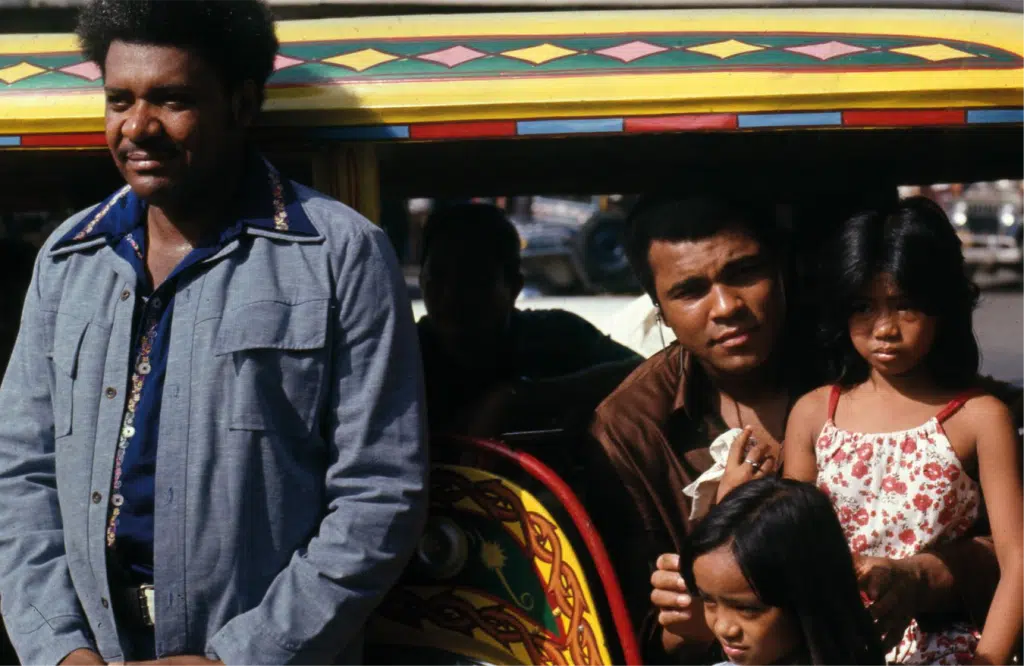
Ali and promoter Don King in Ermita, Manila, posing with Filipino children inside a jeepney.
At around 6 A.M. on the morning of September 15, 1975, Muhammad Ali peered through the window of his Philippine Airlines plane as it hovered over the green fringes of greater Manila.
“Beautiful, beautiful country!” he exclaimed as the Douglas DC-10 jet made its descent on the Manila International Airport, where hordes of newsmen and photographers, hundreds of fans, and a huge Muslim delegation awaited his arrival on the tarmac. “Look at all those beautiful people down there. I gotta see more of this.”
The timing of Ali’s arrival could not have been more strategic.
By September 15, when he arrived two weeks before the October 1 fight to train at the Folk Arts Theater, the people of the Philippines were suffering under their third year of military rule under Marcos—and their patience for his glowing promise of a “New Society” was wearing dangerously thin.
Once a robust Southeast Asian nation in the 1960s, the country was now handicapped by a sagging economy, rampant corruption, and political insurgency.
A brewing revolution was underway. “[By 1975,] the Communist Party of the Philippines, the New People’s Army, and the National Democratic Front had already succeeded in expanding to all regions of the country and in creating guerrilla bases and zones,” says Jose Maria Sison.
There was widespread unrest among workers, who were seething with anger because of unemployment and the soaring prices of basic goods.
Weeks after the fight, a massive labor strike erupted at the La Tondeña liquor factory of beverage king Carlos Palanca Sr., which spread to more than 300 major workplaces until the first quarter of 1976.
“Following the anniversary festivities [of Martial Law], Marcos began a large-scale purge of several government departments,” wrote Thomas Quinn in When ‘Malakas’ met The Greatest: Marcos’ Philippines and the Thrilla in Manila.
“More than 2,000 officials were sacked on Sept. 19; 100 judges resigned on Sept. 21; on Sept. 23 more than 70 Customs officials were fired. Days before the fight, another 1,100 government employees were terminated.
“As the purges thinned the ranks,” Quinn continued, “the visiting athletes provided Marcos with numerous ringing endorsements.
“For several weeks leading up to the match, the Marcos propaganda machine had [Muhammad Ali] at its service. Grand pronouncements about the skill and wisdom of Marcos, the greatness of his regime, and the glory of the Philippines filled airwaves and newspaper columns.”
A WikiLeaks cable, which originated from the US State Department’s Information and Privacy Office on September 23, also confirms this: the telegram divulged that Ali spends the same amount of time “working out” for the fight as he does “praising Marcos” in the press.
“Marcos is a great man. He is humble. He is peaceful. He is loving. I am sure he will lead his people always with the best decisions,” a barong-clad Ali gushed to reporters during his courtesy call to the First Couple on September 19.
(During the press conference, where the international media “ooh’d and ahh’d” at the sight of Ali and Frazier dressed in the national attire, Imelda also effused how the two African-Americans would fit in well into Filipino life. “We have provinces here [called] Negros . . . There is no racial discrimination in the Philippines. We Filipinos think black is beautiful!” she was quoted as saying.)
“President Marcos knows how to solve the problems here better than we could. I’m sure he’s doing something to help his people . . . He really is the right man for the country,” Ali said in the September 21 edition of the Daily Express, sounding like a well-coached ambassador of the administration.“If I were a citizen of this country, he’d be my leader for sure.”
The front-page Express article, published on the same day as Martial Law’s anniversary, carried a magnanimous headline: “Marcos: Ali says I’m a Miracle Man.”
Seven hundred miles from Manila, in the southern island of Mindanao, Muslim insurgents were also gaining ground.
The rebel group Moro National Liberation Front (MNLF) was waging armed struggle against the Armed Forces of the Philippines, who were mired in violent conflict.
Ali, the loquacious media darling who had vocally embraced Islam since 1964, was of particular importance to Marcos in quelling the Muslim insurgency.
“White people told me Filipinos ain’t no good . . . they said Filipinos hate me because I am Muslim and Filipinos are killing Muslims,” a visibly impassioned Ali told reporters when he arrived. “They were all lies. Lies! I see Muslims and Christians together huggin’ and kissin’.”
A few days later, on September 24, Ali was bestowed an award by the first Christian-Muslim Brotherhood Congress, a hastily arranged affair at the Ortanez University auditorium, whose politically opportune theme was “friendship and understanding between Christians and Muslims.”
At another ceremony in a downtown Manila mosque, where Ali was nearly mobbed to death, the Paramount Sultan of the 10 royal houses of Mindanao, Sulu, and Palawan conferred the decorated champion with an honorary title he would treasure above all else: Datu, which—in the native Muslim hierarchy—was a single tier below the noble rank of Sultan.
The newly minted Datu Muhammad Ali, however, defied Muslim and Martial law when he engaged in psychological warfare— “to frighten Frazier to death”—using a replica firing-cap pistol.
“During one of Ali’s pre-dawn training sessions in Roxas Boulevard, he stopped by the Hyatt Hotel and started shouting at Frazier’s window, “Come out, come out, Gorilla!” narrated veteran boxing commentator Ronnie Nathanielsz, who was Ali’s “shadow” and official liaison officer in Manila.
“As the rudely awakened Frazier stepped out into his hotel room’s balcony, Ali pointed the gun at him, fired some blanks, and started screaming, ‘I’m gonna shoot you, Gorilla! I’m gonna kill you, Gorilla!’”
“That was crazy. It was Martial rule, he was firing a ‘gun,’ and it was still curfew,” added Nathanielsz, who kept the pistol in a flannel pouch for Ali. “I still have a picture with him showing that toy gun and having a good laugh about it. ‘I scared him, didn’t I?’ he said. But that was the kind of guy he was.”
The September 23 WikiLeaks cable commented: “Ali’s aiming of empty gun at Frazier, snapping off some ‘shots,’ caused great consternation in official circles, since having a gun is [illegal in] Martial Law. Official investigation resulted. Ali will confine assaults to a more deadly weapon: his tongue.”
Ali at the Araneta family’s Bahay na Puti in Cubao with, from left to right, Judy Araneta-Roxas, Jorge Araneta (standing), Gerry Roxas, and Stella Marquez-Araneta.
The womanizing of Ali, whose wife Belinda “Khalilah Ali” Boyd stayed home in Chicago, provided equal distraction—sometimes of soap opera proportions.
“Ali was on a secret honeymoon . . . he viewed his visit to Manila as an all-expenses paid, four-week vacation [with his mistress],” explained The Independent’s Ken Jones, who was a member of the press corps that covered both the Manila and Zaire fights.
“In Zaire, he had been introduced to a stunning model named Veronica Porsche, with whom he began an affair. On the assumption that it would be a fairly easy encounter [with Frazier], Ali spent much of his time in Manila with his new girlfriend.”
The 19-year-old Porsche, a ravishing Creole dancer who was one of the “poster girls” of the Ali-Foreman bout in Kinshasa, acted as the “baby sitter” to Ali’s four children with Belinda during their stay in Manila. She was also sometimes referred to by Ali’s entourage as “Belinda’s cousin” to avoid suspicion.
Ali made a terrible faux pas, however, when he brought Porsche along as his date to the Marcoses’ welcome reception in Malacañang Palace. It was swamped by the international press.
“The highpoint was when Ali introduced the statuesque Veronica to President Marcos,” remembers Nathanielsz. “Marcos took one look at her and said, ‘Your wife is very beautiful,’ to which Ali—with a twinkle in his eye—looked at Imelda Marcos and said, ‘You haven’t done too badly yourself, Mr. President.”
Ali did not bother to correct his flattered host, foolishly allowing Marcos to believe that he was married to Porsche.
Their conversation was overheard by an eavesdropping Newsweek reporter, who dutifully wrote about the incident in the next issue.
In Chicago, Ali’s real wife, Belinda, eventually got wind of the Newsweek story and its accompanying photographs and was suitably enraged.
Although she was aware of Ali’s infidelities, she was furious at being publicly humiliated by her husband. Belinda immediately hopped on the first flight to the Philippines.
Upon arriving at the Manila Hilton on United Nations Avenue, she violently bolted into Ali’s presidential suite on the 19th floor, where he was being interviewed by American broadcaster Dick Schaap for The Today Show.
Six-feet tall and with a black belt in karate, Mrs. Khalilah Ali, in her ankle-length abaya dress, “tore down drapes, smashed mirrors, and left scratches on her errant husband’s face,” narrated Jones.
“Belinda told him, ‘Either [Veronica] goes home on the next plane, or I go home on the next plane,’” recounted Ferdie Pacheco.
All Ali said, according to Pacheco, was “goodbye.”
“I can still see her now as she swept, imperiously stony-faced, into the [Hilton lobby] behind her mountain of luggage,” an observer recalled. “A couple of hours later, having not even opened a single suitcase, she was on her way back to the airport and home.”
The press had a field day the following morning when Ali gathered them to explain the situation. “It was the first time,” The Observer noted, “that a major celebrity called a press conference to announce his marital infidelity.”
“Ali is a sex symbol, everybody loves him, and you cannot stop him,” a disgruntled Belinda, who landed herself on the cover of Chicago-based newsweekly Jet a few weeks later, disclosed in the magazine’s interview.
Little did Mrs. Ali know that Veronica Porsche wasn’t the only woman the visiting champion had his eyes on.
Two days after the historic fight, Ali was invited to a special luncheon hosted by the family of J. Amado Araneta, the owner of the Araneta Coliseum, at their Bahay na Puti residence in Cubao.
He was there ostensibly to sign a contract drafted by Jorge “Nene” Araneta and his sister, Judy Araneta-Roxas, who were going to construct the Ali Mall, the country’s first enclosed shopping complex to be named in the fighter’s honor. (“We didn’t pay him a thing [for the use of his name],” says Joe Fores, a grandson of J. Amado Araneta, “Ali said he was just grateful to be honored.”)
But the afternoon affair also gave the philandering athlete a chance to get better acquainted with a Filipina fashion model by the name of Rosemarie “Chiqui” Brosas, whom the US newswires claimed he had “fallen hard” for.
“Muhammad Ali may have been able to outpunch Joe Frazier . . . but word is getting around that the champ has been ‘knocked out’ by an 18-year-old beauty queen from the Philippines,” divulged one daily.
An incoming student at the American University of Paris, Brosas was a fourth runner-up at the 1975 Miss Universe pageant in El Salvador earlier that year. She was also one of “Thrilla” ring girls, handpicked by pageant director Stella Marquez-Araneta herself.
“She is beautiful, beautiful, I love her,” Ali was quoted as saying when he first met the Assumption Convent-educated Brosas before the bout.
A social columnist, who wrote about the Bahay na Puti function, described Brosas as “charmingly reserved under Ali’s amorous attention, causing Ali to say, ‘How come you don’t say you love me? Why don’t you say nice things to me? I’m not so bad looking.”
Ali even invited Brosas, “who comported herself in the best traditions of a Filipina in the face of his verbal advances,” to watch the concert of popular Motown group The Temptations with him at the CCP that evening.
“But she declined,” the gossipy article continued, “because she already had a date to the same show. Ali reportedly told her, ‘So you’re going with somebody else huh? You’re not going with me? You break it, you break it!”
“There were quite a few pretty ladies there, but he really fell in love with Chiqui Brosas,” says Nathanielsz, who accompanied Ali and his entourage (which purposely did not include Porsche) to the lunch. “That was crazy, because here he was with Veronica Porsche—the girl he was later going to marry—and yet he was still trying to flirt with Chiqui and take her home with him to the US!”
A few days later, Brosas was asked by a TV reporter as to why she refused the smooth-talking celebrity’s invitation and “flowery expressions of love.”
“He is the best—witty, intelligent, good-looking,” she remarked, before pausing, “but Belinda might get mad.”
“There was another funny incident,” recalls Nathanielsz. “At one of the dinner parties in Jorge Araneta’s home, these five beautiful British models were so star-struck by Ali from the moment he walked in.
“So Ali and the girls talked. They made arrangements. He told them he would go to their room at the Hilton, where he was also staying, after the party.
“He called me to the side and said, ‘Hey, brother, I’m gonna get rid of all my people, all my security [when we get back to the Hilton]. I’m gonna tell them I’m gonna sleep. Will you come to my suite after about 10-15 minutes and we go see those girls?’
“[So later that night] we went together to the girls’ hotel room. He drank orange juice and sat on the couch, surrounded by these beautiful models.
“Do you know what he did the entire night? He preached to them about Islam! I think those girls were particularly disappointed.
“When we left the room, he pulled me aside and quipped, ‘I fooled them, didn’t I?’”
When Ali departed Manila on October 4, a front-page article in the Sunday Express described the scene at the Manila International Airport:
“Ali thanked Pres. Marcos, telling him, ‘I love you,’ and promised to return on Christmas Day. ‘The Philippines—never a place so nice, the best place I’ve been to in the whole world,’ he sighed before moving through a mob of well-wishers, kissing every woman in his way. ‘What a fine place to come back to, to find me my next wife.’”
Brosas, who was also on the tarmac according to the New York Times, sent off her persistent suitor with gifts and leis. The 220-pound fighter “reciprocated with hearty kisses,” before professing to her, “Ali is a lover of beauty.”
The champion, the New York Times claimed, not only left the Philippines with a “shower of kisses” from women, but also “about $60 million in business deals.”
Photo by Dan Farrell/NY Daily News ArchIve vIa Getty Images.
“The fight took place there for one reason: Money,” observed Ken Jones.
Ali was promised “$3 million from the government of a country where the annual salary of 70% of the work force was less than the price of an upper box seat—then $133,” offered Oliver Teves of the Associated Press. (The ring alone, which was flown in from the US, cost $12,000.)
It was mutually beneficial.
Ali, through his New Jersey-based export firm Impro Inc., promised to act as a broker between the Philippines and the oil-exporting Arab countries in the “two-way trade of sugar and crude oil.”
The day before the fight, Ali met with Trade Secretary Troadio Quiazon and Agriculture Secretary Arturo Tanco to sign a memorandum of agreement.
Assuring the two men of his “personal assistance,” Ali said he would speak to the heads of state in Libya, Saudi Arabia, Abu Dhabi, and Kuwait. He even joked that he might just “quit boxing . . . and concentrate on his business” given the export potential of Philippine sugar and cement.
Ali was also the guest of honor at the ground- breaking ceremony of the Sports Center of the Philippines, a sprawling Olympic-standard sports complex that was to rise in 45 hectares of land in Bicutan in time for the 8th Asian Games in 1978.
“All money, after expenses, from the Philippines’ share of the Ali-Frazier promotion will go to the Center,” GAB chairman Tabuena announced to the press on October 2, adding that the projected income from the championship bout would be “at least $10 million.”(Forty years have passed since “Thrilla in Manila” and no such sports complex has ever been built.)
“Everybody gained from the event—the fighters, the promoters, the fans (who got their money’s worth), the Philippines itself,” read the October 5 edition of the Sunday Express, which estimated the event’s total revenue—including ticket sales, advertising, and TV income—to be in the range of $20 to $30 million, plus a media value of $50 million for the host country.
“No regime has more blatantly used tourism for political leverage than that of ex-President Marcos of the Philippines,” wrote Dr. Linda Richter in her 1989 book The Politics of Tourism. “Although
contributed to many of the regime’s political and economic objectives, it achieved those gains at enormous cost to the Filipino economy.”
“Boxing abolitionists would wag their fingers at such questionable venues,” shared London-based political journalist Michael Klimes, comparing Mobutu’s “Rumble” with Marcos’s “Thrilla.”
“But a cynic with a wry sense of humor may ask what is the difference between a shrewd, self-interested boxing promoter and a bloodthirsty dictator? Not much is the answer.”
Reign Supreme: Richard and Pat Nixon (center) at the Manila International Airport with Imelda and Ferdinand Marcos and their children Irene, Bongbong, and Imee.
It was a swinging Wednesday night scene at Malacañang Palace and the heavyweight champion of the world had just rebuffed the First Lady’s request to get it down on the dance floor.
“Sorry lady, I can’t dance,” the fighter, famous for his in-ring shuffle, told Imelda Marcos, who was wearing a king’s ransom in jewels on her ears and wrists as she boogied the night away.
Only nine hours had passed since one of the most brutal fights in boxing history and Muhammad Ali, now contemplating retirement after the toughest fight of his 15-year career, was feeling melancholic.
“Death is so near . . . and time for friendly action is so limited,” he scribbled, almost cryptically, in the Palace guest book.
Hunched in soreness because of the hematomas on his hips, he sat alone in the candle-lit presidential table, looking more like the vanquished than the victor.
But this, it seemed, was not his victory alone.
Standing a few feet away was the most euphoric figure in the room, the true winner of this primal collision of corporate sport and despotic government.
Reveling in the bacchanalia as he led his Iron Butterfly by the hand to the center of the dance floor was Ferdinand Marcos, smiling and laughing and dancing like a man who had just won a multi-million-dollar bet.
Earlier that evening, a top US auditing firm appraised the fight to be worth more than $100 million ($420 million today) for the Philippines.
“Look at the President, look at him dancing like a little boy!” said an amused Ali, his dark brown eyes flickering under the disco lights. “You can’t do this in the White House in America. You can’t do this anywhere else in the world.”
This special report, written by Rogue editor-in-chief Paolo Reyes, first appeared in Rogue’s June 2013 issue. Download the digital edition at Zinio.com/Rogue or through the new Rogue App at iTunes: http://apple.co/1TOqldG.


![[OPINION] To Imelda Marcos](https://www.martiallawchroniclesproject.com/wp-content/uploads/2019/10/to-imelda-marcos-sept-28-2019_030878DE5CE8447C9C9F6A95FB379980.jpg)