
by MLC | Nov 18, 2016 | Martial Law Stories
By Jodesz Gavilan
Source: Rappler.com
(3rd UPDATE) Ferdinand Marcos is interred at the Libingan ng mga Bayani on November 18 after the Supreme Court on November 8 gives the go signal
MASS. Former First Lady Imelda Marcos sprinkles holy water on the flag-draped coffin of her late husband Ferdinand Marcos during a memorial Mass at the Saint William Cathedral in the Philippines while her family watches. AFP file photo
MANILA, Philippines (3rd UPDATE) – The long-running issue of whether or not former president Ferdinand Marcos should be buried at the Libingan ng mga Bayani (Heroes’ Cemetery) has finally been put to rest.
Marcos was stealthily buried at the Heroes’ Cemetery past noon with full military honors.
Just 10 days earlier, the Supreme Court on November 8, decided that the late dictator can be buried at the Libingan – nearly 3 months after President Rodrigo Duterte gave his marching orders for burial preparations. Martial Law victims had filed petitions to block it. (READ: Martial Law 101: Things you should know)
The 21-year administration of Marcos is notorious for its many human rights abuses. Amnesty International recorded about 70,000 people imprisoned, 34,000 tortured, and 3,240 were killed from 1972 to 1981 – the years when the Philippines was placed under Martial Law. (READ: Worse than death: Torture methods during martial law)
In the past 27 years, the final resting place of Marcos had been highly debated but on November 18, it was silenced. (READ: From Hawaii to Ilocos Norte: The long journey of Ferdinand Marcos’ remains)
Rappler lists the events surrounding the controversy.
FEBRUARY 1986
The Marcos administration was toppled through the People Power Revolution. Marcos, his family, and several of his allies were flown to Hawaii, United States.
SEPTEMBER 1989
Three years into exile, Marcos passed away at the age of 72 on September 28, 1989 due to complications brought by kidney, lung, and heart ailments.
Aquino, however, did not allow Marcos’ body to be returned to the Philippines “in the interest of the safety of those who will take the death of Marcos in widely and passionately conflicting ways.” The US Federal Aviation Administration also issued an order preventing the operation of any aircraft carrying Marcos’ body from the US to the Philippines.
OCTOBER 1989
Unable to return to the Philippines due to the government ban, Marcos’ body was interred on October 15, 1989 in a private mausoleum at the Valley of the Temples Memorial Park in Hawaii.
The funeral Mass for Marcos in the state’s largest Roman Catholic church was attended by “more than 1,500 people.”
NOVEMBER 1991
Imelda Marcos and her family returned from exile to the Philippines but without the body of the family patriarch.
SEPTEMBER 1993
Marcos’ body was flown via a chartered Continental Airlines jet direct to his home province, Ilocos Norte, on September 7, 1993 as part of the deal signed by the Philippine government headed by then newly-elected President Fidel V. Ramos and the Marcos family.
After a festive gathering that was attended by thousands of supporters, the former dictator’s body was interred in a glass crypt in the Marcos Museum and Mausoleum in Batac City.
JULY 1998
Then President Joseph Estrada abandoned his plan of finally burying Marcos at the Libingan ng mga Bayani, supposedly scheduled on July 11, 1998, after it was met with “various emotions and sentiments that flared up.”
APRIL 2011
Jejomar Binay, then vice president, recommended to then president Benigno Aquino III to let Marcos be buried in Batac City with full military honors. In 2016, Binay said that Aquino did not act on it. (READ: Aquino sat on Binay proposal to bury Marcos in Ilocos)
AUGUST 7, 2016
After consistently declaring that the late dictator deserves to be buried at the Libingan ng mga Bayani, President Rodrigo Duterte on August 7, 2016 gave the orders to go on with the process on the grounds that he was a “former president and a soldier.”
Duterte’s plan was opposed by several stakeholders, especially by the victims of abuse during the Martial Law period.
He, however, argued that his decision was consistent with upholding the law, stating that the Aquinos and their supporters should have passed a law banning a hero’s burial for Marcos.
AUGUST 23, 2016
A total of 6 petitions to strike down the order were filed at the Supreme Court. It held oral arguments on August 31 and September 8.
On August 23, just before the first day of the oral arguments, the SC issued a status quo ante order (SQAO) on the interment of the former president. It was the first of 3 SQAOs released that effectively extended the postponent to November 8.
NOVEMBER 8, 2016
After several extensions, the Supreme Court ruled 9-5, with one abstention, on Tuesday, November 8, that Marcos’ body can be buried at the Libingan ng mga Bayani. (READ: Supreme Court allows hero’s burial for Marcos)
Associate Justices Arturo Brion, Presbitero Velasco Jr, Diosdado Peralta, Lucas Bersamin, Mariano del Castillo, Jose Perez, Teresita de Castro, Jose Mendoza, and Estela Perlas-Bernabe voted in favor of giving Marcos a hero’s burial.
Chief Justice Maria Lourdes Sereno, together with Senior Associate Justice Antonio Carpio, and Associate Justices Marvic Leonen, Francis Jardeleza, and Alfredo Benjamin Caguioa dissented.
The High Court’s decision cleared all legal obstacles to a Marcos burial.
NOVEMBER 10, 2016
Albay 1st District Representative Edcel Lagman filed a manifestation before the SC on behalf of all petitioners. They said they have yet to receive full copies of the decision and opinions, thus preventing them from challenging the ruling in court. Lagman asked that SC justices consider reissuing another status quo ante order on Marcos’ burial until they are able to submit their motion.
Lagman also asked the High Court to advise the Armed Forces of the Philippines or the defense department to hold implementation of President Duterte’s order to begin preparations for the Marcos burial until the SC ruling becomes final.
NOVEMBER 18, 2016
Marcos’ body was interred at the Libingan ng mga Bayani after being flown from Ilocos Norte. The exact date of the burial was never publicly confirmed prior to Friday, November 18.
According to reports, media who were at the Heroes’ Cemetery thought that there would be a rehearsal only until Philippine National Police chief Director General Ronald dela Rosa arrived. He confirmed the burial and said that the Marcos family requested “simple and private” funeral rites.
As of early afternoon protests are being organized by groups against a hero’s burial for Marcos.

by MLC | Nov 18, 2016 | Martial Law Stories
Source : Rappler.com
(5th UPDATE) The Marcos family asked for ‘simple and private’ funeral rites, says PNP chief Director General Ronald dela Rosa
MANILA, Philippines (5th UPDATE) – Former president Ferdinand Marcos was buried at the Libingan ng mga Bayani with full military honors past noon Friday, November 18, giving closure to his family and supporters but reopening wounds inflicted by his 21-year rule marked by human rights atrocities.
The “simple and private” funeral rites, as requested by the Marcos family, were carried out late Friday morning so that the remains of Marcos would be interred by noon, Chief Superintendent Oscar Albayalde said in an interview with different media groups. (READ: Marcos family arranged for a private burial)
Albayalde said there was a 21-gun salute for the late strongman as part of the military honors, but there was no parade that marked a state funeral service. (READ: Marcos burial captured in ‘same-day’ edit video)
MANILA, Philippines (5th UPDATE) – Former president Ferdinand Marcos was buried at the Libingan ng mga Bayani with full military honors past noon Friday, November 18, giving closure to his family and supporters but reopening wounds inflicted by his 21-year rule marked by human rights atrocities.
The “simple and private” funeral rites, as requested by the Marcos family, were carried out late Friday morning so that the remains of Marcos would be interred by noon, Chief Superintendent Oscar Albayalde said in an interview with different media groups. (READ: Marcos family arranged for a private burial)
Albayalde said there was a 21-gun salute for the late strongman as part of the military honors, but there was no parade that marked a state funeral service. (READ: Marcos burial captured in ‘same-day’ edit video)
Philippine National Police chief Director General Ronald dela Rosa told reporters outside the cemetery gates that 3 helicopters brought members of the Marcos family and the remains of the late dictator to the Libingan.
Reporters who were at the Heroes’ Cemetery said they thought there would only be a rehearsal for the burial until the PNP chief himself arrived on site. (READ: TIMELINE: The Marcos burial controversy)
Dela Rosa said police were only informed about the final schedule of the burial on Thursday night. He said authorities were ordered to ensure that the former president would be “buried properly.”
Palace spokespersons said they did not know about the burial, which was carried out while President Rodrigo Duterte was abroad. He left Manila on Thursday to attend the Asia-Pacific Economic Cooperation Leaders’ Meeting in Peru.
Maximum tolerance
Asked how the police would deal with anti-Marcos groups who were expected to flock to the area, Dela Rosa said, “Maximum tolerance, hindi maximum paluan (not maximum beating)….We are prepared [for them].” (READ: Live updates on protests and other Marcos burial-related activities)
RJ Piniera, a media relations officer of Ilocos Norte Governor Imee Marcos, said Imee flew to Manila last night.
“Kaming mga Ilocano pupunta ng Manila kasi [may] pasasalamat rally baka sakali mailibing(We Ilocanos will go to Manila because there’s a thanksgiving rally in case the burial pushes through),” Piniera said.
Marcos supporters were reportedly informed about the plan but were asked to keep it confidential.
The funeral rites for Marcos took place over a week after the Supreme Court, voting 9-5, ruled in favor of a hero’s burial for the former president. The petitioners against a state interment for Marcos, mostly Martial Law victims, had filed manifestations before the Court that they would file a motion for reconsideration on the ruling.
SC spokesperson Theodore Te said the burial is not prohibited as the Court had already lifted the status quo ante order on it.
‘Like a thief in the night’
Vice President Leni Robredo strongly condemned the hero’s burial for Marcos and reiterated her position that “he is no hero.”
“Like a thief in the night, the Marcos family deliberately hid the information of burying former president Marcos today from the Filipino people,” Robredo said in a statement.
Barry Gutierrez, counsel for the anti-Marcos court petitioners, said the burial was illegal because of the outstanding appeals.
“It’s not really surprising that this is happening. Marcos flouted the law when he was still alive, and even at his burial, he is still breaking the law,” Gutierrez told Agence France-Presse.
“We are shocked and angered,” Gutierrez added.
Anti-Marcos groups and others opposed to the burial, who were caught flat-footed by the surprise burial, also slammed the Marcoses for their “underhandedness” and said they would mark the day with a “Black Friday” protest.
“This is a continuing deception, deviousness, abuse, and underhandedness of the Marcos family. They are just continuing the abuses and atrocities committed during the Martial Law regime,” said Albay Representative Edcel Lagman.
Rule of plunder, abuse
Marcos ruled the Philippines for two decades until forced into US exile by the “People Power” revolution, a largely peaceful event that inspired democracy movements throughout Asia and around the world.
Marcos, his infamously flamboyant wife Imelda, and their cronies plundered up to $10 billion from state coffers during his rule, according to government investigators and historians.
The dictator also oversaw widespread human rights abuses to maintain his control of the country and enable his plundering, with thousands of people killed and tortured, previous Philippine governments said.
Anti-corruption watchdog Transparency International in 2004 named Marcos the second most corrupt leader of all time, behind Indonesian dictator Suharto.
The Philippines’ foreign debt went from $2.67 billion in 1972, when Marcos declared martial law, to $28.2 billion in 1986, according to the World Bank.
After Marcos died in Hawaii in 1989, his family began a successful political comeback and tried repeatedly to have him buried at the heroes’ cemetery, where other presidents and celebrated military figures are interred.
Imelda became a congresswoman and fended off all corruption charges against her.
Two of her children established themselves as influential politicians. Ferdinand “Bongbong” Marcos Jr, was the more successful, becoming a senator before almost winning the vice presidency this year.
However previous presidents had refused to allow the burial in the heroes’ cemetery because of Marcos’s crimes, so the family kept the preserved body in a glass casket at his home in the northern province of Ilocos Norte.
The family’s fortunes changed with the election of Duterte, a longtime ally of the Marcos family, as president in May this year.
He said Marcos deserved to be buried at the heroes’ cemetery based on the fact he had been a president and a veteran of World War II.
Duterte also said he owed loyalty to the family because his father served in the Marcos government and the family had helped fund his election campaign. – with a report from Agence France-Presse/Rappler.com
by MLC | Nov 15, 2016 | Martial Law Stories
By Mara Cepeda
Source: Rappler.com
Ilocos Norte Governor Imee Marcos points out that Fidel Ramos headed the Philippine Constabulary, which conducted arrests and other abuses during Martial Law
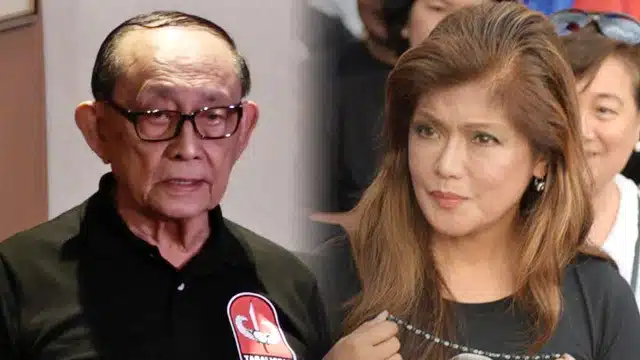
‘ASK HIM.’ Ilocos Norte Governor Imee Marcos (right) tells her father’s critics to direct their questions to former President Fidel Ramos (left). File photos by Rappler
MANILA, Philippines – Ilocos Norte Governor Imee Marcos pointed to former President Fidel Ramos as protests continue regarding the impending burial of her father, the late strongman Ferdinand Marcos, at the Libingan ng mga Bayani.
“Kami ay nag-aaral pa noon at mga bata pa. Bakit nga ba hindi natin tanungin ang dating Philippine Constabulary Chief Fidel Ramos tungkol sa mga pag-aresto at mga pang-aabuso diumano?” said Imee in a Facebook post on Monday, November 14.
(We were still studying and children then. Why don’t we ask former Philippine Constabulary Chief Fidel Ramos about the alleged arrests and abuses?)
The Supreme Court, voting 9-5, junked the petitions seeking to bar the interment of Marcos at the Libingan ng mga Bayani because of the state-sanctioned human rights violations that occurred during his 21-year rule. (READ: Supreme Court: Marcos was not pure evil)
While Marcos loyalists celebrated the SC ruling nationwide, activists and Martial Law victims maintained that a hero’s burial for Marcos is undeserved as his presidency was mired by killings, torture, disappearances, media oppression, and corruption. (READ: Only civil disobedience can block Marcos’ burial)
Among those who was disappointed with the High Court’s decision was Ramos, who was once Marcos’ vice military chief.
“Address [the apology] to all the descendants of the victims, whether or not there is an investigation, to show sincere desire to discard, reject and eliminate already all the dictatorial tendencies and happenings during that period,” Ramos told GMA-7.
In a separate press statement, Imee pointed out that Ramos was also the former chief of the Philippine Constabulary (PC), infamous during the Martial Law years as it was used by the late dictator to arrest his critics. (LOOK BACK: The Philippine Constabulary under Marcos)
The PC was the national police force that began under the American regime in 1901. It eventually became part of the military and was in charge of maintaining peace and order.
The PC was merged with the Integrated National Police to form what is now the Philippine National Police.
Imee also cited a February 2016 Manila Times column of Rigoberto Tiglao, who was among the activists arrested during Martial Law.
“Rigoberto D. Tiglao of the Manila Times, who was a student activist, labor organizer, and ‘firebrand Communist’ (his own words), wrote last February, ‘Arrest orders against me and my late wife… were issued by Ramos,’ adding, ‘it was the PC’s top anti-subversive unit, the 5th Constabulary Security Unit… that arrested us, with one of their tall burly soldiers beating me up,’” said Imee.
But Ramos and then-defense minister Juan Ponce Enrile broke away from Marcos following the 1986 snap elections, starting the series of events that led to the dictator’s downfall during the EDSA People Power Revolution.
Both Imee and her brother, former Senator Ferdinand “Bongbong” Jr, are hoping the SC ruling would lead to “national healing.” Imee also urged her father’s critics to “let go” of their grudges.
No legal admission of guilt?
The Ilocos Norte governor also said that she cannot make a legal admission of guilt over the abuses committed during her father’s presidency. She said she was too young to remember at the time.
“Mayroon daw nagsasabi na kailangang admission of guilt. Parang ang bigat naman kasi I’m not aware of any policy or any presidential order saying na kailangang gawin itong mga karumal-dumal na krimen,” she told ANC’s Headstart.
(Some people are saying there is a need for an admission of guilt. But that seems to heavy because I am not aware of any policy or any presidential order that said these heinous crimes should be committed.)
“In my heart, if in any way you have hurt someone, you should say sorry even if it’s not intentional, even if it was not policy. Okay lang naman sa’kin, pero yung admission of guilt… Unang-una, ang liit-liit ko noon. Paano ko ia-admit, hindi ko naman alam?” she added.
(In my heart, if in any way you have hurt someone, you should say sorry even if it’s not intentional, even if it was not policy. That’s okay for me, but the admission of guilt… First of all, I was too small then. How can I admit these things when I didn’t know about them?)
But Imee was already 22 years old on August 31, 1977, the day her national chairmanship of the Kabataang Barangay was questioned by 21-year-old Archimedes Trajano.
Trajano was then forcibly taken from the venue by Imee’s bodyguards, and was tortured and thrown out of a building window.

by MLC | Nov 11, 2016 | Martial Law Stories
Source: Rappler.com
Read the Supreme Court’s 58-page decision allowing the burial of the late dictator Ferdinand Marcos at the Libingan ng mga Bayani
IN FAVOR. The Supreme Court on November 8 rules 9-5 in favor of the burial of the late dictator Ferdinand Marcos at the Libingan ng mga Bayani. Photo by LeAnne Jazul/Rappler
MANILA, Philippines – On Tuesday, November 8, the Supreme Court (SC) voted 9-5 to allow the burial of Ferdinand Marcos at the Libingan ng mga Bayani (LNMB), rejecting petitions that sought to stop the interment of the late dictator at the final resting place of Filipino soldiers, war veterans, and citizens considered as heroes and martyrs.
Associate Justice Diosdado Peralta wrote the decision, which was concurred in by Justices Arturo Brion, Presbitero Velasco Jr, Lucas Bersamin, Mariano del Castillo, Jose Perez, Teresita de Castro, Jose Mendoza, and Estela Perlas-Bernabe. (READ: Supreme Court: Marcos was not pure evil)
Chief Justice Maria Lourdes Sereno, Senior Associate Justice Antonio Carpio, and Associate Justices Marvic Leonen, Francis Jardeleza, and Alfredo Benjamin Caguioa dissented. (READ: Marcos burial: What did the dissenting SC justices say?)
In the majority decision, the SC said President Rodrigo Duterte, who had issued the order for the late dictator’s burial at the cemetery, acted within the bounds of law and jurisprudence. The Court said Duterte was exercising his mandate under Article VII, section 17 of the 1987 Constitution to ensure the faithful execution of laws, and that there is no law prohibiting Marcos’ burial at the LNMB.
The SC added that it could not deny the former president his “rightful place” at the LNMB. It pointed out that petitioners did not dispute the facts that Marcos was a former president and commander-in-chief, and under military guidelines, these qualify him to be interred at the LNMB. (READ: Who can be buried at Heroes’ Cemetery? AFP explains rules)
While petitioners raise Marcos’ human rights violations and plunder of government coffers during the Martial Law years, the Court said that Marcos’ burial at the LNMB would not confer on him the status of a hero.
“Despite its name, which is actually a misnomer, the purpose of the LNMB, both from legal and historical perspectives, has neither been to confer to the people buried there the title of “hero” nor to require that only those interred therein should be treated as a ‘hero,'” the SC said.
Political act
While petitioners argue that Marcos was dishonorably discharged through the 1986 uprising that came to be known as the EDSA People Power Revolution, the SC said that this political act “should not automatically be given a particular legal meaning other than its obvious political consequence – that of ousting him as president.”
“For his alleged human rights abuses and corrupt practices, we may disregard Marcos as a President and Commander-in-Chief, but we cannot deny him the right to be acknowledged based on the other positions he held or the awards he received. In this sense, we agree with the proposition that Marcos should be viewed and judged in his totality as a person. While he was not all good, he was not pure evil either. Certainly, just a human who erred like us,” the SC said.
The High Court also rejected the argument that Duterte is bound by the 1992 agreement between the Marcos family and former president Fidel Ramos to have the late dictator’s remains interred in Ilocos Norte.
The majority of the magistrates also dismissed the petitioners’ claim that the President’s determination for the burial was spurred by a debt of gratitude to the Marcoses. The SC said petitioners failed to prove this, and that presumption of regularity in the performance of official duty prevails over petitioners’ allegation.
Procedure
Aside from these substantive issues, the SC also said the petitions should be dismissed on procedural grounds. The SC agreed that Duterte’s decision to have the remains of Marcos interred at the LNMB involves a political question that is not a justiciable controversy.
The High Court also said the petitioners failed to show that they have suffered or will suffer direct and personal injury as a result of Marcos’ burial at the heroes’ cemetery. They likewise violated the doctrines of exhaustion of administrative remedies and hierarchy of courts; the SC said the petitioners should have sought reconsideration of the order for Marcos’ burial with the defense department, or to file the petitions first with the proper regional trial court.
In the concluding statement, the ponente wrote: “There are certain things that are better left for history – not this Court – to adjudge. The Court could only do so much in accordance with the clearly established rules and principles. Beyond that, it is ultimately for the people themselves, as the sovereign, to decide, a task that may require the better perspective that the passage of time provides. In the meantime, the country must move on and let this issue rest.”
Supreme Court decision on Marcos burial case by Rappler Philippines on Scribd
– Rappler.com

by MLC | Nov 9, 2016 | Martial Law Stories
Source: Rappler.com
Third-generation Marcoses take to social media to celebrate the Supreme Court ruling to give the late President Ferdinand Marcos a hero’s burial
MANILA, Philippines – The children of former President Ferdinand Marcos have issued official statements, celebrating the decision of the Supreme Court to allow a hero’s burial for their father.
Outside the High Court on Tuesday, November 8, surrounded by loyalists, Ilocos Norte Governor Imee Marcos said she was delighted with the news.
“It’s a state burial and we’re delighted. It’s been 27 years na. Napakahaba na ng panahon. Sa wakas, [naisakatuparan] na ang karapatan ng tatay ko na mailibing,” she said.
(It’s a state burial and we’re delighted. It’s been 27 years. That’s a long time. Finally, my father’s right to be buried at the Libingan ng mga Bayani has been fulfilled.)
Her younger brother, former Senator Ferdinand Marcos Jr thanked the SC for its decision and hoped it would lead to national “healing” as well.
Outside the spotlight, but through public posts on social media, the younger heirs of Marcos had their own way of welcoming the news.
Matthew Manotoc, Imee Marcos’ son, posted a Facebook status thanking the family’s supporters and President Rodrigo Duterte.

Sandro Marcos, Ferdinand Jr’s son, tweeted a peace sign emoji.

On Tuesday, the Supreme Court voted 9-5 to allow the dictator’s burial at the Libingan ng mga Bayani (Heroes’ Cemetery). Malacañang hoped the decision would allow Filipinos to “move forward,” but the online world thought otherwise. A series of rallies were staged in several cities across the country to protest the decision.
What do you think of the SC’s decision? Comment below or write your thoughts on X. – Rappler.com

by MLC | Nov 9, 2016 | Martial Law Stories
By: Paterno Esmaquel II
Source: Rappler.com
‘Marcos is no hero! He should not be presented as one,’ the Catholic Bishops’ Conference of the Philippines says
LATE DICTATOR. This file photo taken on July 2, 2014, shows former Philippine first lady Imelda Marcos kissing the glass case bearing her late husband and former president Ferdinand Marcos during a visit to the mausoleum on her 85th birthday in Batac, Ilocos Norte. Photo by Ted Aljibe/AFP
MANILA, Philippines – The Catholic Bishops’ Conference of the Philippines (CBCP) on Wednesday, November 9, condemned the Supreme Court (SC) ruling to allow a hero’s burial for the late dictator Ferdinand Marcos.
In a statement, the CBCP said it is “saddened by the decision of the Supreme Court to allow the burial of former president Marcos in the Libingan ng mga Bayani (Heroes’ Cemetery).”
“We see this as another step to build the culture of impunity in the country,” Lingayen-Dagupan Archbishop Socrates Villegas said in a statement signed on behalf of the CBCP.
The hero’s burial for Marcos was ordered by President Rodrigo Duterte, whom critics accuse of breeding a culture of impunity.
Duterte, an ally of the late dictator’s family, has urged the killing of drug suspects who resist arrest. Duterte’s war on drugs has killed at least 4,812 people since July 1, with 3,001 of them having been slain in extrajudicial or vigilante-style killings.
Human rights advocates have compared recent killings in the Philippines to the abuses during the Martial Law years under Marcos.
“Marcos is no hero! He should not be presented as one,” Villegas said.
Villegas is the protégé of the late Manila Archbishop Jaime Cardinal Sin, who helped oust Marcos through the EDSA People Power Revolution of 1986.
Villegas was the 25-year-old private secretary of Sin when Filipinos toppled Marcos and restored Philippine democracy. (READ: EDSA: ‘Hand of God’ seen from the House of Sin)
CBCP: ‘We do not forget’
In the CBCP statement that he signed, Villegas pointed out that Marcos “made many people suffer by arbitrary torture and death.” He also “deprived many poor people of their basic needs while his family and cronies were enriched.”
“We do not forget this! We will not allow that this be forgotten by the future generations in order that the same strong-hand oppression may not happen again,” he said.
“Those who do wrong should be made accountable,” he added.
Villegas then said the late dictator’s family and cronies should “admit the wrong they have done.” He also said victims of human rights abuses should be properly compensated.
“This is a matter of justice,” the archbishop said.
Villegas continued: “Burying Marcos in the Libingan ng mga Bayani will not bring peace and unity to the country. Peace can only come if there is justice.”
“Justice demands recognition of the harm done to the people and restitution to the victims,” he said.
He explained that the Church works for peace and unity “based on truth and justice for all, especially for the poor and the victims.”
Villegas ended the statement by saying that the CBCP is “very sad.”
Reiterating an earlier statement, Villegas said a hero’s burial for Marcos “is an insult to the EDSA spirit.” He added that it “mocks our fight to restore democracy.”
“It calls on us for greater courage to make the full truth of the dictatorship known,” Villegas said. “Yes, we do not forget and we will not forget!” – Rappler.com
