
by MLC | Aug 6, 2016 | News
By: Michael Bueza
Source: Rappler.com
(UPDATED) The historical commission says that former president Marcos’ record as a soldier during World War II ‘is fraught with myths, factual inconsistencies, and lies’
MANILA, Philippines (UPDATED) – The National Historical Commission of the Philippines (NHCP) is against the burial of former president Ferdinand Marcos at the Libingan ng mga Bayani.
The dictator’s remains are reportedly set to be transferred from Ilocos Norte to the Heroes’ Cemetery on September 18.
The commission said it studied President Rodrigo Duterte’s basis for allowing Marcos’ burial at the cemetery. In May, days after his election victory, Duterte said he would allow it “because he was a Filipino soldier, period.”
This claim supposedly makes Marcos eligible for interment there, in accordance with guidelines set by the Armed Forces of the Philippines (AFP). (READ: Who can be buried at Heroes’ Cemetery? AFP explains rules)
However, in a 26-page pamphlet entitled, “Why Ferdinand E. Marcos Should Not Be Buried at the Libingan ng mga Bayani”, the NHCP disputed Marcos’ record as a soldier during World War II, saying that it is “fraught with myths, factual inconsistencies, and lies.”
The commission said that Marcos “lied about receiving the Distinguished Service Cross, Silver Star, and Order of the Purple Heart”, a claim he supposedly made as early as 1945.
The NHCP earlier said it was the US Medal of Honor that Marcos claimed he received, but the commission on Monday, August 8, clarified it was the Distinguished Service Cross, along with the two other awards.
Marcos’ supposed guerrilla unit, Ang Mga Maharlika, was also “never officially recognized and neither was his leadership of it,” said the NHCP.
US officials, added the NHCP, “did not recognize Mr. Marcos’ rank promotion,” from major in 1944 to lieutenant colonel by 1947.
The former president’s actions as a soldier during WWII were likewise “officially called into question” by the US military.
Along with other sources, the NHCP referred to two documents from the Guerrilla Unit Recognition Files (1942-1948) in the Philippine Archives Collection.
The Ang Mga Maharlika file “contains letters, memoranda, reports, and accounts relating to the guerrilla unit Maj. Marcos claimed to have founded and led.”
Meanwhile, the Allas Intelligence Unit file “pertains to the organization led by Cipriano Allas, which claimed to be the intelligence unit of Ang Mga Maharlika.”
When a historical matter is doubtful, like Marcos’ WWII record, the NHCP wrote in the study’s executive summary that it “may not be established or taken as fact.”
“A doubtful record also does not serve as sound, unassailable basis of historical recognition of any sort, let alone burial in a site intended, as its name suggests, for heroes,” the NHCP added. (READ: Netizens campaign against Marcos burial at Heroes’ Cemetery)
Published on July 12, the pamphlet was the result of NHCP’s study as part of its mandate under Republic Act 10086 “to conduct and disseminate historical research and resolve historical controversies.” – Rappler.com

by MLC | Jul 4, 2016 | News, Uncategorized
Source: Rappler.com
Donald Trump’s chief campaign strategist Paul Manafort tells Politico Magazine that the money he received from Ferdinand Marcos’ allies was disclosed to the US government
LINKS TO MARCOS. Paul Manafort checks the teleprompters before Donald Trump’s speech at the Mayflower Hotel in Washington, DC, on April 27, 2016. File photo by Chip Somodevilla/Getty Images/AFP
MANILA, Philippines – Thirty years after the fall of Ferdinand Marcos, the international political consultant he hired to help him cling to power is still very much active – this time, as the chief campaign strategist of US Republican presidential candidate Donald Trump.
A Politico Magazine report published in June 2016 revealed more details about Paul Manafort’s links to the Philippines’ late dictator – just one of the several controversial foreign leaders he worked for.
According to Politico Magazine, a front group for Marcos agreed to pay Manafort’s firm a whopping $950,000 a year.
Politico revealed that “Manafort worked more closely than previously known with Marcos and his wife, Imelda,” both in Manila and in Washington, during the 1980s.
According to the magazine, Manafort and his associates advised the Marcoses on electoral strategy, and downplayed concerns in the US about human rights abuses, corruption, and poll fraud in the Philippines.
Documents also showed that the strongman “earmarked huge sums of cash for [Ronald] Reagan’s 1980 and 1984 campaigns – as much as $57 million, according to one claim made to Philippine investigators.”
But Politico reported that without a concrete paper trail, it’s unclear how much money Manafort received, or whether supposed political contributions did end up in the Reagan campaign.
Manafort, for his part, told Politico that the money he got from Marcos’ allies had been disclosed to the US Justice Department, and that rumors that he accepted – and hid – millions of dollars are false.
“It was circulating way back when, when people were out to just pass rumors and things about me. It’s old stuff that never had any legs anywhere,” Politico quoted Manafort as saying. “It’s totally fiction.”
But pressed for clarification, Trump’s top strategist refused to elaborate on the role he played during Marcos’ final years in power.
“When Politico asked him to describe his relationship with Marcos,” the magazine said, “he laughed and said, ‘I’ve got to go.'”

by MLC | Jun 21, 2016 | News
By Bea Cupin
Source: Rappler.com
Quezon City Mayor Herbert Bautista, who oversaw the renovation of the former ‘Boracay Mansion’ into the QC Executive House, explains the Jose Blanco piece
FERDINAND MARCOS. The late dictator is depicted here as a soldier. Photo by Bea Cupin/Rappler
It’s a painting that doesn’t immediately grab your attention despite its size, but once you take a closer look, the man right smack in the middle is sure to catch your eye.
One of the bigger paintings that decorate the Quezon City local government’s “Executive House” – the future home of the Office of the Vice President – is one made by Jose Blanco, commissioned by the late dictator Ferdinand Marcos.
The piece depicts…who else, but Marcos as a hero.
It’s ironic considering who the next occupant of the sprawling home will be: Vice President-elect Leni Robredo, who recently beat Senator Ferdinand Marcos Jr, namesake and only son of the late dictator.
“That is a painting by Jose Blanco, commissioned by former President Marcos… kaya mukha niya ‘yung ando’n eh (That’s why he’s depicted there). We got that not for any political reasons,” explained Quezon City Mayor Herbert Bautista.
Bautista oversaw the rebuilding and refurbishing of the house, which was formerly – and infamously – known as the “Boracay Mansion.”
Bautista, by the way, happens to have been an official of the now-defunct Kabataang Barangay, which was headed by Marcos’ oldest daughter Imee. KB is the precursor of the Sangguniang Kabataan.

ART BY HEART. Celebrity Heart Evangelista’s is among the many art pieces inside the house. Photo by Bea Cupin/Rappler
The Blanco piece is only one of the many paintings that adorn the “Executive House.” At the main sitting area is a newer art piece by local celebrity Heart Evangelista, wife of defeated vice presidential candidate Francis Escudero.
Bautista joked that they should also buy a piece depicting the “Magdalo” flag, a reference to a defeated vice presidential candidate whose political party carries the same name.
But the Blanco piece – and even the Evangelista piece – won’t be inside the Executive House for long.
All the art pieces belong to the Quezon City government and will likely be removed in time for Robredo’s stay in the New Manila house.
by MLC | May 23, 2016 | News
By Pia Ranada
Source: Rappler.com
The president-elect believes the move will ‘erase from our people one hatred’
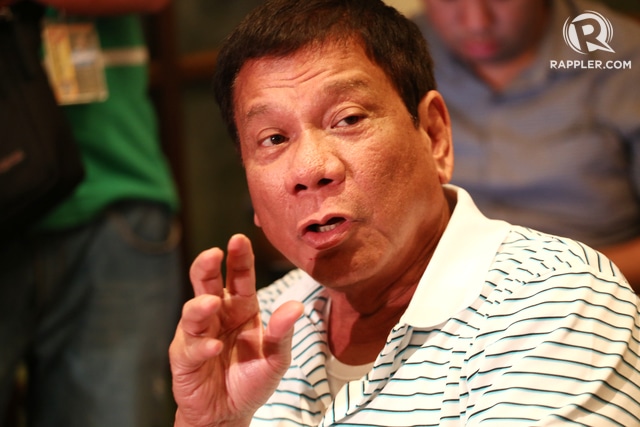
DIVISION OR UNITY? Rody Duterte thinks burying Ferdinand Marcos Sr in the Libingan ng mga Bayani will bring healing to the country. Photo by Manman Dejeto/ Rappler
DAVAO CITY, Philippines – President-elect Rodrigo Duterte plans to make good on his controversial campaign promise to bury the late dictator Ferdinand Marcos Sr in the Libingan ng mga Bayani (Heroes’ Cemetery).
“That can be arranged immediately,” he said when asked when the burial would take place. Duterte granted media interviews on Monday night, May 23.
He admitted that the move may disgust some who don’t believe Marcos deserves to be treated as a hero given his human rights abuses during his dictatorship. But he said there are other reasons for the burial.
“I will allow the burial of President Marcos sa Libingan ng mga Bayani not because he is a hero, kung ayaw ng iba (if others dont’ like it), but because he was a Filipino soldier, period,” he said.
He repeated earlier statements that Marcos’ burial would initiate “healing” among the Filipino people.
“It has long created a division among our people. Almost all Ilocanos naghihinakit talaga(are hurting because of it),” said Duterte.
Asked if he believed the controversial move would really unify Filipinos, he said, “I do not know, but it would erase one hatred. I am sure it would erase from our people one hatred.”
And what about the victims of human rights abuses? Duterte said monetary compensation is already available to them.
“Nandiyan na ‘yung k’wan, kobrahin ‘nyo na ‘yung pera,” he said. (The compensation is there. You can claim the money.)
Marcos’ burial on his birthday on September 11 – he would be 99 years old if he were alive – would be “okay” with Duterte.
“I don’t mind as long as it’s the appropriate time to bury him,” he said.
Duterte first promised to give Marcos a hero’s burial last February while campaigning in Ilocos Norte, home province of the Marcoses.
Marcos’ only son and namesake, Senator Ferdinand “Bongbong” Marcos Jr, is in a tight race for vice president against Liberal Party’s Leni Robredo. The canvassing of their votes start in Congress on Thursday, May 25.
by MLC | May 4, 2016 | News
By Jessica Bartolome
Source: GMA News
This slideshow requires JavaScript.
Marie Hilao Enriquez, 62, has been fighting against the injustices of Martial Law for more than 40 years.
Days before the elections, she was once again in battle.
As chairperson of SELDA, a group of former Martial Law detainees, Enriquez led a Voltes V-themed rally with members of the Campaign Against the Return of the Marcoses to Malacañang (CARMMA) in Araneta Center Cubao on Wednesday.
The group protested the candidacy of Senator Bongbong Marcos, who is running to become the next vice president.
“Paano naman yung mangyayari ngayon kung isa na namang diktador ang nakaupo…kung si Marcos ang umupo,” Enriquez said.
She added that Marcos was involved in his father’s dictatorship, during which many human rights abuses were recorded.
“Hindi naman siya yung unconscious son eh. Noong pinaalis yung buong pamilya nung 1986, ay naka full-battle gear pa siya. Nandoon siya sa balcony ng Malacañang. Dapat sana sinabihan niya yung tatay niya na huwag mangdukot ng tao, huwag mampatay,” Enriquez said.
Enriquez, along with four other family members, had been imprisoned for a year and nine months during the Martial Law.
Their imprisonment cost them the life of his 23-year-old brother.
“Namatay ang kapatid ko sa loob ng detensyon. Kaya ako ay galit na galit at talagang nangangampanya ako na huwag iboto yang si Bongbong Marcos,” she said.
Asked why they chose Voltes V to be the rally’s theme, CARMM youth volunteer Christina Guevarra said that the anime series’ plot was an effective parallel to their battle.
Banned by Marcos in 1979, Voltes V had revolutionary undertones as it told the story of rebel forces overthrowing an empire.
“Si Voltes V ay naging iconic doon sa Martial Law generation. Napaka-clear ang message sa Voltes V na the people are revolting against a super power. During that time, it seemed that the Marcoses were the Boazanian Empire,” Guevarra said.
“Isa lang siyang symbol…we can do away with Voltes V but we cannot do away with freedom of speech, our freedom to assemble, our freedom to speak against abuses like what happened during the Martial Law,” she added.
The protesters said that they will not stop trying to raise awareness no matter the outcome of the May 9 elections.
“Hindi pa tapos ang laban. Tuloy-tuloy ang laban na ito, kahit manalo o matalo siya. We have to do more to educate the voters and the millennials. Kaya ngayon tinatry namin na kahit na malapit na mag-eleksyon, todo bigay kami,” Enriquez said.
CARMMA will also hold a motorcade against Marcos on Thursday, and a play on Martial Law on Friday.

by MLC | Apr 21, 2016 | News
By Patty Pasion
Source: Rappler.com
It’s not the supposedly politically naive millennial voters
THE SCION. Vice Presidential candidate Ferdinand ‘Bongbong’ Marcos Jr during his campaign sortie at San Mateo, Rizal on Monday, April 4, 2016. Photo by Jasmin Dulay/Rappler
MANILA, Philippines – Analysts and critics say that “millennials,” who comprise nearly 40% of voters, would make Senator Ferdinand “Bongbong” Marcos Jr win the vice presidential race.
Millennials, according to the United States-based Pew Research Center, are those born between 1981 and 1996. In the Philippines, these are the people who were born between the period when martial law was lifted and a decade after the EDSA People Power Revolution.
Since these voters do not have a first-hand experience of the dark days of the martial rule of the senator’s father, the late President Ferdinand Marcos, they do not have strong aversion to picking Marcos Jr as their bet. Add that to the fact that the Marcos is in a tandem with Senator Miriam Defensor Santiago who, as she claims, is the youth favorite.
But survey results show that young voters – usually chided for being politically naïve – are not the ones supporting Marcos .
The loyalists
In The Standard’s poll, the leading vice presidential candidate has consistently gotten lower voter preference ratings among those aged 18 to 34 compared to other age groups.

It is Senator Francis “Chiz” Escudero who is actually winning the youth – a good distance away from his closest rivals, Marcos and Liberal Party bet Leni Robredo. Escudero’s standard-bearer, Senator Grace Poe, is also the top choice of this age bracket.

Marcos, on the other hand, is most preferred by voters 55 years old and above – the age group who directly experienced his father’s regime.

This data reflects what happens on ground when he campaigns. The son and namesake of the late dictator enjoys rockstar treatment from loyalists in various places he visits.
He is usually warmly received by these people as if they have long been waiting for him. They remain nostalgic of the late “Apo Marcos” and believe that his junior’s victory would be like his return. (READ: On the campaign trail, Bongbong Marcos taps into his father’s legacy)
CRYING LADIES. Supporters of vice presidential candidate Ferdinand Marcos Jr become emotional during his campaign at Barangay Longos, Malabon on Wednesday, February 17. Photo by Jasmin Dulay
When asked why they will vote for the son, they would normally respond with, “Kasi mas maganda nung panahon ni Marcos (Marcos’ time was better)” even if some studies and statistics show otherwise.
Aside from being loyalists, voters from this age group consists of those who do not necessarily associate Marcos’ administration with human rights violations, political analyst Aries Arugay said.
“The older generation has a long memory. They don’t just see the Marcos administration as the martial law period,” Arugay said in a phone interview with Rappler.
He said that, to these people, the late strongman represented more than the iron-fist rule but a “strong and reliable” leadership. This is what the young Marcos’ supporters say they see in the candidate, as he tries to mirror the image of his father.
The jaded
For sociologist Jayeel Cornelio, these “old” supporters do not only include loyalists but also those who have been jaded by the post-EDSA administrations.
“The people who underwent martial law and People Power, they saw People Power as a turning point for our country. It was almost a religious event, a messianic event,” he told Rappler in an interview.
“What is the kind of development we saw after 1986? Of course the poverty was very high. Unemployment was also very high during the martial law but at the same time, the kind of progress people underwent [after EDSA] was not necessarily what they expected,” he explained.
In fact, Marcos is the preferred candidate among classes ABC and those who have completed college education or finished a post-graduate degree.
Based on Pulse Asia surveys, he has consistently gotten at least 30% rating from members of the upper classes and the formally educated sector of the voting public. He is ahead Escudero, who only got figures in the line of two’s and Robredo who got less than 20% ratings.

Cornelio explained that these “educated” ones are the more disappointed members of the society because they “expected more” radical changes after the 1986 revolution.
Arugay, on the other hand, said that these people know that the problem is systemic and the country’s problems cannot be attributed to one candidate or one family. That is why they are unaffected by the negative campaigns against Marcos.
Failure of anti-Marcos campaign
For Arugay, anti-Marcos protesters are failing to derail the scion’s vice presidential bid because they keep on strengthening the association of the junior to his father.
The political analyst noted that Marcos Jr does not have a stellar educational and public service record like his brilliant senior, but “they are not undermining him by linking him to his father.”
To the loyal Marcos Sr constituency and the others who are yearning for an effective leadership, he said, this strengthens their assumption that if you vote for Marcos, you vote for the return of the leader that, at some point, delivered for the Philippines.
