Without naming their preferred vice presidential candidate, alumni of rival student political parties of the University of the Philippines joined forces to urge Sen. Alan Peter Cayetano to “give way” and prevent a win for Sen. Bongbong Marcos.
In a press conference on Friday, the groups called on Cayetano, a former UP student councilor, to concede from the vice presidential race to prevent Marcos from winning.
The groups said Cayetano, who is running alongside Davao City Mayor Rodrigo Duterte, should just support their candidate so the votes will be undivided. They did not name the candidate they are supporting.
Recent Pulse Asia and Social Weather Stations surveys showed Marcos taking the solo lead in the surveys.
He is followed by Camarines Sur Rep. Leni Robredo and Senator Chiz Escudero, who are statistically tied at second place.
Cayetano is at fourth place while Senators Gringo Honasan and Antonio Trillanes IV take the last two spots.
The groups, which created a petition page on Change.org, urged the public to prevent a Marcos win as they recounted how many people from UP were victims of Martial Law.
“Many from UP were martyred in the long night before freedom, but they are remembered and honored. In memory of these fallen UP heroes, and in the name of our sons and daughters, and the generations yet to come, we now take a stand against the ongoing campaign to erase the horrors of the dictatorship and martial law from the national memory,” the groups said.
The groups were composed of members of the Sandigan Para sa Mag-aaral at Sambayanan (Samasa) and the Nagkakaisang Tugon (Tugon), which were active in the 1980s.
In the statement, the groups also condemn the attempts to whitewash the Marcos regime’s “unrelenting violation of human rights, abuse of power, and plunder of the public coffers”.
Samasa and Tugon also vowed to remind people about the real facts and lessons from the Marcos dictatorship.
They said they will urge fellow UP alumni, especially those involved in the elections, to take a strong stand against the abuses during Martial Law.
They also pledged to resist attempts to give Marcos’ father — the late President Ferdinand Marcos — a hero’s burial at Libingan ng mga Bayani.
IN PHOTOS: The elements in the campaigns of the late president Ferdinand Marcos and his son, Senator Bongbong Marcos, are strikingly similar
LIKE FATHER, LIKE SON. The late president Ferdinand Marcos and son Bongbong are not just look-a-likes. Their campaigns also have common elements. Photo of Bongbong Marcos by Jasmin Dulay/Photo of Ferdinand Marcos from Imelda Romualdez Marcos’ website
MANILA, Philippines – Probably the biggest challenge of Senator Ferdinand “Bongbong” Marcos Jr as a politician and now a vice presidential aspirant is freeing himself from the shadow of his father, the late president and dictator Ferdinand Marcos.
The incumbent senator, at least for this election, has tried to build up his own identity as a public leader. He rarely talks about his father when campaigning. He only mentions “Apo” Marcos when he visits legacy project sites of the former president.
But despite these efforts, Marcos Jr still does not completely sever ties with the late strongman as some elements of his campaign still mirror his father’s. (READ: ‘I’m not my father’s copycat’ – Bongbong Marcos)
The V-sign
GO MARCOS. The victory sign has been an iconic hand gesture of the late president Ferdinand Marcos. Photo by Jasmin Dulay/Rappler
The hand gesture has stuck to the minds of Marcos loyalists that it has also become a regular feature in the senator’s campaign.
The former president Marcos first used the sign in his 1965 campaign against Diosdado Macapagal. The sign went with a stop hand signal and the tagline “Stop, Mac. Go, Marcos.”
Veteran political campaigner Reli German, who was part of Marcos’ advertisements at the time, said they picked up the sign from United States President Dwight Eisenhower. Post-war US presidents such as Eisenhower and Harry Truman used the sign to hail their victories in the elections.
Photo from the website of Imelda Romualdez-Marcos
BAGONG SILANG. VP candidate Ferdinand ‘Bongbong’ Marcos Jr talks to his supporters during his sortie in North Caloocan on February 17. File photo by Jasmin Dulay
Photo from the website of Imelda Romualdez-Marcos
SOLID NORTH. Vice presidential candidate Ferdinand ‘Bongbong’ Marcos Jr during his third day of election sorties in the northern provinces of the Philippines on January 11, 2016. File photo by Jasmin Dulay
The shirt-jack
FURTHER NORTH. Vice presidential candidate Ferdinand ‘Bongbong’ Marcos Jr continues to visit various places in the north on the second day of his election sortie on February 10. File photo by Jasmin Dulay/Rappler
Marcos Jr often wears a shirt-jack in his sorties – a fashion piece the late strongman also donned in many occasions. There is also a variation of the traditional barong Tagalog cut in a shirt-jack style, often used by politicians when campaigning or when visiting localities.
The senator’s shirt-jack pieces are different from his father’s because they are designed with strips of red, blue and yellow – the colors of the Kilusang Bagong Lipunan (KBL) Party. Formed in 1978, it was a coalition of parties supporting the former president.
Photo from the website of Imelda Romualdez-Marcos
FAVORITE. Vice presidential candidate Bongbong Marcos is mobbed by the elderly in Alabang, Muntinlupa on February 22. File photo by Joel Liporada/Rappler
Photo from the website of Imelda Romualdez-Marcos
CAMPAIGNING. Vice Presidential candidate Ferdinand ‘Bongbong’ Marcos during his election campaign in Davao City. File photo by Jasmin Dulay/Rappler
Blue and red theme
File photo by Jasmin Dulay/Rappler
Blue and red were the campaign colors of the late dictator during his first bid in 1986 and the snap elections where he ran for reelection against former president Corazon Aquino.
VINTAGE. Some old campaign paraphernalia of the late president Ferdinand Marcos. Photo by Patty Pasion/Rappler
PARAPHERNALIA. Campaign materials of vice presidential candidate Bongbong Marcos. Photo by Patty Pasion/Rappler
MEMORABILIA. Some old campaign materials of the late president Ferdinand Marcos. Photo by Patty Pasion/Rappler
PARAPHERNALIA. Campaign materials of vice presidential candidate Bongbong Marcos. Photo by Patty Pasion/Rappler
Smart campaign
For political analyst Aries Arugay, Marcos’ strategy is a smart balance of taking advantage of the privilege of being a Marcos and also “veering away from the possible baggage” that comes with it.
For someone born with a household family name in Philippine politics, winning the elections – or mounting a successful campaign, at the very least – can already be served on a silver platter.
But Marcos’ situation is tricky because his family receives polar opposite receptions from the people: it’s either they fanatically love them or bitterly hate them.
“It’s a subtle invoking of his pedigree, but his handlers, I think, know [they] cannot fully [talk] about his pedigree because it might raise more questions,” Arugay added.
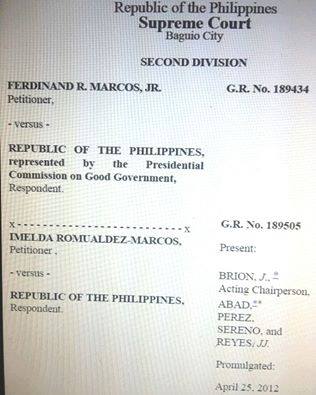
No proof of Marcos Plunder? Bongbong Marcos did not know of the massive plundered loot of his family? Read the Supreme Court cases to learn of their massive plundered loot!
In “Ferdinand Marcos, Jr. vs. Republic of the Philippines”, G.R. No. 189434, April 25, 2012, you will learn that the Marcos children, including Bongbong Marcos, signed several Compromise Agreements with the PCGG all dated 28 December 1993 where they admitted holding US$356 million in Swiss accounts which the Swiss government eventually ruled to be ill-gotten.
However, when the Republic of the Philippines filed on 18 October 1996 to forfeit the $356 million, true to form, sneaky Imelda Marcos disowned the Compromise Agreements claiming she was not a party to it. More importantly, she admitted that she owned 90% of the funds while the remaining 10% belonged to the Marcos estate. A damning admission of ownership of the unbelievable amount of US$356 million.
This is a clear admission of the Marcoses’ ill-gotten wealth especially since in an earlier case, Ferdinand Marcos Jr. v. Republic of the Philippines, G.R. No. 152154, July 15, 2003, the Supreme Court found that based on the admission of the Marcoses, the combined accumulated salaries of Marcos and Imelda from 1966 to 1985 was only P1,570,000 and P718,750, respectively, or a total of P2,288,750.
Unrepentant Plunderers! The Marcoses have no shame. They lie to our faces, use the very same plundered funds to pay off trolls, loyalists, pr men to spin their web of lies!
—
The US Court of Appeals on Wednesday wrote that the “$100,000 per day amount was necessary and appropriate because the Marcoses’ contumacious conduct” caused direct harm to the victims, by preventing them from collecting on their $2 billion judgment.
Excerpt:
“Next time you see a Marcos loyalist post on Facebook or Twitter that no Marcos has ever been convicted in court, you can point out to them that the Marcoses have lost at least FOUR landmark cases in court –
1- the case in Switzerland involving their Swiss loot;
2- the mother case in Manila forfeiting the Swiss money and other stolen assets in favor of the Philippine government (the decision was penned by the late Chief Justice Renato Corona when he was still an Associate Justice);
3- the class action suit filed by human rights victims in Hawaii;
4- and the separate tort case filed by Agapita Trajano over the torture and murder of Archimedes.”
Vice presidential candidate Ferdinand ‘Bongbong’ Marcos Jr has been visiting places where his father, the late strongman Ferdinand Marcos, had projects and programs, tapping into the ‘debt of gratitude’ of supporters
ROM NORTH TO SOUTH. Vice presidential candidate Ferdinand ‘Bongbong’ Marcos Jr campaigns in Mindanao after his several Luzon legs. Photo from the Office of Sen. Bongbong Marcos
MANILA, Philippines – If there’s one thing that separates Senator Ferdinand “Bongbong” Marcos Jr from the other vice presidential candidates, it would be being the son and namesake of former President Ferdinand Marcos.
In a tight race with Senators Francis Escudero and Alan Peter Cayetano – both scions of political families as well – and newbie politician Leni Robredo, being the junior of one of the country’s most prominent presidents is a strong edge.
Despite the atrocities and human rights violations committed during Martial law, the Philippines’ longest serving president has established a strong support base across the country through programs and infrastructure projects he was able to initiate for 21 years.
In fact, Marcos Jr’s supporters – even those outside their bailiwick of Ilocos Norte – cite his relation to the late strongman as to why they will vote for him. It is notable how the vice presidential aspirant incorporate his parents’ accomplishments into his campaign.
Here’s a look at how the Marcos legacy played in the senator’s campaign trail so far:
Marcos kicked off his campaign in the city of Batac where the family’s political prominence was born. This was the birthplace of clan patriarch Mariano Marcos, father of President Marcos who also grew up here. Three generation of Marcoses, including Imee Marcos, served as the district’s representative in Congress.
Ilocanos have a strong loyalty to the family because, as they recall, it was during President Marcos’ time when their province was at its most progressive and when it was brought to the national spotlight.
Barangay Bagong Silang in Caloocan and Barangay Longos in Malabon are resettlement sites opened by President Ferdinand Marcos, which provided housing for thousands of landless Filipinos living in slum areas such as in Tondo, Manila. It was a project initiated by his wife and former First Lady Imelda when she served as the Minister of Human Settlements.
Muntinlupa was first part of Rizal and then of Laguna. President Marcos issued Presidential Decree No. 824 on November 7, 1975, which included Muntinlupa as part of Metropolitan Manila.
It also served as one of the sites for the Urban Bagong Lipunan Improvements of Sites and Services (BLISS). Launched in 1979, BLISS was a housing program that built 3 to 4-storey apartment buildings, with units given to low and middle income families in a rent-to-own payment basis.
University of the Philippines Los Baños – National Institute of Molecular Biology and Biotechnology, March 2
The National Institute of Molecular Biology and Biotechnology, also known as BIOTECH, is a research institution mandated to develop more efficient technologies for agriculture, forestry, environment, and energy. It was created on December 10, 1979, and initially funded by the Ferdinand E. Marcos Foundation.
In 1974, the late president honored the T’boli by granting them their own municipality named after their tribe. The municipality of T’boli was established through Presidential Decree Number 407 issued on March 5, 1974.
When Marcos Jr visited the town on March 9 – 47 years since the town was established – he was declared as the tribe’s “supreme leader” and became an adopted son of the T’boli and Blaan tribes.
Debt of gratitude
It won’t be a stretch to say that the reception he received from the people in these campaign stops could foreshadow the support he would get in terms of votes. As sociologist Clifford Sorita explained, it is like paying a “debt of gratitude” to the Marcoses.
Sorita said that people in these places not only appreciate the physical projects, but also appreciate the mere fact that a prominent public figure visited them. For them, projects and programs reflect the importance an official places on them as a community.
Candidate Marcos reaps the benefits of their supporters’ gratitude because he is the living representation of his father.
“Filipinos are very external, very tactile. They have to be concrete about [their expression]. Since the father has passed, [gratitude] has to be given to the next of kin,” Sorita told Rappler in a phone interview.
Although Marcos does not deliberately ask for these people’s support, Sorita noted that him re-visiting these project sites sends a message to the beneficiaries that he is as close to them as his father was.
Let history judge the administration of Ferdinand Marcos.
Thus, said the son and namesake of the late dictator after President Benigno Aquino III on Thursday countered emerging perceptions that the Marcos administration was a “golden age” in the Philippines’ history.
“Ipaubaya natin ang kasaysayan sa mga propesor, sa mga nag-aaral tungkol sa kasaysayan ng Pilipinas. Kami hindi namin trabaho yun. Ang trabaho namin ay tingnan kung ano ba ang pangangailangan ng taong bayan ngayon,” Senator Ferdinand “Bongbong” Marcos Jr.told reporters in a campaign sortie in Pangasinan.
During the 30th anniversary of the EDSA Revolution and the fall of the Marcos dictatorship, Aquino recalled the instances of widespread corruption and human rights violations during the Marcos Era.
He also called out the senator for his continued refusal to apologize for what many consider the horrors of Martial Law. The younger Marcos is running for vice president after a full term in the Senate.
Aquino said the senator’s continued refusal to acknowledge the abuses committed during martial law and apologize for it on his family’s behalf was an indication that the latter may follow the footstep of the late dictator.
“Kung hindi man lang niya (Marcos) makita ang mali sa ginawa ng kanilang pamilya, paano tayo aasang hindi niya ito uulitin? Ang akin nga, thank you na lang, dahil kahit papaano nagpakatotoo ka sa pagpapakitang handa kang tularan ang iyong ama,” Aquino said.
Marcos, however, denied thinking about declaring Martial Law if he became president.
“Oh, God no. Because if there’s martial law, ibig sabihin we’re in crisis. E ayaw naman nating mapasok ang Pilpinas sa crisis,” Marcos said.
In the latest Social Weather Station (SWS) survey released early this month, Marcos was tied with Senator Francis “Chiz” Escudero as the most preferred vice presidential candidate for the May 9 elections.
Marcos said that instead of criticizing his family and the presidency of his late father, Aquino should instead spend his remaining days in office addressing the country’s problems.
“Kailangan sagutin natin ang taong bayan pagka sinasabi tulungan ninyo kami dito sa mga bagay-bagay na ito, dito sa problemang hinaharap namin. And that is still what we should be doing,” Marcos Jr. said.
Marcos claimed that despite Aquino and some critics’ effort to derail his vice presidential bid the support of some political personalities and the ordinary people remain high.
“Yung suporta yung pagsalubong ng tao ganun pa rin kainit, hindi pa rin nagbabago. Kaya’t nagpapasalamat ako sa lahat ng mga tuluyang hindi nagsasawa sa pagmamahal sa akin, sa pamlya ko, at sa lahat ng aming gustong gawin para tulungan ang bayan,” Marcos said.
Marcos had earlier secured the endorsements of several dominant political figures in north Luzon, namely, former Ilocos Sur Governor Luis “Chavit” Singsons, incumbent Pangasinan governor Amado Espino Jr. and gubernatorial aspirant Mark Cojuangco, incumbent San Fernando City, La Union mayor Pablo Ortega and gubernatorial aspirant Mario Ortega.
Marcos had also secured the endorsements of San Juan City Mayor Guia Gomez and the Eusebio family in Pasig.
More than 40 years after she and her husband were arrested in 1974, Marie Hilao-Enriquez remains adamant against a repeat of the widespread human rights violations committed during the Marcos dictatorship.
Enriquez, now 62, said the torture they suffered would only push her to continue the fight against threats to human rights.
She made the remarks on the 30th anniversary of the EDSA Revolution that forced Ferdinand Marcos out of Malacañang.
“Hangga’t kaya ko pang mag martsa at kaya ko pang magsalita ay magmasasalita at magmamartsa ako para ipaglaban iyong aming karapatan,” she said in a report by Ivan Mayrina on “24 Oras.”
Enriquez also recalled the case of her sister Lilie, a scholar and student activist.
Liloe was taken members of the Philippine Constabulary and after two days, she was found dead inside Camp Crame. She was said to have been tortured and abused.
“Double murder na ang ginawa sa kapatid ko kasi mukhang patay na siya, noong i-autopsy, iyong utak nakita sa parte ng digestive system at iyong internal organs ni Lilie, wala na,” Enriquez said.
While the horrors of Martial Law remained vivid in Enriquez’s mind, the present generation seemed oblivious to the tragedies that fell on many Filipinos during the Marcos regime.
“Hindi po masyado eh kasi siyempre hidi ko naman po inabutan iyong mga ganoong klaseng pangyayari. Sa akin, mga kwento-kwento ng mga matatanda,” a 22-year-old told GMA News.
A senior citizen said those that witnessed and experienced Martial Law must have fallen short of telling the youth about those years.
“Nagkulang din tayo siguro sa pagkuwento sa mga kabataan kasi sa mga kabataan siyempre malay nila,” he said.
“Kaya dapat talaga, ito malaking bagay ito na siguro buhayin natin ang pagtuturo sa bagong henerasyon na ito ang pinagdaanan natin. Masakit,” he added.