Victims of martial law were given special honors on the 30th anniversary of the People Power uprising that won for the country its freedom from the dictatorial regime of the late strongman Ferdinand Marcos.
During the wreath-laying ceremony at the Bantayog ng mga Bayani (Wall of Remembrance) in Quezon City, the Bantayog Foundation stressed the sacrifices of those who were killed and had died in the struggle to restore our democracy.
“Dito sa Bantayog, inaalala natin ang mga taong nag-alay ng kanilang buhay alang-alang sa demokrasya na ating tinatamasa ngayon,” said Cristina Rodriguez, Bantayog Foundation executive director.
In an interview with GMA News’ Raffy Tima, Rodriguez also said that the young should be taught about the hardships during Martial Law, and that they should be encouraged to value the victims’ sacrifices.
Also, she urged people to work together to prevent the return of military rule in our country.
“Layunin ng foundation ay maituro sa kabataan ang mga alala ng mga taong nag-alay ng kanilang buhay para sa kalayaan … at kumilos upang hindi na maulit ang karahasan ng martial law,” she added.
According to her, the Bantayog ng mga Bayani, located at corner of EDSA and Quezon Avenue, is a wall where some of the names of those who died for our freedom are written.
The wall was set up by the Bantayog Foundation established by former Senator Jovito Salonga and some of those who fought against Marcos’ martial rule.
Rodriguez encouraged the youth to know more about the sacrifices and the lives of the victims by visiting the Bantayog website at www.bantayog.org and visit the Bantayog Museum and library.
Rene Saguisag and Raissa Robles at the launch of Robles’ book, ‘Marcos Martial Law: Never Again.’ Photos: Aya Tantiangco
It is hard to imagine a person professing admiration for Hitler, but I met that person and I instinctively balked. Why would anyone have anything but contempt for a man who ordered the death of millions?
“He was a great speaker,” this person said, “He held sway over an entire nation. That kind of charm is fascinating.”
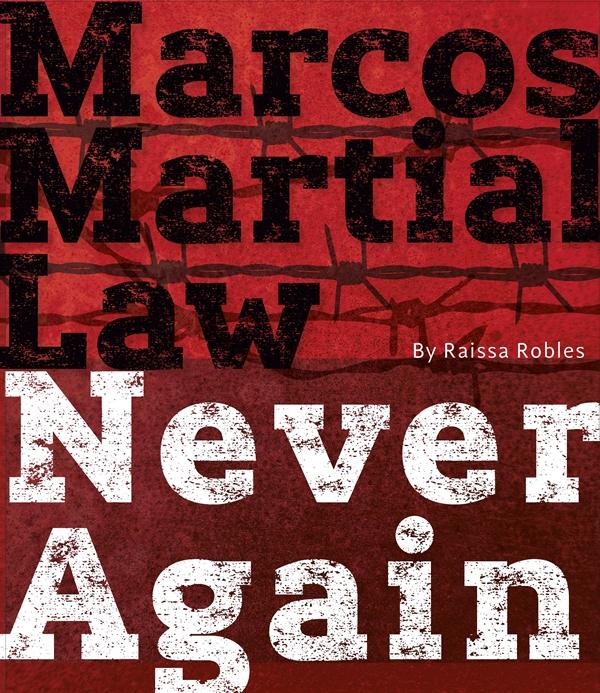
After reading the preview to “Marcos Martial Law: Never Again” by Raissa Robles, what he said made more sense. During the launch of the book, human rights lawyer and former senator Rene Saguisag verbalized these thoughts.
“Marcos always has claimed he’s a genius,” Saguisag said, “I agree—a criminal one, a criminal genius. He could not not have known about the disappearances.”
he continued, “You will read about how Marcos engineered—how Marcos fooled the entire nation to declare Martial Law. You will see how the generals plotted with Marcos and we didn’t know about it.”
In chapter one, a section titled “Ferdinand Marcos” begins with a story that will inspire feelings close to reverence for the young Ferdinand. A law student at age 18, the future president of the Philippines became a suspect of nothing less than an assassination.
If his growing number of young fans need one more thing to admire, it turns out that Marcos was also an excellent marksman. He was the national rifle champion at the time when his father’s greatest political rival Julio Nalundasan was shot after being elected…and so he became a suspect.
That and the fact that the Western Lubaloy .22 caliber bullet that pierced Nalundasan’s heart was similar to ones loaded in the rifles Marcos used in competition more than aroused suspicion.
I do not remember this from my history lessons, but apparently, Marcos was arrested for the crime and convicted. This was after he took the bar and placed first (of course), but he was imprisoned in the same year.
However, “he didn’t stay long in jail,” Robles writes. His conviction was overturned by the Supreme Court and Marcos would later claim that his “legal prowess” won him his freedom, but research points to Associate Justice Jose P. Laurel.
According to the book, Laurel believed Marcos to be guilty, but he himself was convicted of homicide after stabbing a romantic rival. He was acquitted by a sympathetic Supreme Court justice and as a way to pay it forward, he extended the same “courtesy” to Marcos.
Robles writes that Laurel “felt like the country couldn’t afford to lose a person of such potential.”
The story has a surreal, superhero origin feel to it. A bar topnotcher, an excellent marksman, incarceration, and a potential so evident and grand that it compelled a Supreme Court judge to reverse a lower court’s decision? He sounds amazing.
And truly, he was. For you to have done what Marcos did, you would have to be tremendously clever. About as clever as, perhaps, Dr. Doom.
Dr. Doom is himself one of the greatest minds in comic book history. Readers accept and, yes, even admire that he is a genius…but he remains a villain, without much argument from even the biggest of fans.
When Robles releases the full book, possibly in March, she will include a testimony by former US Ambassador Stephen Bosworth containing Marcos’ confession that he knew about the human rights violations during his dictatorship.
“Marcos told him [Bosworth] specifically that he knew all along about the torture,” Robles told the press. “But it’s okay, because anyway they are communists.”
The same excuse now springs from the youth’s lips. If you obey and comply, you wouldn’t be harmed. Only those who dare to question authority would suffer.
“So many of the victims of Martial Law were the cream of the crop of the last generation,” Robles lamented, “That is why we have very few good leaders, because they either died or they were so brutalized, they were so affected psychologically.”
Even if the word “brutalized” was written a hundred times over on this page, it would mean nothing for those who haven’t experienced or encountered a genuinely brutal incident. For example, no matter how uncomfortable the bear attack in “The Revenant” seems, it is probably nowhere near as gruesome as what actually happened.
A survivor of the horrors of Martial Law, Roberto Verzola, confirms this.
“The youth don’t have scars on their body. They don’t have friends who died. They just read about history,” he said.
Martial Law survivor Roberto Verzola shares his story.
And Marcos reads beautifully. The rise, the struggle, the fall…even the slow and sure return of his son to power—it all seems so exquisitely crafted.
Perhaps it is. Robles seems keen on delivering on the promise to show the readers how Marcos orchestrated everything, down to the lack of strong voices passing on the atrocity of his crime.
On the 30th anniversary of the People Power Revolution, the once uplifting color of sunshine is slowly being shunned. What a show.
Former First Lady Imelda Marcos found herself in an awkward position on Wednesday when she attended a Mass intended for the victims of the authoritarian rule of her late husband, Ferdinand Marcos.
Sitting in a wheelchair in front of the altar of Baclaran Church in Parañaque City, the Ilocos Norte lawmaker heard testimonies of human rights victims and the priest’s homily on the Martial Law regime.
Imelda’s presence at the Mass, which was held a day before the 30th anniversary of her family’s ouster from power, was just coincidental, according to the lawmaker’s close-in staff Ricardo Malasa.
In a report by GMA News’ Maki Pulido on “24 Oras” on Thursday, Malasa said Imelda always attends Mass at the church, especially on Wednesdays, as she is a devotee of Our Lady of Perpetual Help.
“Every Wednesday po talaga kami nagma-Mass doon kasi nagno-novena kami for nine consecutive Wednesdays. Pang-third Wednesday na kami kahapon,” he said.
Malasa said they were unaware that the Mass was for Martial Law victims.
“Nagtaka po kami kasi sa Mass nagpasaring sa Martial Law. Nung malapit na matapos ‘yung Mass, ang daming media. Hindi namin akalain ganun pala ‘yun. Nung sinabi sa kanya may EDSA event sabi niya (Imelda) ‘Sige lang at may pinagdadasal tayong lahat,'” Malasa added.
The Mass was organized by ecumenical group Promotion of Church People’s Response, a member of the Campaign Against the Return of the Marcoses to Malacañang (CARMMA), a movement that calls on voters to reject the candidacy of Senator Ferdinand Marcos Jr. for vice president.
The younger Marcos had refused to apologize for massive corruption and human rights abuses of his father’s 20-year regime.
Speaking to reporters in Ilocos Norte on February 9, the senator said he will only apologize for any wrong that he may have done against somebody.
“That is always my position and I will continue to hold that position,” he said.
It is hard to imagine a person professing admiration for Hitler, but I met that person and I instinctively balked. Why would anyone have anything but contempt for a man who ordered the death of millions?
“He was a great speaker,” this person said, “He held sway over an entire nation. That kind of charm is fascinating.”
After reading the preview to “Marcos Martial Law: Never Again” by Raissa Robles, what he said made more sense. During the launch of the book, human rights lawyer and former senator Rene Saguisag verbalized these thoughts.
“Marcos always has claimed he’s a genius,” Saguisag said, “I agree—a criminal one, a criminal genius. He could not not have known about the disappearances.”
Rene Saguisag and Raissa Robles at the launch of Robles’ book, ‘Marcos Martial Law: Never Again.’ Photos: Aya Tantiangco
Robles’ extensive research honors the Marcos family’s wishes regarding their great patriarch’s legacy. Facts are presented and carefully footnoted, so that the memory of Ferdinand Marcos is preserved.
“This is history,” she stressed, “I am presenting history.”
The timing seems suspect, with the launch so close not just to the 30th anniversary of the historic protest that overthrew the dictator, and in an election year in which the dictator’s son is in a good position to emerge a victor in the vice-presidential race.
“The timing is accidental,” Robles said, “I should have released it much earlier, when I realized that the memory is fading.”
Her book is not the first to be published about the Marcos regime, but it reads easier, simpler, and above all, fresher. Robles, with the aid of her husband Alan, flexed every muscle involved in writing.
“We tried to put everything,” she tells the media holding the advance copy of the book, “You will not just read about the torture. You will read about why the torture happened [and] what happened before.”
She continued, “You will read about how Marcos engineered—how Marcos fooled the entire nation to declare Martial Law. You will see how the generals plotted with Marcos and we didn’t know about it.”
In chapter one, a section titled “Ferdinand Marcos” begins with a story that will inspire feelings close to reverence for the young Ferdinand. A law student at age 18, the future president of the Philippines became a suspect of nothing less than an assassination.
If his growing number of young fans need one more thing to admire, it turns out that Marcos was also an excellent marksman. He was the national rifle champion at the time when his father’s greatest political rival Julio Nalundasan was shot after being elected…and so he became a suspect.
That and the fact that the Western Lubaloy .22 caliber bullet that pierced Nalundasan’s heart was similar to ones loaded in the rifles Marcos used in competition more than aroused suspicion.
I do not remember this from my history lessons, but apparently, Marcos was arrested for the crime and convicted. This was after he took the bar and placed first (of course), but he was imprisoned in the same year.
However, “he didn’t stay long in jail,” Robles writes. His conviction was overturned by the Supreme Court and Marcos would later claim that his “legal prowess” won him his freedom, but research points to Associate Justice Jose P. Laurel.
According to the book, Laurel believed Marcos to be guilty, but he himself was convicted of homicide after stabbing a romantic rival. He was acquitted by a sympathetic Supreme Court justice and as a way to pay it forward, he extended the same “courtesy” to Marcos.
Robles writes that Laurel “felt like the country couldn’t afford to lose a person of such potential.”
The story has a surreal, superhero origin feel to it. A bar topnotcher, an excellent marksman, incarceration, and a potential so evident and grand that it compelled a Supreme Court judge to reverse a lower court’s decision? He sounds amazing.
And truly, he was. For you to have done what Marcos did, you would have to be tremendously clever. About as clever as, perhaps, Dr. Doom.
Dr. Doom is himself one of the greatest minds in comic book history. Readers accept and, yes, even admire that he is a genius…but he remains a villain, without much argument from even the biggest of fans.
When Robles releases the full book, possibly in March, she will include a testimony by former US Ambassador Stephen Bosworth containing Marcos’ confession that he knew about the human rights violations during his dictatorship.
“Marcos told him [Bosworth] specifically that he knew all along about the torture,” Robles told the press. “But it’s okay, because anyway they are communists.”
The same excuse now springs from the youth’s lips. If you obey and comply, you wouldn’t be harmed. Only those who dare to question authority would suffer.
“So many of the victims of Martial Law were the cream of the crop of the last generation,” Robles lamented, “That is why we have very few good leaders, because they either died or they were so brutalized, they were so affected psychologically.”
Even if the word “brutalized” was written a hundred times over on this page, it would mean nothing for those who haven’t experienced or encountered a genuinely brutal incident. For example, no matter how uncomfortable the bear attack in “The Revenant” seems, it is probably nowhere near as gruesome as what actually happened.
A survivor of the horrors of Martial Law, Roberto Verzola, confirms this.
“The youth don’t have scars on their body. They don’t have friends who died. They just read about history,” he said.
Martial Law survivor Roberto Verzola shares his story.
And Marcos reads beautifully. The rise, the struggle, the fall…even the slow and sure return of his son to power—it all seems so exquisitely crafted.
Perhaps it is. Robles seems keen on delivering on the promise to show the readers how Marcos orchestrated everything, down to the lack of strong voices passing on the atrocity of his crime.
On the 30th anniversary of the People Power Revolution, the once uplifting color of sunshine is slowly being shunned. What a show.
The presidential bet says burying the late dictator in the Libingan ng mga Bayani will begin the ‘healing’ of the nation
MARCOS COUNTRY. Rodrigo Duterte eats Ilocos empanada in front of a portrait of former President Ferdinand Marcos Sr and beside his daughter, Ilocos Norte governor Imee Marcos. All photos by Pia Ranada/Rappler
LAOAG CITY, Philippines – In the heart of Marcos country, Rodrigo Duterte said that, if elected president, he will allow the burial of former president Ferdinand Marcos in the Libingan ng mga Bayani (Heroes’ Cemetery).
“My decision will be to allow his burial in Libingan ng mga Bayani,” he said during an ambush interview just a few steps away from the late Marcos’ remains in the Batac Marcos Museum and Mausoleum on Friday, February 19.
“Because he was a great president and he was a hero…He had the idealism, the vision for this country,” he said of Marcos, who was president of the Philippines from 1969 to 1986, but whose final years in power were marred by an abusive dictatorship.
Asked about widespread condemnation for the Marcos regime due to human rights abuses, ballooning national debt, and corruption, Duterte said Marcos was a “human” who made mistakes.
“We all have our faults. Every human being [is] fit to fail…People see nothing but mistakes. People judge best when they condemn. You are at your best element when you are speaking ill of your fellow man,” he said.
Duterte had previously said that, if not for the dictatorship and abuses, Marcos was the country’s best president.
‘Let’s heal’
The presidential bet said burying Marcos in the resting place of other Philippine presidents would catalyze a nationwide “healing.”
“Why don’t we heal? It’s also the Filipino nation who wants to see something good come out of it.”
He added that Marcos’ dictatorship “remains to be debated” but his government programs and projects have stood the test of time.
MEETING DUTERTE. Ilocos Norte local government officials and sector representatives meet Duterte
“All the things Marcos has built are still standing…Biyayang Dagat was good. Masagana 99 was good. He gave it to the people, this is the blueprint,” he said.
Biyayang Dagat and Masagana 99 were fisheries and agricultural programs, respectively, that were implemented during the Marcos presidency.
Imee Marcos, governor of Ilocos Norte and the eldest child of Ferdinand Marcos, stood beside Duterte as he explained his plan for her father’s remains.
“We’re very very grateful. Certainly, we’ve waited a long, long time and I think this kind of healing will finally unify this country and make this nation great again, as someone said,” she said in reaction to Duterte.
DuBong tandem?
Duterte had a warm reception during his first visit to Ilocos Norte as a presidential bet.
Main roads were lined with Duterte posters, and noticeably, posters promoting the tandem of Duterte and Senator Bongbong Marcos, the son of the late dictator who is now running for vice president.
TANDEM OF CHOICE? Some in Ilocos Norte support a Duterte-Marcos tandem
Duterte said he was “thankful” to those supporting his presidential bid, saying his father, a former governor of the undivided Davao, was a Marcos loyalist “until the end.”
Imee Marcos and Duterte were inseparable for the better part of the Davao City mayor’s visit. After receiving him in the Provincial Capitol, Marcos introduced Duterte to Ilocos Norte mayors and vice-mayors.
They then proceeded to the Marcos Museum and Mausoleum where both paid their respects to the remains of the late dictator.
Is the Ilocos Norte governor endorsing Duterte even if her brother is running with a different presidential bet?
“Well, Bongbong is running with Miriam [Santiago] so obviously there’s that, but Digong is a good friend and everyone is welcome to come to Ilocos Norte,” she told reporters.
Bongbong had asked to run as Duterte’s vice president for the 2016 elections. But Duterte chose Senator Alan Peter Cayetano instead. Cayetano did not attend the Ilocos Norte sortie.
Ilocos Norte is home to almost 380,000 registered voters, according to the Commission on Elections.
Duterte’s statements on Marcos comes 3 days before the anniversary of the EDSA Revolution, the people power movement that led to the dictator’s fall.
Philippine authorities pledge to auction off as soon as possible millions of dollars’ worth of jewellery recovered from late dictator Ferdinand Marcos and his family
FOR AUCTION. A Filipino employee displays a necklace seized three decades ago from Imelda Marcos, the former First Lady of the Philippines, during an appraisal at the Central Bank of the Philippines in Manila, Philippines, 27 November 2015. Photo by Francis R. Malasig / EPA
MANILA, Philippines – Philippine authorities pledged Monday, February 15, to auction off as soon as possible millions of dollars’ worth of jewellery recovered from late dictator Ferdinand Marcos and his family.
The Presidential Commission on Good Government (PCGG), created to recover the millions stolen by Marcos and his allies, has also launched a website aimed at retrieving hundreds of art masterpieces believed to have been obtained by theMarcos family with “ill-gotten wealth,” said commissioner Andrew de Castro.
The renewed effort comes as Ferdinand Marcos‘s son and namesake takes the lead in the race to win election in May as the country’s next vice-president.
De Castro said authorities hope to auction off most of the jewels before President Benigno Aquino steps down in June and a new president and vice-president take over.
“Regardless of who is in power after June 2016, it is our duty to dispose of the jewellery as soon as possible,” he told AFP.
The long-hidden collection, seized in three batches after Marcos was overthrown in a popular revolt in 1986, has been cited by critics as proof of how his family enriched itself while the nation sank deeper into poverty during his 20 years in power.
Former first lady Imelda Marcos amassed a huge collection of jewels, valuable art and shoes even as other Marcos relatives and allies gained fortunes, critics have said.
De Castro said appraisals by auction houses put the value of the seized jewellery at more than a billion pesos ($21 million).
Although ownership of part of the collection is still being contested by the Marcosfamily in court, the government is free to sell of the bulk of the jewels, de Castro said.
The PCGG described the jewels as “diamonds-studded tiaras, necklaces, brooches, earrings, belts and other gems (including a) 25-carat pink diamond”.
The government is now working to set a date for the public exhibition of the recovered artefacts and their eventual sale.
The commission on Monday also launched a website listing great artworks that the Marcosfamily are believed to have obtained.
The website, www.missingart.ph includes works by great artists including Henri Matisse, Edgar Degas and Rene Magritte that still have to be recovered.
De Castro said more than 200 artworks are still missing and the website is intended to help in their recovery as well as to increase “awareness” of the family’s crimes.
The government estimates that Marcos and his allies stole about $10 billion when he was in power. The PCGG has recovered less than half of that, de Castro said.
The son of the late dictator, Ferdinand Marcos Junior, is running for vice-president, raising fears the family will regain its influence.