by MLC | Sep 22, 2020 | Martial Law Stories
Source: Amado Picardal
After sharing an account of my arrest, torture and imprisonment I will now share the stories of persons close to me who were victims of the Marcos Dictatorial Rule:
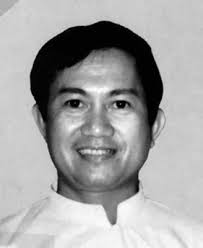
Fr. Rudy Romano (Redemptorist)Victoriano Zapanta & Vicky Hatague (parish workers)Mrs. Nicole Legaspi Picardal (my mother)
1. Fr. Rudy Romano, CSsR (Redemptorist) On July 11, 1985, Fr. Rudy Romano – a fellow Redemptorist priest – was reported missing. He was active in the movement against the dictatorial regime – often speaking at rallies.
According to witnesses, he was picked up by military intelligence operatives in Cebu. A scuttlebutt I heard coming from a retired military officer was that he did not survive torture and his body was dumped somewhere.
I had known Fr. Roman since I was a seminarian. He was assigned in Iligan City and I joined him for my summer mission exposure in Misamis Oriental. His disappearance was devastating to me.
2. Victoriano “Pantoy” Zapanta & Victoria Hatague (Parish Workers)
On August 7, 1985, while I was having breakfast in the monastery, Efren – a parish worker — arrived. He was panting and he told me: “Father, Pantoy has been shot! He was on his way to the mission area when two men shot him.”
“Where is he?”
“He is on the side of the road.”
We immediately took the motorbike and speeded towards Pugaan. When we arrived, I saw his body sprawling on the side of the road with a hole in his head and his arm pits.
There were flies on his face. His white shirt was filled with blood. His bicycle was on the ground. His wife, Naty, was wailing beside him. There were tears in my eyes as I put my arms around her shoulder.
Nobody knew who killed him but we immediately suspected that this was the work of the military and Civilian Home Defense Forces (CHDF) who had threatened him several times. Victoriano “Pantoy” Zapanta was a parish worker whom we trained and who was working with us in the Hinaplanon area. Pantoy was formerly a member of the CHDF.
He had quit from the CHDF and became actively involved in the local Basic Ecclesial Community as a Kaabag — a lay liturgical leader. Later, he was recruited and trained as a parish worker when we conducted the parish mission in Iligan City.
The funeral of Pantoy turned into a protest march attended by over 4,000 people from the mission areas carrying placards and streamers. His bicycle and bloodied white shirt were brought before the altar as symbolic offering during the funeral mass concelebrated by 14 priests. Pantoy was hailed as martyr. But his former CHDF companions regarded him a traitor.
We were shocked by Pantoy’s brutal death. At that time we had not recovered from Victoria “Vicky” Hatague’s death. Just several months before, Vicky, a parish worker of Jimenez whom we trained earlier during the parish mission was shot to death by the CHDF.
These tragic events, weighed heavily on us. We were not surprised when Alvin, one of the Redemptorist seminarians who was on exposure with the mission team, left hurriedly without informing us. He couldn’t bear the pressure.
In spite of the harassment, we continued our mission work. It was difficult to evangelize and organize the people because the military kept telling them that we were subversives. Consequently, our approach became liturgical-centered.
We also used some of the methods of the traditional mission. We focused on popular religious practices and organized mass weddings for the mancibados — couples living as husband and wife without the benefit of the sacrament of marriage.
We also continued the Misa-Pamalandong. It was very difficult to hold Bible-reflection in the homes because of the black propaganda against us.
3. Mrs. Nicole Legaspi Picardal (my mother)On December 16, 1985 my mother was killed. A bullet pierced her head and brain. According to eyewitnesses, three armed men accosted her while she was on her way to the rice mill.
She had just came back from the bank. They grabbed her bag, pushed her down the canal and then shot her. The killers fled on board a car.She was still alive when I arrived in the emergency room. Blood was oozing from her head.
She was gasping as I helplessly watched her die. All I could do was to anoint her and entrust her to God’s loving care. She died at exactly 3:00 o’clock in the afternoon.
Frs. Ramon Fruto and Louie Hechanova, stood beside me and touched my shoulder. Ramon asked me if I was O.K. I went out of the hospital without feeling anything — no anger, no sadness, no sorrow. I could not cry.
My main worry was how to break the news to Papa. I immediately went home and told him what happened. He started crying, calling out Mama’s name.
I put my arms around his shoulder. Dr. Yañez and Aunt Sally arrived and took his blood pressure. It was 200/100. They were worried that he might have a stroke.
They gave him some medication and stayed behind to console him.Late in the afternoon, I went to the funeral parlor. Mama’s body was laid on the table in the morgue.
The embalmer told me that they had to wait for a few hours before embalming the body and place it on the coffin.
So, I was left all alone for half an hour gazing at Mama’s body. Her face looked serene in spite of the bullet hole on her head. I came closer and kissed her forehead.
When I went back to the monastery, Luting, a leader of the Charismatic movement expressed her condolence and told me: “It’s God’s will. You’ll have to accept the will of God.” I answered her, “No, I don’t think it is God’s will.” I was simply revolted by the idea that Mama’s death was God’s will. I just could not accept this kind of theology.
On January 24, 1986 celebrated today the 40th day after Mama’s death. Many came to pray and celebrate with us. It was our final good bye.
Papa told me that the men who killed Mama had recently been identified and all of them were killed by the police during a shoot- out. They were all part of a gang composed of Philippine Constabulary soldiers who were engaged in armed robbery.
The police had received a call that there were armed men inside the house of the Delestes. The police encircled the house.
They killed the three men and when they checked their identity they turned out to be members of the Philippine Constabulary (PC). It was later confirmed in the ballistic tests that the .45 caliber pistol found in one of corpses was the gun used to kill Mama.
My cousin Nica said that these were the same men who were hanging around the store a few days before Mama was killed. My mother was a public school-teacher, principal and assistant supervisor who had retired.
She was deeply religious, a member of the Cursillo Movement and Legion of Mary. She was recruited by Fr. McHugh – Columban priest – to be part of the Citizen’s Commission for Justice and Peace after Martial Law was declared.
At the time of her death she was the treasurer of the Rice Mill co-owned with her siblings. I was filled with disgust that the Philippine Constabulary and the Armed Forces who were supposed to serve and protect the citizens had themselves became criminals.
This is what the Marcos dictatorial rule had done. This is his lasting legacy – to turn a respected institution into a criminal organization. I was filled with despair and a sense of helplessness.
This is the poem I wrote at that time:
An Elegy for my Mother
My heart turned to stone
as I watched you gasped
for the last time,
your eyes blank
and blood oozed from a hole in your head
made point-blank.
My eyes couldn’t even
shed a single tear.
Numb, numb, numb.
This is the only way
I could survive this madness.
What used to be mere news reports and statistics have finally hit home.
“This is God’s will.”
Some pious people consoled me.
Praise the Lord!
But I do not believe in a God
who can mastermind the murder
of a helpless mother.
What a blasphemy
to make God the prime suspect
for the crime committed
by men who were supposed to maintain
peace and order.
This is the will of a rapacious regime
that has spawned an army
of thieves and murderers.
Mother, I just cannot imagine you
as a mere pile of dust and bones
in a dark and lonely tomb.
Mother, I can never believe
that a bullet can annihilate
everything that you have been and will always be.
This was a dark night of the soul for me. This is what I wrote in my diary on the last week of January 1986:
“These past few days, I have been plagued by doubts about my faith. I have been questioning the reality of God’s existence.
Is God really real? Is He really the God who liberates the poor and oppressed? Can He really do something about our present situation? How is God present in the suffering of our people and what is He doing about it?
I have often felt God’s absence rather than His presence in my life.
Last night, as I tried to pray in the dark chapel, I expressed all these doubts and questions. Finally, I cried out: “Oh God, I’m not sure if I am talking to you or I am speaking to the wind. If you really exist, please give me a sign.”
A month later, I got my answer. Marcos was ousted peacefully by People Power.
by MLC | Sep 22, 2020 | Martial Law Stories
Source: Humans of Pinas
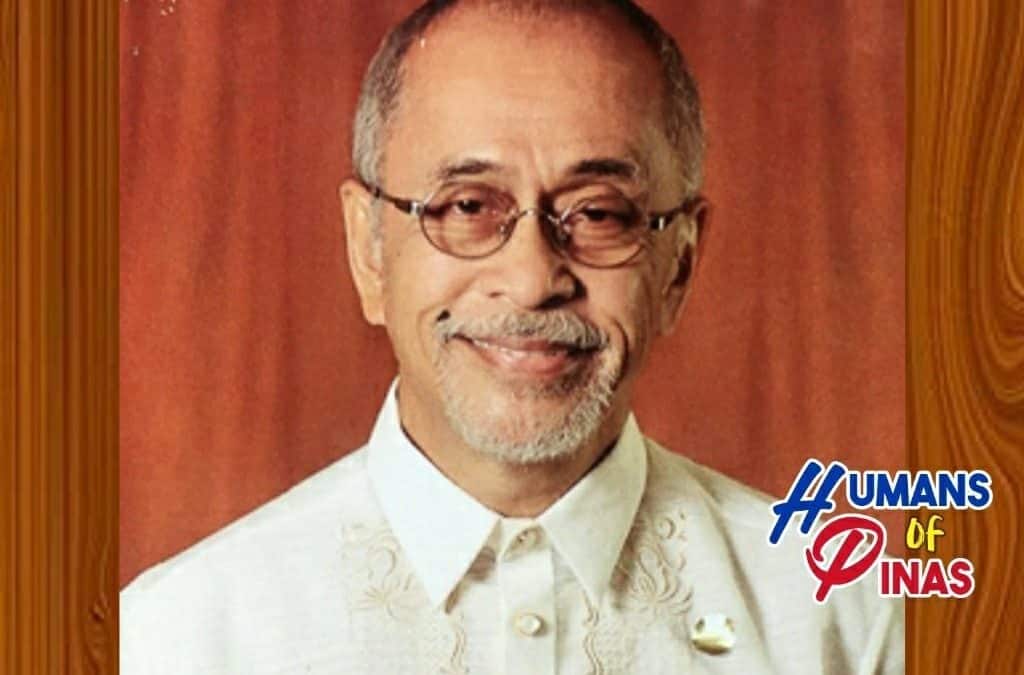
I woke up being shaken by Pete. “Raid! Raid!” he was saying, and rushed out of the room. Men, furiously pounding the door, were shouting for us to open up. It was between three and four in the morning.
The door had flung open. Pete, the poet and journalist Jose F. Lacaba, was pinned to the floor. He was being mauled by armed men in civilian clothes swarming over our tiny rented bungalow in Novaliches, Quezon City.

They were operatives of the 5th Constabulary Security Unit. I saw fists and the barrel of a gun coming at me as shouts of “Dapa! Dapa!” rang in my ears.
They forced open another room. I caught sight of Prof. Dolores Stephens Feria, who taught English in the University of the Philippines until she fled the Diliman campus to join us in the underground press and cultural unit of the anti-Marcos dictatorship movement.
The soldiers aimed their rifles and ordered her to raise her hands, but she just sat there. The law enforcers ransacked our house, taking money and valuables they could lay their hands on. Lieutenant RA raised a woman’s underwear and, in mocking disdain, shouted obscenities.
Sonja had luckily left the house on an errand a day or two earlier. As the skies brightened that day of April 25, 1974, Col. MA, the commanding officer of the 5th CSU, arrived and asked if our identities had been confirmed.
“Yes, sir,” replied our arresting officer who would be Rizal provincial commander of the Philippine National Police in the 1980s. Now in the company of our captors, the stories of horror heard from comrades previously arrested flashed in my mind.
My time had come, I dreaded the thought. I was relieved that Sonja, who was pregnant, was spared. For more than an hour before being brought to Camp Crame, we were already beaten black and blue.“Welcome to Camp Crame,” the sergeant beside me mumbled as the convoy entered the military compound.
I think, he purposely tightened my handcuffs to inflict pain. Camp Crame will forever be a reminder of the fascist inhumanity of martial law.

The beatings continued in the camp that is today the headquarters of those who have sworn “to serve and protect” whatever. At times, the torture was methodical, particularly when the senior intelligence officers took turns interrogating me about what they assumed I knew of the resistance movement.
At times, it was because the soldiers didn’t like my face or because I was a “subversive,” which today translates to “terrorist.” And then, again, there was this lieutenant who made life miserable for me more than it already was because he had decided that I, being a UP student, was arrogant.
I wondered how his valuation of UP students could even remotely endanger state and national security – and why a 22-year old had to be tortured for it.The gruesome physical and psychological torture continued. Among the methods used by my interrogators on me that I will never forget are the San Juanico Bridge, wherein I would be made to lie between two cots and if my body would fall or sag, I would be heavily beaten; burning of my feet with a flat iron; and inserting a thin reed or stick into my penis.I was never transferred to a regular detention center.
And so were Pete and Prof. Feria, in whose memory I named a character in a martial law film that I wrote in 2011. Our dehumanization in the intelligence headquarters persisted beyond the usual weeks.My mother was my first visitor. She never missed a visitation day, came hell or high water. She would insist that the food she carried all the way from Laguna be given to me even if the camp was off-limits for some reason.
I had just been released from prison when my younger sister, Rizalina, disappeared in 1977, together with nine other comrades — Gerry Faustino, Jessica Sales, Modesto Sison, Cristina Catalla, Ramon Jasul, Emmanuel Salvacruz, Salvador Panganiban, Virgilio Silva, and Erwin de la Torre.

My mother prepared to embark on another mission to have a second child in prison comforted, and hopefully, saved. But it was not to be.Modesto’s corpse was dug up in a common grave in Lucena City, Quezon, while those of Salvador and Virgilio were retrieved in a ravine in Tagaytay. The fate of the rest remains uncertain up to this day.
What’s certain, though, is that they all fell prey to a composite intelligence unit of the armed forces in Southern Tagalog, called Ground Team 205, headed by a Col. AG.Today, martial law comes to me as a hideous diorama of a tyrannical government wielding the power of life and death over citizens who dare raise a fist against the evils of society.
But if there be just one image, it will have to be my mother, my mater dolorosa, sorrowful yet bravely insisting on human rights for the sake of a prodigal son, and, too, storming military camps and graveyards in search of an activist daughter who was abducted by state security forces and never returned home.
by MLC | Sep 22, 2020 | Martial Law Stories
Source: Alpha Phi Beta Fraternity
The Alpha Phi Beta Fraternity is one with the nation in remembering Sept. 21, 1972, a day when an emerging beacon of democracy was shrouded in the shadows of tyranny.
Almost half a century has passed when Ferdinand E. Marcos declared Martial Law. The world witnessed as our nation plunged into the horrors of greed, corruption, and injustice. In this infamous time, billions of the nation’s wealth were plundered; fundamental freedoms were impaired; social institutions were dismantled; and thousands of Filipino lives were lost; all in the name of preserving power.
The people of that day saw their lives change for the worst as their ideals and principles are put to the test. Their eager spirits were awoken to the political ills that dismantled the very institutions they have placed trust in. Fear was cast and everyone took a hit.
Amidst this fear, men and women stood up and frontlined a movement determined to counter the suppression of civil liberties. They stood up against the full political force of the tyrant, and armed with nothing but faith in their principles and a hope for their nation, they braved their way against the terrors of despotic rule. By their sheer will and sacrifice, this country once again saw light and regained its treasured freedom.
The Alpha Phi Beta Fraternity echoes the cries of the victims of the human rights abuses, the woes of those left to deal with the disappearance and death of loved ones, and the quest for justice of those who suffered and died under Martial Law.
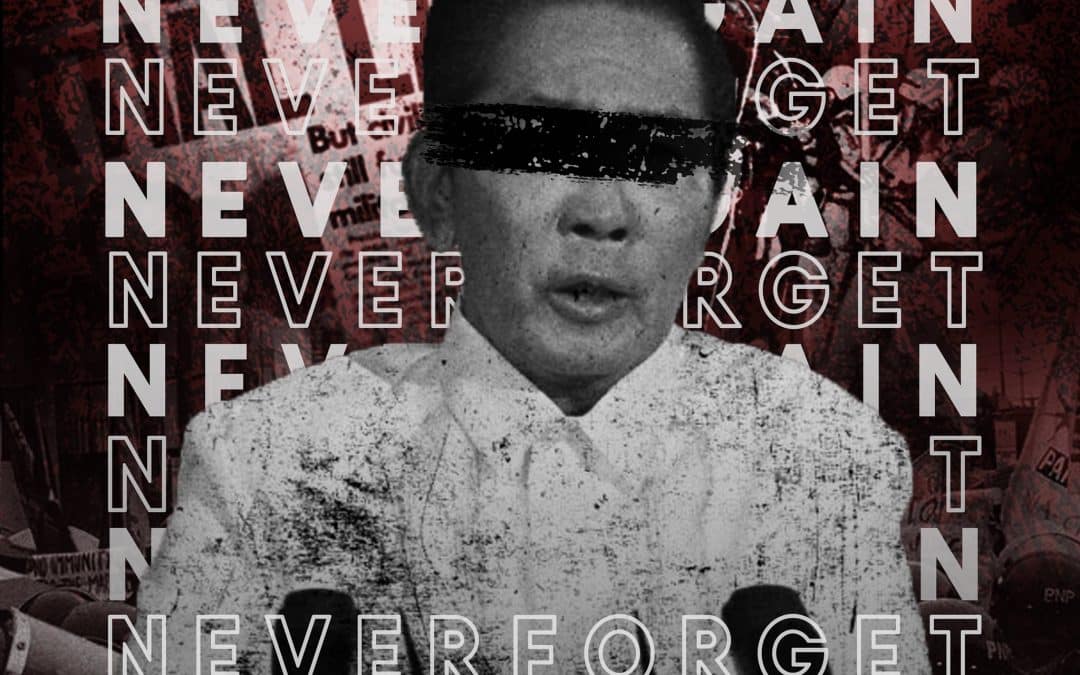
The resiliency of the people’s voice that attest to the veracity of these harms must be as enduring as the vow to never let anyone cause them again. As the remnants of the social cancer that gave rise to the despot continue to spread a wave of revisionism, disinformation, and delusion, our outcry for truth should resound as loud as ever. Our memory shall be as sharp as our words. We shout NEVER FORGET. NEVER AGAIN.
#parasabayan
by MLC | Sep 22, 2020 | Martial Law Stories
Source: Humans of Pinas
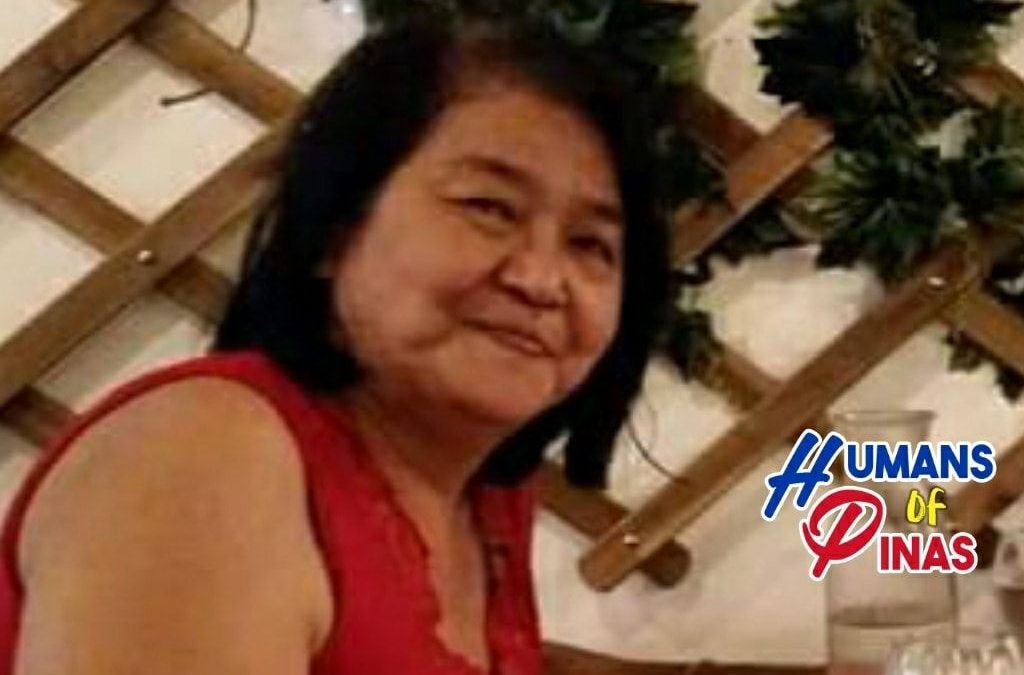
Unidentified military officers dumped me into their car. It was about five minute trip from my ISAFP. Immediately, I was subjected to a most degrading, inhuman and humiliating experience I would never want to relive again. But the memories keep coming back. Upto now, in detention, I still have recurrent nightmares.
They threatened to kill me, get my relatives and torture them in front of me. They kept telling me nobody saw them taking me in……An agent then forcibly removed my blouse and bra and unzipped my fly. Another brought in a hand-cranked electric generator used in military telephone.
Two exposed wires were then tied around the little fingers of my right hand and foot. … … I could do nothing but scream… The electric session lasted for nearly two hours and was repeated in the evening.

After the electric shock, the military authorities were still not satisfied. This time I was stripped naked and forced to lie on a short table. At this instance, Major Arsenio Esguerra of the 5th MIG-ISAFP entered the room and signaled the start of the water cure, which they laughingly called the NAWASA session – Nawasa being the supplier of water in Manila.
This time, besides four men restraining my hands and feet, another formed my hair into a bun and pulled my head down (covered with my Igorot- weaved bag) so that it kept hanging on the air until I felt that the water was racing through my brains. I passed out twice but they kept pouring until I thought I would die. Beside pouring water, several agents mashed my breasts while another contented himself by inserting his fingers in my vagina after failing to make me masturbate.” (Alfred McCoy, “Closer than Brothers,” p. 215-16)
On September 21, 1972, I was studying on a UP government scholarship then administered by Dean Armando Malay at the University of the Philippines – Diliman. I chose this, instead of the National Science Development Board (NSDB) scholarship as I thought it was a faster way to graduate and work.
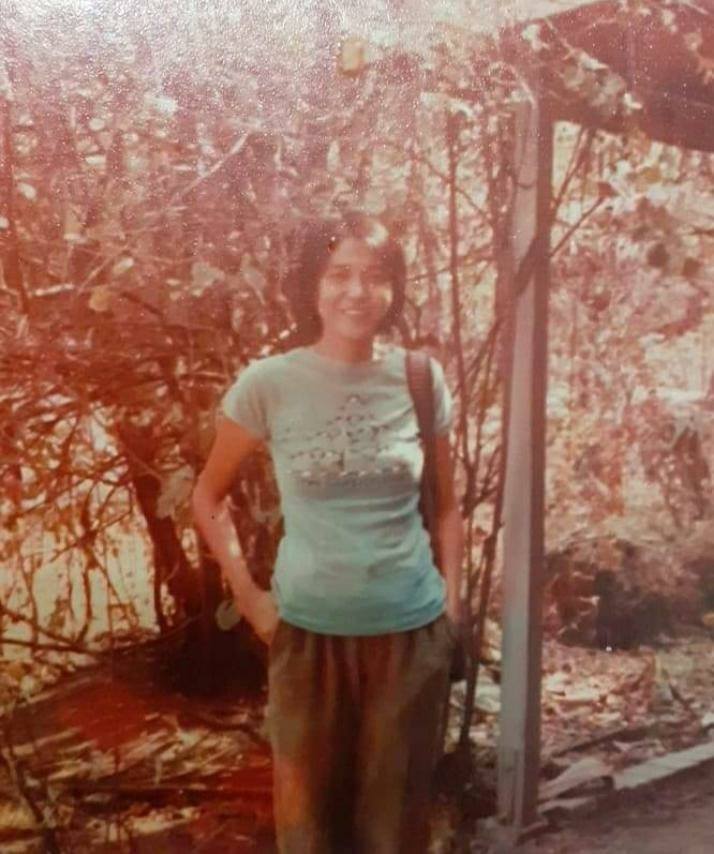
Less than two months earlier, I had joined the national democratic organization, Aletheia, which beauty queen Maita Gomez also joined and has as its motto ‘Ang katotohanan ay ang pakikibaka.’ This fitted well with my ideal and my quest for an answer to ‘why is there widespread poverty and exploitation of the Filipino people?’ a question which nagged me from the time in high school a priest shared his thoughts and writing on the plight of the Negros sacadas (‘There is blood in your sugar’).
Months before, I had regularly attended demonstrations organized by the Movement for a Democratic Philippines (MDP) and ex-Senator Diokno’s Movement of Concerned Citizens for Civil Liberties (MCCCL) at Plazas Miranda and Lawton then and, at its height, mobilized 100,000. I listened intently to the speakers and complemented this with studying books, in class, history books; newsmagazines and journals readily available at the University Library as well as immersion at workers’ picket lines and nearby communities.When martial law was announced by Marcos on the grainy black-and-white television (all channels were blank except this one channel) of the thatch-roofed boardinghouse at the back of the Faculty Center where I stayed, we already knew.
For, on the evening before, we could hear gunfire being exchanged between the security guards of the Iglesia ni Cristo church on Commonwealth Avenue and raiding military men as well when a passing taxi driver shouted to coeds holding vigil at a nearby residence hall, “Martial law na!”The day after, I journeyed on a bus. The sky was overcast, as if agreeing with the mood at the time.
People were quiet and I witnessed long-haired men being forcibly given the crew cut by soldiers.A week after classes opened (we had to pass through entrances guarded by UP police), UP students organized protest actions against the Marcos dictatorship (noise barrages at Vinzons Hall cafeteria, singing of the national anthem during switch of classes, wearing of black armbands), I was arrested for the first time and brought to Camp Aguinaldo, where I saw Miss International Gemma Cruz-Araneta and an Imelda niece (surname Romualdez) also being detained.

On my third arrest on August 5, 1976, I share the following. I had to clarify to the second author that it is not true that when read my account in an auditorium at the University of Wisconsin, one of the RAM boys claimed he was asleep; when his shod feet were on the table, hands cradling the back of his head while I was in front of him screaming and being electrocuted.I owe it to the Filipino people to tell the truth about martial law with my little story as another tyrannical history is unfolding when human rights defenders, lawyers, indigenous people, church people, workers, farmers and activists and even their loved ones are outrightly killed.
There are many more atrocious accounts which I heard and documented as a human rights worker in ML times (during which I journeyed as far south as Kiamba where I heard stories of a mosque full of old men, women and children being torched and Muslim women being put on a barge never to be seen again. For months afterwards, we never ate fish or shrimps, my narrator said.)
by MLC | Sep 22, 2020 | Martial Law Stories
Source: AkbayanYouth.UPD
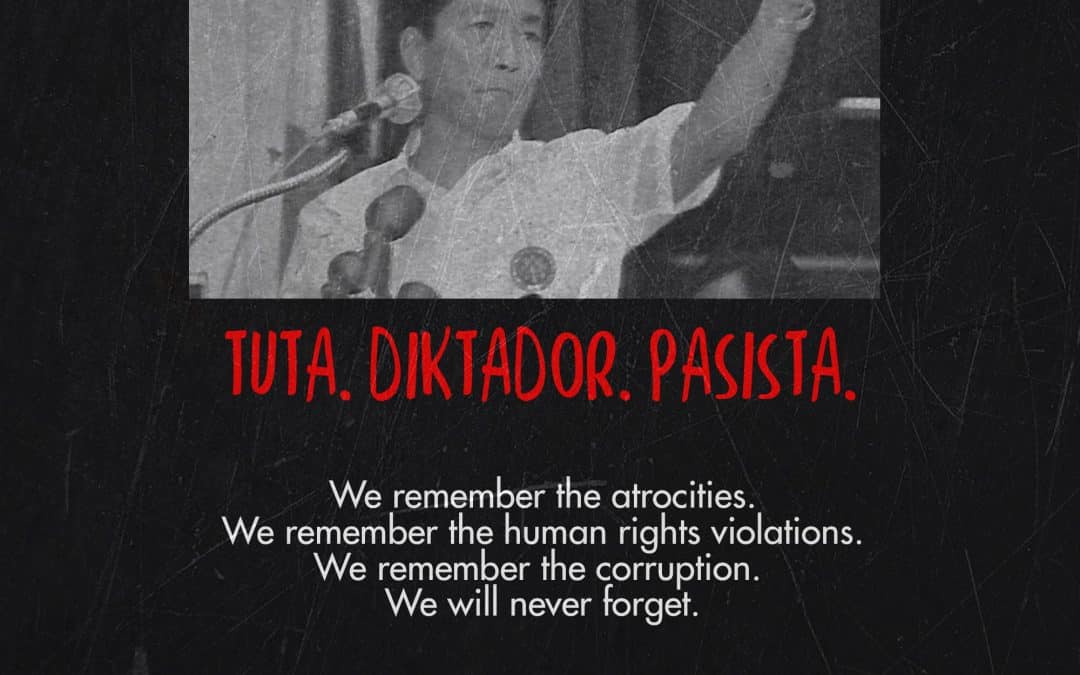
We refuse to commemorate a dictator. We refuse to allow the Marcoses to rewrite our history and silence the victims of Martial Law. We remember the atrocities and we will not forget.
After Ferdinand Marcos was ousted back in 1986, the Marcos family fled to Hawaii at the expense of millions of Filipinos. Despite their ill-gotten wealth, accumulated by stealing from public funds, purchasing private companies, and managing state-owned monopolies, and despite the thousands of human rights violations committed during their reign of terror, the Marcos family roams free, unscathed by their crimes against the Filipino people.
So unscathed, in fact, that they continue to take government positions, backed by the same corrupt practices that they once fostered.
History will tell us that it is through protest that we fight for our democracy, and the 1986 People Power Revolution is a testament to this.
But in this age of growing restlessness, we must not allow another Martial law to control our nation. This is why we must collectively fight against the current dictatorship, in the same way that our fellow Filipinos in 1986 bravely fought for our democratic rights.
We remember the atrocities.We remember the human rights violations.We remember the corruption. We will never forget.NEVER AGAIN. NEVER FORGET. NEVER AGAIN TO MARTIAL LAW.
#MarcosHindiBayani
#NoToHistoricalRevisionism
#NeverAgain
#NeverForget
#JunkHB7137


