BAYANI
Do not begrudge me my burial at Libingan ng mga Bayani.
It was my dying wish, even though this fiction has been manufactured by my family to advance their political agenda, in which I no longer have an interest or stake.
After all, I am dead…
Dead as the remains of my bust at Tuba, Benguet, majestically blasted.
Dead as my handsome wax likeness standing in for my corpse at my sometime mausoleum.
Truth is I really wanted to be buried beside my mother at Batac, Ilocos Norte.
Quibbles aside, know that I am a hero, bayani.
This claim matters…
Please pause awhile to contemplate it.
I am a decorated soldier, the most bemedaled in Philippine military history!
Audie Murphy of the U.S. Army received only 27 awards and medals.
I got 33!
Do not envy me my medals, which radiate like five-pointed stars, old as the universe.
They flame like the eight-rayed sun.
They shine like the purest white of the Philippine flag.
They are warrior red.
They are in justice, peace, and truth, blue.
They are golden laurels adorning my brow.
They are golden lampstands honoring my valor.
They are golden crowns capping my molars.
Do not pay the least attention to my detractors who dispute the circumstances under which I acquired these honors.
Fact is, they are real awards.
Two medals were awarded during the Second World War, the Gold Cross and the Distinguished Service Star.
Admittedly, everything else was awarded years after the war ended.
Eight are campaign ribbons that all Bataan veterans and World War II Philippine guerrillas receive…true, many of our compatriots have them.
I received ten awards on a single day, almost twenty years after the war’s end!
Small matter that I received the highest Philippine award for military valor, the Medal of Valor, twelve years later, based on only two affidavits signed by my comrades-in-arms.
Why would my confreres lie? Take it from me: it is the getting that matters.
Three U.S. Army medals of which I am most proud were all given for different actions in which I risked my life, even though I had never been assigned to patrol or combat, only civil affairs.
Please examine the authenticated photograph of my breast adorned by the Distinguished Service Cross, the Silver Star, and the Order of the Purple Heart—this last I received without any evidence of physical injuries, including scars!
General Douglas MacArthur himself pinned the Distinguished Service Cross on my chest! At the time, he had exclaimed that if it were not for my exploits, Bataan would have fallen three months earlier!
When he said so, he bit down so hard on the stem of his corn cob pipe, it broke!
In 1947 General Omar Bradley himself saluted me when he saw my breast emblazoned with six rows of ribbons, headed by 22 valor medals!
Although Bradley was suffering from double vision at the time—he was getting on, his eyesight was failing, you see—you can be sure it was no mean display that embroidered my svelte torso!
Trust me, if you want to receive that many medals and awards, go after multiple different awards for the same action—
You can get eight, nine, ten awards for the same event, just by being persistent!
I was the most decorated hero of the Second World War!
Only a Christmas tree does better!
Iginuhit ng Tadhana!
In meekness and humility, I received when I was president, U.S. Congress’ rejection of my application for the Congressional Medal of Honor.
By then forty years had lapsed from the time General Mateo Capinpin, following General Jonathan Wainwright’s instruction at Bataan, had in writing recommended me for the award.
The papers were lost during the Fall of Bataan, so anyone living at the time who could have contradicted my statement was dead.
I suppose that when you have 33 awards and medals, one more, even if it is the U.S. Congressional Medal of Honor, doesn’t make a whole lot of difference.
Does it?
I joined in the defense of Bataan with the rank of Third Lieutenant.
By war’s end I had attained the rank of Lieutenant Colonel, even though in the files of the United States Armed Forces in the Far East and of the Philippine Commonwealth Army, there is no evidence or record of my promotion beyond First Lieutenant.
Know that in only 72 days, I was promoted from Third Lieutenant to Captain, this last promotion from General Wainwright by telephone from Corregidor!
At the time, he was encamped at Bagac, Ilocos Norte!
Don’t ask me how he could have been in two places at one time!
In 1942, I was promoted to Major and in 1944 to Lieutenant Colonel, both by “Unknown Authority.”
Don’t ask me how it happened—it is unknown even to me!
After the Fall of Bataan, I joined my valiant comrades in the Death March, staggering into Camp O’Donnell at Capas, Tarlac.
Released by the Japanese in August 1942, I was soon arrested by the Kempeitai. Tortured in Fort Santiago prison, I escaped.
Just because no one remembers I was there doesn’t mean I wasn’t.
After my escape, I organized Ang Mga Maharlika, a guerrilla band which was responsible for intelligence gathering, and conducting sabotage and assassination operations against the invaders.
I led Ang Mga Maharlika during more than 300 skirmishes, conducting guerrilla operations in North Luzon, Baguio, Zambales, and Manila, growing the band to 8,300 men at its peak strength!
I am proud to have served with them, all brave fighters, no bandits or black-market hustlers.
When they sold war materials to the enemy, it was undertaken solely as a cunning ploy to gather intelligence.
Know that as a guerrilla, I regularly tramped around barefoot, inuring myself to hardship.
All my exploits I achieved barefoot! Ask Ray C. Hunt Jr., the U.S. Army captain whom met I met during the war!
In total, I fought in 27 battles, some of them occurring in different places at the same time!
Do not believe those who say they never saw me at the Battle of Bessang Pass.
Proof I was there: my story is identical to that of Colonel Conrado Rigor Sr.!
After the battle, General Russell Volckmann confided to me that Yamashita had almost surrendered to my intrepid guerrilla band!
I was not, like Jose Rizal, a martyr.
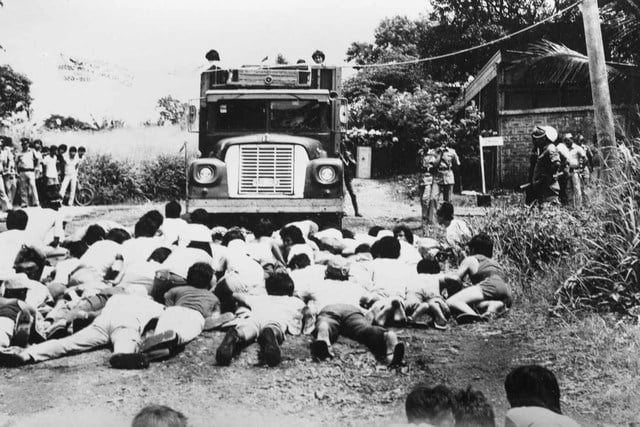
On the contrary, under my regime I martyred many thousands who opposed me.
Estimates put it at about 70,000 imprisoned in violation of their human rights, 34,000 tortured, and precisely 3,275 killed or disappeared, of which 2,520 were left as broken, dismembered, mutilated bodies for roadside recovery.
I take full responsibility for it, everything.
After all, they were every single one of them Communists, no exception.
True, some denied it, even under torture.
Never believe a Communist, I always say.
I did not, like Andres Bonifacio, incite our people to revolt against an oppressive colonial government.
It was my own oppressive government that was overthrown by our people in a largely peaceful civilian revolution.
Despite some world-class play-acting…if I might say so myself, my talents are manifold…on my part and that of my irrepressible henchman, General Fabian Ver…during a moro-moro televised live…I demonstrated laudably high-minded efforts to restrain our loyal soldiers from inflicting excessive violence on our unarmed people…with remarkable self-possession I guided them in fulfilling their duty to defend my family, that is, our nation…yes, I was ignominiously deposed.
Our Philippine Air Force deserted me…I had little choice but to flee Malacañang, absconding via a U.S. C-140 plane for what I thought at the time was a flight to my homeland at Paoay, Ilocos Norte.
Turns out my pal, Ronald Reagan, had misinformed the U.S. Air Force pilot that I had booked my family a two-week vacation at Hawaii.
How could I possibly have been planning a vacation when my family had brought with us enough loot to last way beyond two weeks?…to be precise, 22 crates of $717 million equivalent in cash, 300 crates of assorted jewelry, estimated value unknown, unset gems worth $4 million, assorted jewelry worth $7.7 million, including 65 Seiko and Cartier watches, lustrous pearls filling a 12” x 4” box, a 3-foot high solid gold statue bedecked with precious stones, gold bullion worth $200,000, and $124 million in deposit slips to U.S., Swiss, and Cayman Islands banks.
No, I did not, like Emilio Aguinaldo, barter away the Philippine state for the proverbial bowl of lentils.
When our first president exchanged for lucre the declaration of our nascent independence, he surrendered to our Spanish colonial masters the opportunity for us to establish our first constitutional republic.
I did not enrich myself so opportunistically while I served in government.
I was a rich man before I became president…very, very, very rich…
I did not declare the full extent of my assets, among them, hidden vaults stacked with gold bars to the ceiling a la Atahualpa, so that our people would not contemn me because of my wealth.
Seeing in me instead an exceptionally gifted man of humble means, they would vote for me.
Our people gave me the chance to serve, all I ever really wanted.
Do not believe the CIA estimate that I looted $5 to $10 billion from our treasury.
You don’t believe the CIA, do you?
The World Bank officially endorses the CIA estimate, true.
All the major independent news networks, international and local, as well.
Professional historians of good repute, too.
The latter cite in support judicial rulings and legislative acts in the U.S., Switzerland, Singapore, and the Philippines.
Not so long ago the Philippine government passed “The Human Rights Victims Reparation and Recognition Act of 2013,” awarding $246 million of some $683 million of my Swiss bank deposits to 9,539 victims in the Hawaii class action suit.
So far, under this law 75,730 claims have been filed and counting.
I concede that many sources have invoked masses of circumstantial evidence against me—Imelda’s extravagant shopping sprees in the hundreds of thousands of dollars, including her one-day $2,181,000.00 splurge in New York City; signature cards abandoned when I fled Malacañang, for secret Swiss bank accounts in the pseudonyms of “William Saunders,”“John Lewis,”and “Jane Ryan”; $1.2 billion missing in Central Bank reserves, $6 billion missing in Special Accounts; 6.325 metric tons of gold, also missing from Central Bank; $21 million worth of Old Masters paintings seized by the U.S. government and liquidated in a 1991 Christie’s auction; The Crown Building on Fifth Avenue corner 57th Street, also sold in a 1991 auction for $93.6 million; government sequestered tracts of land in Cagayan, Manila, Tagaytay, Batangas, and Rizal, appraised at $12.62 million in 2006; $20 to $30 million of U.S. assets seized by U.S. federal officials in 2012; Imelda’s $23 million collection of jewelry and watches, primed for auction; Imee’s secret offshore trust fund in the British Virgin Islands…
Recently, the Philippine Commission on Good Government declared that in the period from 1986 to 2015, it was able recover $3.69 billion of my ill-gotten wealth.
Let’s cut to the chase.
Who do you choose to believe?
I may have committed very many sins in my life, but stealing money from the Philippine people is not one of them.
Numerous indeed are my detractors, but surely my word shines forth honorably, underpinned redoubtably by the integrity of my 33 awards and medals, all of which were gained at suicidal risk to my life and to those of my men!
Historians, economists, journalists, many others say that during my term as president, the Philippines transformed from the second most dynamic economy this part of the world into the “Sick Man of Asia.”
They say we were left behind by our neighbors in East and Southeast Asia—Singapore, Malaysia, Thailand, Taiwan, Hong Kong, South Korea—countries or societies that posted annual growth rates of five percent or higher.
They say we lost two decades of development—beginning in 1982 when our per capita gross domestic product began to decline, recovering its value only 21 years later, in 2003.
They say that from 1984 to 1985, we experienced the worst recession in our history, our gross domestic product contracting each year by 7.3 percent…that during the 21-year period under my rule, underemployment rose from 10 to 33 percent of the population…that real wages dropped by as much as 73 percent from 1966 to 1985…that inflation shot to 50 percent in 1984…that the poverty rate increased from 41 percent in 1965 to 58.9 percent in 1985…that our foreign debt ballooned from $4.1 billion in 1975 to $8.2 billion in 1977 to $28.3 billion in 1986…that our national debt equaled 58.63 percent of our gross domestic product in 1986…that the peso-dollar exchange rate plummeted from Php3.92 to one dollar in 1969 to Php8.54 in 1982 to Php18.61 in 1986…that I resorted to “crony capitalism,” awarding huge projects and entire industries to my political allies, resulting in inefficiency, bankruptcy, and stagnation in the manufacturing sector…that I spent $2.3 billion to build the Bataan Nuclear Power Plant, generating tens of millions of pesos in annual costs, besides zero electricity.
Let’s put it this way.
Are you going to listen to eggheads?
Or will you believe your eyes?
Anyone can fabricate mountains of statistics…I should know.
Now, infrastructure—you can’t make that up.
Under my administration the Cultural Center of the Philippines was built…Folk Arts Theater…Philippine International Convention Center…Makiling Center for the Arts…Nayong Pilipino…Coconut Palace…People’s Park in the Sky…Philippine Heart Center…National Kidney and Transplant Institute…Lung Center of the Philippines…at least 20 power plants…30 state colleges and universities…11,472 meters of bridges…105,000 km of roads and highways…230,000 public housing units…irrigation facilities for 1.5 million hectares of agricultural land…nationwide telecommunications systems…innumerable public schools…
As for cronies, my answer is that you can’t build this country working just by yourself.
You’ll need industrialists, financiers, technocrats, all sorts—what’s wrong with that?
It was a Golden Age for the Philippines under my regime—a shining sun of peace and order, discipline, economic development, industrial growth, tourism and foreign investment, patronage of the arts, entertainment, movie stars, boxing legends, beauty queens…the halcyon days of the Miss Universe Beauty Pageant, the Thrilla in Manila, the Manila International Film Festival…the Bolshoi Ballet, Dame Margot Fonteyn, tenor Placido Domingo, pianist Van Cliburn, “Ol’ Blue Eyes” Frank Sinatra…Brooke Shields, Franco Nero, Ben Kingsley, Robert Duvall, George Hamilton, Peter Ustinov, Priscilla Presley, Jeremy Irons…Smokin’ Joe Frazier, Muhammad Ali…Gloria Diaz, Margie Moran, Aurora Pijuan, Melanie Marquez, Amparo Muñoz…the good, the true, and the beautiful!
I don’t want to toot my horn, but I also can’t resist telling the truth.
I am the most decorated soldier in the history of the Philippines, a hero surpassing Rizal, Bonifacio, Aguinaldo…indeed, if I might say so, any other Filipino who has preceded and who will succeed me in Philippine history…I, who have endured endless defamation by the world at large, who expended his prodigious genius to serve his country unstintingly without any desire for personal gain, wish to be laid to rest only as a Filipino…hero among heroes, yes, bayani, because after all, the title goes with the real estate…
Muhammad Ali is not the greatest.
I am the greatest Philippine president. I am the greatest.
Originally published in J Journal, Volume XI, No. 2 (Fall 2018), pages 3-11
REFERENCES
References are organized by topics.
MARCOS’ FAKE MEDALS
Washington Post
Sharkey, John. (January 24, 1986). New Doubts on Marcos’ War Role. The Washington Post. Retrieved from https://www.washingtonpost.com/archive/politics/1986/01/24/new-doubts-on-marcos-war-role/40076661-fe6a-4695-88ea-1ee707e1c090/?utm_term=.c3fb56704fff
New York Times
Gerth, Jeff, and Brinkley, Joel. (January 23, 1986). Marcos’s Wartime Role Discredited in US Files. The New York Times. Retrieved from http://www.nytimes.com/1986/01/23/world/marcos-s-wartime-role-discredited-in-us-files.html?pagewanted=all
Vera files
Ariate, Joel F., and Reyes, Miguel Paolo P. (July 2, 2016). File No. 60: Marcos’ Invented Heroism. Vera Files. Retrieved from http://verafiles.org/articles/file-no-60-marcos-invented-heroism
Ariate, Joel F., and Reyes, Miguel Paolo P. (July 2, 2016). File No. 60: A Family Affair. Vera Files. Retrieved from http://verafiles.org/articles/file-no-60-family-affair
Ariate, Joel F., and Reyes, Miguel Paolo P. (July 2, 2016). File No. 60: Debunking the Marcos War Myth. Vera Files. Retrieved from http://verafiles.org/articles/file-no-60-debunking-marcos-war-myth
Doyo series of articles
Doyo, Ma. Ceres P. (August 18, 2016). Marcos ‘war medals’ exposed, questioned (1). Philippine Daily Inquirer. Retrieved from http://opinion.inquirer.net/96588/marcos-war-medals-exposed-questioned-1
Doyo, Ma. Ceres P. (August 25, 2016). Marcos ‘war medals’ exposed, questioned (2). Philippine Daily Inquirer. Retrieved from http://opinion.inquirer.net/96781/marcos-war-medals-exposed-questioned-2
Doyo, Ma. Ceres P. (September 1, 2016). Marcos ‘war medals’ exposed, questioned (3). Philippine Daily Inquirer. Retrieved from http://opinion.inquirer.net/96971/marcos-war-medals-exposed-questioned-3
Doyo, Ma. Ceres P. (September 8, 2016). Marcos ‘war medals’ exposed, questioned (Conclusion). Philippine Daily Inquirer. Retrieved from http://opinion.inquirer.net/97159/marcos-war-medals-exposed-questioned
Professor Ricardo Jose
ABS-CBN News. (August 12, 2016). US Army: Marcos was arrested for anomalies involving money. YouTube. Retrieved from https://www.youtube.com/watch?v=r2cvpe2mHlM
Robles, Raissa. (May 17, 2011). Part 1 – Eminent Filipino war historian slams Marcos burial as a “hero.” Raissa Robles: Inside Philippine Politics & Beyond. Retrieved from https://www.raissarobles.com/2011/05/17/part-1-eminent-filipino-war-historian-slams-marcos-burial-as-a-hero/
Marcos’ fabricated war record
ABS-CBN News. (August 12, 2016). Marcos Claims ‘Ang Maharlika’ formed during Death March [Facebook post]. Retrieved from https://www.facebook.com/AngLagalagPH/videos/686267611530385/
Ang Lagalag. (August 10, 2016). Marcos’ Invented Heroism [Facebook post]. Retrieved from https://www.facebook.com/pierre.toussaint.338/posts/740699646071965
Gomez, Buddy. (August 20, 2015). Marcos’ ‘Major’ Escapade. ABS-CBN News. Retrieved from http://news.abs-cbn.com/blogs/opinions/08/19/15/marcos-major-escapade
Gomez, Buddy. (November 25, 2016). Opinion: Stolen Valor: Honoring a Scoundrel. ABS-CBN News. Retrieved from http://news.abs-cbn.com/blogs/opinions/11/24/16/opinion-stolen-valor-honoring-a-scoundrel
Hays, Jeffrey. (June 2015). Ferdinand Marcos Years. Facts and Details. Retrieved from http://factsanddetails.com/southeast-asia/Philippines/sub5_6b/entry-3843.html
Hot Manila. (August 9, 2016). Marcos the military fraud [Facebook post]. Retrieved from https://www.facebook.com/pierre.toussaint.338/posts/740245549450708
Remitio, Rex. (August 11, 2016). Historian: Marcos’ war exploits ‘full of lies.’ CNN Philippines. Retrieved from http://cnnphilippines.com/news/2016/08/10/Historian-says-Marcos-war-exploits-full-of-lies.html
REFERENCES (continued page 2)
Only two medals given in battle
Bondoc, Jarius. (April 29, 2011). Marcos medals: Only 2 of 33 given in battle. The Philippine Star Global. Retrieved from http://www.philstar.com/opinion/680306/marcos-medals-only-2-33-given-battle
Maynigo, Benjamin. (April 30, 2011). Marcos Fake Medals Redux (Part I). Asian Journal San Diego. Retrieved from http://asianjournalusa.com/marcos-fake-medals-redux-part-i-p10747-95.htm
Colonel Conrado Rigor, hero of Bessang Pass
TV Patrol. (August 15, 2016). Bayaning Bessang Pass [Facebook post]. Retrieved from https://www.facebook.com/tvpatrol.abscbn/videos/1078847702170618/
REGIME OF LIES
Philippine Daily Inquirer
Regime of lies [Editorial]. (September 22, 2014). Philippine Daily Inquirer. Retrieved from http://opinion.inquirer.net/78674/regime-of-lies
Tasaday hoax
Pineda, DLS. (February 27, 2016). My favorite Marcos lie: The Tasaday. The Philippine Star Global. Retrieved from http://www.philstar.com/supreme/2016/02/27/1557062/my-favorite-marcos-lie-tasaday
“I may have committed many sins in my life, but stealing money from the people…from the government is not one of them.”
Randyboi Dt. (October 29, 2013). President Ferdinand Edralin Marcos. YouTube. Retrieved from https://www.youtube.com/watch?v=9bJAOzL83CI
“Don’t you think that two terms…is enough for any man?”
Agbayani, Eufemio, III. (December 1, 2016). Video mula sa dokumentaryong “Batas Militar” (1997) [Facebook post]. Retrieved from https://www.facebook.com/eufemio.agbayani/posts/10202586576580872
Marcos’ “body”
Baluyut, Rasec. (November 21, 2016). Asked if the Marcos body displayed is wax or not [Facebook post]. Retrieved from https://www.facebook.com/groups/1561746860801516/permalink/1596663573976511/
Esquamel, Paterno, II. (November 19, 2016). Marcos ‘body’ still in Batac mausoleum after burial. Rappler. Retrieved from http://www.rappler.com/nation/152941-marcos-body-batac-mausoleum-hero-burial
Montalvan, Antonio, III. (August 15, 2016). There is no refrigerated crypt. Philippine Daily Inquirer. Retrieved from http://opinion.inquirer.net/96516/no-refrigerated-crypt
REFERENCES (continued page 3)
MARCOS’ PLUNDER
The Guardian
Davies, Nick. (May 7, 2016). The $10bn question: what happened to the Marcos millions? The Guardian. Retrieved from www.theguardian.com/world/2016/may/07/10bn-dollar-question-marcos-millions-nick-davies
Jeffrey Hays’ summary
Hays, Jeffrey. (June 2015). Marcos’s Plunder and Wealth. Facts and Details. Retrieved from http://factsanddetails.com/southeast-asia/Philippines/sub5_6b/entry-3845.html
StAR
The World Bank-UNODC. (July 20, 2017). Asset Recovery Watch: Case ID ARW-61. StAR: Stolen Asset Recovery Initiative. Retrieved from http://star.worldbank.org/corruption-cases/node/18497
ABS-CBN News
Ang Lagalag. (August 24, 2016). Marcos Wealth [Facebook post]. Retrieved from https://www.facebook.com/AngLagalagPH/videos/692592304231249/
Ang Lagalag. (October 5, 2016). PCGG Still Fighting Marcoses for Ill-Gotten Wealth in 248 Cases [Facebook post]. Retrieved from https://www.facebook.com/AngLagalagPH/videos/715152131975266/
Bantayog ng mga Bayani
Avila, Charlie. (October 25, 2015). Asian Journal: Chronology of the Marcos Plunder. Bantayog ng mga Bayani. Retrieved from http://www.bantayog.org/?p=1200
Marcos Revisionism. (November 7, 2015). In Bantayog ng mga Bayani.Retrieved from http://www.bantayog.org/?p=1261
Interaksyon (missing articles)
Caroline Kennedy
Kennedy, Caroline. (June 1987). The Marcoses and the Missing Filipino Millions. Caroline Kennedy: My Travels. Retrieved from https://anywhereiwander.com/2011/06/24/%e2%80%9cthe-marcoses-the-missing-filipino-millions%e2%80%9d/
Chronology
Ang Lagalag. (July 17, 2016). Marcos Loot by the Numbers [Facebook post]. Retrieved from https://www.facebook.com/AngLagalagPH/photos/a.206942782796206.1073741828.206869209470230/665037200320093/?type=3&hc_ref=ARQ65_0tYOv3mWoPhjL0Q1ojasqYyJUGJx7W6W4PByRnmhvoI_HM1aEzJiSnXe_pi_Q
Techniques used
Presidential Commission on Good Government. (May 6, 2016). How the Marcoses Exploited the Banking System. Retrieved from http://pcgg.gov.ph/how-the-marcoses-exploited-the-banking-system/
Roa, Ana. (September 29, 2014). Regime of Marcoses, cronies, kleptocracy. Philippine Daily Inquirer. Retrieved from http://newsinfo.inquirer.net/641277/regime-of-marcoses-cronies-kleptocracy
Bataan Nuclear Power Plant
Ang Lagalag. (November 19, 2017). Remember Bataan Nuclear Power Plant [Facebook post]. Retrieved from https://web.facebook.com/AngLagalagPH/posts/944383032385507
Butterfield, Fox. (March 7, 1986). Filipinos Say Marcos Was Given Millions for ’76 Nuclear Contract. Yes, Ferdinand Marcos Ruined the Philippines. Retrieved from https://yesferdinandmarcosruinedthephilippines.wordpress.com/1986/03/07/filipinos-say-marcos-was-given-millions-for-76-nuclear-contract/
REFERENCES (continued page 4)
Marcos income discrepancy
G.R. No. 152154. (July 15, 2003). The LAWPHiL Project. Retrieved from http://www.lawphil.net/judjuris/juri2003/jul2003/gr_152154_2003.html
News5. (January 30, 2016). Editoryal. Retrieved from https://www.facebook.com/News5Everywhere/videos/584445255045566/
Imelda profligacy
Rogers, Lisa Waller. (March 31, 2010). Imelda Marcos: The “Mine” Girl. Lisa’s History Room. Retrieved from https://lisawallerrogers.com/tag/manila-international-film-festival/
Missing gold bullion
Fineman, Mark. (March 16, 1986). Marcos-Era Gold Reported Missing: Philippines Tracing Flow of Millions in Bullion, Cash and Illegal Profits. Los Angeles Times. Retrieved from http://articles.latimes.com/1986-03-16/news/mn-26520_1_gold-bullion/2
Hawaii loot
Plana, Ridel. (November 29, 2016). Imelda Marcos [Facebook post]. Retrieved from https://www.facebook.com/100014256548547/videos/127322561086295/
Tantiangco, Aya, and Bigtas, Jannielyn Ann. (February 25, 2016). What Marcoses brought to Hawaii after fleeing PHL in ’86: $717-M in cash, $124-M in deposit slips. GMA News Online. Retrieved from http://www.gmanetwork.com/news/story/556744/news/specialreports/what-marcoses-brought-to-hawaii-after-fleeing-phl-in-86-717-m-in-cash-124-m-in-deposit-slips
Marcos’ plunder up to $10 billion
ABS-CBN News. (August 23, 2016). Nakaw na yaman ni Marcos, abot ng $10-bilyon. Retrieved from http://news.abs-cbn.com/video/focus/08/23/16/nakaw-na-yaman-ni-marcos-abot-ng-10-bilyon
1986 Guinness biggest thief
Laguatan, Ted. (June 30, 2013). Adding insult to injury: UP College named after Marcos’ Prime Minister. Philippine Daily Inquirer. Retrieved from https://globalnation.inquirer.net/79187/adding-insult-to-injury-up-college-named-after-marcos-prime-minister
Suharto biggest kleptocrat
Worst kleptocrat of modern times.(2018). Guinness World Records. Retrieved from
http://www.guinnessworldrecords.com/world-records/worst-kleptocrat-of-modern-times
Recovery efforts
Ang Lagalag. (October 5, 2016). PCGG Still Fighting Marcoses for Ill-Gotten Wealth in 248 Cases [Facebook post]. Retrieved from https://www.facebook.com/AngLagalagPH/videos/715152131975266/
De Castro, Andrew. (February 24, 2016). Opinion: Recovering from Plunder — Why the PCGG is Still Relevant Today. Pampubliko. Retrieved from http://www.pampubliko.com/opinion-articles/view/opinion-recovering-from-plunder-why-the-pcgg-is-still-relevant-today
Lustre, Philip M., Jr. (February 25, 2016). Recovering Marcos’ ill-gotten wealth: After 30 years, what? Rappler. Retrieved from http://www.rappler.com/newsbreak/in-depth/123664-recovering-marcos-ill-gotten-wealth-30-years
Mateo, Janvic. (February 24, 2016). P170-B ill-gotten wealth recovered from Marcoses, cronies. The Philippine Star Global. Retrieved from http://www.philstar.com/headlines/2016/02/25/1556605/p170-b-ill-gotten-wealth-recovered-marcoses-cronies
PH gov’t wins ill-gotten wealth case vs Marcoses, Alfonso Lim’s family. (January 4, 2016). In Rappler. Retrieved from http://www.rappler.com/nation/117880-pcgg-wins-case-marcos-alfonso-lim-taggat-industries
Compromising with Marcos’ cronies
Lustre, Philip M., Jr. (February 27, 2016). Search for Marcos’ wealth: Compromising with cronies. Rappler. Retrieved from http://www.rappler.com/newsbreak/in-depth/123667-marcos-cronies-compromise
U.S. government seizes $1 billion of Marcos’ properties in 2012
Cabacungan, Gil C. (November 21, 2012). US officials seize Marcos properties worth P1B. Philippine Daily Inquirer. Retrieved from https://globalnation.inquirer.net/57227/us-officials-seize-marcos-properties-worth-p1b
Marcos family complicit in father’s plunder
Villanueva, Susan. (March 16, 2016). Para sa Ating Kaalaman [Facebook post]. Retrieved from https://www.facebook.com/photo.php?fbid=10209258686413569&set=a.1081886256748.14876.1514076134&type=3
REFERENCES (continued page 5)
Imee’s secret offshore trust
Ang Lagalag. (July 22, 2016). Offshore Trust Account? [Facebook post]. Retrieved from https://www.facebook.com/206869209470230/videos/667415076748972/
Landingin, Roel, and Ilagan, Karol. (April 2, 2013). Ferdinand Marcos’ Daughter Tied to Offshore Trust in Caribbean. International Consortium of Investigative Journalists. Retrieved from https://www.icij.org/offshore/ferdinand-marcos-daughter-tied-offshore-trust-caribbean
Landingin, Roel, and Ilagan, Karol. (April 4, 2013). Imee Marcos tied to secret offshore trust. Rappler. Retrieved from http://www.rappler.com/nation/25473-imee-marcos-tied-to-secret-offshore-trust
Samasa Kontra Mandarambong. (July 10, 2016). PCIJ Report Links Imee Marcos, Children to Secret Offshore Trust [Facebook post]. Retrieved from https://www.facebook.com/samasakm/videos/1225019040864937/
Bongbong and the Arelma account
Ang Lagalag. (July 13, 2016). Fact: Court records would show… [Facebook post]. Retrieved from https://www.facebook.com/AngLagalagPH/photos/a.206942782796206.1073741828.206869209470230/662715367218943/?type=3&hc_ref=ARSumkxRFt_4m9dTKse8X2kk5FKJk-GO6M5jLc5aJlZbvbu9OzssWo8nzws0bMRX9Ok
AngLagalag. (July 16, 2016). Ibalik ang mga Ninakaw [Facebook post]. Retrieved from https://www.facebook.com/AngLagalagPH/photos/a.206942782796206.1073741828.206869209470230/662992537191226/?type=3&hc_ref=ARSR3grfS13DA5pKLyoBh-FGoOBi_Q-4rtmZDGLdDP0aHrB0TbyLN9BAaw7sh5ipXIc
Marcus V. (April 15, 2016). PCGG: Bongbong, not the gov’t, blocking awards for martial law victims. Kicker Daily News. Retrieved from http://kickerdaily.com/posts/2016/04/pcgg-bongbong-not-the-govt-blocking-awards-martial-law-victims/
Alan Cayetano’s 2016 debate with Bongbong
Gonzales, Joseph. (July 17, 2016). Pilipinas Debates 2016 [Facebook post]. Retrieved from https://www.facebook.com/pierre.toussaint.338/posts/729111380564125
Greatest thief stole his own burial
Gonzales, Joseph. (November 23, 2016). The greatest thief has even stolen his own burial [Facebook post]. Retrieved from https://www.facebook.com/pierre.toussaint.338/posts/800360843439178
FINAL MARCOS JUDGMENTS
TV5 Aksyon
News5. (January 30, 2016). Editoryal. Retrieved from https://www.facebook.com/News5Everywhere/videos/584445255045566/
Marcos kleptocracy
Roa, Ana. (September 29, 2014). Regime of Marcoses, cronies, kleptocracy. Philippine Daily Inquirer. Retrieved from http://newsinfo.inquirer.net/641277/regime-of-marcoses-cronies-kleptocracy
Timelines
Agence France-Presse. (April 11, 2011). Court orders Imelda Marcos to repay funds. Philippine Daily Inquirer. Retrieved from http://newsinfo.inquirer.net/2810/court-orders-imelda-marcos-to-repay-funds
CNN Library. (June 23, 2017). Imelda Marcos Fast Facts. CNN. Retrieved from http://edition.cnn.com/2015/10/09/asia/imelda-marcos-fast-facts/
Garcia, Myles A. (2016). Thirty Years Later…Catching Up with the Marcos-Era Crimes. MAG Publishing. Retrieved from https://books.google.com.ph/books?id=q9zbCwAAQBAJ&pg=PT60&lpg=PT60&dq=philippine+supreme+court+marcos+ill+gotten+wealth+civil+cases&source=bl&ots=Emc0PLL8e_&sig=e864mSE-nwKBd_dlFWYYM6sk3MM&hl=en&sa=X&ved=0ahUKEwjNsf73g_vQAhXJI5QKHVsUBdI4ChDoAQg_MAc#v=onepage&q=philippine%20supreme%20court%20marcos%20ill%20gotten%20wealth%20civil%20cases&f=false
Rmn Iloilo. (November 19, 2016). Fast Facts: Swiss Accounts ni Marcos [Facebook post]. Retrieved from https://www.facebook.com/rmniloilo/posts/1834736470075301
REFERENCES (continued page 6)
The Philippines
The Supreme Court twice held Marcos guilty of ill-gotten wealth involving the total amount of US$664 million.
Flores, Mikhail Franz E. (April 2, 2014). Decision to forfeit alleged ill-gotten wealth of the Marcos family upheld. BusinessWorld Online. Retrieved from http://www.bworldonline.com/content.php?section=Nation&title=decision-to-forfeit-alleged-ill-gotten-wealth-of-the-marcos-family-upheld&id=85550
G.R. No. 152154. (July 15, 2003). Supreme Court of the Philippines. Retrieved from http://sc.judiciary.gov.ph/jurisprudence/2012/april2012/189434.htm
G.R. Nos. 189434 and 189505. (April 25, 2012). Supreme Court of the Philippines. Retrieved from http://sc.judiciary.gov.ph/jurisprudence/2003/jul2003/152154.htm
In no less than 20 cases, the Supreme Court ruled that Marcos was a dictator and caused massive economic hardships to the country.
Rifareal, Doris Lois. (July 15, 2016). No to Marcos Burial in LNMB [Facebook post]. Retrieved from https://www.facebook.com/doris.rifareal/posts/1453888011305845?pnref=story
USA
Ang Lagalag. (July 15, 2016). Ang Katotohanan [Facebook post]. Retrieved from https://www.facebook.com/pierre.toussaint.338/posts/728462140629049
In RE Estate of Ferdinand Marcos cites 1995 and 1996 Hawaii judgments
In re: Estate of Ferdinand Marcos Human Rights Litigation. (August 22, 1996). FindLaw for Legal Professionals. Retrieved from http://caselaw.findlaw.com/us-9th-circuit/1120999.html
Switzerland
Ang Lagalag. (December 26, 2016). Recovered Marcos Wealth [Facebook post]. Retrieved from https://www.facebook.com/AngLagalagPH/posts/764781047012374?comment_id=766214310202381¬if_t=share_reply¬if_id=1482969144590644
Singapore
Cayabyab, Marc Jayson, and JDS. (January 3, 2014). Singapore court awards $23M in Marcos money to PNB. GMA News Online. Retrieved from http://www.gmanetwork.com/news/story/342344/money/singapore-court-awards-23m-in-marcos-money-to-pnb#sthash.reUTtxLT.dpuf
MARTIAL LAW STATISTICS
Killed, tortured, imprisoned, salvaged
Ang Lagalag. (July 14, 2016). Myth: Only communists believe tales of abuses… [Facebook post]. Retrieved from https://www.facebook.com/206869209470230/photos/a.206942782796206.1073741828.206869209470230/662944813862665/?type=3&pnref=story
Desaparecidos
Ang Lagalag. (August 29, 2016). Recorded Number of Desaperecidos under the Marcos Regime [Facebook post]. Retrieved from https://www.facebook.com/206869209470230/photos/a.206942782796206.1073741828.206869209470230/693991997424613/?type=3&pnref=story
Fact checking total killed
Ang Lagalag. (July 16, 2016). 3,257: Fact checking the Marcos killings, 1975-1985 [Facebook post]. Retrieved from https://www.facebook.com/permalink.php?story_fbid=664495750374238&id=206869209470230&substory_index=0
Hawaii class action suit victims
Cruz, Tonyo. (August 9, 2016). 9,539 reasons [Facebook post]. Retrieved from https://www.facebook.com/tonyocruz/posts/10154365638039326
Human Rights Victims’ Claims Board
Ang Lagalag. (November 2, 2017). Unfinished Justice [Facebook post]. Retrieved from https://www.facebook.com/AngLagalagPH/posts/935580826599061
Freedom of the press
Ang Lagalag. (September 15, 2016). 3,257: Nung panahon ng Batas Militar… [Facebook post]. Retrieved from https://www.facebook.com/AngLagalagPH/photos/a.206942782796206.1073741828.206869209470230/704501216373691/?type=3&hc_ref=ARSkTaM_XKi8kW9ILpslJBaWB2efSE2NEyLr8a2kVHWvNvg-35rcV6ZXy5CwXGZuVVw
Life under Marcos: A Fact Check
Ang Lagalag. (August 10, 2016). Life under Marcos: A Fact Check [Facebook post]. Retrieved from https://www.facebook.com/206869209470230/videos/685314144959065/
REFERENCES (continued page 7)
Major martial law myths
League of Filipino Students – UP Diliman. (September 2015). Major Myths about Martial Law [Facebook post]. Retrieved from https://www.facebook.com/pg/lfsupdiliman/photos/?tab=album&album_id=1685701508329120
Marcos’ accomplishments
President Ferdinand E. Marcos’ Accomplishments. (October 21, 2014). In Amazing Philippines. Retrieved from http://www.theamazingpilipinas.com/2014/10/president-ferdinand-e-marcos.html
1986 EDSA REVOLUTION
Five Marcos Myths
Marcos Trolloyalists. (November 16, 2016). 5 Pernicious Marcos Myths [Facebook post]. Retrieved from https://www.facebook.com/MarcosTrolloyalists/photos/a.1114703431920699.1073741827.1114700075254368/1271048609619513/?type=3&pnref=story
1986 “snap” elections
Lustre, Philip, Jr. (February 7, 2017). The 1986 ‘Snap’ Presidential Elections [Facebook post]. Retrieved from https://web.facebook.com/groups/1561746860801516/permalink/1626386557670879/
Chronology of a Revolution
Santiago, Angela-Stuart. (December 1, 1995). Chronology of a Revolution: Day 1, February 22. Retrieved from http://edsarevolution.com/day1.htm
Santiago, Angela-Stuart. (December 1, 1995). Chronology of a Revolution: Day 2, February 23. Retrieved from http://edsarevolution.com/day2.htm
Santiago, Angela-Stuart. (December 1, 1995). Chronology of a Revolution: Day 3, February 24. Retrieved from http://edsarevolution.com/day3.htm
Santiago, Angela-Stuart. (December 1, 1995). Chronology of a Revolution: Day 4, February 25. Retrieved from http://edsarevolution.com/day4.htm
Marcos’ last day
Lustre, Philip, Jr. (February 25, 2016). Ferdinand Marcos: His last day at the Palace. CNN Philippines. Retrieved from http://cnnphilippines.com/news/2015/02/25/Ferdinand-Marcos-Malaca%C3%B1an-last-day.html
ECONOMIC MISMANAGEMENT
“Golden Age” myth
ABS-CBN News. (September 23, 2017). The Philippine Economy during the Marcos Years. Retrieved from https://web.facebook.com/abscbnNEWS/videos/10155552751740168/
Alejo, Mel. (November 27, 2016). In One Minute: Ferdinand Marcos by the Numbers [Facebook post]. Retrieved from https://web.facebook.com/mel.alejo.info/videos/10202076323585088/?_rdc=1&_rdr
Ang Lagalag. (July 26, 2016). Malakas at Maganda: Marcos Reign Myth-Making, and Deception in History [Facebook post]. Retrieved from https://www.facebook.com/permalink.php?story_fbid=665703840253429&id=206869209470230&substory_index=0
Aquino, Lorelei. (November 18, 2016). Check Your Facts! (Pro-Marcos Arguments and Claims Quashed). Mom on a Mission. Retrieved from https://loreleiaquino.wordpress.com/2016/11/18/check-your-facts-pro-marcos-arguments-and-claims-quashed/
Canlas, KC. (February 26, 2016). Look: Martial Law in Numbers. When in Manila. Retrieved from http://www.wheninmanila.com/look-martial-law-in-numbers/
REFERENCES (continued page 8)
de Dios, Emmanuel S. (November 15, 2015). The Truth about the Economy under the Marcos Regime. Yes, Ferdinand Marcos Ruined the Philippines. Retrieved from https://yesferdinandmarcosruinedthephilippines.wordpress.com/2015/11/15/the-truth-about-the-economy-under-the-marcos-regime/
de Ynchausti, Nik. (September 24, 2016). The Tallies of Martial Law. Esquire. Retrieved from https://www.esquiremag.ph/politics/martial-law-tallies-a1576-20160924-lfrm4
Gil, Hazel. (June 5, 2016). The Martial Law Misconceptions of Filipino Millennials: It’s Time to Open Our Eyes. Affinity. Retrieved from http://affinitymagazine.us/2016/06/05/the-martial-law-misconceptions-of-filipino-millennials-its-time-to-open-our-eyes/
Guido, Joseph, and de los Reyes, Che. (September 21, 2017). The best of times? Data debunk Marcos’s economic ‘golden years.’ ABS-CBN News. Retrieved from http://news.abs-cbn.com/business/09/21/17/the-best-of-times-data-debunk-marcoss-economic-golden-years
History with Lourd. (September 23, 2015). History Presents Martial Law Myths Busted [Facebook post]. Retrieved from https://web.facebook.com/historywithlourd/videos/990790937650045/?_rdc=1&_rdr
Kontrabando. (September 24, 2015). Mag-isip at magsaliksik, mga mangmang [Facebook post]. Retrieved from https://web.facebook.com/News5Kontrabando/videos/1640805172863926/
Mendoza, Ronald U. (February 26, 2016). Ferdinand Marcos’ economic disaster. Rappler. Retrieved from http://www.rappler.com/thought-leaders/123773-marcos-economic-disaster
Punongbayan, JC, and Mandrilla, Kevin. (March 5, 2016). Marcos years marked ‘golden age’ of PH economy? Look at the data. Rappler. Retrieved from http://www.rappler.com/views/imho/124682-marcos-economy-golden-age-philippines
Rappler.com. (November 26, 2016). Marcos ‘stole’ our future – decades of development and potential incomes. Meme Buster. Retrieved from http://memebuster.net/marcos-stole-future-decades-development-potential-incomes/
San Agustin, Boom. (June 1, 2013). Which Philippine President Caused the Downfall of the Philippines’ Economy? Our Knowledge Consulting Services (Asia). Retrieved from http://www.ourknowledge.asia/blog-posts–articles/which-philippine-president-caused-the-downfall-of-the-philippines-economy
Crony capitalism
Ang Lagalag. (February 8, 2017). World-Class Bureaucrat Capitalism [Facebook post]. Retrieved from https://web.facebook.com/AngLagalagPH/posts/788695194620959:0
Bunachita, Jose Santino S. (November 30, 2016). Corruption: A Marcos ‘legacy.’ Cebu Daily News. Retrieved from http://cebudailynews.inquirer.net/114260/corruption-marcos-legacy
Pilipinas Kong Mahal. (June 15, 2016). No to Marcos Burial at Libingan ng mga Bayani [Facebook post]. Retrieved from https://www.facebook.com/PilipinasKongMinamahal/videos/944309302348374/
Roa, Ana. (September 29, 2014). Regime of Marcoses, cronies, kleptocracy. Philippine Daily Inquirer. Retrieved from http://newsinfo.inquirer.net/641277/regime-of-marcoses-cronies-kleptocracy
Edifice complex
Afinidad-Bernardo, Deni Rose M. (2016). Edifice Complex. The Philippine Star Global. Retrieved from http://newslab.philstar.com/31-years-of-amnesia/building-spree
Ang Lagalag. (March 21, 2017). The Truth: Marcos bankrupted the Philippines [Facebook post]. Retrieved from https://web.facebook.com/AngLagalagPH/posts/812017438955401:0
Martial Law Museum. (n.d.). Edifice Complex: Building on the Backs of the Filipino People. Retrieved from https://martiallawmuseum.ph/magaral/edifice-complex-building-on-the-backs-of-the-filipino-people/
Manila Film Center
Manahan, Tats. (November 2015). The enduring nightmare of the Manila Film Center. Rogue. Retrieved from http://rogue.ph/enduring-nightmare-manila-film-center/
REFERENCES (continued page 9)
The Marcos debt
GMANews.TV. (April 7, 2007). Taxpayers to shoulder Marcos debt until 2025 – Ibon. GMA News Online. Retrieved from http://www.gmanetwork.com/news/story/37314/news/nation/taxpayers-to-shoulder-marcos-debt-until-2025-ibon
Tadem, Eduardo C. (November 24, 2016). The Marcos debt. Philippine Daily Inquirer. Retrieved from http://opinion.inquirer.net/99481/the-marcos-debt
Behest loans under Marcos
Araneta, Sandy. (April 20, 2006). PCGG uncovers 130 behest loans worth P50 billion. The Philippine Star Global. Retrieved from http://www.philstar.com:8080/headlines/332342/pcgg-uncovers-130-behest-loans-worth-p50-billion
Marcos destroyed the spirit of the Filipino entrepreneur
Gonzales, Joseph. (July 15, 2016). He destroyed the spirit of the Filipino entrepreneur [Facebook post]. Retrieved from
https://www.facebook.com/pierre.toussaint.338/posts/728290823979514
ARGUMENTS AGAINST MARCOS’ BURIAL AT LNMB
No brainer
The Coalition Against the Marcos Burial in Libingan ng mga Bayani. (September 3, 2016). To bury or not to bury in Libingan, this is a no-brainer. Philippine Daily Inquirer. Retrieved from http://opinion.inquirer.net/97011/bury-not-bury-libingan-no-brainer
Letter to Bongbong
Trustees, Bantayog ng mga Bayani.(September 8, 2015). An Open Letter to Senator Ferdinand ‘Bong Bong’ Marcos, Jr. Bantayog ng mga Bayani.Retrieved from
http://www.bantayog.org/an-open-letter-to-senator-ferdinand-bong-bong-marcos-jr/
Pride of the living
Adriano, L., Cardinoza, G., Visaya, Villamor, Jr., and Sotelo, Y. (August 18, 2016). ‘Let Marcos rest in peace.’ Philippine Daily Inquirer. Retrieved from http://newsinfo.inquirer.net/807228/let-marcos-rest-in-peace
Adolph Hitler
Pangilinan, Kiko. (August 7, 2016). We can certainly choose to forgive Adolph Hitler… [Facebook post]. Retrieved from https://www.facebook.com/kikopangilinan/posts/10153933645936936
Crime pays
Garcia, Ed. (June 14, 2016). They shoot journalists, don’t they? Philippine Daily Inquirer. Retrieved from http://opinion.inquirer.net/95202/shoot-journalists-dont#ixzz4E5Q8dJKt
Filipinos forget
Lustre, Philip, Jr. (February 7, 2017). The 1986 ‘Snap’ Presidential Elections [Facebook post]. Retrieved from https://www.facebook.com/events/1122772611097733/permalink/1178436218864705/
Against historical revisionism
Ang Lagalag. (July 13, 2016). Constantly True: Ateneo Against Marcos Revisionism [Facebook post]. Retrieved from https://www.facebook.com/AngLagalagPH/posts/662162883940858
Negros victims
Rappler.com. (August 20, 2016). No to hero’s burial: Negrenses cite sugar plunder, killings, famine. Rappler. Retrieved from http://www.rappler.com/nation/143607-no-hero-burial-marcos-negros-occidental
Handog ng Pilipino sa Mundo
Samasa Kontra Mandarambong. (May 5, 2016). Handog ng Pilipino sa Mundo [Facebook post]. Retrieved from https://www.facebook.com/samasakm/videos/1182065811826927/
REFERENCES (continued page 10)
APOLOGIA PRO MARCOS
Starter pack
Robles, Alan. (November 29, 2016). Opinion: Introducing: the Marcos Apologist Starter Pack. ABS-CBN News. Retrieved from http://news.abs-cbn.com/blogs/opinions/11/29/16/opinion-introducing-the-marcos-apologist-starter-pack
8 millennial myths
Ang Lagalag. (January 19, 2016). 8 Things Millennials Get Wrong about the Marcos Regime [Facebook post]. Retrieved from https://www.facebook.com/AngLagalagPH/photos/a.206942782796206.1073741828.206869209470230/574057836084697/?type=3
Bongbong
Almario, Manuel F. (February 27, 2011). The dismal record of the Marcos regime. The Philippine Star Global. Retrieved from http://laonlaan.blogspot.com/2011/04/national-treasure-saga-of-marcos-loot.html
Duterte
Dancel, Raul. (August 7, 2016). Philippines’ Duterte says former dictator Marcos can be buried at heroes’ cemetery. The Straits Times. Retrieved from http://www.straitstimes.com/asia/se-asia/philippines-duterte-gives-go-ahead-for-former-dictator-marcos-burial-at-heroes-cemetery
Robles, Alan. (March 25, 2014). Marcos loyalists online. Hot Manila. Retrieved from http://www.hotmanila.ph/content/tyranny-and-dictatorship/marcos-loyalists-online
CULTURAL LIFE UNDER MARCOS
Agence France-Presse. (September 4, 2009). Iconic Philippine cultural center a Marcos legacy. ABS-CBN News. Retrieved from http://news.abs-cbn.com/features/09/24/09/iconic-philippine-cultural-center-marcos-legacy
Hollie, Pamela G. (February 7, 1982). Manila Film Festival Proves All-Out Spectacular. The New York Times. Retrieved from https://www.nytimes.com/1982/02/07/movies/manila-film-festival-proves-all-out-spectacular.html
Miguel, Valerie. (January 19, 2013). Martial Law (1972-1985): Philippine Literature, Culture, and Music. Music, Media, and Culture. Retrieved from http://musicmediaandculture.blogspot.com/2013/01/martial-law-1972-1985-philippine.html
Moral, Cheche V. (September 27, 2015). The Marcos years: ‘Golden age’ of PH fashion. Philippine Daily Inquirer. Retrieved from http://lifestyle.inquirer.net/208044/the-marcos-years-golden-age-of-ph-fashion/