
by MLC | Aug 4, 2017 | Martial Law Stories
By Deni Rose M. Afinidad-Bernardo
Source: Philstar.com NewsLab
If you think Ferdinand Marcos was the best president the Philippines ever had because he allegedly built a slew of infrastructure that are still used today, think again.
“Past is past,” you might say, “Let us forget, forgive and move on!”
Move on, if you must, but one thing is for sure though: Filipinos cannot yet move on from paying the debt Marcos incurred to construct his projects. It is still questionable if these buildings’ use outweighs their cost and the expenses of renovating them.
World Bank and International Monetary Fund (IMF) records show that most of Marcos’ infrastructure projects were funded by loans that jacked up the country’s foreign deficit from $360 million when Marcos came into power in 1962, to around $28.3 billion when he stepped down in 1986. While borrowing for sizeable projects could have been a wise move, many of the projects were rushed, so they are not safe for long-term use.
Economist Emmanuel de Dios and colleagues at the University of the Philippines, moreover, wrote in 1984 that the bulk of construction projects were “not very productive and many were outrightly wasteful.” While some have cultural value, other projects would be “over-designed bridges, highways, public buildings or large energy projects designed to secure a political constituency, to get a commission, or to corner a contract.”
According to expert estimates, it will take the country up to 2025 to fully pay the debt, almost 40 years after the EDSA People Power Revolution. Marcos and his allies allegedly overpriced the projects to be able to pocket billions of dollars in kickbacks, which Filipinos are still paying for.
Cultural Center of the Philippines (CCP)
Photo by Cultural Center of the Philippines
“As the state became the new patron of the arts, the cultural sphere became Imelda’s power base,” Gerard Lico writes in the 2003 book “Edifice Complex: Power, Myth, and Marcos State Architecture.”
“To assert this obsession with identity and promote the image of the nation as a progressive economy in the third world, the first lady built the Cultural Center of the Philippines, a cultural convention facility on land reclaimed from the historical Manila Bay. The center was built with money from the Cultural Development Fund, nourished by the Special Fund for Education, which in turn originated from the Philippine War claims from the United States,” Lico said in the book.
A popular venue for international exhibits and performances, the CCP was built in 1966 in Pasay City under Marcos’ Executive Order 30. The 62-hectare complex opened on Sept. 8, 1969.
Since the CCP was allegedly “rushed” by then First Lady Imelda Marcos for the late dictator’s 52nd birthday, the complex had “unpaid obligations” throughout the Marcos regime, which were then paid after the People Power in terms of assets. The complex, as a result, lost some of its land, including the site of today’s Sofitel Hotel, Star City, Coconut Palace and Philippine International Convention Center, or PICC.
Since it was constructed, the CCP is said to be always short in budget, thus, it always pleads for renovation and has to rely on donations and government subsidy to survive. The government recently shelled out another P2 billion for the center’s renovation and extension.
The Manila Film Center tragedy

Photo by Christopher Duque Toledo IV

Photo by Philippine Urban Legends
At the southwest end of the CCP was the Manila Film Center, originally built as a national film archive spearheaded by Imelda Marcos.
The deadline for the building’s construction was tight, requiring around 4,000 workers who worked in three shifts non-stop for 24 hours a day. The lobby, for example, was only built in 72 hours, when it should have been erected in six weeks.
At about 3 a.m. of Nov. 17, 1981, the center’s scaffolding collapsed, burying around 169 workers alive in quick-drying cement. The Marcos administration tried to cover up the accident by not permitting rescuers and ambulances into the site not until nine hours after the incident.
When the center opened in 1982, it cost the government around $25 million, only to become a venue for screenings of “pito-pito” and “penekula” or porn films in the ’80s.
Bataan Nuclear Power Plant (BNPP)
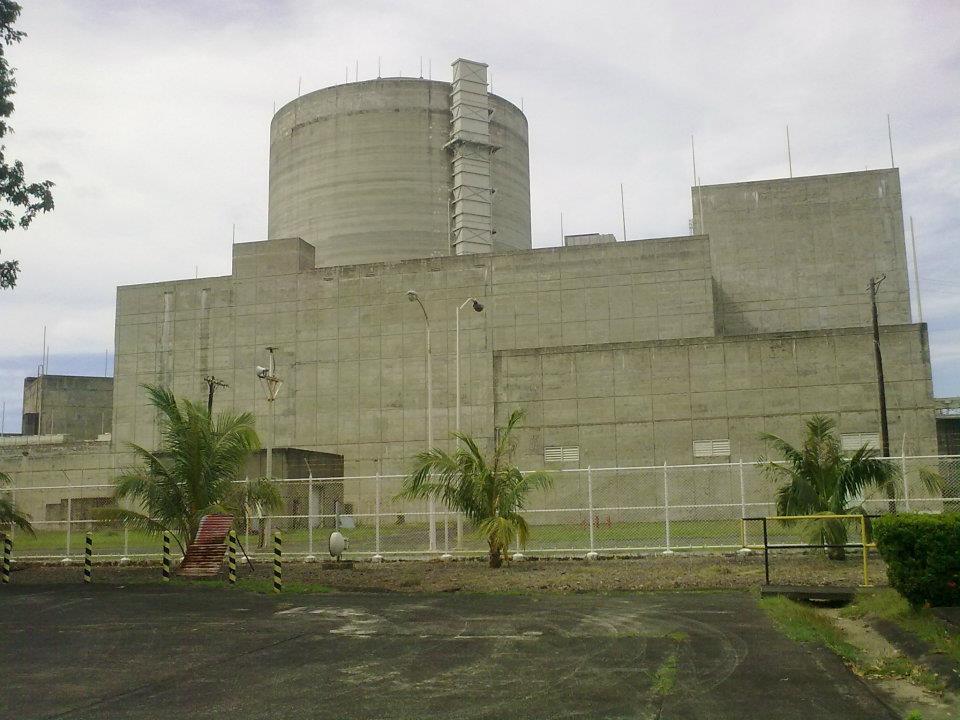
Photo by Wikipedia (Jiru27)
Marcos believed that to meet the country’s energy demands during the oil crisis in 1973 and decrease its dependence on imported oil, the country should shift to nuclear power.
Two reputable energy companies, Westinghouse Elecric and General Electric (GE), passed proposals. GE’s proposal reportedly contained details and specifications amounting to about $700 million, while Westinghouse’s proposal was $500 million, but with no details or specifications given. The presidential committee preferred GE’s proposal, but Marcos overruled this in June 1974, thereby awarding the project to Westinghouse.
By March 1975, however, without much explanation, Westinghouse’s asking price ballooned to $1.2 billion. Soon, it was reportedly discovered that Westinghouse sold the same technology to other nations for only a fraction of the price it billed the Philippines.
The BNPP was then started to be built in 1976. Three years after, following the Three Mile Island incident in the US, construction of the nuclear plant was halted. According to a safety inquiry into the plant, it has over 4,000 defects that include being built in a major earthquake fault line and its close proximity to Mount Pinatubo. Throughout the ’70s and ’80s, the plant had been protested for its potential threats to public health and safety.
When the plant was nearly complete in 1984, it had cost the government US$2.3 billion. The country was only able to pay it off in April 2007—30 years after its construction.
When Marcos was overthrown in 1986, in April of that year, the Chernobyl disaster happened, prompting the succeeding Corazon Aquino administration to discontinue the plant. The government sued Westinghouse for the supposed bribery and overpricing, which were rejected by the US court.
Repaying the debts incurred for the plant became the Philippines’ obligation. The next administrations tried finding uses for it. There were proposals to convert it into a power station for oil, gas, or coal, but constructing new power stations had been less costly than holding these in the plant.
To this day, maintaining the plant costs the government P40 million a year. In 2011, the government was due to reimburse P4.2 billion to National Power Corporation for maintaining the plant. To help ease the cost of maintaining it, the plant was transformed into a tourist attraction.
In 2016, after an inspection by Philippine senators, the plant has been found to have over 2,000 defects. In the 2000s, a Korean corporation’s assessment found out that it might cost the country another US$1 billion to rehabilitate the plant.
Solar, wave and wind power were also found to be cheaper than nuclear power as alternative energy sources, so the plant’s usefulness today or in the future remains questionable.
Philippine International Convention Center (PICC)

Photo by Efigenio Christopher Duque Toledo IV

Originally a part of the CCP complex, the PICC was touted as Asia’s first international convention center that has been hosting local and foreign meetings and conventions.
It was inaugurated on Sept. 5, 1976 under Marcos’ Presidential Decree No. 520.
Like the CCP, it has degraded, with many parts no longer or rarely used. It is no longer owned by the CCP because it has been used to repay part of the debts the CCP has incurred during the Marcos era.
The Tanghalang Francisco Balagtas (Folk Arts Theater)

Photo by Efigenio Christopher Duque Toledo IV
Commissioned by Imelda Marcos in 1974 for the Miss Universe competition in Manila, the Folk Arts Theater was designed to seat 10,000. Today, it is still being used as a theater although it should have been torn down a long time ago since it was done in a record time of only 77 days.
Coconut Palace (Tahanang Filipino)

Photo by Efigenio Christopher Duque Toledo IV
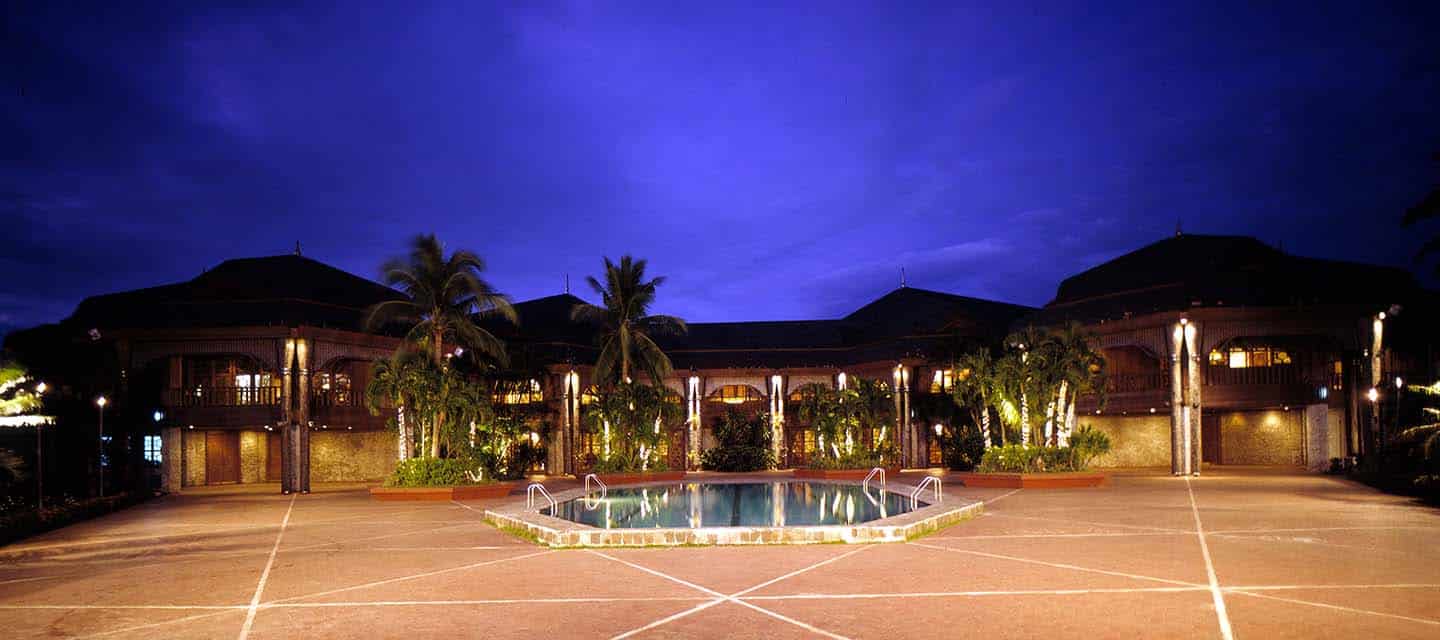
Photo by Manosa and Company
According to Lico, Imelda wanted a house that would embody everything Filipino in terms of design, philosophy, material and execution. Thus the Tahanang Filipino was erected in 1981.
A homage to vernacular and modern Philippine architecture, the Coconut Palace was partly funded by the coconut levy, which was supposed to be for the development of the country’s coconut industry, specifically, for welfare projects for coconut farmers.
“The fund, when audited and placed under government sequestration after the fall of the Marcos dictatorship in 1986, was also found to have been disbursed on such items as a scholarship program by Imelda Marcos, or donated for Ms. Marcos’s pet projects such as the Miss Universe pageant and the World Chess Championship, among others,” Lico adds in his book.
Nayong Pilipino

Photo by Deni Rose M. Afinidad-Bernardo
Built in 1969, the Nayong Pilipino near the Ninoy Aquino International Airport was a brainchild of Imelda. It ran as a theme park featuring replicas of the country’s tourist spots for 32 years before it was transferred to Clark, Pampanga, where it recently became the subject of an alleged casino anomaly.
In 1873, Ileana Maramag was quoted by Lico as saying: “The question really was to what extent authenticity was compromised in the process of transplantation to Imelda’s theme park.”
San Juanico Bridge

Photo by NB
Completed in 1973, the San Juanico Bridge is the country’s longest. It spans from Samar to Imelda’s home province, Leyte, as it was the late dictator’s birthday gift to her.
“The ‘Love Bridge,’ the press would call it. The public hated it,” Conrado de Quiros writes in “Dead Aim,” in 1997.
Makiling Center for the Arts (National Arts Center)

Photo by Wikipedia Nickrds09
Found in Mount Makiling, Los Baños, Laguna, the National Arts Center was built in 1976 as a haven for aspiring Filipino artists. The 13.5-hectare property includes a Boy Scouts of the Philippines hotel also tainted with anomaly as former Vice President Jejomar Binay allegedly tried to have the facility under his control.
People’s Park in the Sky

Photo by Kathy Dancel

Photo by Noli Fernan Perez
People’s Park in the Sky was established in 1981 originally as a guest house for then US President Ronald Reagan, but the visit never pushed through as Marcos was ousted in 1986. It now serves as a park that includes Mother of Fair Love, The Shrine of Our Lady and a weather station of the Philippine Atmospheric, Geophysical and Astronomical Services Administration (Pagasa).
Philippine Heart Center

Photo by Imelda Romualdez Marcos Website

Photo by PHC
Originally known as Philippine Heart Center of Asia, this hospital in Quezon City was built under Presidential Decree No. 673 by Marcos. Since it was inaugurated in 1975, it has been the site of thousands of surgeries, including what was claimed to be the first successful renal transplant in the country.
In 1975, Maramag, as cited by Lico writes that the center was Imelda’s “monument to the heart.” The “designer hospital” by Architect Jorge Ramos was finished reportedly to heed to Imelda’s request that the building should be inaugurated on Valentine’s Day.
National Kidney and Transplant Institute

Photo by NKTI FB page
Formerly the “National Kidney Foundation of the Philippines,” the hospital was erected in 1981 and claimed to have hosted many firsts in the Philippines, but already after the Marcos regime. These included the first double kidney and pancreas transplant in Asia in 1988; the first kidney and liver transplant in Asia in 1990; and the first bone marrow transplant in the Philippines in 1990.
Recently, the institute was under fire as its officials allegedly acquired P750 million worth of specialized medical equipment without undergoing public bidding.
Lung Center of the Philippines

Photo by NB
Established in 1981 to address health care for lung and pulmonary disease, this hospital in Quezon City was built under Marcos’ Presidential Decree No. 1823. A fire destroyed much of the center in 1988. In 1999, it reopened and is still under construction.
Just a facade
Were the Marcoses really concerned about the arts, health and transportation that is why they built all these cultural centers, hospitals and bridges?
In “Dead Aim,” De Quiros warns that all these are just a facade for the real motive.
“Maybe Marcos truly could not curb his wife’s ‘edifice complex,’ as the press called it, and her constant need for self-advertisement,” De Quiros writes in the book.
De Quiros adds: “But even more possibly, he (Ferdinand) encouraged it, as it diverted attention from the real pillage. The real pillage was not in the taxpayers’ money being frittered away in Roman circuses; it lay elsewhere…The rape and pillage was Marcos’s other compelling reason to want to stay in power…He needed wealth to acquire power, and he needed power to acquire wealth.”
According to De Quiros and Lico, when these infrastructure were made, aesthetics was prioritized over function as these edifices served as a mask to hide the atrocities of the regime, to give the world the illusion that the Philippines was progressive and Filipinos were not living in trees.
by MLC | Aug 4, 2017 | Martial Law Stories
By AJ Bolando
Source: Philstar.com NewsLab
In the pursuit to claim Sabah, the Marcos government needed to establish the long existence of Filipinos.
Enter the Tasadays, a primitive group believed to be living for years in a cave, tracing their roots to the pre-historic era and untouched by civilization.
It was wealthy businessman and amateur anthropologist Manuel Elizalde Jr. who introduced the minuscule group of Paleolithic humans to the world in June 1971, earning enormous attention that drew headlines, anthropologists, linguists and even Hollywood stars.
The story piqued the curiosity of experts until it turned out to be too good to be true.
Untouched by civilization
A hunter laying traps in the wild allegedly discovered the presence of the Tasadays and reported it to Elizalde, who quickly jumped into a helicopter to see for himself what could be one of the humanity’s greatest treasures.

The Tasaday tribe.
Photo by the Panamin Research Center

Businessman Manuel Elizalde Jr. with a Tasaday woman, Balayem, in 1971.
Photo by AP/John Nance
Elizalde, known for being a playboy and drunkard, was in command after President Ferdinand Marcos appointed him as a presidential assistant on national minorities.
He was welcomed by the Tasadays as a hero, a god, a savior, and was regarded by the group as “Momo Dakel Diwata Tasadayor” or the “Great Bringer of Good Fortune to the Tasaday.”
Elizalde claimed that the leaves-wearing Tasadays were isolated, uncorrupted and existed in the rainforests and caves, without knowledge of the developed world.
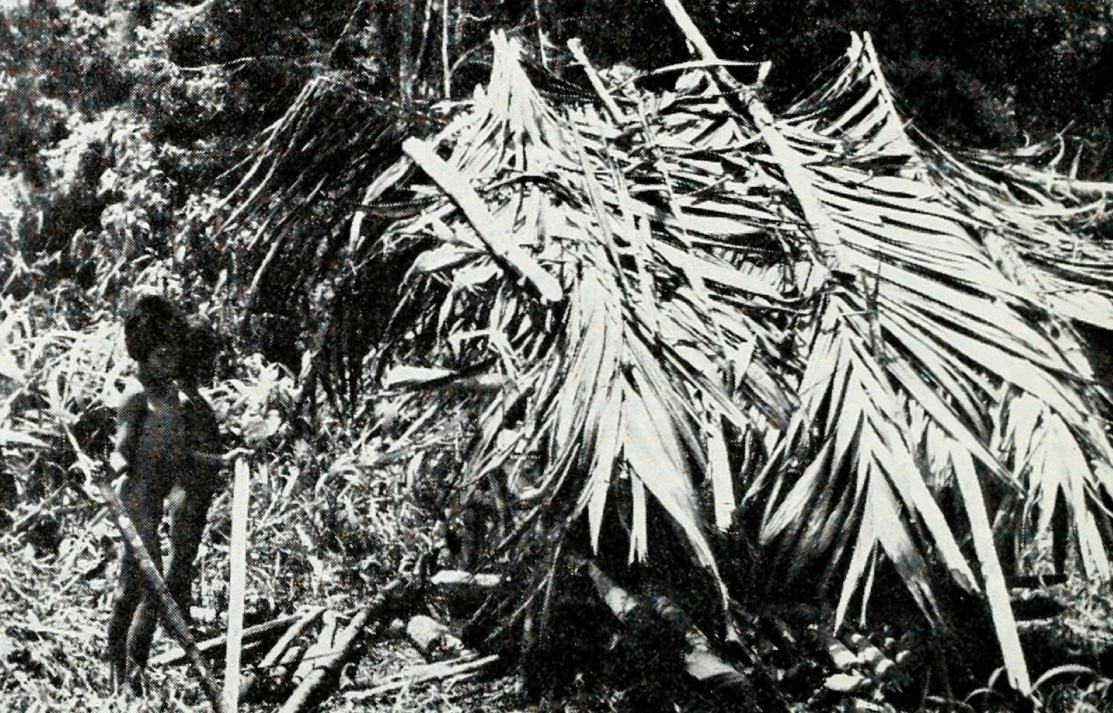
The group lived peacefully and had no knowledge of agriculture and hunting for food, running naked in their diminutive community. They were believed to be the last remnants of the Stone Age.
Worldwide interest
The story of the Tasadays caught the attention of the whole world. Many flew to the Philippines to study the ethnic group, immersing themselves to fully understand the tribe’s way of life.
The discovery was even carried as a cover story by the National Geographic. The respected magazine dedicated 32 pages of coverage on the tribe and featured a full-size image of a Tasaday kid hanging on a vine, identified as Lobo, on the cover. Veteran Associated Press photographer John Nance also wrote his firsthand experience in a book entitled “The Gentle Tasaday.”

A 1972 issue of the National Geographic featuring Tasaday boy Lobo.
Soon, the then serene community was disturbed by inquisitive foreigners, which led to the closing of its doors to the public.
Controlling the access, Elizalde decided to restrict the public around the same time Marcos declared martial law to protect the Tasadays and their home. A presidential decree was enacted in 1976 protecting the 26 members of the tribe and the 46,299-acre land from the dangers of exploitation due to rampant logging and mining as well as experts studying them.
The champion of the Tasadays even amassed at least $35 million from his initiative to raise funds for the small tribe while they were again kept from the public’s radar.
Issues
While many celebrated the discovery of the Tasadays, some smelled the stinking lies that could not be kept secret.
Critics of the administration accused Elizalde and Marcos of using the innocent tribe to cover up human rights violations, abuse of power and corruption during that dark period in Philippine history. The Tasadays were used to perfume the regime around the time of Martial Law.
Aside from concealing national issues, the two men were also accused of land grabbing.

In the 1970s, Marcos fabricated tales of the Tasaday, supposedly a Stone Age tribe living in Mindanao. The hoax fooled Filipinos and the world.
Photo by John Nance/AP
Then came the revelation.
When the country tried to climb out of the grave Marcos excavated, the truth about the Tasadays was also unearthed.
Marcos and his family fled the country after the EDSA Revolution in 1986. His long-overdue term as president got cut, and when his regime ended so was the authority of Elizalde.
The hero of the Tasadays left the country in 1983, reportedly bringing along with him the million raised for the group and funds of the Panamin Research Center.
“For 17 years I’ve been accused of having cordoned off the Tasaday reservation in order to take advantage of it for business reasons. Seventeen years have passed and I have still gotten nothing from this land, whatsoever,” Elizalde said in a 1993 documentary by Nova titled “The Lost Tribe.”
Hoax?
While Filipinos celebrated their independence, Oswald Iten, a Swiss journalist, saw the opportunity to check the life of the Tasadays and confirm their authenticity. To his surprise, the once-celebrated Stone Age community was found away from the caves, living in nipa huts and wearing casual clothes, and were into farming.
“They lived in houses, they didn’t live in caves and they told me they were in fact not a separate tribe called Tasaday. They told me it was the idea of Elizalde to make them pose as cavemen and Stone Age people in order to become famous,” Iten said in “The Lost Tribe.”
Iten’s report quoted a member of the Tasadays as saying that they were promised money and protection by Elizalde in exchange for pretending to be cavemen.

In this photo taken by the late John Nance in 1971, members of the Tasaday drive supposedly try to make fire with crude tools.
“Elizalde forced us to live in the caves so that we’d be better cavemen. Before he came, we lived in huts on the other side of the mountain and we farmed. We took off our clothes because Elizalde told us to do so and promised if we looked poor that we would get assistance. He gave us money to pose as Tasadays and promised us security from counter-insurgency and tribal fighting.”
Iten showed photos of the Tasadays wearing casual clothes to add credibility to his story.
Iten’s revelation again drew international attention, but this time for all the wrong reasons. Journalists and scientists once again scrambled to report and study the real lives of the once believed to be Stone Age people.
Without knowing the rumors of a hoax, a German group of journalists also sought to check the Tasadays a week after Iten came. The group documented how the Tasadays were back again in the caves wearing leaves as clothing and living a primitive way of life.
Another photo was presented by Iten showing Tasadays wearing leaves, but contemporary underwear could be glimpsed.
“The Tasaday was a hoax orchestrated by Elizalde,” Iten claimed.
ABC News made a follow-up story called “The Tribe That Never Was” and quoted another Tasaday about conspiring with Elizalde.
“The Tasaday told us that in exchange for posing naked and playing the Stone Age caveman routine they said they were promised food, clothing and much to our astonishment, they were promised of their own helicopter,” the producer of the story, Judith Moses, said in the same documentary.
Meanwhile, Elizalde, who came back to the country after four years, denied the accusations thrown against him.
“All these accusations are foundless. They are based on gossip rumors and deliberate lies. Now why they did this is a rather complicated story and I am ready to confront any of them… the loggers, cause oriented groups, who may have a political motivation, scientist, who perhaps, were scared to go into the mountains where we lived, because I lived in the mountains with the tribes,” he said.
Evidence
Further studies revealed that the Tasadays were not from the Stone Age based on linguistic analysis. The tribe was found to be a break off group of the nearby Manobos and Tboli, who lived separately for 150 years before they were discovered.
Experts also doubted that the Tasadays were isolated for a long time and had no knowledge of farming since they are a three-hour walk away from neighboring communities in secluded areas in Mindanao where agriculture was already introduced.
Another expert said the Tasadays could not be vegetarians as they claimed to be because they could not survive with the food they ate.

Tasadays are seen in this undated photo by Susanne Haerpfer in front of their home, the last primal rain forest of Mindanao.
Photo by Susanne Haerpfer
The claim that they lived for thousands of years inside the cave was also debunked since no human habitation was found.
On the other hand, some of the first scientists to study the ethnic group believed that the whole Tasaday story was not a hoax, insisting the group itself is real.
To settle the issue, the American Anthropological Association sought the services of Thomas Headland to preside over a symposium where journalists and scientists debated over the authenticity of the Tasadays.
Headland, who spent more than 20 years in the Philippines, edited the book “The Tasaday Controversy: Assessing the Evidence” in 1992 where all arguments were presented.
Headland concluded that the Tasadays were not performers paid to act like Stone Age people, but added that there were exaggerations to the stories.
“We know for a fact that they were originally part of the Manobo farming community, for some reason they broke off from a larger community. We know that they broke off sometime in the 19th century based on linguistic data,” Headland said.
Victims
The debates went for years until Congress, through the Committee on National Cultural Communities, declared the Tasadays to be genuine. The fame faded and the attention was gone for the simple Tasadays.
Decades later, Lobo, the kid holding on to a vine, revealed that their discovery, Elizalde’s intrusion, and the worldwide attention made their simple lives complicated.
Regardless of their origins, the Tasadays were clearly used by powerful people for their own selfish interests. — Philstar.com NewsLab

by MLC | Aug 4, 2017 | Martial Law Stories
By Mikas Matsuzawa
Source: Philstar.com NewsLab
Among the nostalgias that Martial Law evoked was the peace and order during that period. Some remember an era of discipline and argue that only those who did not abide by the law got punished. But historians and human rights victims remember an era of impunity.
Ferdinand Marcos signed Proclamation No. 1081 declaring martial law on Sept. 21, 1972. Two months earlier, the entire island of Luzon was placed under a state of calamity after being hit by Typhoon Gloring. Economic uncertainty loomed. Gas prices were rising, strikes and rallies abound and there was the double threat of rebellion by the New People’s Army and secession by the Moro Islamic Liberation Front.
The country was in crisis, according to historian and University of the Philippines Third World Studies Director Ricardo Jose.
Marcos cited the communist rebellion as the reason behind the proclamation—though it was contested that the police and Armed Forces could still quell the rebels even without it.
Martial law was established to try to restore order, and it seemed to succeed for the first couple of years.
“Well to put it properly, I was in high school during Martial Law. I was in second-year high school in 1972. It seemed peaceful for the first few years maybe the first four or five years because there was censorship going on because people were willing to give it a chance actually because it was so different from the pre-Martial Law days where you had all the rallies going on,” Jose said.
Once the martial law was in full effect, Marcos ordered the arrest of people he considered as threats—Sens. Benigno Aquino Jr., Jose Diokno, Francisco Rodrigo and Ramon Mitra Jr., and journalists Joaquin Roces, Teodoro Locsin Sr., Maximo Soliven and Amando Doronila.
The military had closed down mass media banned incoming overseas calls and stopped flights.
Photo courtesy of the Gerry Roxas Foundation.
All powers were transferred to the president, curfew was imposed and assemblies were forbidden. With the censorship, then University of the Philippines student Boni Ilagan and his companions, journalist Jose Lacaba and university professor Dolores Stephens Feria, came up with an underground publication.
“I think yun yung isa sa una naming ginawa noon. Yung kontrahin yung kondisyon na yun ng suppression ng expression at saka i-articulate yung sentiment ng tao. So we did very early during Martial Law, we did come up with an underground publication,” Ilagan said.
Such actions did not sit well with authorities. At dawn in April 1974, members of the Philippine Constabulary’s intelligence unit, then headed by former President Fidel Ramos, arrested the three and brought them to Camp Crame. Ilagan was subjected to excruciating torture and detained for over two years.
“Tuluy-tuloy ang torture. In fact, parang desensitized na kahit ‘yung mga civilian employees ng opisina. Kasi pag nakaupo kami sa isang sulok, ‘pag may dumaraan na sundalo either naka-uniform o naka-civilian at nakatingin sa amin at nalaman na kami ay detainee susuntukin kami, sisipain kami. No questions asked, parang ‘yung inaano ka dine-dehumanize ka. Sinisira ang iyong morale,” Ilagan said.
One of the torture methods he was subjected to was the “San Juanico bridge,” in which he was made to lie between two cots with his nape resting on one and his feet on the other. In this torture method, a victim is beaten if his or her body sags or falls down.
This slideshow requires JavaScript.
It wasn’t only those opposing the dictatorship who were arrested, but civilians, too.
“Nung panahon ng Martial Law, especially mga unang taon ng Martial Law, listahan lang yan e na nilalabas. Hindi siya warrant of arrest so minsan nasa listahan ka aarestuhin ka hindi mo alam kung ano ang iyong kaso,” historian Michael Charleston Chua said.
“Or minsan nakita ka lang doon sa rally, hindi ka naman talaga kasali, napadaan ka lang, puwede ka hulihin… At siyempre kapag ikaw ay ‘di nagustuhan ang mukha mo ng militar, puwede ka ng kunin lang, kasi suspendido nga ang tinatawag na writ of habeas corpus,” he added.
“Minsan nakita ka lang doon sa rally, hindi ka naman talaga kasali, napadaan ka lang, puwede ka hulihin.
The writ of habeas corpus is the legal remedy protecting citizens from unlawful arrests and indefinite detentions. Summary executions and extrajudicial killings also proliferated during the period. It was during this time that the word salvage, which originally means to save, became part of the local language to denote extralegal killings.
Lacaba, in an online thread discussing Filipino words in the Oxford English Dictionary, attributed the change in meaning to the words visual similarity to the Tagalog word salbahe which means naughty or abusive. Salbahe is derived from the Spanish word salvaje which means savage.
Chua related accounts from people who lived during the period saying there were lots of instances where bodies would be discovered in rivers. Bodies of suspected rebels would also be lined up at the plaza to scare away dissidence.
Chua said it was uncertain if the killings were done by the military or by vigilantes. He said that although not all of the killings perpetrated at that time were ordered by Marcos, a climate of fear and impunity prevailed, which emboldened some to commit summary executions as they could get away with it scot-free.
“Kaya oo totoo ‘yun na hindi lahat ito ay kagagawan ni Pangulong Marcos mismo pero nabigyan niya ng kapangyarihan yung mga nagpatupad nito na umabuso dahil walang nakulong dahil sila’y nag-tortyur,” he said.
“Matapos ang EDSA 1, marami sa mga nagtortyur na ito, dahil lang sila ay sumabit sa EDSA ay sila ay nanatili sa puwesto, hindi nanagot at naging matatas na opisyal pa ng pamahalaan.
“In fact, napo-promote pa. In fact, matapos ang EDSA 1, marami sa mga nagtortyur na ito, dahil lang sila ay sumabit sa EDSA ay sila ay nanatili sa puwesto, hindi nanagot at naging matatas na opisyal pa ng pamahalaan.”
During Martial Law, 70,000 people were imprisoned, 34,000 were tortured and 3,240 were killed, according to Amnesty International.
Martial law rule was formally ended on Jan. 17, 1981 through Proclamation No. 2045. The dictatorship, however, would go on until Feb. 25, 1986. — Philstar.com NewsLab

by MLC | Aug 4, 2017 | Martial Law Stories
By Leif Sykioco
Source: Philstar.com NewsLab
When the smoke cleared after the first People Power Revolution, four heroes emerged—Cory Aquino, Cardinal Sin, Juan Ponce Enrile and Fidel V. Ramos.
The latter two figured prominently because of their crucial role in the revolution. Enrile was the secretary of National Defense while Ramos was head of the Philippine Constabulary. Both leaders launched a coup d’etat against Ferdinand Marcos and encouraged their troops to do the same, rendering Marcos handicapped.
Enrile would then become Aquino’s Defense secretary but resigned in 1986 because Aquino lost confidence in him after instigating a coup. He then served as a senator in 1987 and was even the Senate president from 2008 to 2013.
Ramos, meanwhile, was appointed as chief of staff of the Armed Forces of the Philippines and eventually Defense secretary as well.
Lieutenant General Fidel V. Ramos and Defense Minister Juan Ponce Enrile announce defection from the Marcos administration in 1986.
Photo from Bayan Ko!/gov.ph
He ran in the 1992 presidential election, narrowly beating Miriam Defensor-Santiago. Enrile, for his part, won 23.58 percent of the vote, the lowest plurality in Philippine election history.
On Nov. 8, 2016, the Supreme Court rejected petitions to stop the burial of Ferdinand Marcos. Fourteen justices voted for a 9-5 decision.
The Supreme Court said President Rodrigo Duterte has the power to decide on the use of land within public domain and that Marcos was a former commander-in-chief, former soldier and former secretary of National Defense.
They also said the late dictator has not been convicted by any final judgment and that all cases were civil in nature.
Ten days later, the remains of Marcos were buried at the Libingan ng mga Bayani in a “private and intimate” ceremony. This sparked opposition from victims of atrocities during Martial Law, and Ramos urged the Marcoses to admit wrongdoing and apologize to the victims.
Finger pointing
Ilocos Norte Gov. Imee Marcos said they would not admit anything, arguing that they were still children when the atrocities were committed and did not know of such.
“In my heart, if in any way you have hurt someone, you should say sorry even if it’s not intentional, even if it was not policy. Okay lang naman sa’kin, pero yung admission of guilt… Unang-una, ang liit-liit ko noon. Paano ko ia-admit, hindi ko naman alam?” she told ANC’s “Headstart” in November last year.
She went as far to say it should be Ramos who should apologize and admit his faults since he has direct command with the Philippine Constabulary.
“Kami ay nag-aaral pa noon at mga bata pa. Bakit nga ba hindi natin tanungin ang dating Philippine Constabulary chief Fidel Ramos tungkol sa mga pag-aresto at mga pang-aabuso diumano?”
But at a separate press conference, Ramos said it’s impossible Imee did not have an idea since she is a year older than his daughter.
“I know how old she is because she’s one year older than my oldest daughter. My oldest daughter at that time, looking at the beginning of martial law, was already 18 years old,” he said.

No longer a child: Imee Marcos (right) share a light moment with her father, Ferdinand Marcos, and sister Irene (left), who is wearing a Kabataang Barangay T-shirt in the 1970s.
Photo from the Presidential Museum and Library
“So was she a little baby at that time or a little musmusin, or a little teenager? Of course not, she was a responsible person.”
Imee was born on Nov. 12, 1955.
On August 31, 1977, she attended an open forum as National Chairman of the Kabataang Barangay. A 21-year-old student from Mapua Institute of Technology, Archimedes Trajano, questioned her appointment to the post.
Trajano was dragged out of the venue by Imee’s bodyguards and went missing. His body was found severely beaten.
Imee was 21 years old that time.
Fourteen years later, Imee would admit to a court in Hawaii that Trajano was tortured by his bodyguards with her knowledge, but argued she can’t be convicted because the court does not have jurisdiction in the Philippines.
Ask the ‘heroes’
“Si Marcos ba ang nagtuturo? Siya bang naglilista ng mga aarestuhin or sila ang naglilista at pinipirmahan lang ni Marcos kung kailangan ang pirma niya?”
— Francisco Tatad, Marcos’ press secretary
Imee’s resort to blaming Ramos is not a first. Former Cyprus and Greece ambassador and Manila Times columnist Rigoberto Tiglao said Ramos and Enrile should be held accountable for the atrocities during Martial Law.
“Was there a policy of the Marcos regime to systematically kill the opposition and torture them? Or were the human rights abuses exceptional cases, aberrations, similar to cases of police brutality?” he said.
He said that he and his wife were arrested and incarcerated for two years and that the arrest orders were issued by Ramos.
Francisco Tatad, Marcos’ press secretary also said Ramos and Enrile should tell everything that transpired during that time.
“Si Marcos ba ang nagtuturo? Siya bang naglilista ng mga aarestuhin or sila ang naglilista at pinipirmahan lang ni Marcos kung kailangan ang pirma niya?” Tatad was quoted as saying.
Ramos, for his part, said he has atoned for his role during Martial Law by leading the coup that stirred the people’s revolt in 1986.
Command responsibility
Under superior responsibility, the commander is responsible for the acts committed by his subordinates. The doctrine also covers the responsibility of omission.
Japanese General Tomoyuki Yamashita was charged when his troops who invaded the Philippines during World War II engaged in atrocities. He was charged with “unlawfully disregarding and failing to discharge his duty as a commander to control the acts of members of his command by permitting them to commit war crimes.”
Both Enrile and Ramos were reporting to Marcos, who was the chief commander of the military albeit as a civilian.
In 1996, the United States 9th Circuit Court of Appeals upheld a verdict by a Hawaii court which found Marcos responsible for human rights abuses, torture, murder and “disappearances of fellow Filipinos,” a report from the Los Angeles Times noted.
The appeals court charged Marcos for military “command responsibility,” saying the principle is applicable to peacetime by agents of a political leader.
Lawyer Robert Swift, who led the class suit against Marcos, argued that command responsibility should similarly be applied during times of peace, as the goal of the international law is to “protect civilian populations and prisoners from brutality.”

Juan Ponce Enrile endorses Ferdinand “Bongbong” Marcos Jr. for vice president in October 2015.
Photo by STAR/Geremy Pintolo
Former University of the Philippines Mass Communications Dean Rolando Tolentino said the top figures of Martial Law must face the proper sanction should they be found guilty.
“Sila mismo naglabas na ng sarili nilang revisionist interpretation of that history of Marcos dictatorship,” he said.
“Scot-free pa rin ang mga figures na ito na when in fact dapat nakakulong. Well in fact dapat hindi nakakatakbo katulad ng napakarami na nangyari sa ibang bansa na (na-ban) from holding government positions noong nakitang may accountability sa mga dictatorships.” — Philstar.com NewsLab
by MLC | Aug 4, 2017 | Martial Law Stories
By Jonathan de Santos
Source: Philstar.com NewsLab
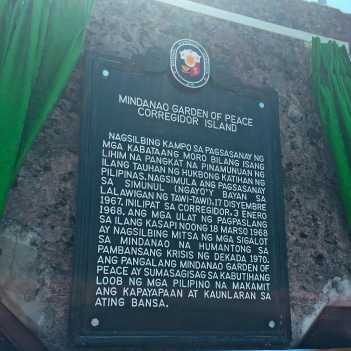
In a part of Corregidor Island in Manila Bay is the Mindanao Garden of Peace, a memorial to the “Jabidah” massacre, an atrocity that some argue did not happen at all.
A marker in the garden identifies the island as a site where a contingent of Moro youth was trained by elements of the Armed Forces the Philippines in 1968.
What happened in March—the supposed deaths of at least 28 recruits—has been described as a historical injustice by Moro advocacy groups and as a hoax by, for example, Marcos loyalist and failed KBL senatorial candidate Larry Gadon.
“In our minds and hearts, there is no question that it happened and that it is true. In our history, there is no question about its rightful place in the long narrative of our struggle for self-determination,” Autonomous Region in Muslim Mindanao Regional Gov. Mujiv Hataman said in a commemoration of Jabidah in 2016.

He said the killings, which have been dismissed by some as part of a political ploy to discredit the Marcos administration, left “a mark akin to a wound that has never fully healed as its scab is picked over and over again with every other act of injustice committed against our people.”
What is beyond debate, however, is that the massacre led to fighting in Mindanao that was used partially to justify the declaration of martial law in 1972 and had already taken at least 120,000 lives 20 years later.
“The so-called Jabidah massacre had a galvanizing effect on the Muslim student community in Manila,” Thomas McKenna wrote in “Muslim Rulers and Rebels: Everyday Politics and Armed Separatism in the Southern Philippines”—the primary source for an Official Gazette timeline article on the massacre.
“Throughout the year, Muslim students protested against the Jabidah killings. The Jabidah protests transformed one campus activist in particular into a Muslim separatist,” McKenna wrote of Nur Misuari, a Tausug scholar, and activist who would become the founding chairman of the Moro Nationalist Liberation Front.
President Rodrigo Duterte, who considers Misuari a friend, has himself said that the conflict in Mindanao is rooted in Moro nationalism. Less acknowledged is how those roots were watered by blood spilled while the father of Duterte’s political ally, former Sen. Ferdinand “Bongbong” Marcos Jr., was president.
“Less acknowledged is how the roots of the Mindanao conflict were watered by blood spilled while Ferdinand Marcos was president.
In an editorial issued months before the remains of ousted dictator Ferdinand Marcos were hastily interred at the Libingan ng mga Bayani in Taguig, the MILF, expressed the rebel group’s objection to it.
“In fact, the Moros suffered the most numbers of killed or victims during the height of Martial Law, in particular, those victims of massacres. This is not to include the thousands upon thousands of hectares of Moro and other indigenous peoples’ ancestral lands in Mindanao given to migrants or outsiders,” the Luwaran.net editorial said.
But Jabidah was just one of the events that contributed to the rise of the Muslim separatist movement in Mindanao, writes Temario Rivera in “The Moro Reader: History and Contemporary Struggles of the Bangsamoro People.” In response to the massacre, Datu Udtog Matalam, governor of Cotabato province, founded the Muslim Independence Movement.
That movement gained traction after mass killings of Muslims between 1971 and 1972 in central Mindanao that were perpetrated by paramilitary groups and “provoked by escalating ethnic, economic and political tensions between Christian and Muslim communities.”
Among those groups was the Ilaga militia group, which has been implicated in at least 20 massacres and atrocities in Mindanao.
Malisbong and Tictapul
Beyond books and dry historical accounts, Laisa Masuhud Alamia, a human rights lawyer and executive secretary of the ARMM government, narrated her childhood in Tictapul in Zamboanga City.
“It was my first playground, with a river running through it. I remember looking out our window and saw coconut trees that seemed to go all the way up the sky. It was magical! I remember my brothers on a small boat rowing down the river, happily jumping into its depths. We lived a simple life then,” she said in a personal Facebook post that Philstar.com was allowed to quote.
“More than 400 men, women, and children were massacred there in 1977,” she said.
“Martial law reminds me of my mother. They looted her house, store, and bodega of copra, rice and sugar before they burned everything down. Some of our relatives and workers survived. Others weren’t so lucky. Among those dead was a Christian cousin of mine. Muslims, Christians, even the carabaos, and cows were not spared, survivors said.”
Alamia and her mother were spared because they were away when the killings happened, but the incident nevertheless left a mark.
“Martial law reminds me of the light that was in my mother’s eyes, the smile on her lips, her natural joie de vivre— all gone. She didn’t really die in 2002 when she finally left us. She died on the day she learned of the massacre in Tictapul back in 1977.
“No, don’t talk to me about how it was better during the time of Marcos. Don’t talk to me about apologies and non-apologies. Don’t talk to me about forgetting these and moving on. Indeed, some of us survived martial law and rebuilt our lives after the massacres in Tictapul and other areas in the country. But to this day, justice has not been served. No amount of compensation or apology would make up for what was lost. — Laisa Masuhud Alamia
Amir Mawalil of the Young Moro Professionals Network and new Office on Bangsamoro Youth Affairs chief wrote in September 2016 about the military “pacification” operations in 1974 in Malisbong, in what is now Sultan Kudarat.
“‘Pacification’ during the Martial Law years meant that the men of the village were to be forcibly sent to the village mosque, while women and children were dragged for interrogation to warships docked nearby… Pacification then for the people of Malisbong was a euphemism for mass murder,” Mawalil said of the incident where 1,500 people died.
On Sept. 24, 1974, close to 300 houses were burned in Malisbong, and boys as young as 11 were rounded up and sent to the Tacbil mosque with men as old as 70. They were shot at point-blank range.
Women, “girls and grandmothers alike,” were raped, Mawalil wrote.
“The rape of women and mass murder of men, and the destruction of property in Malisbong were, without question, sponsored by the state. It was an act of violence against the people of Malisbong under the auspices of then President Ferdinand Marcos,” he said.
“Our elders passed on their account of history to us so we can learn from it, and our history is replete with stories of how Martial Law has changed the lives of our people,” the YMPN said in a statement after the Marcos burial. “To deny that these atrocities happened and to forget the suffering it has caused is to betray our history as people who fought for freedom from the dark days of dictatorship.”
“To deny that these atrocities happened and to forget the suffering it has caused is to betray our history as people who fought for freedom from the dark days of dictatorship.
While the government in Manila has decided that this year’s celebration of the 1986 People Power Revolution, which toppled Marcos from power, will focus on “moving forward” instead of being “stuck in the past,” that will be a more difficult for the Bangsamoro to do.
Guiamel Alim, chairman of the Consortium of Bangsamoro Civil Society and who works with the Transitional Justice and Reconciliation Commission, said the Moros have yet to move on from the massacres and displacements in the 1970s.
“No reparation, no justice, no institutional reform and structural changes. Simply said, the Bangsamoro has not recovered from these war atrocities,” he said.
“They still remember how their relatives were massacred, their women raped and the ultimate result of social disintegration. No justice served to the victims of the Martial law. Only when transitional justice will make the Bangsamoro feel lighthearted after what happened in the 1970s,” he also said in an email to Philstar.com.
Among those overtures for transitional justice was the dedication of the Mindanao Garden of Peace in 2015, but a bigger step is the anticipated passage of the Bangsamoro Basic Law and the creation of a new political entity that will have more autonomy than the ARMM and that will remain a part of the Republic of the Philippines.
“Marcos’ legacy to the Bangsamoro was the deteriorating peace and order situation that the Moro are still experiencing until now,” the CBCS said in a separate email.
That includes poverty in Moro areas and ancestral land lost to land-grabbing.
“Now, the Moro have become alien in their own land, denied the justice for all the wrongs brought to them,” it also said.
“Lastly,” the CBCS said, “martial law planted hatred in the hearts of the Bangsamoro and the idea that guns, rather than the state, are what’s needed for protection.” — Philstar.com
by MLC | Aug 4, 2017 | Martial Law Stories
By Mikas Matsuzawa
Source: Philstar.com NewsLab
In one of his war stories, Ferdinand Marcos claimed that he had heroically defended the junction of Salian River and Abo-Abo River in Bataan for five days from January 22 to 26, 1942.
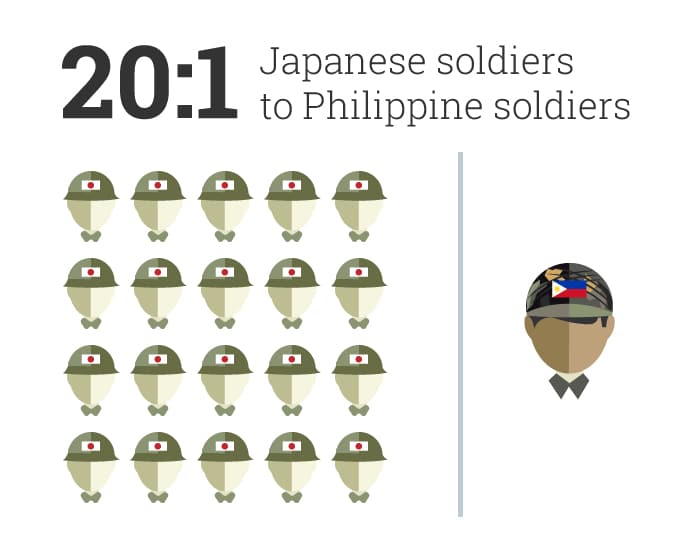
He only had a hundred fighting men in the suicidal action against 2,000 highly-trained and well-equipped Japanese troops.
His action has allegedly delayed the fall of Bataan… or so the story goes.
Military and diplomatic history expert Ricardo Jose, however, casted doubts on this story.
By sheer numbers, Jose argued that a hundred troops successfully blocking 2,000 is physically impossible. He added that Marcos was an assistant intelligence officer and not an infantry soldier who engages in combat.
Sixteen years after the supposed incident, Marcos—then a congressman—received a Medal of Valor for his claimed heroism. The citation was one of the arguments the Solicitor General presented to the Supreme Court in September 2016 to argue that Marcos deserves to be buried at the Heroes’ Cemetery.
Sixteen years after the supposed incident, Marcos—then a congressman—received a Medal of Valor for his claimed heroism. The citation was one of the arguments the Solicitor General presented to the Supreme Court in September 2016 to argue that Marcos deserves to be buried at the Heroes’ Cemetery.
http://www.dailymotion.com/9c0b95d9-5603-4c4c-ad86-d5669748aaa2
Battle of films and books
“If you look at the world conditions at that time, karamihan ng world leaders at that time were war heroes… So parang ganun yung idea na in order to become a more effective political leader kailangan World War 2 hero ka din.
Marcos’ supposed heroism was decisive in his rise to power. He won the presidency in 1965 against incumbent President Diosdado Macapagal and was reelected in 1969.
“If you look at the world conditions at that time, karamihan ng world leaders at that time were war heroes. Sa US Eisenhower, siya ‘yung top US general sa Europe, 1960s si Kennedy was president of the US war hero din siya sa South Pacific, sa Europe si Charles de Gaulle, sa France war hero yun,” Jose explained.
“So parang ganun yung idea na in order to become a more effective political leader kailangan World War 2 hero ka din.”
The 1965 election was a battle of books and films. Marcos used his commissioned biography “For Every Tear a Victory” by American writer Hartzell Spence. Macapagal released “Macapagal the Incorruptible” written by Quentin Reynolds, an American, and Geoffrey Bocca, a British.
The biopic “Iginuhit ng Tadhana” depicted Marcos as a war hero. Meanwhile, “Daigdig ng Mga Api” portrayed Macapagal as a savior from poverty.
In the 1969 presidential elections, then Sen. Sergio Osmeña accused Marcos of being the “most corrupt in Philippine history.” Marcos retaliated by raising that Osmeña collaborated with the Japanese during the war by doing business with them.
The fabulist Mr. Marcos
Stories in “For Every Tear a Victory” became the basis of “what journalists wrote and American officials believed” about Marcos, New York Times veteran journalist Raymond Bonner wrote in his 1987 book “Waltzing with a Dictator: The Marcoses and the Making of American Policy.”
Bonner noted that Marcos “could tell the most brazen lie with the straightest of faces, then continue telling it until it became accepted as fact.”
Spence’s biography was reissued in 1969 under the title “Marcos of the Philippines: A Biography.”
Marcos “could tell the most brazen lie with the straightest of faces, then continue telling it until it became accepted as fact.” – Raymond Bonner, author of “Waltzing with a Dictator”
For years, his war tales were largely uncontested.
But in November 1982, World War 2 veteran Bonifacio Gillego wrote a series of articles which debunked the late dictator’s feats.
The series published on WE Forum resulted in the jailing of the paper’s publisher-editor, the late Jose Burgos, and fourteen of his staff for subversion and rebellion.
Gillego found that out of Marcos’ 33 medals and awards, only two were given during World War 2. One was the Gold Cross and the other the Distinguished Service Star. Both were given in 1945 and both contested by Marcos’ superiors.
The gold cross was awarded to Marcos, supposedly a colonel of the 14th Infantry of the United States Armed Forces in the Philippines-North Luzon then, for “gallantry in action at Kiangan, Mt. Province, in April 1945.” Marcos allegedly spotted camouflaged enemy trucks a mile away and by himself ambushed them. The Japanese allegedly fled after a 30-minute firefight.
The Distinguished Service Star, meanwhile, was for his outstanding achievement as a leader of the 8,200-strong guerilla group Ang Manga Maharlika. The citation read:
“For outstanding achievement as a guerrilla leader. After escaping from the Fort Santiago Kempei Tai, Marcos supported ex-Mayor Vicente Umali, organizer and commanding general of the PQOG (President Quezon’s Own Guerilla)… Despite his illness, he stayed at the headquarters in Banahaw to guide both the staff and combat echelons. He refused the rank of ‘general’ offered him by General Umali and organized his own guerrilla group known as the Maharlika.”
Marcos’ regimental commander, Col. Romulo Manriquez, in an interview with Gillego said the former was an S-5 who handles civil affairs and was never assigned to patrol or combat. Not to mention that geographically, it was impossible to spot Japanese trucks a mile away from the regimental command post as the nearest road was half a day’s hike away.
It was also found that Marcos was not a colonel but a lower rank of captain. And he was never recommended for any decoration by his 14th Infantry adjutant, Capt. Vicente Rivera.
As for Ang Manga Maharlika, repeated investigation by the US Army found that the guerrilla group was, according to its judgment, nonexistent. The now-declassified File No. 60 detailed Marcos’ quest for official recognition of the guerrilla group Ang Manga Maharlika, which he later changed into Ang Mga Maharlika. Recognition by the US Army as a guerilla meant getting back pay, and the longer the service the bigger the remuneration.
The US Army denied the recognition of the guerilla group on June 7, 1947 citing reasons such as:
- The lack of sufficient acceptable evidence to prove their record of service. Adequate records were not maintained and a definite organization was not established.
- The unit did not devote entire efforts in fighting Japanese forces in the field and did not contribute materially to the eventual defeat of the enemy. In fact, the probe found that “[m]any members apparently lived at home, supporting their families by means of farming or other civilian pursuits and assisted the guerrilla unit on a part-time basis only.”
- Impossibility that its claimed strength and sphere of operations were true given terrain problems, limitation of communication facilities and the degree of Japanese anti-resistance activities.
Marcos protested the decision in an angry cablegram. Capt. Elbert Curtis responded with a strongly worded rebuttal. His conclusion was:
- Ang Mga Maharlica Unit under the alleged command of Ferdinand Marcos is fraudulent.
- The insertion of his name on a roster other than the USAFIP, NL roster was a malicious act.
In an earlier response, Curtis also wrote: “It is also known that Marcos has enough political prestige to bring pressure to bear where it is needed for his own personal benefit.”
He cited an account attested to by American guerilla leader Robert Lapham detailing how Marcos was placed under arrest by former Army captain Ray Hunt Jr. for collecting money under false pretense. Gen. Manuel Roxas intervened on his behalf and had him released.
Ferdinand Marcos was in San Quintin, Pangasinan, two or three months prior to the landing of the American forces, soliciting funds and guerilla help to construct a landing field in the vicinity. The purpose of the landing field was to allow a plane to come in and evacuate General Roxas. Capt. Ray C. Hunt, commanding officer of PMD, LGAF placed Marcos under arrest for collecting money under false pretense. Gen. Roxas intervened on Marcos’ behalf and had him released to his custody.

Second page of Capt. Elbert Curtis’ check sheet on the radiogram protest by Marcos.
Photo from NCHP’s report
The final and irrevocable refusal on the claim was issued on March 31, 1948.
The claims of 111 men listed on the Maharlika roster, however, was recognized for their “aid during the liberation of the Philippines.” But a Jan. 23, 1986 article of The New York Times said there were conflicting statements in the Army records on “whether the United States intended to recognize the 111 men as individuals or as a Maharlika unit attached to American forces after the invasion.”
The same article also cited a Philippine Army document stating that several men listed as Maharlika members sold and purchased steel cable—an important wartime commodity—to enemy forces.
Lapham in a May 31, 1945 communication said that 24 men led by Marcos who identified themselves as Maharlika were “employed by [his] organization to guard the Regimental Supply Dump and perform warehousing details.” He, however, did not recommend them for recognition “because of the limited military value of their duties.”
“It is also known that Marcos has enough political prestige to bring pressure to bear where it is needed for his own personal benefit.
Hunt, who during the war directed guerilla activities in Pangasinan, where a Maharlika unit purportedly operated, was quoted by New York Times countering Marcos’s claims. He said Marcos never led a large guerrilla organization.
“Nothing like that could have happened without my knowledge.”
Although the Army documents did not successfully refute Marcos’ claim to leadership of a parent organization known as Maharlika—under which a special intelligence unit officially recognized by the US military operated—the story behind the guerilla group is clouded by doubts and counterclaims, Time correspondent Sandra Burton said in her 1989 book “Impossible Dream: The Marcoses, the Aquinos, and the Unfinished Revolution.”
She noted that an affidavit by Narciso Ramos, father of former President Fidel Ramos, offered an explanation on why Marcos failed to get accreditation for the parent organization. The explanation offered a different perspective on Marcos’ imprisonment from Lapham’s.
The senior Ramos was wartime chief of the special intelligence section of Maharlika. According to his account, Marcos had failed to meet the American filing deadline for a roster of members of the parent organization, because he was thrown in the brig by an American captain acting on information fed to him by “unsympathetic” rival guerrilla groups. Lacking that central roster, US military authorities granted sole accreditation to the Maharlika intelligence branch, on the basis of a more limited membership roster submitted by Ramos, who was acting as commanding officer in Marcos’ absence.
Burton said exaggeration and fabrication were so commonplace that over one million Filipinos claimed guerilla status after the war even though the US estimated that only 250,000 actually fought the Japanese.
Stolen valor
It was also questioned why virtually all of Marcos’ medals were awarded long after the war.
Eleven medals were given in 1963, when Marcos was Senate President, according to Gillego. Of these, 10 were awarded on the same day on December 20.
He added that eight of Marcos’ “American and Philippine medals” were campaign ribbons given to all who participated in the defense of Bataan and the resistance against Japanese. One of the awards was received by Marcos on Sept. 17, 1972, his 55th birthday.
He also noted that some medal citations were for the same event.

Ferdinand Marcos claimed to be the most decorated World War 2 hero. Photo from Imelda Marcos official website.
Marcos presented affidavits in 1962 from already dead witnesses attesting to his war exploits, Primitivo Mijares wrote in his 1975 book “The Conjugal Dictatorship of Ferdinand and Imelda Marcos” citing official statements in preserved journals of the Congress.
The medals were awarded the same year by the newly installed Liberal Party administration. Then Secretary of Defense Macario Peralta Jr. said he approved the requests for medals in exchange for Marcos’ pledge that he would not run against Macapagal in 1965.
Mijares, who served as Marcos’ chief propagandist, would later disappear never to be found again after the publication of his tell-all book on the excesses of the first couple and their cronies.
“The credit was taken from him. Kaya mayroong tampo ang pamilya as far as the Marcoses are concerned… They basked in the glory of someone else’s credit.
Gillego also debunked Marcos’ claim of being the hero of Bessang Pass, the battle that led to the surrender of General Tomoyuki Yamashita.
A passage from “Marcos of the Philippines” narrated how he single-handedly defeated 50 enemy soldiers in defending Bessang Pass. It read:
“On April 5 [1945] Ferdinand won his second Silver Star. He was at a command post …. in Kiangan …. still defending Bessang Pass…. What he discovered was a well-camouflaged infiltration by fifty Japanese….
Sending his man back to alarm headquarters, Marcos stood alone between the attack force and its goal, a Thompson sub-machine gun under his arm. But now the element of surprise was with him…. the enemy… did not see Ferdinand at all. At a point-blank fifty yards, he began to shoot, killing the commanding officer with the first burst. Disorganized, the detachment regrouped and attacked, but Marcos repulsed it. For half an hour the skirmish continued, with grenades and automatic-rifle fire…. Still unsupported, Major Marcos counterattacked. He had pursued the Japanese nearly two kilometers down the trail before reinforcements reached him.”
Gillego said that the late dictator was never mentioned as a participant in many first-hand accounts of the battle that lasted between January 9 and June 15 in 1945.
Manuel Rigor, the son of Colonel Conrado Rigor Sr., one of the heroes of Bessang Pass, also discounted Marcos’ participation in the historic battle, in an interview with ABS-CBN News.
Conrado, then a major and commander of the 3rd Battalion of the 121st Infantry, was handed Yamashita’s Rising Sun flag after the surrender.
“The credit was taken from him. Kaya mayroong tampo ang pamilya as far as the Marcoses are concerned… They basked in the glory of someone else’s credit,” Manuel said.
He said there was no proof that Marcos was even at Bessang Pass in Ilocos Sur, based on accounts from his father and those who fought with him.
In a study released by the National Historical Commission of the Philippines (NHCP) on Independence Day last year, it said that Marcos lied about receiving three of his US medals: the Distinguished Service Cross, Silver Star and Order of the Purple Heart.
Marcos’ fabricated heroism was one of the reasons the state agency on the preservation of Philippine history disputed his burial at the Libingan ng mga Bayani.
A doubtful record, it argued, does not serve as a sound basis of historical recognition, let alone burial in a space for heroes.
“The rule in history is that when a claim is disproven—such as Mr. Marcos’s claims about his medals, rank, and guerrilla unit—it is simply dismissed,” NHCP said. — Philstar.com NewsLab
