by MLC | Aug 4, 2017 | Martial Law Stories
By Audrey Morallo
Source: Philstar.com NewsLab
One of the most persistent myths about the dictatorship of Ferdinand Marcos was on the flourishing and vibrancy of democracy during his time. Some even claim that democracy was at its peak when he was president.
This myth, however, misses reality by miles.
From employing vicious terrorism and violence during elections to the militarization and “Ilocanization” of the bureaucracy, the record of the dictator could be described as anything but democratic.
Ferdinand Marcos always believed himself to be a man of destiny, a heroic figure who would save the Philippines from the morass of poverty, conflict, and violence it was mired with.
In his book “Dead Aim: How Marcos Ambushed Philippine Democracy,” Conrado de Quiros said Marcos combined personal ambition with national interest and the divine to give his actions—in his mind—a sense of obligation and inexorability.
Although he believed himself to be a heroic figure, he still displayed a propensity to embellish things, which could be partly explained by his need to be seen as head and shoulders above everyone else.
However, even if Marcos had great faith in his destiny as the “liberator” of the Philippines from the stasis it experienced in its post-war politics, he still believed in giving destiny a hand, and this was where his assault on the country’s democracy was at its most pernicious.
Election of ‘guns, goons, and gold’
According to De Quiros, Ferdinand Marcos employed during his time the infamous three Gs: “Guns, Goons, and Gold.”
In 1969, for instance, Marcos defeated Sergio Osmena Jr. by employing vote-buying, terrorism and ballot snatching. Marcos used the “pork barrel” in his presidential bid that year, setting a new precedent in patronage politics. In Cebu alone, he spent P24 million in pork on top of the P1 billion he expended to get reelected.
In “Dead Aim,” Sen. Benigno Aquino said that for every P1 that Osmena spent, Marcos spent P100. Because of this heavy campaign spending, the peso crashed to nearly P4 to in February 1970 from P2 to before the November 1969 polls.
Among the most brazen electoral terrorism was done by the Philippine Constabulary. In Batanes, its officers, paramilitary groups, and hoodlums took over the entire island and allowed thugs in Suzuki motorcycles to terrorize voters and Comelec officials and beat up opposition leaders.
All these led Time and Newsweek to call the 1969 election the “dirtiest, most violent and most corrupt” in Philippine modern history.
“All these led Time and Newsweek to call the 1969 election the ‘dirtiest, most violent and most corrupt’ in Philippine modern history.
Another case of brutal electoral violence the country witnessed was the bombing of the miting de avance of the Liberal Party on Aug. 21, 1971.
The Liberal Party was the main opposition party to the rule of Marcos. Before the 1971 elections, the Liberals faced years of electoral abyss. In 1965, they lost not only the presidency but also the Senate. That year, only two Liberals of the eight voted during that election cycle won—Sergio Osmeña Jr. and Jovito Salango, who topped that race.
The 1967 polls proved even worse for the LP. Only one Liberal managed to make it to the Senate that year, and his name was Benigno “Ninoy” Aquino Jr. He was almost booted out of the Senate because of allegations of being underage, but fortunately for him, he had a good lawyer by his side, Jovito Salonga who lost no time to prove why he once topped the bar examination, according to De Quiros.
The fortunes of the LP did not change in 1969. Their candidate for the presidency, Osmeña Jr., lost, and Marcos became the first president to get reelected after the Great War. That cycle, only two Liberals managed to get to the Senate.
The direction of the wind, however, began to change in 1971. De Quiros said that the Liberals could already feel the presidency, and the 1971 elections were a prelude to their impending victory in 1973. On the night of Aug. 21, 1971, the Liberals prepared to start their journey back to Malacañang.
Their miting de avance at Plaza Miranda was meant to be a show of force both by local and national candidates. The candidates condemned to high heavens the abuses and excesses of Marcos. Everybody was in high spirits, and they thought that their political rally that night was the start of a political comeback that would end with an electoral bang.
This slideshow requires JavaScript.
Little did they know that a literal explosion would rip through Plaza Miranda.
That night, nine people were murdered and almost a hundred hurt. All the LP senatorial bets, except Aquino, were hurt. Osmeña was pronounced to be in critical condition while Salonga’s body was peppered with more than 100 pieces of metal.
The injured, the widowed, the media, the Catholic Church and other victims of the bombing had one person in mind on who perpetrated the bombing: Ferdinand Marcos.
Legal veneer for martial law
Probably because of his legal background, Marcos had to give his actions a facade of legality. Some would say that this was even his propensity. Rigged referendums and elections were his main tools to achieve this.
Marcos engineered the ratification of the 1973 Constitution by using his appointed village chairmen to report that the people approved the new charter by raising their hands. Television footage showed people raising their hands in affirmation, but this was because they were asked who among them would like to have a regular ration of rice.
Before the 1973 referendum, Malacañang tried to bribe delegates to the 1970 Constitution Convention, as exposed by Eduardo Quintero, a delegate from Leyte.
The dictatorship conducted another referendum in 1977 and elections for the Interim Batasang Pambansa in 1978 to show that he had the mandate from the people. In all these, Marcos got the votes, and in one instance got a statistically improbable 99 percent.
He also assaulted the Supreme Court using carrot and stick methods. Marcos was able to force the high court to uphold his rule (even to the extent of forging the opinion of one justice) and the constitutionality of Martial Law in Aquino vs. Enrile, according to Rigoberto Tiglao in a chapter that he wrote in the book “Dictatorship and Revolution.”
Militarization for ‘peace and order’
The military was the locus of power during Martial Law. It was the keeper of “peace” and “order.” To concentrate power, Marcos harnessed the military to the utmost.
To achieve this, the dictator showered the military with blessings. Even before he became president, he was already a champion of the military by fighting for the Armed Forces budget and campaigning for the promotion of his favorite officers in Congress.
Upon becoming president, he increased the Armed Forces of the Philippines’ (AFP) budget. During Martial Law, it ballooned to P4 billion in 1976 from P880 million in 1972, based on Tiglao’s monograph. Troop size also increased from 60,000 in 1972 to 250,000 in 1975.
As a demonstration of how central the military is in his rule, Marcos utilized the military for functions formerly reserved for the civilian bureaucracy such as doing community work. This brought them in contact with politicians and gave them the chance to see they had the potential, even moral obligation, to run the country in the face of inefficiencies of the civilian government.
“The reign of terror of the military during the Marcos regime was so widespread and systematic that international and human rights watchdogs such as Amnesty International lost no time criticizing the abuses in the Philippines.
The military’s main function in the Marcos government, however, was in nipping through violence dissent and actions that could threaten the dictatorship, and most of the most ruthless violence transpired in the countryside. The special and paramilitary forces raised their scale of political violence in the provinces, literally turning the AFP into Marcos’ private army. He also allowed the private armies of his supporters such as the Crisologos of the North and the Duranos of Cebu to operate.
The reign of terror of the military during the Marcos regime was so widespread and systematic that international and human rights watchdogs such as Amnesty International lost no time criticizing the abuses in the Philippines. The military generated havoc in communities suspected of being communist infiltrated even without evidence. Many abuses were committed by paramilitary groups in the name of national security.
This slideshow requires JavaScript.
In extreme cases, whole families such as the Hilao family were the subject of abuse and brutality. Seven members of the family were arrested and detained, including a seven-year-old child. Winifredo was severely tortured, and Liliosa was raped, tortured and murdered after Martial Law was declared.
Aside from his support, Marcos instilled loyalty and kinship with the soldiers by making it appear that he was one of them through his questionable medals. In the case of generals and military officers he could not rely on, Marcos retired them or sent them abroad for ambassadorships as in the case of Manuel Yan, who became the envoy in Thailand after his military stint.
‘Ilocanization’ of government

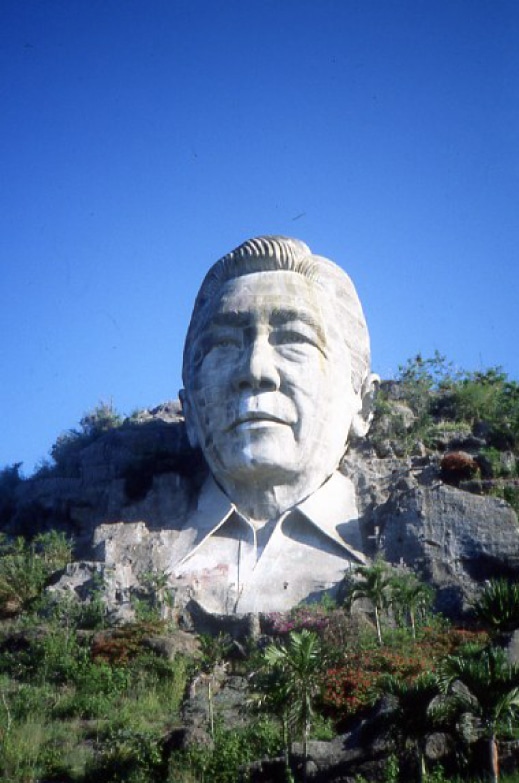
A bust of Ferdinand Marcos near Baguio as seen in 1989. It was partially destroyed in 2002.
Tiglao wrote that 18 out of the 22 generals of the Philippine Constabulary were from the Ilocos region. The Metropolitan Command (Metrocom), the first infantry in Fort Magsaysay and Task Force Lawin were also heavily Ilocano. In addition, a vast intelligence network was placed under the command of Gen. Fabian Ver, a known loyal Marcos relative.
The “Ilocanization” of the military was symptomatic of the preponderance of Ilocano politicians, or Northern politicians as Marcos called them, in his government. This enabled Marcos to have individuals who were blindly loyal to him to man the military. This precluded dissenting voices and ideas from emerging. More importantly, this enabled Marcos to consolidate his grasp of the Armed Forces.
Marcos filled government posts with Ilocanos whom he had known since the days when he built his network of allies from his hometown. He preferred his province mates over other individuals for a simple reason: The Ilocanos were fiercely loyal to him.
De Quiros explained that in Ilocos there was this strong patron-client relationship or the very concept of family. In this setup, Marcos provided for the region but in return demanded fealty from it. Any “errant” subordinate was cut down to size, usually in public.
Debt-driven growth and support of the elite
Tiglao said the Marcos regime took advantage of the country’s “credit-worthiness” arising from its balance-of-trade, the difference between a country’s imports and exports. The government heavily borrowed partly to finance infrastructure projects that would provide artificial stimulus to the country and the growth of the Philippine ruling class that would be absolutely loyal to him- — — his “cronies.”
The infrastructure spending enabled the Marcos regime to build up a semblance of prosperity and peace to court the support of the middle and upper classes. The seeming efficiency of the dictatorship in its first few years also led the elite to support it. Strikes were banned, which proved beneficial for the upper class, and the “climate of anarchy” that pervaded in the early 70s was quickly extinguished, at least on the surface.
The first few years of Martial Law proved economically beneficial for the elite, which led them to support martial rule. According to Tiglao, the profits of the country’s top 1,000 corporations jumped from P1.3 billion in 1972 to P3.02 billion in 1973 and to P3.5 billion in 1975. This period for the elite provided a favorable business climate.
“The support of the middle and upper classes was crucial in Marcos’ effort to consolidate his dictatorship.
The support of the middle and upper classes was crucial in Marcos’ effort to consolidate his dictatorship. With the upper and middle classes silent in satisfaction, there would not be any class in Philippine society capable enough to criticize and oppose him.
Suppressed press
One of the most important institutions of democracy in any society is the press, regardless of its flaws. It functions as an agenda-setter and watchdog especially against the excesses of a government with its tremendous powers. It’s no wonder then that when martial law was declared in 1972, one of the first to get demolished was this institution.
The first Letter of Instruction signed by Marcos ordered the Press secretary and the defense secretary “to take over and control or cause the taking over and control of the mass media for the duration of the national emergency, or until otherwise ordered by the President or by his duly-designated representatives.”
“This did not mean that there were no media at that time; what was vanished was critical media.
All newspapers, magazines, and television stations were closed down. Among the anti-Marcos media organizations that were closed were the old “Manila Times,” “Daily Mirror,” “Taliba,” “Manila Chronicle,” “Philippines Free Press” and “Graphic.”
Leading media men such as Joaquin Roces, Eugenio Lopez Jr, Amando Doronilla, Max Soliven and Napoleon Rama were arrested and detained. Materials critical of the government were banned, and before anyone could print he should first secure the permission of the Department of Public Information (DPI).
This did not mean that there were no media at that time; what was vanished was critical media. Publications that were allowed to operate were those controlled by associates of Marcos. Among these were the “Philippines Daily Express” of Roberto Benedicto, “Times Journal” of Benjamin Romualdez, “Bulletin Today” of Hans Menzi and “Evening Post” of the Tuveras.
There was also strong censorship even among these “crony” newspapers. Censors would sit next to editors to weed out materials critical of the man, and woman, at the Palace. There were also military men and government lawyers who regularly visited the offices of these publications.
The “crony” papers and the muzzled media were one of the large pieces of the scheme of Marcos to sabotage Philippine democracy, and unfortunately, he succeeded.
The “crony” papers “clearly did a great disservice to the nation by preventing a large body of Filipino citizens from being properly informed,” Alice Colet Villadolid, a journalism professor, and former New York Times correspondent, said in a Center for Media Freedom and Responsibility article. — Philstar.com NewsLab

by MLC | Aug 3, 2017 | Martial Law Stories

By Rosette Adel
Source: Philstar.com NewsLab
The Holy Bible’s Book of Genesis tells us that God created man from dust. The Philippine creation myth, on the other hand, claims that man emerged from inside a bamboo tree split in half by a magical bird.
Philippine lore states that Malakas or “The Strong One” and Maganda or “The Beautiful One” surfaced from both sections of the bamboo. They are considered as Filipino versions of Adam and Eve.
In the 70s, the glory days of the Marcoses, then President Ferdinand Marcos Sr. and his wife Imelda Romualdez Marcos fashioned themselves as the real-life representations of Malakas and Maganda.
Ferdinand justified the metaphor with his supposed war medals and awards, while Imelda embraced the role of being the face of her husband’s regime, showing off her glamor to local and international scenes.
Psychological warfare
The Marcoses used art for their deception. Paintings and sculptures during the Martial Law period portrayed the First Couple as Malakas and Maganda.
One commissioned painting by the late Evan Cosayco displayed at Malacañan showed a muscular Ferdinand pictured as Malakas, while Imelda looked pure and beautiful as Maganda.
This slideshow requires JavaScript.
Dr. Rolando Tolentino, a former dean of the University of the Philippines Diliman College of Mass Communications, said the Philippine creation myth touched the collective unconscious of the Filipinos. He said that although Malakas and Maganda are gender-neutral, the Marcos couple saw it as an opportunity to build their image.
“Ibig sabihin, ‘di mo alam kung sino si Malakas, kung ano sex ni Malakas at ni Maganda dahil puwede mo naman sabihin na malakas itong babae o maganda siyang lalaki. Hanggang sa na-illustrate siya nitong visual representation at doon pumasok yung co-optation ng mga Marcoses sa myth na ito kasi makikita mo talaga commissioned murals na kung saan ay nag-si-split yung kawayan at si Marcos ay, kahit medyo matanda na siya nung panahon na ito, ay batang-bata, very masculine ang hitsura. At si Imelda naman ay overly feminine,” Tolentino said in an interview with Philstar.com.
http://www.dailymotion.com/1c942d08-e982-4a3e-bcbe-e30606dce585
Using the Malakas and Maganda narrative, the First Couple portrayed themselves as the mother and father of the country.
The family paradigm was exploited by the two in remaking the Philippines into Ferdinand’s image of a Bagong Lipunan or New Society, historian Alfred McCoy says in his book “An Anarchy of Families: State and Family in the Philippines.”
Months after the declaration of martial law in 1972, veteran psychological warfare specialist Jose Ma. Crisol, working through the Philippine Army’s Office of Civil Relations, convened an academic think tank to construct a master plan for social reform, McCoy writes.
The resulting report titled “Towards the Restructuring of Filipino Values” states that Ferdinand should harness the Filipino family paradigm to rid the country of negative values. McCoy quoted the report below:
What is recommended therefore is an expansion of the family to a larger group—the country. We should treat the country as our very own family, where the President of the Republic is the father and all the citizens as our brothers. From this new value we develop a strong sense of oneness, loyalty to the country, and a feeling of nationalism. Because all Filipinos are brothers, we become just and sincere. There will develop in us a feeling of trust such that values, such as lamangan, pakitang-tao, bahala na, etc. will be eliminated from our system….
Because the New Society provides us with an opportunity to grow, it is the most appropriate time to develop our very selves…. [I]t is only when we develop a value of self-reliance, self-discipline and a high sense of self-esteem that we could come up a progressive country.
‘Brainwashing’
http://www.dailymotion.com/81df20de-3494-4f42-a2cc-7f086d4778a2
Historian and educator Michael Charleston Chua said Imelda herself disagreed with the Book of Genesis’s claims saying evil was derived from Eve. She admitted that she prefers the Philippine creation myth and relates it to herself and her husband.
“Marcos myth-making served to hide the power grab and greed of a Malakas at Maganda
The University of the Philippines History Department last year released a statement rejecting the “brainwashing” of the Marcoses.
“The sad thing indeed that could happen is to fall for the trap of seeking a better society from a mythical ‘golden’ past. In that past, Marcos myth-making served to hide the power grab and greed of a Malakas at Maganda. Today, Marcos deception seeks to evade accountability,” the statement read.
“We reject deception and demand accountability!” the department added.
Despite painting their era as a golden age, the Marcoses failed to hide the truth, and historians were still able to unveil the reality behind all the myth-making. — Philstar.com NewsLab

by MLC | Aug 3, 2017 | Martial Law Stories
By Camille Diola
Source: Philstar.com NewsLab
Shortly after academics slammed his “revisionist” view, defeated vice presidential aspirant Bongbong Marcos denied having said that the years of his father, the dictator Ferdinand, was the Philippines’ golden age. But on the campaign trail last year, Marcos Jr. did fuel the myth by praising his father’s “good work” which for him continues to benefit the people.
The prosperity myth has endured for decades despite a peaceful revolution that drove the autocrat from power. Marcos supporters usually back their view with mini-narratives on the narrow peso-to-dollar conversion rate, growth in early Marcos years, free-flowing traffic, enthusiastic government spending and the country’s regional competitiveness, among others.
Experts such as Cesar Polvorosa Jr. of Canada’s Humber Business School say, however, that economic performance under any given administration should be measured by the sustainability of growth and its benefits to the general population.
“Other aspects of economic policy making simply follow from those two major issues. Promoting economic growth enhances employment and livelihood opportunities,” Polvorosa wrote last year.
Retelling the tragedy necessarily starts with a picture of the economy in a dismal state, worse than it had ever been, in the years leading to the ouster of the Marcos family in 1986. It is a story of debt, deprivation and the spoils of a dictatorship.
Debts and downturns
The country was deep in debt—owing $24 billion by 1984 to be exact—with major businesses having absorbed much funding despite lacking in productivity. Massive government construction projects remained either unfinished or without immediate socioeconomic yield. There was a broad gap in incomes of the richest and poorest, while prices of goods skyrocketed. Only a few families controlled and benefited from key industries. The list went on.
Economists from the University of the Philippines led by Emmanuel de Dios sought answers on the crisis felt then. Was it mainly an effect of external shocks, as Marcos supporters claimed? Was it because of the assassination of opposition leader Sen. Ninoy Aquino in 1983? Or was the downturn primarily due to Marcos’ policies and abuses?
“Was the economic disaster mainly an effect of external shocks? Was it because of the assassination of opposition leader Sen. Ninoy Aquino in 1983? Or was the downturn primarily due to Marcos’ policies and abuses?
They found all three factors playing a role, but the explanation that best satisfied their inquiries pointed to a concentration of power in government and its economic policies that dug deeper and deeper holes.
“While the Philippines experienced more or less the same external shocks as other developing countries, there is a residual variation in its performance and response which makes it fall below the average for countries in its class,” they wrote.
Needless to say, the economy did not simply sink overnight.
Myth: The region’s powerhouse
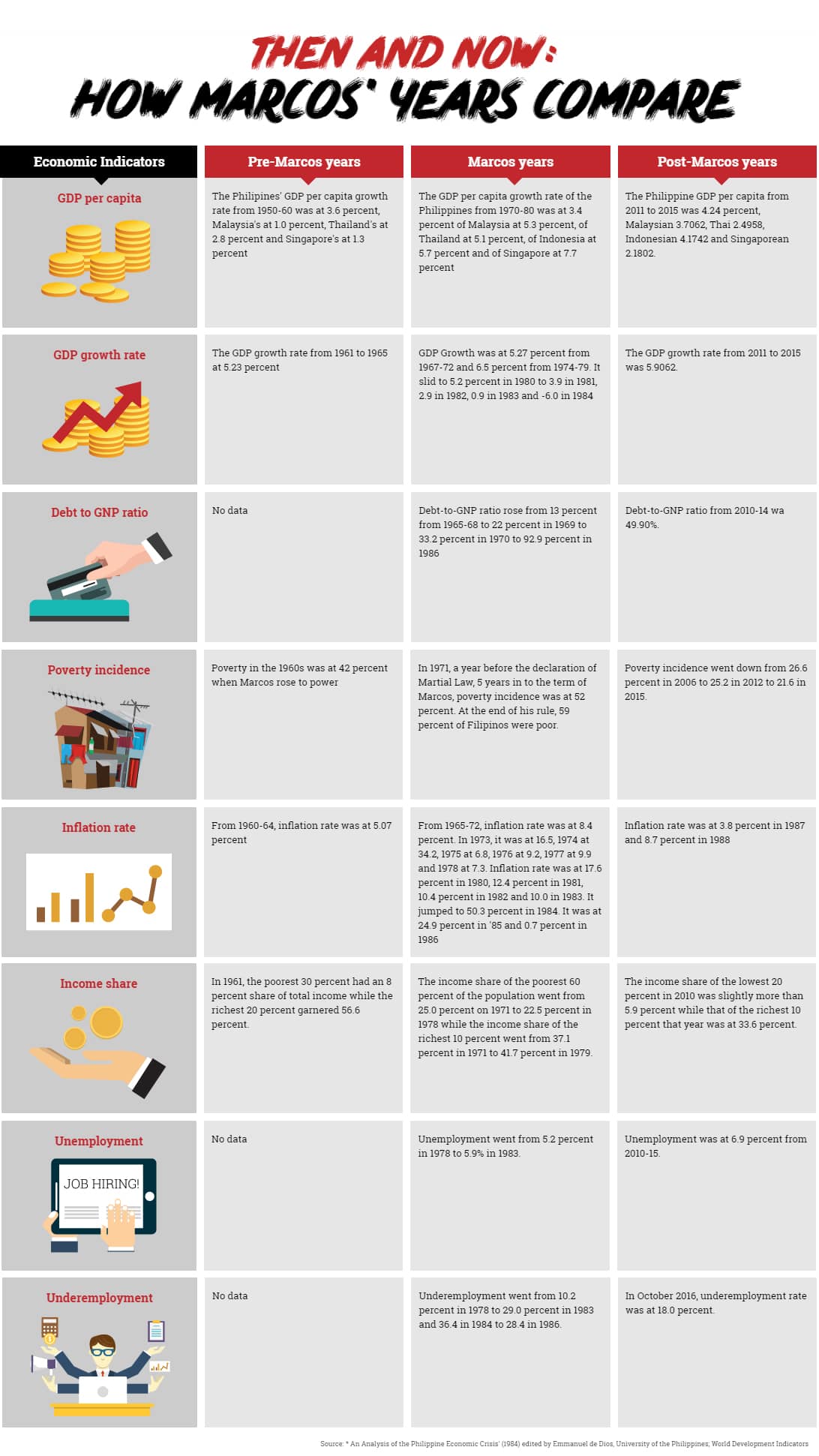
In the 1950s, the Philippines was second to Japan in terms of per capita income in the region. The country enjoyed moderate economic growth alongside its neighbors while focusing on imports. A common anachronism today’s apologists commit is to label this relatively prosperous time part of the “Marcos period.”
Marcos assumed the presidency only in 1965 when things started to spiral downward in the late 1960s as existing policies no longer encouraged rapid growth. The would-be dictator then pursued an aggressive, expensive run for a second term by foraying into the public treasury to boost his campaign, buy votes and threaten voters. The peso crashed in late 1969, and by the dawn of the following year it lost half its value, Conrado de Quiros wrote in “Dead Aim.”
The 1960s crisis, for economists Arsenio Balisacan and Hall Hill, “was triggered by one politician’s particularly shameless efforts to maintain a grasp on the reins of the political machinery.”
Among its peers, the country could no longer keep up. “While the Philippines started with the highest growth rates for [Southeast Asia] in 1950-1960 (3.6 percent annually), it lagged behind its neighbors in 1960-1970,” economists De Dios, Dante Canlas, Solita Monsod and their fellow U.P. economists wrote.
To deal with external shocks and a campaign spree that ingested ridiculous amounts in the guise of government projects, the country resorted to debt, and according to the U.S. Library of Congress, was behind by $2.3 billion in payment due in the early 1970s. Then came a pattern of chronic borrowing, devaluation of the peso which bloated prices of goods, and reckless spending.
Myth: A spectacular economy and showmanship
More debts were incurred to pay outstanding debts and to stimulate the economy. The debt-fueled boom in the early 1970s coupled with sweeping reforms and infrastructure programs deceived many, providing the semblance of stability Marcos needed to calm the business elite after he placed the country under martial law.
“The trouble with debt-driven growth with populist tendencies is that it produces a buoyant economic environment—at least in the beginning. As long as the facade of investment for competitiveness is still there, then investors continue to pour money into the economy, which keeps it growing,” Harvard-trained economist Ronald Mendoza, dean of the Ateneo School of Government, explained to Philstar.com.
“Initially, it looks very good,” Mendoza admitted. “It doesn’t take rocket science to figure out that the country’s debt-driven growth was a party that would soon end, once investors figured out that despite the mounting debt, the country failed to effectively invest in key infrastructure and competitiveness-enhancing projects.”
The 1970s saw the kind of progress without momentum. As then Social Security System chief Adrian Cristobal told Harvard University fellow William Overholt, “It was like an old lady taking off her girdle. Everything just fell out.”
The regime’s initial reforms turned upside down as institutions bowed to corruption, red tape, inefficiency and Marcos-led cronyism. His development strategies and trade policies were likewise incoherent, not to mention the padding of debt mainly for a gamut of projects that required large funding despite little gain.
Overholt said these included hosting of ostentatious international meetings. International Monetary Fund delegates, for example, were each assigned a brand new Mercedes Benz that was afterward sold as a second-hand car.
The wastefulness could not be exaggerated. Explaining the capital-output ratio at the time, Overholt said it was typical for Asia-Pacific countries to spend $2 to $4 to raise national output by $1. But the Philippines was spending $9 for every buck.

“It was typical for Asia-Pacific countries to spend $2 to $4 to raise national ouput by $1. But the Philippines was spending $9 for every dollar.
Debt climbed to $17.2 billion by 1980, and the rate of gross national product—which measures the total value of production—took a dive. Already crippled, the Philippines was gasping for air when world recession hit and its exports suffered way worse than those of its neighbors.
“External factors could help trigger a crisis, but domestic fundamentals (or the lack of it) will dictate resilience to these external shocks. For the most part, I think the crisis in the Philippines was largely man-made—the external shocks merely exposed them,” Ateneo Dean Ronald Mendoza said in an online interview with Philstar.com.
Filipinos today are able to look back and understand what happened, but in those years even the experts misinterpreted the signals of an impending crisis by the end of 1983.
Myth: Aquino’s assassination to blame
In 1983, Aquino, the staunch Marcos critic, returned to the Philippines from exile and was killed on the tarmac as he alighted from the plane. As a result, foreign banks lost confidence in the regime and refused to grant further borrowings, De Dios wrote. This explains why Martial Law advocates to this day blame Aquino’s return and death for economic misfortunes in the latter Marcos years.

“All it took was a crisis to expose these weaknesses and for the facade of democracy to unravel.”
For Mendoza, the senator’s assassination played a role in triggering “what was already a simmering political and economic crisis.”
“But if it wasn’t the assassination of Ninoy, it would have been something else, perhaps.”
The economist said the weakening of institutions under Marcos had by then taken its toll. The institutional cracks included the lack of independence of the central bank, weaknesses in competitive bidding for government projects, rent-seeking and cronyism in government subsidies for industrial policy and outright plunder of the public purse.
“All it took was a crisis to expose these weaknesses and for the facade of democracy to unravel,” Mendoza said.
Spoils of dictatorship
Tasked to recover what was believed to be the strongman’s hidden wealth, the Philippine Commission on Good Government set to work by going after agents working for Marcos in the Philippines and abroad. The PCGG was among the first bodies President Corazon Aquino formed after Marcos was overthrown through “people power.”
The Jovito Salonga-led commission uncovered a trail to what appeared to be vast assets of Marcos “stretching from a small Texas motel to a San Francisco bank, from a glitzy Manhattan shopping mall to a block of apartment buildings in downtown Seattle,” the Los Angeles Times reported in 1986.
As president, Marcos earned a yearly salary of $4,700 or about P100,000, and was not part of the traditional elite before becoming a politician. How he came to be worth billions of dollars by the end of his rule was seen as a sign of how he used martial law to line his pockets.
As dictator, Marcos wrote letters of instruction and decrees to position his cronies—as his associates came to be called—to set up monopolies of key industries. Even as he gained popular support for attacking the ruling class he called the “oligarchy,” Marcos ironically created a loyal new elite controlling the country’s largest enterprises.
“Some are smarter than others,” Marcos’ wife, Imelda, famously answered when Fortune magazine asked her about relatives and friends who grew rich during the period.
“Some are smarter than others.
Loyal Marcos backer Roberto Benedicto took over the lucrative sugar industry, while Eduardo Cojuangco led a powerful crony corporation sitting on taxes from coconut farmers. “By the 1980s, the ‘coco levy’ would become one of the major issues against the dictatorship, the term connoting its most rapacious aspects,” wrote business journalist Rigoberto Tiglao in 1988.
Historian Alfred McCoy said Imelda’s brother, Benjamin Romualdez, took control of P5.7 million in holdings of the influential Lopez family, including the largest power distributor Meralco, newspapers, and television studios, for a mere $1,500.
Marcos allowed a handful of families to cinch monopolies and semi-monopolies in manufacturing, construction, finance and other important sectors of the economy, which were even favored with tax cuts and other privileges. When these select corporations proved unprofitable and inefficient, the government loaned millions to keep them going.
The massive bailouts for failed crony businesses and the earnings from sugar and coconut exports placed in foreign banks were critical factors leading to another economic disaster. While this caused much resentment among a portion of the business community, it was the most vulnerable and voiceless that were hit the hardest.
After all, many of the crony business leaders continued to hold levers of power even after the dictator was deposed in 1986, Canada-based economist Polvorosa observed.
The captain at the helm not only caused the ship to sink, he also managed to swim away with a sizeable loot for himself.
And the poor were poorer
Myth: ‘Mas madali ang buhay noon’
Women started to seek jobs in the mid-1970s due to the decline in their husbands’ income.
Some Filipinos today recall that life was “simpler”—even better—during Marcos’s years. But these anecdotes are nowhere reflected when looking at the hard data on the population’s welfare.
About 42 percent of Filipinos were considered poor in the 1960s when Marcos rose to power. In 1971, the year before Marcos declared martial law, poverty incidence rose to 52 percent. By the time Marcos approached the end of his 21-year rule, already three of five Filipinos (59 percent) were poor.
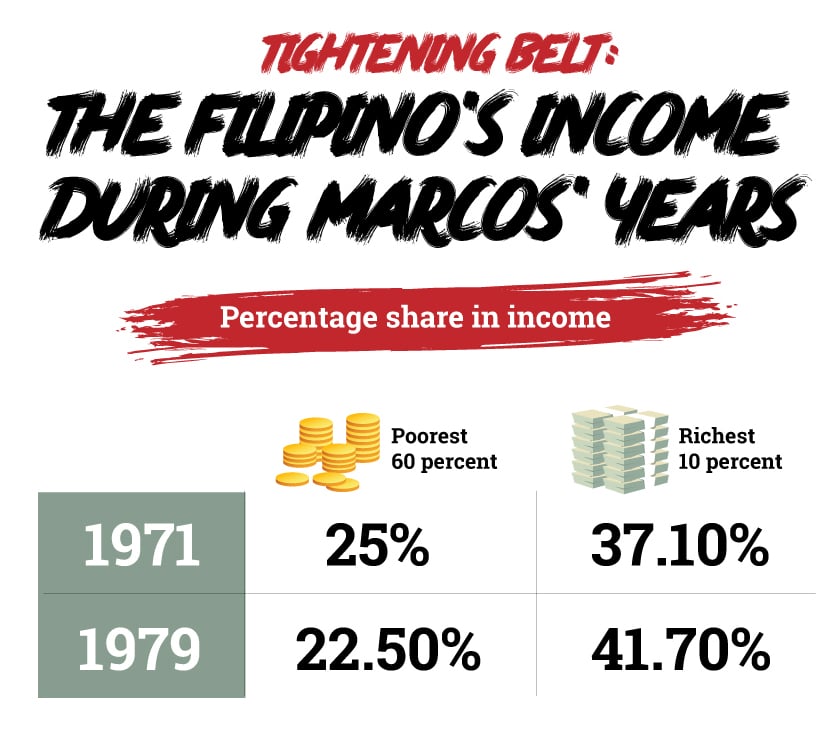
Income distribution also worsened during Martial Law, with the poorest segment of society seeing a decline in their share of the total income between 1971 and 1979. The richest 10 percent, on the other hand, enjoyed a much larger piece of the pie.
Shifts in employment in those years get even interesting. De Dios and fellow economists observed an “unusually high” expansion of labor supply, or the number of people available for work.
This was due to housewives who started to seek jobs in the mid-1970s—a phenomenon attributed not necessarily to women empowerment, but to the decline in husbands’ income below what used to be enough for their families’ subsistence.
“The economy today is dramatically better than the Marcos economy; but without inclusion, many of our citizens probably can’t tell the difference.
— Ronald Mendoza, economist
From 1978 to 1983, the number of workers without jobs increased from 800,000 to 1.2 million. But the figure for underemployment was more shameful, going from 1.6 million to 5.6 million.
How people could afford goods also suffered from dramatic swings in inflation. While an annual inflation rate of 1 to 4 percent is considered respectable today, in the 1970s, it sprang to double digits.
This was partly ascribed to roiling external conditions, but a comparison of the Philippines’ performance with those of its neighbors suggests that high inflation rate and lower economic growth “could have been avoided and could be attributed, not to the general problems of a developing country, but to the character of the policies of the present government,” De Dios and colleagues explained in 1984.
If a critical measure of an economy’s performance is its trickle-down effect, then the Martial Law enablers miserably failed.
Challenges of inclusion, however, continue to this day. For Dean Ronald Mendoza, this has likely made the Marcos prosperity myth endure for decades even when the economy has grown dramatically better.
“I think the Marcos myth persists largely because we have failed to effectively push in the Post-Marcos era the key or deep institutional reforms, notably political and economic reforms that could make our politics and economy much more inclusive,” Mendoza explained.
“Understandably, many are tempted by shortcuts and strongman rule, instead of faithfully building the institutions that could strengthen our democracy and economy.
“The economy today is dramatically better than the Marcos economy; but without inclusion, many of our citizens probably can’t tell the difference,” he added. — Philstar.com NewsLab with reports from Audrey Morallo
by MLC | Aug 3, 2017 | Martial Law Stories
By Denison Rey A. Dalupang
Among the items on the muddled list of Ferdinand Marcos’ supposed achievements was a piece of legislation he signed into a decree in 1974.
Enacted aptly on May 1, 1974, Marcos put in place a Labor Code to promote overseas contract work. Many have regarded this as a milestone as it was the first time that the government turned the spotlight on labor. Some said it was the new Magna Carta secured by the Filipino working class.
But roughly four decades later, it has become nothing but a reference to another discordant topic that hounds the country.

If we look at the numbers, they would say that there was indeed an upshot.
From 1975 through 1986, the 36,035 workers deployed swelled to 266,243. That’s a whopping 949-percent increase.
But experts note that such numbers should be taken with the fitting footnotes.
“That time, labor export was a response to the demand for workers in the Middle East, given the boom of the oil sector,” said Jeremaiah Opiniano, executive director for Institute for Migration and Development Issues.
And while the ’74 Labor Code was a stellar piece of legislation on its own, it also served as a political tool.
In his book “Philippine Labour Migration: Critical Dimensions of Public Policy,” Joaquin Gonzales said that the decree was “a response to partly address the nation’s worsening economic problems.”
“It was also seen at that time as a stop-gap measure to help arrest challenges in the economy, like the dollar shortfall and unemployment,” Opiniano chimed in.
The Migration Policy Institute, a think tank based in Washington DC, echoed the same sentiment, adding that “the absence of sustained economic development, political instability, a growing population, double-digit unemployment levels, and low wages continue to compel people to look abroad.”

Data-crunching whiz Jan Carlo Punongbayan, who served both the World Bank and National Economic and Development Authority, noted in a study that “dissatisfaction in the labor force” was among the key factors for underemployment.
The spike in underemployment, which Punongbayan noted to have peaked during the ’70s and ’80s, would later greatly influence the Philippines’ labor export. And the upshot? The ever-growing number of Filipinos seeking opportunities far from the motherland.
Linda Cervales may have not shouldered the burden of becoming an OFW during those tumultuous times, but the residual effects haunted her.
Now 49 years old, she recalled struggling to land a job due to being a former activist.
“Takot ‘yung mga big companies to hire PUPians, so medyo discriminated na kami,” she shared. “I tried applying sa banks, since banking and finance student ako. I passed the exam pero pagdating sa final interview, they gave the position sa mga graduates from exclusive schools.
“I ended up working for a multinational company but the job is not related to my course, so underemployed na ako nun,” Cervales added.
The series of setbacks forced Cervales to make the seemingly inevitable course of action. She went on to work in Taiwan and eventually, Dubai.
Now a housewife juggling informal jobs, she looks back to say, “It was not a choice. It was a desperate move.” — Philstar.com NewsLab

by MLC | Aug 3, 2017 | Martial Law Stories
Source: Philstar.com NewsLab
http://www.dailymotion.com/d26632ba-5514-4399-a5bc-e2bb08bc0ff1

by MLC | Aug 3, 2017 | Martial Law Stories
By Denison Rey A. Dalupang
Source: Philstar.com NewsLab
Many of the fictions concocted by the Marcos family have left an indelible mark in today’s political discourse.
And one of the most enduring? It’s neither the nuclear plants nor the forged war records.
It’s a piece of bread that for sure, many of today’s adults have heard: The Nutribun.
For many millennials, the word “Nutribun” wouldn’t ring a bell. But for the generations who lived through the Marcoses’ might, it’s easily a throwback to a life’s phase.
“It’s nothing like the pan de sal we all eat now,” Alvin Toledano narrated in Filipino. “It was bigger than a coaster. It was something that was given to us in school for ‘merienda.'”
“It’s as big as a burger bun,” he adds. “Although it’s bigger, much more dense, and tastier than the modern counterpart.”
Toledano belonged to a generation where they could barely ask what the Nutribun was. Yes, he could remember how it looked like. Yes, he could recall how it was a part of the daily school grind. Yes, he’s able to reminisce how it tasted.
But to remember why he had it in the first place? No.
Toledano was born in 1975—right smack in the Martial Law period. Whenever he looks back at the time when he ate the Nutribun, all he could remember was school.
Many of the Marcos myths bounce between the spectrums of fraudulent and absurd. But the Nutribun story has been the most divisive.
The most ardent of the strongman’s supporters assert that it was one of the Marcos presidency’s best contributions to Philippine society.
Daily bread
Wading through Facebook with the texts “Nutribun” and “Marcos” leads to myriad pages reinforcing the Marcos supporters’ claims.
On many occasions, these pages use the Nutribun anecdote as a springboard to refute the plunder and abuses that the Marcos administration had committed.
“[B]inusog mo ang mga kabataan noon, at may disiplina sila noong panahon mo,” one Facebook page’s entry read.
“Noon may libreng gatas na Klim, tinapay na Nutribun at Trigo or Bulgur na pinamimigay araw-araw sa mga public schools para malabanan ang malnutrisyon sa bansa natin,” another stated.
“Pero nung sa nawala si Marcos at si Cory Aquino na ang presidente unti-unting nawala ang libreng [Nutribun],” it added.
But for staunch critics, it’s just another well-oiled cog in the credit-grabbing machine that the Marcoses employ to date.
Credit grabbing

Recent reportage points us to the bread being a product of the United States Agency for International Development’s (USAID) mission in the country during the late 1960s.
A document was made available online by the same US humanitarian body. The same trove of documents detail the development of a “convenience food” to “supplement in elementary school feeding programs.”
Further examination on the 1979 document indicated that, “USAID Nutrition was responsible for development of the formula to justify a claim for nutritious snack food … [It] made its decision to combine its Food for Peace and its nutrition activities and to target its food donations to the malnourished child population.”
“Through operational research support to Catholic Relief Services and Foster Parents, the AID nutrition office had developed a methodology for a ‘Targetted Maternal Child Health Program; and had begun testing the ‘nutribun,’ a ready-to-eat bakery-bun snack food for school children,” it furthered.

The 383-page report, which was furnished by none other than the mission’s chief of party Dr. Reuben William Engel, bared essential details on the snack food—its ingredients, how many students were involved in the initial serving, its evolution into “Nutribun,” and eventually, how it became the stuff of many Philippine households.
“USAID Nutrition was responsible for development of the formula to justify a claim for nutritious snack food.
“I know in my heart it was tasty. The teachers gave it to us during afternoons,” Toledano recalls. “But what I didn’t know at that time that it was part of the government’s projects. Eventually, I would learn of it as part of the Marcos administration’s many projects.”
Was it?
Careful examination of the paper would tell that a food snack’s development came in 1970. This coincides with the establishment of “Project Tulungan,” which was spearheaded by the then First Lady herself, Imelda Marcos. The private entity paved the way for a collaboration between the Nutrition and Population offices of USAID in Manila using the “Targeted Maternal Child Health Program.”
“The project represented a first major effort to combine nutrition and basic health services with family planning services, initially in Manila and other city slums and later extended to rural areas,” Engel’s record said.
It was in the “Great Flood” of 1972 when the bread gained household buzz. In a 1974 edition of the journal International Nutrition, Dr. Grace Goldsmith wrote that “8 million nutribuns were airdropped to about one million people in the most severely affected area. The bakeries shifted from schools to disaster feeding.”
But it was also during this period when the Marcos administration pulled off a treacherous act, according to American Nancy Dammann, a longtime media advisor for the USAID.
In her memoir published in 2003, Dammann wrote, “the nutribun bags were being stamped with the slogan ‘Courtesy of Imelda Marcos — Tulungan project.'”

“The wives of several American officials helped package rice and nutribuns (a horrible bun made with high-vitamin, milk-content flour invented by an AID official and donated by USAID) for distribution to flood victims,” she wrote.
“Provincial politicians also stamped food packages with their names,” an excerpt of the chapter also read.
The Nutribun, went on to fill the tummies of many Filipino children. The bread continued to be an essential to be a part of various administrations’ thrust for proper nutrition. It last saw action in 1997.
In 2014, the Manila government, under the rule then president and now Mayor Joseph Estrada, revived the vitamin-enriched bread. The next year, then Valenzuela solon Sherwin Gatchalian pushed for the bun’s relaunch on a national scale.
In 2016, it returned. Sort of. But now, more divisive than ever. — Philstar.com NewsLab
