After the prosecutors send their memorandum, the case will be set for judgment
GRAFT. Former first lady Imelda Marcos, shown here attending a political rally for her son Ferdinand Jr in 2016, faces 10 counts of graft filed 25 years ago. File photo by Rob Reyes/Rappler
MANILA, Philippines – Ombudsman prosecutors are set to submit on August 4 their memorandum summarizing their case against Ilocos Norte Representative Imelda Marcos over 10 graft charges in a corruption case that’s lasted 26 years.
The charges, filed in 1991, accuse Marcos of creating private foundations in Switzerland and having financial interests in several enterprises from 1978 to 1984 while she was governor of Metro Manila. (READ: Recovering Marcos’ ill-gotten wealth: After 30 years, what?)
Prosecutors ended their presentation in December 2015 which would have marked the start for the defense to present theirs, but Marcos’ lawyer snubbed the hearings.
In February this year, the anti-graft court Sandiganbayan held Marcos’ lawyer Robert Sison in contempt for failing to attend the hearing. The 5th Division also waived their right to present evidence.
Prosecutors were supposed to submit on July 4 their memorandum that would conclude the trial at last after 26 years, but they asked for a one-month deadline. The new deadline ends on August 4.
Evidence against Marcos includes a sworn affidavit from the late former solicitor general Frank Chavez with details of how the former first lady used the Switzerland foundation to conceal millions worth of alleged ill-gotten wealth. Bank records and handwritten letters from the Marcos couple to foreign banks were also submitted to court.
Documents obtained from Chavez were also corroborated by former Bangko Sentral ng Pilipinas governor Jaime C. Laya when he testified in the case.
The government has since been able to identify $658 million worth of Marcos Swiss deposits. Documents which were used by the government to track down these deposits are used in related cases, such as this 1991 graft case.
The Philippines’ Court of Appeals says the Hawaii court had no jurisdiction over the case filed by victims of human rights abuses
BANTAYOG WALL. Relatives of victims of Martial Law light candles at the Bantayog ng mga Bayani Wall of Remembrance to honor the heroism of their fallen kin. File photo by LeAnne Jazul/Rappler
MANILA, Philippines – The Court of Appeals (CA) ruled against victims of human rights violations during Martial Law under Ferdinand Marcos’ dictatorship by denying their petition seeking the enforcement of a Hawaii court’s judgment granting them $2 billion in damages.
The appellate court’s 12th Division affirmed the ruling of the Makati City Regional Trial Court that dismissed the petition to recognize and enforce the ruling of the court in the United States on the class suit filed by Martial Law victims.
Class Action MDL 840 was filed by Priscilla Mijares, Hilda Narciso, Mariano Dimaranan, director Joel Lamangan, and former Commission on Human Rights (CHR) chairperson Loretta Ann Rosales.
In the 19-page decision authored by Associate Justice Normandie Pizarro, the CA ruled that the Hawaii court had no jurisdiction over the case. It also said that the right to due process of the unnamed claimants and even Marcos was violated. (READ: HR victims stake claim on part of Marcos art collection)
“Rules of comity should not be made to prevail over our Constitution and we cannot allow foreign impositions to trample upon our sovereignty,” the ruling said.
The Hawaii court, said the CA, failed to prove that the 10 Filipino citizens who initiated MDL 840 were legally authorized by the other claimants of the case.
“In the absence, therefore, of such authority, the final judgment rendered by said court is not binding because the right to due process of all the unnamed claimants, as well as the herein respondent estate, had been violated.”
The CA added that the case should not have been brought as a class suit since there is “no common question of law and fact [that] exists between or among the claimants.” The claimants were classified under 3 subclasses – torture, summary execution, and forced disappearance.
Involving around 10,000 Martial Law victims, the Hawaii class suit was considered the first successful case filed against the late dictator. The judgment was rendered on February 3, 1995, granting the petitioners $1.964 billion in damages. (READ: What the gov’t still owes Martial Law victims)
Alien Tort Claims Act
The case was hinged on the Alien Tort Claims Act (ATCA) of 1789, which gives US federal courts the jurisdiction over cases where a foreigner sues for any harm that came from a violation of international law, regardless of where it occurred.
It covers lawsuits filed against aliens who have taken refuge in the US. Marcos and his family went into exile in Hawaii after the 1986 EDSA Revolution.
The CA said, however, that the US Supreme Court earlier issued a ruling in Kiobel vs Royal Dutch Petroleum showing the ATCA no longer covers human rights abuses that happened in foreign countries.
“Given the foregoing recent development, it is our considered opinion that the instant final judgment may not be enforced in this jurisdiction as it is clear that even the US Supreme Court has come to realize that American laws could not have jurisdiction over sovereign countries,” said the CA.
“As things stand, therefore, the claimants in MDL 840 have lost whatever right of action they may have under the ATS or the ATCA.”
It also noted that the US court decision was not based on the ATCA but “presumably” the Torture Victim Protection Act.
The former First Lady is known for her lavish spending on shoes, jewelry and fine art during the rule of the late dictator Ferdinand Marcos
IRON BUTTERFLY. Former first lady Imelda Marcos at Senator Bongbong Marcos rally in Mandaluyong. Photo by Rob Reyes/Rappler
MANILA, Philippines – Imelda Romualdez Marcos, the so-called Iron Butterfly, celebrates her 88th birthday on Sunday, July 2.
Known for her excessive style now dubbed as “Imeldific,” Imelda’s rags-to-riches story explains her love for orchestrating lavish events and owning an extravagant collection of shoes, clothes, and jewlery.
Her cousin Loreto Ramos revealed that when they were younger, Imelda belonged to the poor side of the family. According to a book on Imelda Marcos’ life, Siloy, a family helper, even bought Imelda new shoes, because she could not afford to replace her only worn out pair. This, the book said, eventually led to the obsession of creating a glamorous image for herself.
It was then-Congressman Ferdinand Marcos who gave Imelda the life she could only once dream of. After an 11-day courtship, Ferdinand Marcos married the former beauty queen Imelda in 1954. Eleven years later, Ferdinand was elected President in 1965, making Imelda the 10th First Lady of the Philippines.
During her time in Malacañang Palace, she was appointed governor of Metro Manila and Minister of Human Settlements. Following the downfall of her late husband’s dictatorial regime, Imelda resumed a career in politics, serving in the House of Representatives,from 1995-1998, and from 2010 until present.
Throughout the decades, Imelda Marcos has amassed more than 3,000 pairs of shoes, including heels, flats, sandals, boots, and slippers made by both local and international brands. Her locally-made shoes are said to cost up to $11, while imported shoes amount to around $100 each.
Imelda also owned an impressive jewelry collection valued at $8 million. This ranged from antique to modern pieces and included Old Indian diamonds, Burmese rubies, and Colombian emeralds. Three decades after it was confiscated, Imelda’s Hawaii jewelry collection was approved for auction in 2016.
When the Marcos family fled the country in 1986, 1,200 pairs of shoes, 800 purses, hundreds of gowns, luxurious jewelry collections, and several paintings of Monet and Picasso were confiscated as well. The Marikina Shoe Museum now displays 800 pairs of Imelda’s shoes. Some 150 boxes of her clothes, shoes, and jewelry were also moved to the National Museum in 2010 for protection, but were ironically destroyed due to termites, mould, and storms.
IRON BUTTERFLY. Imelda Marcos was the Philippines’ First Lady during the term of her late husband, Ferdinand Marcos. Photo from the Presidential Museum and Library, courtesy of The National Library of the Philippines
IMELDA MARCOS
“The Iron Butterfly”
Born: 02 July 1929
Father: Vicente Orestes Romualdez
Mother: Remedios Trinidad
Spouse: Ferdinand Marcos
Children: Irene, Bongbong, Imee, Aimee
Political career
1965 First Lady
1975-1986 Appointed governor of Metropolitan Manila
President Rodrigo Duterte says he can declare martial law ‘a second time’ if the Supreme Court says there ‘is no factual basis’ for military rule in Mindanao
COMMANDER IN CHIEF. President Rodrigo Duterte looks through the scope of a sniper rifle as he leads the inspection of firearms recovered by the troops of the 4th Infantry Division during his visit to the 4th Infantry Division Advance Command Post in Butuan City on June 17, 2017. Malacañang photo
“If that rebellion burns Mindanao and the other parts of the Philippines, and I’ll be forced to declare martial law again. This time, I will do it on my own to preserve my nation. I will not consult anybody. And there is no telling when it will end,” Duterte said.
“Then it could be a copycat of Marcos,” he added.
The 1987 Constitution states that martial law should not initially exceed 60 days, and that any extension should be approved by Congress by a joint vote. Duterte allies dominate both houses of Congress.
‘Terrorists are committing rebellion’
The President made his remarks as the SC is set to decide if there is sufficient factual basis to declare martial law in Mindanao. The High Court will release its decision on or before July 5. (READ: SUMMARY: SC oral arguments on martial law in Mindanao)
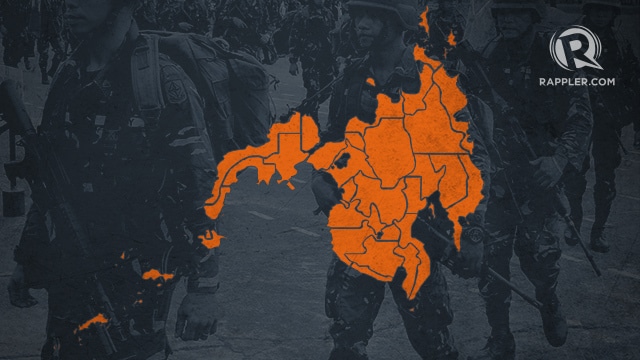
Duterte declared martial law in Mindanao after clashes erupted between government troops and local terrorists in Marawi City.
In his interview with reporters on Saturday, Duterte called out justices “arguing” that the Marawi clashes can only be considered “terrorism” and not “rebellion.”
“The terrorists are committing rebellion. The rebels are committing rebellion,” Duterte said.
He added it is “crazy” to think that the terrorists should affect half of Mindanao “before we can call it a true-blue rebellion.”
The President earlier said he would “follow” the High Court’s decision on his martial declaration, hoping the justices would take into consideration the threat of the Islamic State or ISIS.
Duterte had warned as early as May 24 that martial law in Mindanao “will not be any different from what President Marcos did.”
The long-time Davao City mayor known as “The Punisher” said then, “I’d be harsh.”
This is the first time since the Marcos-era years that a portion of the country marks Independence Day under martial law
MANILA, Philippines – On Monday, June 12, the Philippines celebrates its 119th Independence Day.
This is also the first time since the regime of the late dictator Ferdinand Marcos that the Philippines is celebrating its Independence Day with a portion of it – Mindanao – under martial law.
On May 23, President Rodrigo Duterte declared martial law in the Philippines’ southern island following the attack of local terrorists in Marawi City.
Duterte’s declaration was met with approval, outrage, and apprehension among the public. Many still fear that the entire country may be placed under military rule, especially after the President admitted that he was considering extending this to Luzon and the Visayas if the threat of the Islamic State (ISIS) persists.
As the Philippines celebrates its annual Independence Day amid martial law in Mindanao, we ask: How did the Philippines celebrate Independence Day during Marcos’ martial law era?
Presidential speeches
If one can recall history lessons, it was former president Diosdado Macapagal who made the decision to move the Philippines’ Independence Day to June 12 instead of July 4. (READ: Why celebrate Philippine independence on June 12?)
According to Primitivo Mijares’ “The Conjugal Dictatorship,” Ferdinand Marcos was a senator during the Macapagal administration and was also one of the biggest supporters of this decision to move the date of Philippine independence. Marcos continued to uphold the June 12 independence date even as he declared martial law in September 1972.
After Marcos declared martial law in September 1972, he commemorated the Philippines’ Independence Day with presidential speeches, along with the usual ceremonies done during this public holiday.
Such commemorations were usually held in Manila, along with the ceremonial flag-raising ceremony and a parade. Philippine flags were also hoisted during official ceremonies in historically significant places in the country.
In 1980, the year before martial law was lifted, Marcos delivered an Independence Day speech at the Quirino Grandstand in Manila.
At 8 am, Marcos and his first lady hoisted the Philippine flag at Rizal Park, while other Philippine flags were raised at the Aguinaldo Shrine in Cavite, Fort Bonifacio, and at the Bonifacio Monument in Quezon City.
Marcos, in his speeches, also defended the implementation of the “emergency government” of martial law, saying that it was needed in order to ultimately preserve the country’s democracy and maintain stability.
In his 1981 speech during the Independence Day Reception, Marcos said:
“We have lived through nearly a decade of emergency government in our country, during which we not only sought to ensure the survival of our Republic, but also to effect the fundamental restructuring of our society. When we took the fateful course of constitutional authoritarianism, we did not forget that we were the First Republic to rise in Asia, and that the vision of our fathers was to found a thriving and living democracy upon our land.”
In his 1977 and 1979 speeches, Marcos also repeatedly mentioned the “Isang Bansa, Isang Diwa” (“One Nation, One Soul”) theme, stressing the need for discipline and unity at a time when the country was said to be in great turmoil.
Yearly commemorations
After Marcos declared martial law on September 21, 1972, he delivered a presidential speech during Independence Day in 1973. It was the first Independence Day speech that Marcos delivered to the public after a mere 9 months under martial law.
In his 1973 speech, he said: “Natamo natin ang isang malayang Republika subalit ang Republikang iyan ay hindi naging demokratiko o matatag.” (We achieved an independent Republic but that Republic was neither democratic nor strong.)
In a mix of English and Filipino, Marcos added: “We didn’t have the strength and the will to eradicate injustice, oppression and corruption, o igupo ang mga kaaway ng Republika, confront the enemies of our Republic. Ngunit sa taong ito ay natamo natin ang lahat ng ito. We have achieved all of these this year. This is our true independence.”
In 1973 and in the years that followed, Marcos would consistently deliver speeches during Independence Day celebrations. His speeches were charged with nationalistic sentiments that were used to justify the political context at the time.
During those days, celebrating Independence Day meant celebrating the kind of independence Marcos constantly emphasized in his speeches – that the nation that was truly free was one that transcended its own setbacks.
Perhaps the irony in this was the context in which this independence was celebrated. Given that it was a country under a dictatorship, it was not truly free.
Although Marcos did celebrate Independence Day and commemorate it even during the martial law years, he also used this public holiday as a way of justifying his strongman rule in the name of upholding a strong republic.
It depends on Duterte’s report to Congress which is subject to approval through a majority vote.
The report is supposed to outline how Duterte plans to bring about peace and order through the proclamation, including coordination with local government units.
Ateneo de Manila University Political Science instructor Arjan Aguirre said that one thing is certain: Local chief executives – barangay captains, mayors, and governors – would have to yield majority of their powers to the national government.
These powers include their mandate to order or supervise local counterparts of national agencies such as the Armed Forces of the Philippines and the Philippine National Police to hasten the restoration of peace. For purposes of streamlining relief operations, these agencies could be the Department of Social Welfare and Development, and the Department of Health.
University of the Philippines National College of Public Administration and Governance Dean Maria Fe Villamejor-Mendoza added that the central government “may restrict some of the movements and freedoms of regular citizens” via curfews and travel bans. (READ: Davao City ‘on lockdown’ after terror attack in Marawi)
“The theory behind it is that if there is an armed conflict, the local government units cannot handle situations like it on its own,” Aguirre said.
Aguirre and Villamejor-Mendoza, however, called on Duterte to keep terms and conditions with local governments within the mandate of the 1987 Consitution.
Villamejor-Mendoza predicted that the President will most likely have his way with the law, given a supermajority in the House of Representatives and overwhelming public support that can easily thwart opposing local chief executives.
In execution, they both reminded Duterte and the public, that the revised version of martial law does not suspend constitutional rights of regular citizens.
According to the Constitution, “The suspension of the privilege of the writ of habeas corpus shall apply only to persons judicially charged for rebellion or offenses inherent in, or directly connected with, invasion.”
Villamejor-Mendoza said the implementation of martial law in the region is a critical moment for the administration as it can make or break the peace agreements still being negotiated. – Rappler.com