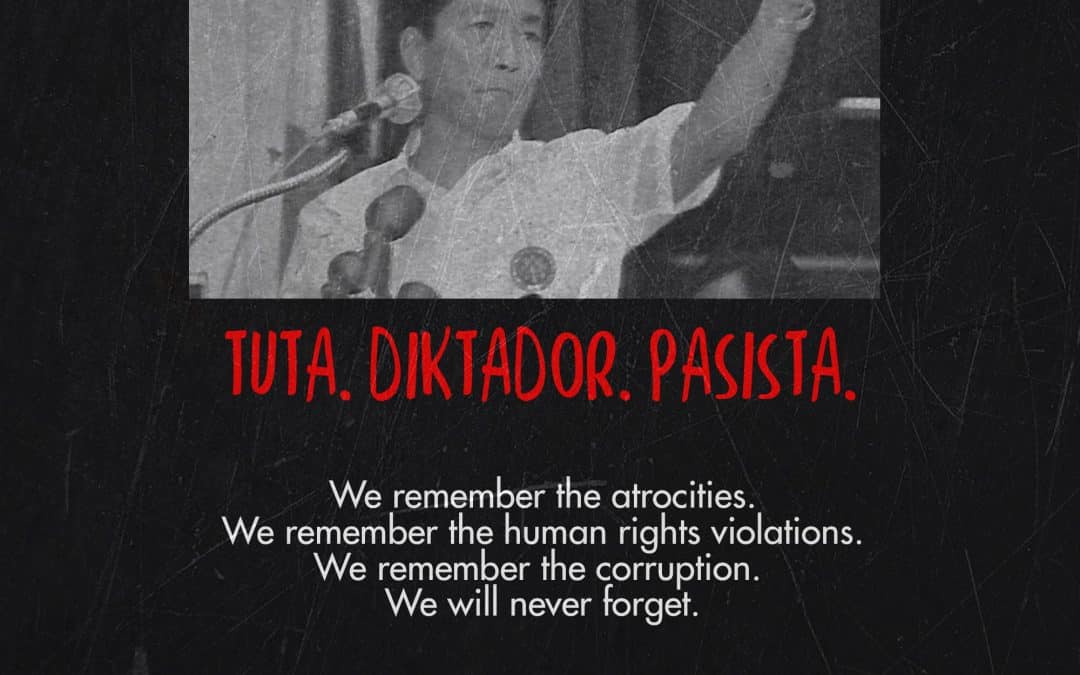
We refuse to commemorate a dictator. We refuse to allow the Marcoses to rewrite our history and silence the victims of Martial Law. We remember the atrocities and we will not forget.
After Ferdinand Marcos was ousted back in 1986, the Marcos family fled to Hawaii at the expense of millions of Filipinos. Despite their ill-gotten wealth, accumulated by stealing from public funds, purchasing private companies, and managing state-owned monopolies, and despite the thousands of human rights violations committed during their reign of terror, the Marcos family roams free, unscathed by their crimes against the Filipino people.
So unscathed, in fact, that they continue to take government positions, backed by the same corrupt practices that they once fostered.
History will tell us that it is through protest that we fight for our democracy, and the 1986 People Power Revolution is a testament to this.
But in this age of growing restlessness, we must not allow another Martial law to control our nation. This is why we must collectively fight against the current dictatorship, in the same way that our fellow Filipinos in 1986 bravely fought for our democratic rights.
We remember the atrocities.We remember the human rights violations.We remember the corruption. We will never forget.NEVER AGAIN. NEVER FORGET. NEVER AGAIN TO MARTIAL LAW.
“I will never forget when they put my father, Ka Pepe, in solitary confinement in Fort Magsaysay in Laur, Nueva Ecija.
It was barely six months after Martial Law was declared. I remember my mom waking me up one morning and asking me to accompany her downstairs. There was an Army truck in front of our house, and there were soldiers unloading my Dad’s things—things that used to be in his maximum-security cell in Fort Bonifacio, where he was imprisoned without charges.
My mom asked the soldiers why, and where my father was. But I guess they were ordered not to say anything. They finished unloading and left. My mom then told me to get dressed. It was time to visit our lawyer, Senator Lorenzo Tañada, who prepared a petition for habeas corpus, which he filed before the Supreme Court. Being young then, the timeline is fuzzy and the days blend together, but I remember that our whole family went to the Supreme Court during the hearing.
I vaguely recall that a recess was called in the middle of oral arguments. When Sen. Tañada returned, he told my mom that we and the Aquino family would be allowed to visit Dad and Ninoy. When my Mom received the Order from the Supreme Court allowing us to visit Dad, we went to Fort Bonifacio expecting to see him but the military authorities just made us wait until we ended up going home. The following day we returned to Fort Bonifacio.
They told my Mom that we could visit Dad that afternoon but we would need to bring our cars. When my Mom asked where we were going, the officer just said, “North, crossing Guadalupe Bridge.” He told us to wait for a guide to arrive. And so we did. We had no idea where we were going.
We (the Diokno and Aquino families) just followed the convoy to Highway 54, which is now EDSA. We headed north until we reached North Diversion Road, now NLEX, and kept going. We passed through Bulacan and into Nueva Ecija.It was dark when we reached Fort Magsaysay. An army officer approached my mother and Cory Aquino, and said we could visit Dad and Ninoy—but only for half an hour.
I remember thinking how unfair it was that after traveling for hours, after not seeing my father for days, we were just being given thirty minutes with him. But who were we to complain? We were just happy to see him again.The Aquino family told us to go ahead. Soldiers brought us to the visiting area. There we saw that we couldn’t even touch our dad—there were two layers of chicken wire between us.
My father looked so much older. He was unshaven. He just stood there, at the door, with a guard beside him. He was silent, and he had his left hand behind his back. We all cried at the sight of him. Dad broke the silence by asking us how we were. He told my Mom that his main concern was our welfare.
He showed us that he had to hold up his pants because he had lost a lot of weight, and was not allowed to wear a belt. He told us he was placed in solitary confinement in a bartolina with windows boarded up and hardly any ventilation.No one informed us where Dad was, and it turned out no one told him and Ninoy either. One evening, he said, a soldier went to his cell in Fort Bonifacio, blindfolded him, handcuffed him, and brought him with Ninoy to a helicopter.
His blindfold was only removed in the bartolina. But we were surprised because he was able to deduce where he was: from the conversations of the guards and from the food they gave him, he figured he was in Central Luzon, perhaps Nueva Ecija. He confirmed it with us.It was a very emotional half-hour.
We were all crying—out of anger, out of frustration, out of hopelessness, out of knowing there was absolutely nothing we could do against the powers that brought him and kept him there. We wanted to continue talking, but the soldiers said our time was up. We left and returned to where the Aquino family waited, and the sight of us shocked them.
We learned from them later that they saw us as a strong family and that we never broke down in public. Then it was their turn to enter.Soon—too soon—it was time to say goodbye. By 7:45PM, we were heading back to Manila.All I remember about going back is that our van broke down, and while we were waiting inside we started to sing Bayan Ko.
The soldiers escorting us told us to stop but my Mom said to continue and we did. The rest of the trip home is a blur. We reached Manila just before midnight. It was the same city. The same house. I went to sleep in the same bed.
But I knew—deep down, in that half hour, in that eight-hour round-trip to and from Laur—that something had changed. I was only 12 years old at the time but I felt much older. What they did to Dad made us even more determined to fight for him and the other victims of the Marcos Dictatorship.
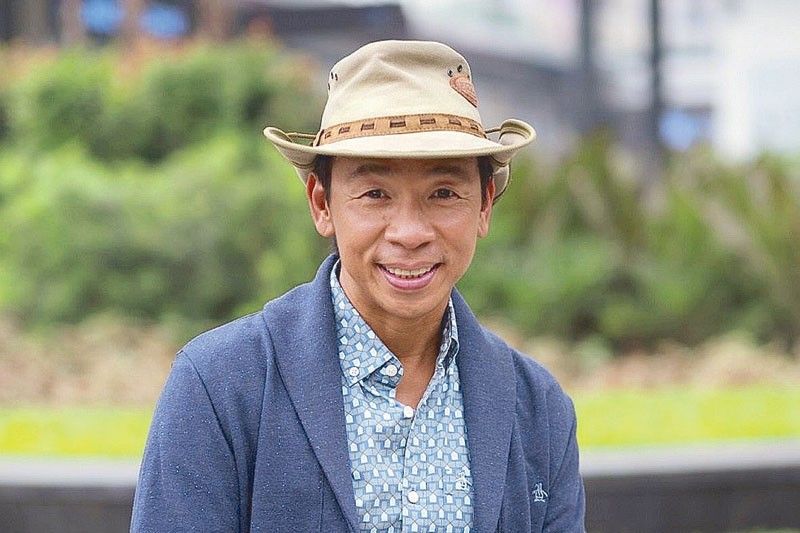
MANILA, Philippines — Kapamilya host Kim Atienza recalled a frightening incident he experienced from supporters of ousted dictator Ferdinand Marcos Sr.
In his Twitter account, Kim posted a photo of an old newspaper clip showing him.
Look what I found in my baul. #flashbackfriday 1986, In the failed Manila Hotel Coup d' etat attempt.
I've had so many close calls and am still alive only by His grace. Thank you for this life Lord. pic.twitter.com/DS6jnEWI42
“Look what I found in my baul. #flashbackfriday 1986, In the failed Manila Hotel Coup d’ etat attempt. I’ve had so many close calls and am still alive only by His grace. Thank you for this life Lord,” he wrote.
According to the old newspaper, Kim was beaten inside a comfort room in Manila Hotel.
“Isinalaysay ni Alejandro Atienza, anak ni NHA general manager Lito Atienza, kung paano siya kinulong sa banyo noong Lunes at binugbog ng apat na sundalong Marcos loyalists sa Manila Hotel at pinaamin na isa siyang komunista,” the caption in the photo read.
According to reports, the failed Manila Hotel coup attempt in 1986 was one of the six plots devised to overthrow then President Corazon Aquino which involved various members of the Armed Forces of the Philippines.
Recently, House of Representatives approved House Bill 7137 which seeks to declare September 11 as “Marcos Day” in Ilocos Norte.
Critics slammed the move as a form of historical revisionism with Marcos and his family being accused of massive corruption and countless human rights violations in the 1970s to 1980s.
Undelivered speech of Senator Benigno S. Aquino Jr.: Upon his return from the United States of America on August 21, 1983
I have returned on my free will to join the ranks of those struggling to restore our rights and freedoms through nonviolence.
I seek no confrontation. I only pray and will strive for a genuine national reconciliation founded on justice.
I am prepared for the worst, and have decided against the advice of my mother, my spiritual adviser, many of my tested friends and a few of my most valued political mentors.
A death sentence awaits me. Two more subversion charges, both calling for death penalties, have been filed since I left three years ago and are now pending with the courts.
I could have opted to seek political asylum in America, but I feel it is my duty, as it is the duty of every Filipino, to suffer with his people especially in time of crisis.
I never sought nor have I been given assurances or promise of leniency by the regime. I return voluntarily armed only with a clear conscience and fortified in the faith that in the end justice will emerge triumphant.
According to Gandhi, the willing sacrifice of the innocent is the most powerful answer to insolent tyranny that has yet been conceived by God and man.
Three years ago when I left for an emergency heart bypass operation, I hoped and prayed that the rights and freedoms of our people would soon be restored, that living conditions would improve and that blood-letting would stop.
Rather than move forward, we have moved backward. The killings have increased, the economy has taken a turn for the worse and the human rights situation has deteriorated.
During the martial law period, the Supreme Court heard petitions for Habeas Corpus. It is most ironic, after martial law has allegedly been lifted, that the Supreme Court last April ruled it can no longer entertain petitions for Habeas Corpus for persons detained under a Presidential Commitment Order, which covers all so-called national security cases and which under present circumstances can cover almost anything.
The country is far advanced in her times of trouble. Economic, social and political problems bedevil the Filipino. These problems may be surmounted if we are united. But we can be united only if all the rights and freedoms enjoyed before September 21, 1972 are fully restored.
The Filipino asks for nothing more, but will surely accept nothing less, than all the rights and freedoms guaranteed by the 1935 Constitution—the most sacred legacies from the Founding Fathers.
Yes, the Filipino is patient, but there is a limit to his patience. Must we wait until that patience snaps?
The nation-wide rebellion is escalating and threatens to explode into a bloody revolution. There is a growing cadre of young Filipinos who have finally come to realize that freedom is never granted, it is taken. Must we relive the agonies and the blood-letting of the past that brought forth our Republic or can we sit down as brothers and sisters and discuss our differences with reason and goodwill?
I have often wondered how many disputes could have been settled easily had the disputants only dared to define their terms.
So as to leave no room for misunderstanding, I shall define my terms:
1. Six years ago, I was sentenced to die before a firing squad by a Military Tribunal whose jurisdiction I steadfastly refused to recognize. It is now time for the regime to decide. Order my IMMEDIATE EXECUTION OR SET ME FREE.
I was sentenced to die for allegedly being the leading communist leader. I am not a communist, never was and never will be.
2. National reconciliation and unity can be achieved but only with justice, including justice for our Muslim and Ifugao brothers. There can be no deal with a Dictator. No compromise with Dictatorship.
3. In a revolution there can really be no victors, only victims. We do not have to destroy in order to build.
4. Subversion stems from economic, social and political causes and will not be solved by purely military solutions; it can be curbed not with ever increasing repression but with a more equitable distribution of wealth, more democracy and more freedom, and
5. For the economy to get going once again, the workingman must be given his just and rightful share of his labor, and to the owners and managers must be restored the hope where there is so much uncertainty if not despair.
On one of the long corridors of Harvard University are carved in granite the words of Archibald Macleish:
“How shall freedom be defended? By arms when it is attacked by arms; by truth when it is attacked by lies; by democratic faith when it is attacked by authoritarian dogma. Always, and in the final act, by determination and faith.”
I return from exile and to an uncertain future with only determination and faith to offer—faith in our people and faith in God.
CONVERSATION WITH MR. SWIFT / JULY 9, 2019 Robert Swift, counsel for the Marcos human rights victims recount his experience in fighting for the human rights victims claims in court during a forum at the Bocobo Hall, University of the Philippines, Dliman, Quezon City on Tuesday, July 9, 2019. INQUIRER PHOTO / GRIG C. MONTEGRANDE
CLASS ACTION Robert Swift (right), the American lawyer who led the successful class action lawsuit against dictator Ferdinand Marcos in Hawaii, speaks to a gathering of martial law victims on Tuesday at the University of the Philippines Diliman. He explained that in an unfortunate turn of events, the Hawaii court ruled to compensate only about 6,000 of the close to 10,000 who had originally filed the suit. —GRIG C. MONTEGRANDE
MANILA, Philippines — Martial law victims and their relatives who have been removed from the official list of people to be awarded compensation after winning a class action lawsuit for human rights violations against the estate of dictator Ferdinand Marcos in Hawaii confronted American lawyer Robert Swift on Tuesday about their delisting.
Swift, who spoke at the UP (University of the Philippines) Law Center about the historic Hawaii class action that resulted in a nearly $2-billion award for some 6,000 martial law victims, said he had no control over the Hawaii court’s decision to reduce the number of award claimants.
To claim compensation, victims or their relatives were required to submit claim forms twice, first in 1993, and again in 1999, after the Marcos family raised the matter of some “fake” claimants.
“We were one of the first to join the Hawaii lawsuit in 1986, but why were we delisted? There are a lot of us from Region 3 (Central Luzon), our husbands are listed as missing to this day,” a tearful Helena Jimenez said in Filipino during the open forum following Swift’s talk.
Jimenez and a handful of other martial law victims and their families borrowed money to travel as early as 3 a.m. to the forum to confront Swift.
US court ruling
Earlier this year, a US court directed the third compensation distribution, which amounted to $13.75 million to thousands of martial law victims who had won the Hawaii lawsuit, after finding Marcos liable for enforced disappearances, torture and extrajudicial killings.
The money was allocated for the victims in a settlement agreement reached in January as their share of $32 million obtained from the sale of four paintings, including a Monet, acquired by the dictator’s widow, Imelda, and part of their family’s ill-gotten wealth.
Also under the deal, the government was to receive $4 million and the remainder to be split between Golden Buddha Corp. and the estate of Roger Roxas, who reportedly discovered the so-called Yamashita treasure.
Of the initial class members of close to 10,000, however, only around 6,000 were allowed by the Hawaii court to receive compensation after they had completed the requirements for registration.
Administrative glitch
Some, like Carol Araullo, said she never got a notice to register a second time though she had not changed her address all these years.
“I am disappointed that it was some form of administrative glitch that was the basis to delist me, and many others,” Araullo said.
Swift, in his response to the angry martial law victims, admitted that thousands were delisted due to circumstances beyond the control of lawyers, such as the failure of the postal system to deliver letters in time.
He also explained that the delisting was “outside [his] control,” citing the US court order in 1999 for all original claimants to file new claims.
“They only gave me five weeks. We tried to get the word out, we sent letters to class members, we worked furiously to do that,” Swift said.
He said his group received a couple of thousands of new claimants, and that some who were on the list in 1993 did not receive letters to register again.
“In 2011, when there was finally money to distribute, the court ruled that claimants must have filed both times. There was an order and I have to abide by that order,” Swift said.
“In litigation, you don’t always get what you want. You try hard, but ultimately it’s up to the court to decide that,” he said.
He said he had hoped that the Philippine government, through Republic Act No. 10368, or the Human Rights Victims Reparation and Recognition Act of 2013, would compensate those who were delisted in the class action suit.
Lawyers’ fees
Former Commission on Human Rights Chair Etta Rosales, a martial law victim herself, defended the lawyers’ fees that Swift had requested in exchange for working on the class action for over 30 years.
Swift had requested fees equivalent to 30 percent, or $4.125 million, of the $13.75 million granted to members of the class suit.
According to Rosales, the American lawyer deserves to be paid for starting the legal battle back in 1986 against Marcos, which has resulted in monetary compensation for thousands of victims.
“How long ago was that? And this entailed the money of his office, and these entailed travels not only to the Philippines, to Switzerland, and to several other areas,” Rosales said, adding that Swift even “deserves more.”
(Editor’s Note: Below is an abridged version of the author’s story, “Lest We Forget,” which first appeared in a recent best-selling book on martial law, “Not On Our Watch.” After his martial law ordeal, Roberto S. Verzola went on to finish electrical engineering at UP, pioneered in the local computer industry and helped launch the green movement in the country. He currently promotes an ecologically benign method of farming and teaches math at UP.)
I graduated from Philippine Science High School in 1969 and entered the University of the Philippines (UP) the same year as a scholar of the National Science Development Board (now the Department of Science and Technology).
As a UP freshman on the Diliman campus, I was relatively unperturbed by the student activism that had begun to draw other members of my batch. Pampered as an honor student and government scholar, my future seemed secure.
The consecutive national elections of 1969, 1970 and 1971 were unique in Philippine political history. This string of highly political election years kept the nation in ferment, heightened the political awareness of the public, especially youth like us, and gradually brought the cauldron to a boil.
Things were coming to a head. As the specter of military rule started to become real, the Communist Party of the Philippines (CPP) launched an ambitious effort to recruit from among radicalized activists. I was one of them.
On Aug. 21, 1971, the Liberal Party (LP) rally at Plaza Miranda was bombed, killing several people and almost decimating the LP leadership. Immediately, [President Ferdinand E.] Marcos suspended the writ of habeas corpus. The suspension basically allowed the military to detain anyone indefinitely. What seemed a theoretical possibility was now becoming real. Marcos was, indeed, hell-bent on extending his rule, regardless of constitutional prohibitions.
After the writ suspension, the movement, to me, became the Movement, and eventually the Revolution. My distaste for government corruption, my desire to do good for the poor, and my early commitment to stand by my country rather than adopt a new more prosperous one—values I had picked up at the family dinner table which led me to activism in the first place—were giving way to class consciousness, revolutionary fervor and communist ideology.
Life in the underground
The declaration of martial law on Sept. 21, 1972, swept my niggling questions under the rug. As we entered this dark period of recent Philippine history, my life in the underground began. I turned 20 in November 1972.
I was part of a group that consisted mostly of journalists and writers. I was assigned to a team that worked on an underground newspaper in Filipino, which we called Taliba ng Bayan. For almost two years, I was part of the group that published Taliba ng Bayan.
On Oct. 4, 1974, I was in a meeting with members of the [CPP] Manila-Rizal Committee in a UG house in Valenzuela, Bulacan, when armed men broke into the door and I found myself face to face with a gun.
Body blows
I felt myself freeze and blanch before the muzzles pointed at my face. Shouts of “Down! Down!” brought me to my senses and I lay face down on the floor, as the raiding team settled down to identify the captives. I was one month short of my 22nd birthday.
Of all the body blows, I found it hardest to deal with those to the solar plexus. Exhale all the air in your lungs. Then force more air out—twice, three times—until you can squeeze nothing more out of your lungs. Hold your breath as long as you can. Now try to breathe in. If you somehow cannot, that’s how it feels to get well-placed blows to the solar plexus.
It leaves you gasping for breath, for air that won’t come because of the cramp on your diaphragm. The physical pain of fists hitting skin, muscles and bones recedes to the background, until it’s just you and the air that won’t come. (I wonder if Sisa’s Basilio in Rizal’s Noli felt the same, hung upside down and dunked into a well?)
At one point, when I felt I was about give in (the bone of contention was my uncle’s home address), I told myself to last a little longer. A few seconds more, a few minutes more. No, not yet. Then they would pause for the questions. And we’d go one more round.
Subconsciously, I felt that giving away my uncle’s address would be giving away nothing at all. It would, on the other hand, inform my relatives and subsequently my parents that I was in military hands.
But then I didn’t want to impose on my uncle and my aunt the terror of getting raided in their home. My frustrated interrogators probably did not realize it, but they were testing not my loyalty to the Movement, but my filial love for Auntie Orang, a cousin of my father, and her husband Uncle Domeng, who gave me sanctuary in the earliest days of martial law when I had nowhere to go.
Electric shock
After my Isafp [Intelligence Service of the Armed Forces of the Philippines] ordeal, I was “borrowed” by another intelligence unit for further interrogation. Lieutenant Garcia of the Metrocom Intelligence and Security Group (MISG) took me to Camp Panopio along Edsa near the PC [Philippine Constabulary] headquarters.
I told them the same story. They didn’t believe me. So they brought in the machine. Two lengths of wire extended from it, both ending with bare wire, the insulation stripped. One end was tied around the handle of a spoon.
The machine is a field generator, with a wheel with a handle. It probably generates 40-60 volts and, if turned really fast, may give as high as ninety volts or even more.
My interrogators tied the end of one wire around my right index finger and inserted the spoon into my pants, on my right waist, until it rested where the leg meets the lower abdomen, near the crotch. My body would complete the circuit.
When I was young, I used to watch my uncles and older cousins as they slaughtered a pig. As soon as the pig realized something bad was going to happen, it would shriek for dear life.
Shriek of terror
It was a grating shriek of helplessness, desperation, and terror, one that rang in your mind long after the pig was dead.
It was that kind of scream that issued from my throat every time my torturers spun the wheel around. It was totally involuntary, the automatic response of a body invaded by an alien current of a thousand spikes snaking through one’s cells and nerves. I could stifle it no more than I could stop my hand from jerking away when shocked briefly by live house wiring.
Across the aisle were two civilian Metrocom employees. They were women, apparently on overtime. They went on with their work, as if they heard or saw nothing. Business as usual.
No sign of surprise or concern. Metrocom apparently used the electric shock treatment often enough to make its civilian employees inured to screams.
Soft drink bottle
After less than a week at the Ipil detention center, I was called to the office, told to pack my things, and taken to another intelligence unit, the dreaded 5th CSU [Constabulary Security Unit], for further interrogation.
Until then, I had no idea that a soft drink bottle could be used for torture. I was made to squat inside a room with the air conditioner fully turned on, and the session began.
What I got were not the hard body blows that I had endured in Isafp, but sharp taps on my limbs with a soft drink bottle.
These taps were unlike the jarring shock of a chest blow or the asphyxiating cramp of an upper cut to the solar plexus. They brought instead a gradually growing numbness that became an ache that grew sharper as muscle, tendon, ligament, and bone began to get sore and the nerves on the skin became even more sensitive to pain.
The taps weren’t done in a hurry. In fact, they came at a deliberate pace. Starting with the left upper arm, gradually going down to the elbow and the forearm. And then the right upper arm.
Then the legs, one at a time. The knees, and the shins, finally. Have you ever bumped your knee or shin into a hard object? Remember, that was a single bump.
When they finally gave up on me, I was so sore I could hardly move. Reddish blotches had started to erupt all over my limbs, which soon turned bluish-violet and then almost black. Parts of my arms and legs had literally turned black and blue from the beating.
Dark blotches would remain visible almost two months later. When the blotches became unnoticeable, I was allowed to have visitors.
Plaza Miranda bombing
It was in the 5th CSU where I first heard it told and confirmed that the Party chairman had secretly ordered the Plaza Miranda bombing.
This information was not forcibly extracted but freely volunteered to us by conscience-stricken Party leaders in prison who were in the midst of their own soul-searching, perhaps suffering from pangs of guilt that the confessions helped ease.
Kumander Dante (Bernabe Buscayno, then commander in chief of the New People’s Army), supposedly shed tears when he learned about the Party’s role. I did too.
The Plaza Miranda revelations were a watershed for me. So, the Party had been telling us lies. And I had echoed the lies too, recalling the pieces on the Plaza Miranda bombing I had written in the Philippine Collegian, Taliba ng Bayan, and elsewhere. I was wracked with questions and doubts.
I didn’t realize then how much worse it could get. But, in fact, it did. Purges had happened in the Soviet Union under Stalin, in China under Mao, in Cambodia under Pol Pot, and possibly elsewhere too, when communists were already in power.
In the late 1980s, before they had even won power, those who professed belief in national democracy and wanted a dictatorship of the proletariat in the Philippines prefaced their mission with an internal purge. This purge left nearly a thousand or so of their own members and followers dead—after a horrible ordeal of interrogation, torture, and eventually, execution in the hands of their own comrades.
Self-cleansing
Although I would not immediately renounce my commitment to the national democratic movement, fundamental questions would flood back and I would replay in my mind all the internal debates many times.
It would take not months but years of self-cleansing, guided by nothing but my own conscience, before I could again face the world with confidence in my own system of beliefs.
For our generation, the horrors of martial law were common knowledge, especially because the postdictatorship President, Cory Aquino, was herself the wife of one of its victims.
But when Gloria Macapagal-Arroyo, following Marcos’ footsteps, was on the verge of imposing full military rule to cover up her own brand of corruption, yet not enough crowds formed to kick her out, I realized that subsequent generations never really knew what it meant to live under a dictatorship.
They have no memories of dictatorship. Unlike me, they don’t have marks on their bodies, bad dreams at night, or friends who died in the prime of youth to remind them.
When we of this generation go, our memories should not leave the world with us. No, we must never forget.