by MLC | Oct 25, 2015 | News
Source: Bantayog.org
September 1976, the Marcoses bought their first property in the U.S. – a condo in the exclusive Olympic Towers on Fifth Avenue in New York . Five months later they would also buy the three adjoining apartments, paying a total of $4,000,000.00 for the four and using Antonio Floirendo’s company, The Aventures Limited in Hong Kong, as front for these purchases.
October 13, 1977. Today, after addressing the UN General Assembly, Imelda celebrated by going shopping and spending $384,000 including $50,000 for a platinum bracelet with rubies; $50,000 for a diamond bracelet; and $58,000 for a pin set with diamonds.
The day before, Vilma Bautista, one of her private secretaries, paid $18,500 for a gold pendant with diamonds and emeralds; $9,450 for a gold ring with diamonds and emeralds; and $4,800 for a gold and diamond necklace.
October 27, 1977
The Marcoses donated $1.5 million to Tufts University in Boston, endowing a professorial chair in East Asian and Pacific Studies at the Fletcher School of Law and Diplomacy. The students and professors discovered this and forced the school to reject the donation. To save face, the Marcoses were allowed to finance several seminars and lectures.
November 2, 1977. Still at her shopping spree, Imelda paid $450,000 for a gold necklace and bracelet with emeralds, rubies, and diamonds; $300,000 for a gold ring with emeralds and diamonds; and $300,000 for a gold pendant with diamonds, rubies, and thirty-nine emeralds.
July 1978. After a trip to Russia, Imelda arrived in New York and immediately warmed up for a shopping spree. She started with paying $193,320 for antiques, including $12,000 for a Ming Period side table; $24,000 for a pair of Georgian mahogany Gainsborough armchairs; $6,240 for a Sheraton double-sided writing desk; $11,600 for a George II wood side table with marble top – all in the name of the Philippine consulate to dodge New York sales tax.
That was merely for starters.
A week later she spent $2,181,000.00 in one day! This included $1,150,000 for a platinum and emerald bracelet with diamonds from Bulgari; $330,000 for a necklace with a ruby, diamonds, and emeralds; $300,000 for a ring with heart-shaped emeralds; $78,000 for 18-carat gold ear clips with diamonds; $300,000 for a pendant with canary diamonds, rubies and emeralds on a gold chain.
After New York, she dropped by Hong Kong where a Cartier representative admitted it was this Filipina, Imelda, who had put together the world’s largest collection of gems – in 1978.
May 1979 The Marcos couple celebrated their twenty-fifth wedding anniversary in a party that cost $5,000,000.00 There was a silver carriage drawn by eight white horses.
November 23, 1978 A house was purchased at 4 Capshire Drive in Cherry Hill , New Jersey (actually near to Philadelphia where Bongbong was taking courses at that time) for use by servants and Bongbong’s security detachment.
The Marcoses did not neglect their annual real estate purchase. During this year and next year, 1979, they purchased two properties – one at 3850 Princeton Pike, Princeton – a 13-acre estate for use by daughter Imee as she attended Princeton.
The other was a house at 19 Pendleton Drive in Cherry Hill for use of Bongbong and under the name of Tristan Beplat, erstwhile head of the American Chamber of Commerce in the Philippines .
April 1979 in two days in New York this month, Imelda spent $280,000 for a necklace wet with emeralds and diamonds; $18,500 for a yellow gold evening bag with one round cut diamond; $8,975.20 for 20-carat gold ear clips with twenty-four baguette diamonds; $8,438.10 for 18-carat gold ear clips with fifty-two tapered baguette diamonds; and $12,056.50 for 20 carat gold ear clips with diamonds.
June 1980. For $1,577,000.00 in New York Imelda buys Webster Hotel on West 45th Street . She rewards Gen. Romeo Gatan as a limited partner. Gatan arrested Ninoy at the beginning of Martial Law.
The insurgents’ ranks grew by twenty percent a year. . Meritorious officers in the armed forces experienced low moral due to Marcos’ penchant for promoting friends over more deserving officers.
February 16, 1986. In Fe’s records of monies paid out during Marcos’ last campaign, one unusually large item was authorized by “FL” (First Lady) and paid to Assemblyman Arturo Pacificador on this day. A few days later, two carloads of men drove into San Jose , the provincial capital of Antique.
Evelio Javier, head of Aquino’s campaign, was watching the votes being counted when the men opened fire and killed Evelio after he was still able to run through town but finally got cornered in a public toilet where he was gunned down in front of shocked townspeople. Pacificador was later convicted of the murder.
February 25, 1986. Marcos fled the Philippines leaving behind a foreign debt of $27 billion and a bureaucracy gone mad. “Cash advances” for the elections from the national treasury amounted to Php 3.12 billion ($150 million). The Central Bank printed millions of peso bills, many with the same serial number. Sixty million pesos in newly printed bills were found in a vehicle owned by Imelda’s brother Bejo in the Port Area of Manila, and another Php 100 million aboard the MV Legaspi also owned by Bejo Romualdez.
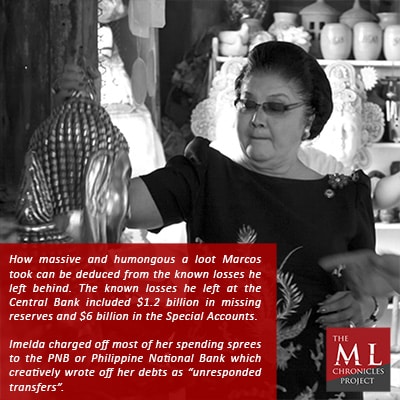
How massive and humongous a loot Marcos took can be deduced from the known losses he left behind. The known losses he left at the Central Bank included $1.2 billion in missing reserves and $6 billion in the Special Accounts.
Imelda charged off most of her spending sprees to the PNB or Philippine National Bank which creatively wrote off her debts as “unresponded transfers”.
Ver also used PNB funds to finance his “intelligence” operations.
The known losses at the PNB amounted to Php72.1 billion.
At the DBP, the losses Marcos left behind totaled Php85 billion; at the Philguarantee, it was Php 6.2 billion ;
and at the NIDC or National Investment and Development Corporation (NDC) – the losses amounted to Php 2.8 billion.
These losses were primarily due to cronyism – giving loans to cronies that had little or no collateral, whose corporations were undercapitalized, whose loan proceeds were not used for the avowed purpose, and where the practice of corporate layering was common, i.e. using two or more companies with the same incorporators and officers, whereby one company which gives the loan owns the company which obtains the loan, or similar arrangements.
The cronies enjoyed their closeness to Marcos. With him they formed a Grand Coalition. They participated in the exercise of dictatorship. But Marcos owned them. The wealth of the cronies belonged to him. Because of the free rides taken by Imelda, Marcos and the cronies, the Philippine Airlines was in debt by $13.8 billion.
The conservative Grand Total for losses Marcos left behind (and therefore the kind of loot he grabbed and hid) amounted to $17.1 billion. The Central Bank, the PNB, and other financial institutions badly need an audit. The special review (not regular audit because there seems not to have been any – there are no records anyway) did not uncover Imelda’s spending – her name never appeared – and Ver’s intelligence fund. The review gave no hint of theft or missing money, only “downward adjustments” and “proposed adjustments” to “deficiencies” and “shortages of money”.
February 26, 1986. A few hours after the Marcos party landed in Honolulu, their luggage arrived – 300 crates on board a C-141 cargo jet. It took twenty-five customs officers five hours to tag the bags and identify the contents. The process was videotaped because of all the money and jewelry found inside.
There were 278 crates of jewelry and art worth an estimated US$5 million. Twenty-two crates contained more than Php27.7 million in newly minted currency, mostly hundred-peso denominations worth approximately US $1,270,000. 00 (It was illegal at that time for anyone to depart the Philippines carrying more than Php500 in cash.)
There were other certificates of deposit from Philippine banks worth about US$1 million, five handguns, 154 videotapes, seventeen cassette tapes, and 2,068 pages of documents – all of which were impounded by Customs.
The Marcos party was allowed to keep only US$300,000.00 in gold and $150,000.00 in bearer bonds that they brought in with their personal luggage because they declared them and broke no US customs laws.
There were 24 one-kilo gold bars fitted into 2 0$17,000 hand-tooled Gucci briefcase with a solid gold buckle and a plaque on it that read, “To Ferdinand Marcos, from Imelda, on the Occasion of our 24th Wedding Anniversary.”
February 1986. When Marcos departed the Philippines, the losses in the three Central Bank accounts surpassed Php 122 billion (more than $6 billion). The big bulk of losses was attributed to the RIR account mainly due to two items: forward cover and swap contracts.
Forward cover referred to foreign exchange provided by the CB at a fixed exchange rate to importers of essential commodities. Swap contracts referred to CB’s receiving foreign exchange from banks in exchange for pesos at the prevailing rate with a promise to deliver the foreign exchange back to them at an agreed future date. There was no mention of losses due to CB transactions in gold or foreign exchange.
February 28, 1986. On this day, Jim Burke, security expert from the US Embassy, was tapping on the wooden paneling in Imelda’s abandoned Malacanang bedroom when he heard a hollow sound. It was the walk-in vault. Inside were thirty-five suitcases secured with locks and tape.
They contained a treasure trove of documents about Swiss bank accounts, New York real estate, foundations in Vaduz , and some notepaper on which Marcos had practiced his William Saunders signature. They also contained jewelry valued at some US$10.5 million.
March 16, 1986. Did Marcos steal any gold from the CB? The CB always refused to comment. Why?
Today, the LA Times reported that 6.325 metric tons of gold was unaccounted for in the Central Bank. Between 1978, the year Marcos ordered all gold producers to sell only to the CB, and end 1984, the Bureau of Mines reported that 124,234 pounds of gold were refined. But the CB reported receiving only 110,319 pounds during this same period.
That left a difference of 13,915 pounds (6.325 metric tons).
March 1986. Jokingly referring to themselves as the Office of National Revenge, a vigilante team led by Charlie Avila and Linggoy Alcuaz received a tip in the morning that Marcos’ daughter Imee had kept a private office in the suburb of Mandaluyong at 82 Edsa. They obtained a search warrant, then rushed to Camp Crame to pick up some soldiers.
After devising a plan, they boarded four cars and drove to the premises, arriving around midnight. The soldiers scaled a fence and sealed off the area. Avila , Alcuaz, and their men moved in and found documents in cardboard boxes, desks, and filing cabinets. Gunfire could be heard outside but it didn’t deter the search.
The documents revealed the names of offshore companies and overseas investments of Marcos and his cronies – a late link in the paper trail that had been started abroad by the teams of Avila, Steve Psinakis, Sonny Alvarez, Raul Daza, Boni Gillego, and Raul Manglapus.
March 09, 1986. A Greek-American, Demetrios Roumeliotes, was stopped at the Manila International Airport before he could leave with eight large envelopes stuffed with jewelry that he admitted belonged to Imelda – valued at US$4.7 million.
March 15, 1986. Ernie Maceda, Minister of Natural Resources, revealed today that some 7 to 14 tons of Philippine gold are sold to the Binondo Central Bank annually and then smuggled to Sabah , Malaysia – this gold being part of some 20 tons produced by 200,000 panners all over the country. Maceda’s query was whether part of the gold they produced was siphoned to the “invisible gold hoard of Ms. Imelda R. Marcos.”
“We deliver to the Central Bank,” the miners said. “If it happened (the siphoning), it happened in the Central Bank.”
Is it true that Marcos propagated the Yamashita myth to hide the fact that he looted the Central Bank, that its gold bars were melted down and recast in odd-size bars to make them look old (how does gold look old, anyway?). Marcos claimed that he “received the surrender of Gen. Yamashita” after a battle with his guerrilla outfit.
History has recorded that Yamashita surrendered to Lt. Co. Aubrey Smith Kenworthy and that there was no battle. Yamashita’s peaceful surrender had been arranged at least two weeks before the event.
In one entry in Marcos’ diary he noted, “I often wonder what I will be remembered for in history. Scholar? Military hero…?” In a supreme irony, he did achieve what he so vainly sought – lasting fame – but not in the way he envisioned:
The largest human rights case in history – 10,000 victims.
Guinness Book of Records – the world’s greatest thief.
The largest monetary award in history – $22 billion..
September 30, 1986. Questioned by Philippine and US lawyers about his hidden wealth, Marcos took the Fifth Amendment 197 times. Imelda followed suit – 200 times.
December 1989. An American jury found the Marcos estate liable for $15 million in the killing of anti-Marcos activists Gene Viernes and Silme Domingo. Manglapus, Psinakis, Gillego and other erstwhile exile oppositionists testified at the trial.
November 04, 1991. Today, a Sunday, the circus came to town. The Swiss Federal Tribunal had ruled the year before that the Philippine government must comply with the European Convention of Human Rights, especially due process. There had to be a lawsuit filed within one year. Thus, the solicitor general’s office filed all sorts of cases against Imelda and the government had to allow her to return to answer the charges.
“I come home penniless,” she tearfully said on arrival. She then repaired to her suite at the Philippine Plaza Hotel which cost $2,000 a day and rented sixty rooms for her entourage – American lawyers, American security guards and American PR firms.
December 1991. The Central Bank had accumulated losses of Php324 billion in the Special Accounts.
November 30, 1992. The Central Bank losses were Php561 billion and climbing. Cuisia asked that the CB be restructured. Sen. Romulo asked to see the 1983 audit of the international reserves. He couldn’t get a copy. It was “restricted” .
January 05, 1993. Imelda didn’t show up for the scheduled signing of a new PCGG agreement. She kept vacillating on the terms and conditions – demanding she be allowed to travel abroad for thirty-three days to confer with bank officials in Switzerland, Austria, Hong Kong and Morocco to work out the transfer of the frozen funds.
Actually she was hoping a guy she had authorized, J.T.Calderon, would be able to move the funds just as the order was lifted, before the government had a chance to transfer them to Manila . When the government discovered the authority, all negotiations with Imelda were halted and her requests for travel suspended.
August 10, 1993. Georges Philippe, a Swiss lawyer of Imelda, wrote today a confidential letter to the Marcoses’ old Swiss lawyer, Bruno de Preux, who handled almost all of the Marcos family’s hidden accounts in Switzerland . Philippe requested de Preux for the status of:
A $750 million account with United Mizrahi Bank in Zurich ;
Various currency and gold deposits at the Union Bank of Switzerland , at Kloten airport and at Credit Suisse;
A $356 million account (now in escrow and worth almost $600 million) which was being claimed by the PCGG.
In 1994, the human rights jury awarded the victims $1.2 billion in exemplary damages, then $766.4 million in compensatory damages a year after that, for a total of $1.964 billion. Two days after, another $7.3 million was awarded to twenty-one Filipinos in a separate lawsuit.
In 1995, the US Supreme Court upheld the $1.2 billion judgment.
March 29, 1995. The Swiss Parliament passed a law (an amendment to a previous act) that removed the need for a final judgment of criminal conviction of the accused (such as the Marcoses) in the case of criminally acquired assets which could now therefore be returned to claimants (such as the Philippine government) by Swiss court order.
July 1996. In part because of the torture of Roger Roxas, $22 billion was awarded to his Golden Budha Corporation.
December 10, 1997. The Swiss Supreme Court promulgated a landmark decision that took into account the March 1995 Swiss Parliament act and the fact that new criminal cases had been filed against Imelda Marcos.
The court held that there was no need for any criminal proceeding; that a civil or administrative proceeding would suffice, and the Marcos Swiss deposits which had been “criminally acquired” can be returned to the Philippines in deference to the final judgment of the Philippine court as to the ownership of these deposits.
The Swiss court also announced that the interest and reputation of Switzerland was at stake if it would become a haven for money launderers laundering money obtained by crime. Therefore, in the case of the Marcos deposits, because “the illegal source of the assets in this case cannot be doubted” the Swiss court ordered that the money be returned to the
Philippines to be held in escrow account in the PNB to await the judgment of the Sandiganbayan in the forfeiture case.
By the way, in January 17, 1975, a secret decree not made public until after the Edsa insurrection was signed by Marcos stating that in the event he became incapacitated or died, power would be turned over to Imelda.
On June 7, 1975, in his own handwriting, Marcos amended the January 17th decree and clarified imelda’s role as chairperson of committee with presidential powers.
In February 1979, Imelda was named chairman of the cabinet committee, composed of all ministries, to launch the BLISS (Bagong Lipunan Sites and Services) program, an ambitious attempt to centralize control of all economic and social development. She assumed responsibility for the “11 needs of Man” codified in her ministry’s multi-year Human Settlements Plan,1978-2000.
By 1986, the number of Filipinos living below the poverty line doubled from 18 million in 1965 to 35 million. And the ecological balance of the country had degraded from 75 % to 27% forest cover remaining – with 39 million acres of forest falling victim to rampant logging. This was BLISS.
She was also the head of the Metro Manila Commission, which by year-end 1985 had managed to accumulate debts of Php 1.99 billion (which included $100 million in foreign loans) in its ten years of existence. Imelda had accomplished nothing and left the people embittered and even more disillusioned.
In September 1992 Marcos was found guilty of violating the human rights of 10,000 victims. The ruling occurred just after a judge found Imee Marcos-Manotoc guilty of the torture and murder of Archimedes Trajano, a 21 year old engineering student at Mapua who had the temerity to ask Imee after a speech she gave whether the Kabataang Barangay (a national youth group) “must be headed by the president’s daughter?”
Imee and brother Ferdinand “Bongbong” Marcos, Jr. have been active in the political scene. Bongbong, who finished 3 terms as Ilocos Norte governor, is now running for Senator under Presidential bet, Manny Villar’s senatorial slate.. he’s been quoted as saying that if given a chance, he’d like to run for President one day…(gads) .
Bongbong is now a Senator, Imelda is Governor of Ilocos Norte and Imee is in Congress. The MARCOSES are back in full force thanks to our “despicable amnesia” as aptly described by the eminent writer, F. Sionil Jose.
by MLC | Oct 20, 2015 | News
A speech by Raissa Robles delivered at a forum sponsored by the University of the Philippines Third World Studies Center, in 2014
Translated into Filipino by Cha Coronel Datu
Original Source of speech: http://raissarobles.com/2015/10/20/pigilan-ang-pamilyang-marcos-sa-pagbubura-ng-kanilang-krimen-sa-ating-kasaysayan
Original English version: https://raissarobles.com/2014/02/09/stopping-the-marcoses-from-erasing-their-crimes-from-history/
Photo inspiration for artwork: tripod.com
Magandang umaga. Bago ako magsimula, meron muna akong isang kuwento sa inyo.
Dito sa building na ito, una kong nakilala si Imee Marcos. Siya ang gumanap noon na pangunahing aktor sa tagalog na bersyon ng isang dulang may pamagat sa Ingles na “Animal Farm”. Si Professor Jonas Sebastian ang direktor. At ako naman ang Stage Manager.
Naaalala ko na kinailangang baguhin ni Jonas ang ilang linyang bibigkasin ni Imee sa dulang ito kasi may pagkakahawig ang buod nito sa mga tunay na nangyayari sa ating bansa noong mga panahong iyon. Tungkol kasi ang “Animal Farm” sa isang rebolusyong nadiskaril.
Nagkataon naman noon, yun din ang nangyayari sa tinatawag ni Marcos na “Revolution from the Center”. Unti-unti na ring nadidiskaril noon.
Hanggang sa napatalsik na nga ng taong bayan si Marcos. Unti-unti, yung mga pumalit naman na gobyerno ay nagmistulang iba’t ibang bersyon na rin ng “Animal Farm”.
Ngayon ang pamilyang Marcos ay nakabalik na, at kung magsikilos ang mga ito ay para bang walang nangyaring “People Power Revolution” sa EDSA noong taong 1986.
Dumarami rin ang mga Pilipinong umaasang makakaupo sa pwesto si Bongbong Marcos sa Malakanyang. Marami sa mga Pilipinong ito ay ipinanganak pagkatapos na ng mga pangyayari sa EDSA.
Susubukan kong isalaysay ang mga kadahilanan kung paanong si Ferdinand Marcos – na isang brutal, mamamatay-tao at ganid na diktador – ay tinitingala na ngayon bilang bayani ng ilang mga nakababatang Pilipino, makalipas lamang ang dalawamput-limang taon ng kanyang pagkamatay at dalawamput walong taon naman pagkatapos ng kanyang diktadura.
Susubukan ko ring ilahad kung papaanong ang kanyang asawang si Imelda at kanilang tatlong anak ay nakabalik na ngayon sa hanay ng mga nakakariwasa at nakakaangat sa ating lipunan. Bukod diyan ay hinahangaan pa nga sila ngayon.
Isa itong mahalagang aral sa mga kurakot : Magnakaw nang kaunti, sa kalaboso ang bagsak mo. Mas mabuti na ang magnakaw ng sukdulan katulad ng mga Marcos.
Tahasan kong ginagamit ang salitang “pagnanakaw” dahil ang hukuman mismo ng bansang Switzerland ang nagsabi, sa isang makasaysayang paghahatol noong 2003, na ang perang tinago ng mga Marcos sa mga bangko sa kanilang bansa ay galing sa kriminal na pamamaraan. Mahigit na isang bilyong dolyar na kabilang sa nakaw ng mga Marcos ang ipinabalik ng hukuman ng Switzerland sa Pilipinas.
Kung ganon naman pala, bakit wala ni isa man sa mga Marcos ay na-kalaboso? Bakit tatlo sa kanila ang ngayon ay nakaupo sa posisyon at may hawak nang kapangyarihan?
Meron akong nakikitang tatlong kadahilanan.
Una – Ang henerasyon na nagpatalsik sa mag-asawang diktadura ay nag-akala na dahil sa kanilang pagiging sobrang brutal at gahaman sa pagpapayaman at pagtamasa ng kapangyarihan, hindi na kailangan pang ipaalala pa sa mga tao ang tungkol dito.
Nakalimutan ng henerasyong nag-People Power na isa-dokumento o itala ang mga kalabisan ng mga Marcos para sa kaalaman ng mga sumunod na henerasyon.
Meron din namang naisulat si Nick Joaquin na librong pinamagatang “Quarter of the Tiger Moon” at nariyan din yung “coffee table book” tungkol sa People Power.
Ngunit hanggang ngayon , ang librong “History of the Filipino People” na isinulat ng mananalaysay mula sa UP na si Teodoro Agoncillo at siyang ginagamit ng maraming paaralan sa pagtuturo ng kasaysayan (History) ay hindi pa rin nababago, hindi pa rin naidagdag ang mga kapanahunang namayani si Marcos at pati na ang maraming taon na sumunod pa pagkatapos nito
Dahil dito, ang mga sumunod na henerasyon ay walang kaalam-alam kung bakit si Malakas at Maganda – ang Makapangyarihan at ang Maganda – na ginawang alamat ng mag-asawang Marcos tungkol sa kanilang sarili – ay si Marahas at si Mapurot sa tunay na buhay.
Sa Waray, ibig sabihin ng “mapurot” ay pangit at hindi kanais-nais.
Marami kasi sa mga intelektuwal ay naki-kuntsaba sa mga Marcos. Naging propagandista sila at sumulat ng kung anu-anong mga lathalaing pinapagawa ni Marcos noon. Kaya naman nahihiya silang ipaalam sa lahat ang kanilang ginawa sa panahon ng Martial Law.
Yung building kung saan naroon ang UP Asian Center dati ang naging sentro noon ng mga tagapag-isip at tagapag- saliksik o think-tank ng mga Marcos. Ang tawag dito dati ay ang Philippine Center for Advanced Studies o PCAS. Ang kanilang pinuno ay si Col. Joe Almonte. Kahit anong pag-aaral ang iutos ni Marcos, ginawa nila ito.
Alam ko ito dahil bilang isang bagong gradweyt sa kolehiyo noon, nag-trabaho ako doon bilang tagapag-sulat ng mga “script” sa radyo na kasama sa seryeng pinamagatang Kasaysayan ng Lahing Pilipino. Umalis na ako bago naging paksa ng seryeng ito si Marcos.
Sa kawalan ng malawakang ulat sa ating Kasaysayan na tumatalakay sa rehimen ni Marcos, nagawa ng pamilyang Marcos na ibenta sa mga bagong henerasyong botante ang mga sumusunod na kasinungalingan :
1. Na ang Martial Law ay isang mabuti at makataong diktadura
2. Na walang naging mga biktima ng pang-aabuso sa mga karapatang pangtao noong panahon na iyon. Ang sabi pa nga ni Bongbong, yun daw mga nagsasabing biktima sila ay naghahangad lamang ng kabayarang salapi.
3. Na ang ating ekonomiya ay naging maunlad sa panahon ni Marcos.
4. Na si Marcos ang pinakadakilang Presidente dahil nakapagpatayo siya ng mga gusaling tulad ng Cultural Center, Folk Arts Theater, Film Center, Heart Center, Kidney Center, Lung Center, at San Juanico Bridge. Makikita ninyo ang mga ganitong pagpapahayag sa “social media” tulad ng Facebook at Youtube.
Isa-isa kong tatalakayin ang mga ito.
Tinawag ni Marcos ang kanyang rehimen na isang mabuting diktadura (benevolent dictatorship), o martial law daw na nakangiti. Ang katotohanan – takot ang namayani sa buong bansa at ang sinasabing ngiti ay pangiwi.
Sa paaralang Katoliko na pinasukan ko, isang direktiba galing sa mga madre ang agad ipinaabot sa aming mga estudyante. Sa aming pananghalian o “lunchtime”, bawal na daw ang kumain ng tatlo-tatlo o mahigit pa. Dahil ang ganitong paggu-grupo ay itinuturing na labag sa batas o “illegal assembly” sa Martial Law.
Ano ba naman kaya ang nalalaman ng mga kababaihang teen-ager tungkol sa pagiging subersibo? Ni hindi ko nga alam ang ibig sabihin nito noon.
Ngunit ganyan na lamang ang ginawang pagsupil ni Marcos sa taong-bayan.
Ang mga militar at kapulisan ay maaaring basta na lamang dumampot ng sinuman mula sa mga kalye o kaya ay mula mismo sa kanilang mga bahay.
At kailangan noong maging maingat ang bawat isa sa pagbibiro tungkol sa mga Marcos at sa Bagong Lipunan.
Noon na lamang mapatalsik ang mga Marcos tuluyang napagtanto ng mga Pilipino ang tunay na kagimbal-gimbal na larawan ng pang-aabusong naganap sa panahon ng Bagong Lipunan. Hindi babababa sa sampung libo ang bilang ng mga pinatay o kaya ay pinahirapan at tinortyur.
Heto ang ilang pagbibilang na magpapakita kung gaano kasamâ ang sitwasyon ng pang-aabuso sa mga karapatang pangtao at kung gaaano rin karami ang bilang ng mga nagtangkang tumutol sa Bagong Lipunan – habang namamayani bilang isang diktador si Marcos at habang ang kanyang asawang si Imelda na Ministro ng Pagpapabahay (Human Settlements) ay nagpapasasa sa pagsiya-shopping sa ibang bansa, may tinatayang pitong daang biktima ang nadadagdag kada buwan sa bilang ng mga biktima ng pang-aabuso.
Ibig sabihin sa bawat araw na siya’y nasa kapangyarihan, may dalawamput tatlong bagong biktima araw-araw. O sa loob ng kanyang labing-apat na taong pagiging diktador, may isang Pilipinong pinatay o tinortyur sa bawat isang oras.
Pati ang magandang gubernador ng Ilocos Norte na si Imee Marcos ay may dugo rin sa kaniyang mga kamay. Isang estudyante mula sa Mapua, si Archimedes Trajano, ang minsang nagtanong sa kanya – dapat bang ang anak ng Presidente ang mamuno sa Kabataang Barangay?
Ilang araw pagkatapos ng kanyang pagtatanong na ito kay Imee, natagpuan na lamang si Trajanong patay na. Sabi ng mga imbestigador, napatay daw siya sa rambulan ng mga fraternity.
Naghabla ang ina ni Trajano sa Amerika laban kay Imee Marcos. Nanalo ang kanyang ina sa kaso.
Bagamat hindi ako naging aktibista, alam ko ang mga nangyayaring pang-aaresto dahil ang aking amang propesor sa UP Law ay may ginampanang papel sa pagpapalaya sa ilan sa mga naaresto. Isa rito si Gerry Barican. Hindi ako sigurado kung ang isa pa ay si Herminio Sonny Coloma. At ang isa sa kanila, sa palagay ko, ay siguradong magpapa-iling sa aking yumaong ama sa kabilang buhay. Ang pangalan niya ay Gary Olivar – yung propagandista ni Presidente Gloria Arroyo.
Ang kapansin-pansin dito ay lahat silang tatlo ay naging presidential spokesman o tagapag-salita ng pangulo.
Nakukuha ko nang tumawa ngayon tungkol dito. Pero noong panahong iyon, ang mga ginawang pagtulong ng aking ama ay nagbunga ng hindi maganda para sa aming pamilya. Bigla na lang sinabi ng BIR (Bureau of Internal Revenue) na hindi sila makapaniwala na kami ay mahirap. Kung bumisita lang sana sila sa bahay namin, naliwanagan sana sila sa kanilang sinsasabing hindi maipaliwanag na kahirapan ng aming pamilya.
Paulit-ulit na sinisingil kami ng BIR na magbayad ng mas mataas na buwis. Lumapit ang aking ina sa aming kapitbahay na empleyado sa BIR para humingi ng tulong. Sabi sa kanya, maaayos na daw yung “assessment” para sa taông iyon kung meron kaming maiaabot na padulas para sa ilang taga-loob ng BIR.
Tuwing nangyayari ito noon, kinukuha ng nanay ko sa aming budget para sa pagkain ang pambayad. Naaalala ko pa na kung minsan nakakabili lamang kami ng pagkain dahil lang nakasingil ang nanay ko sa isang customer na nagpapatahi sa kanya.
Kaya nga kahit hindi ako aktibista, alam ko kung ano ang nagiging resulta kapag hindi ka sumunod o umayon kay Marcos.
At hindi lang yan, hinawakan ni Marcos at ng kapamilya ni Imelda na mga Romualdez ang pamamalakad sa media – sa tv, sa radio at sa radio.
Hindi ipinapakita ng media noon ang tunay na mga nangyayari sa digmaan sa Mindanao – ang digmaan kung saan sina Nur Misuari, Hashim Salamat at Murad Ebrahim ay nagkakaisa at sama-sama pang nakikipaglaban sa ilalim ng Moro National Liberation Front.
Tinatayang animnapung libo hanggang walumpung libong sibilyan at mga rebelde ang namatay sa Mindanao noong 1972 hanggang 1976. Mahigit sa isang milyong residente naman ang nagsilikas.
Binago ni Marcos ang mapa ng bahaging iyon ng Pilipinas, tinanggal ang Palawan sa Mindanao at pinaghati-hati ang natira upang pamunuan ng mga kumander ng kanyang hukbong sandatahan.
Ang mga ginawa ni Marcos sa Mindanao at ang kawalan ng kaalaman ng mga taga-Luzon tungkol dito ang mga naging pugon upang magkaroon ng kakulangan ng pagtitiwala sa pagitan ng mga taga-Mindanao at taga-Luzon. Nakapagdagdag rin ito sa kakulangan ng pag-unawa hinggil sa layunin ng mga Muslim sa pagnanais ng awtonomiya.
Pag-usapan naman natin ngayon ang mga nagawa o “achievements” ni Marcos noong Martial Law. Totoong ipinatayo nga niya ang mga building at pati na ang tulay na nabanggit ko sa umpisa sa loob ng dalawampung taon niyang nasa kapangyarihan – mula December 30, 1965 hanggang February 25, 1986.
Pero magkano? At magkano rin ang kanyang komisyon? Yung kanyangtongpats?
Noong maging Presidente si Marcos noong 1965, ang utang o foreign debt ng ating bansa ay kulang-kulang sa isang bilyong dolyares (US$1 B) lamang. Nang umalis siya at ang kanyang pamilya, lumobo na ang ating utang at umabot ng dalawamput-pitong bilyong dolyares (US$27B), halos dalawamput-anim na bilyon ang nadagdag (US$26 B). Ibig sabihin mahigit sa isang bilyong dolyar ang nadagdag bawat isang taon na nakaupo si Marcos.
Sa estimasyon ng “Presidential Commission on Good Government” na binuo noong 1986, ang halagang ninakaw ng mga Marcos ay umabot sa sampung bilyong dolyar (US$10 B). Ang halaga ay kuwarenta porsiyento (40%) ng halagang inutang ng kanyang rehimen.
Yung mga nagmamahal kay Marcos, hindi nila binabanggit ang mga pagkakautang na iniwan niya. Hindi rin nila binabanggit ang isa pang naging bunga ng pamamahala ni Marcos sa ating bansa – ang napakalaking pagbagsak sa halaga ng ating piso.
Nang manalo sa eleksyon si Marcos noong 1965 taglay ang pangakong muling dadakilain ang ating bansa, ang isang dolyar ay katumbas ng tatlong piso at nobenta sentimos (P3.90) lamang.
Noong idineklara niya ang Martial Law para daw bumuo ng isang Bagong Lipunan, bumagsak na sa anim na piso at pitumput-pitong sentimo (P6.77) ang katumbas ng isang dolyar. Noong napatay si Benigno Ninoy Aquino noong 1983, sumubsob sa halagang labing-isang piso (P11) ang katumbas ng bawat dolyar. Nang lumayas na ang mga Marcos noong 1986, dalawampung piso (P20) na ang katumbas nito.
Yan ang mga tutoong nagawa ni Marcos – mahigit dalawamput-limang bilyong dolyar (US$25 billion) na naidagdag sa ating pagkakautang, ang pagbagsak ng piso mula sa P3.90 na umabot sa P20 katumbas ng isang dolyar, at posibleng dalawampung bilyong dolyar (US$20 billion) na suhol.
Bukod pa dito, nariyan din ang napakaraming mga mahihirap na katulad ng inilalarawan ng Smokey Mountain. Nariyan din ang napakaraming Pilipinong ini-export o ipinadala sa Middle East upang maging mga mumurahing trabahador sa ibat-ibang bansa.
Pag-isipan ninyo ito: Ayon sa paghahatol ng dating Chief Justice ng Korte Suprema na si Renato Corona noong 2003 sa Kasong Sibil 0141 o yung “civil forfeiture case” laban sa mga Marcos, ang kanilang “net worth” noong umalis sila ay $US957,487.75 – o di hihigit sa isang milyong dolyar lamang.
Paano ngayon maipapaliwanag yung halagang US$356 M na nakalagay sa kanilang mga “account” sa bangko sa Switzerland na hindi na pinagalaw ng pamahalaan ng Switzerland mula noong 1986 at bagkus ay ipinabalik sa Pilipinas pagkatapos.
Idagdag pa natin ito – paano ipapaliwanag ni Imelda Marcos ang tatlong koleksyon niya ng mga alahas na nagkakahalagang apat na milyong dolyar (US$4 M). Isa sa mga koleksiyon na ito ay ipinabalik na sa gobyerno ng Pilipinas. Pero kailan lamang ay lumapit pa si Bongbong sa Korte Suprema at umapela na baligtaran ang desisyon ng korte dahil hindi naman daw talaga isinama ang koleksyong ito ng ating gobyerno sa kanilang kaso (forfeiture suit sa Korte Suprema).
Mayroon pa siyang isang sinabi na makatawag pansin – sabi ni Senador Bongbong Marcos ya kailangang humingi ng patawad si Presidente Benigno dahil sa palpak na pag-rescue sa mga taga-Hongkong na naging hostage doon sa insidente sa tourist bus noong 2010. Sabi niya hirap raw siyang intindihin yung pagtangging humingi ng patawad.
Si Bongbong Marcos at ang kaniyang pamilya kahit kailanman ay hindi humingi ng patawad sa kanilang mga biktima ng pang-aabuso ng karapatang pantao. Para sa kanila, walang mga naging biktimang ganito.
Dahil sa mga ganitong pagkilos at pananalita, maaari nating maisip, bakit ba talaga gusto ni Bongbong maging Presidente. Dahil kaya para mabasura ang mga kaso tungkol sa kanilang pamilya at mapigilan ang pagkumpiska sa kanilang kinulimbat na yaman?
Nagpahiwatig na ang gobyerno na isusubasta ang mga alahas.
Isa yang malaking pagkakamali. Ang mga alahas ay pag-aari ng mga Pilipino. Ang naging kabayaran ng mga ito ay ang dugo ng mga inabuso ng rehimeng Marcos at ang kanilang mga bigong pangako ng ating magandang kinabukasan. Ang mga ito ay dapat maging bahagi ng ating paggunita sa napakalaking nakawan at katiwalian na naganap sa panahon ng diktadura, upang hindi na ito mangyari pang muli.
Alam ba ninyo na sinubukan kong kuhanan ng retrato ang mga alahas na ito noon sa PCGG at ang sabi sa akin ay hindi pa daw pwede dahil ito ay nasasa-ilalim pa ng paglilitis. Pero alam ba ninyo, itong mga alahas na ito ay nalathala na sa isang “coffee table book” na may pamagat na “Thoroughly Imeldific”.
May pagkakamali sa kung papaano nai-ukit sa ispan ng maraming Pilipino ang alaala ng mga alahas na ito. Inilalarawan si Imelda na isang tagapagtaguyod o “patroness” ng sining at mapagmahal sa “katotohanan, kabutihan, at kagandahan”. Hindi na sumagi sa isip na ang tunay na dapat maala-ala sa mga alahas na ito ay ang kaniyang pagiging “shopaholic”, na walang patumanggang ginamit niya ang mga buwis na ibinayad ng taong bayan para sa kanyang pansariling kasiyahan. Ang perang nilaspag niya ay nagamit na lang sana upang tulungan ang maraming Pilipinong naghihikahos sa buhay.
Para sa mga tulad ni Irene Vinluan na tagahanga ng mga Marcos, ang mga ganitong pagpapasikat ng kanilang katiwalian ay balewala lamang. Ito ang isinulat niya sa Facebook page ng anak ni Marcos na si Imee :
“I love the Marcoses! During the time of his Presidency, despite of his corruption, at the same time, he also did good for the country, the streets was cleaner, not much street crimes, the Philippines was one of the richest in Asia.”
(Mahal na mahal ko ang mga Marcos. Noong panahon na siya ang pangulo, kahit siya ay korap, kasabay nito, may mabuti pa rin siyang ginawa sa ating bayan, malinis ang mga kalye, konti lang ang krimen, ang Pilipinas ay isa sa pinakamayaman sa Asia.)
Palitan natin ang pangalang Marcos ng Hitler at gamitin ang Germany sa halip ng Pilipinas, at basahin ng ganito :
Mahal na mahal ko si Hitler. Noong panahon na siya ang Chancellor, kahit siya ay korap, kasabay nito, may mabuti pa rin siyang ginawa sa ating bayan, malinis ang mga kalye, konti lang ang krimen, ang Germany ay isa sa pinakamayaman sa Europe.
Hindi kanyo makatwiran?
Mali. Si Marcos mismo ang nagsabi na isa sa mga pinag-aralan niya bilang paghahanda sa pagdeklara ng Martial Law ay kung paano nakuha ni Hitler ang kanyang kapangyarihan sa Germany.
Siyanga pala, hindi tutoo na walang Marcos na nahatulan ng husgado ng pagiging kriminal. Si Imelda Marcos ay nahatulang nagkasala ng krimeng korapsyon noong September 24, 1993 at nasentensiyahan ng dalawamput-apat na taon sa kulungan. Ngunit sa di maipaliwanag na dahilan – o kaya ayon sa iba ay maliwanag naman na dahilan – ang Solicitor General noon ni Presidente Fidel Ramos ay ibinasura yung kaso at sinabihan ang Korte Suprema na mali sila sa pag-akusa kay Imelda.
Ang pangalawang dahilan kung bakit halos nabaon na sa limot ang mga kasamaang nagawa ng mga Marcos ay dahil sinamantala nila at ng kanilang mga taga-suporta ang ilang kaugaliang Pilipino upang maipakalat ang kanilang bersiyon ng mga pangyayari.
Heto ang mga ugaling tinutukoy ko :Ang una ay ang paggalang sa mga nakatatanda.
Ginamit ito ni Marcos at nagpatawag ng “Apô” , na ibig sabihin sa Ilokano ay nakatatandaang lalaki na may awtoridad.
At si Imelda Marcos naman, kahit gaano pa katawa-tawa kung magsalita at kahit pa naman napakalaki ng kanyang idinagdag sa ating mga pagkakautang dahil sa kanyang bisyong pagsiya-shopping , binbigyan pa rin siya ng respeto dahil matanda na siya.
Isa sa mga malinaw kong ala-ala noong araw na lumisan ang mga Marcos ay ang aking pagbisita sa Malakanyang. Bilang isang reporter tungkol sa pulitika para sa diyaryong Business Day, nakapasok ako sa palasyo at pinahintulutang lumigid kahit saang parte nito.
Si Bea Zobel na asawa ni Jaime Zobel at ang kanyang kaibigan na si Mercy Tuazon ay nasa loob rin at tumutulong sa pag-imbentaryo ng mga naiwang gamit ng mga Marcos.
Nakita mo na ba ang Rustan’s? , tanong ng isa sa kanila sa akin. Sabi ko hindi.
Dinala nila ko sa isang silid sa likod ng kuwarto ni Imelda. Lahat ng sapatos niya nandoon. At ang napakaraming salansan ng kanyang mga panty at bra. Pero ang isang nakatawag ng aking pansin ay yung nasa loob ng kaniyang banyo. Isa itong MALAKING botelya ng isang mamahaling pabango na halos sinlaki ko at halos puno pa ang laman. Palagay ko hindi kayang ubusin ang laman noon kung mag-spray ka lang araw-araw, mauubos lang ito kung ipapaligo ang laman nito.
Naala ko rin na bawat kuwarto ay may mga bungkos ng mga nalantang bulaklak. Malaking halaga daw ang gastusin noon ni Imelda sa mga bulaklak na imported, ayon sa pag-uulat ng PCGG.
Nang mamatay si Ferdinand Marcos noong 1989, isa pang ugaling Pilipino ang napakinabangan ng kaniyang pamilya : Huwag kang magsalita ng masama tungkol sa isang yumao na.
Ang gawing ito ay sumasalungat sa tamang pagsusulat ng ating kasaysaysayan. Sa pagkakaalam ko, iilan na lamang ang kumukuha ng kursong History sa UP. Hindi ito nakakatuwa. Ito ay nakakalungkot. Ang isang bansa ay hindi makakasulong kung hindi ito matututo sa mga aral ng kasaysayan.
Saludo ako sa mga taong patuloy na sumusulat tungkol sa kasaysayan kahit hindi ito pagkakakitaan ng maraming pera.
Ang pangatlong kaugaliang Pilipinong ibinabato ng mga Marcos sa mga tumutuligsa sa kanila ay ito – Patawarin mo ang iyong mga kaaway.
Ang isang taong hindi nagpapatawad sa kanyang mga kaaway ay napapagsabihang mapaghiganti. At kung siya ay pulitiko, sinasabing ginagamit niya ang pulitika sa paghihigant1.
Naalala ko noong presidente si Corazon Aquino, ang sabi ni Manoling Morato na Chairman noon ng Board of Censors, dapat raw tigilan na ang pagsasalita ng hindi maganda tungkol kay Marcos upang sa gayon ay mamayani na ang pagkakaisa ng lahat.
Inaani natin ngayon ang resulta ng payong ito, hanggang ngayon, ipinagpipilitan ng mga anak ni Marcos at ng kanyang asawa na walang ginawang masama si Marcos, walang naging pang-aabuso sa mga karapatang pantao, at siya ang pinakadakilang Presidente ng Pilinas.
Ang pang-apat na kaugaliang Pilipinong babanggitin ko ang pinakamalaking banta sa ating kinabukasan – Huwag isisi ang mga kasalanan ng ama sa kanyang mga anak.
Pati na ang aktibista at dating Congressman na si Satur Ocampo, ipinagtanggol ang kataka-takang pakikipag-alyansa ng Bayan Muna kay Bongbong Marcos noong 2010 sa pamamagitan ng paggamit ng argumentong ito. Sabi ni Ocampo hindi raw sila mangongolekta sa anak.
Ngunit yung anak ay matagal nang kasabwat ng ama at ina. Dati ay sinubukan pa nga niyang gamitin ang isang taong pinag-utusang mag-withdraw ng itinago nilang pera sa Switzerland. At ang anak rin na ito ang siya ngayong legal na tagapamahala ng mga naiwang ari-arian ng ama. Bago pa man nito, itong anak rin na ito ay isa sa mga nakapangalang benepisyaryo ng US$356M na kinulimbat ng ama at inilagak sa bangko sa Switzerland.
Itong mga lihim na bank account sa Switzerland ay ginamitan nila ng mga alyas o ibang pangalan. Pero pumirma naman ang mag-asawang Marcos ng mga hiwalay na dokumentong nagsasabing pag-aari nila ang mga nasabing bank account. Pumirma rin sila ng mga dokumentong nagsasabi kung sino ang mga magiging benepisyaryo o tatanggap ng pera kung sila ay mamatay.
Noong Pebrero, 2011, pinalad akong mapatabi kay Bongbong Marcos sa isang pananghaliang ginanap sabay ng press conference ng Foreign Correspondents Association of the Philippines, nakapagbigay ako sa kanya ng ilang katanungan.
Bilang sagot sa aking mga tanong, sinabi niya na ipagpapatuloy niya ang mga hakbang upang magkaroon ng kasunduan o compromise settlement sa pagitan nila at ng gobyerno tungkol sa mga kaso ng mga Marcos at mga ari-ariang hinahabol sa kanila ng pamahalaan. Ngunit hindi niya kinumpirma na kasama siya sa mga benepisyaryo ng mga perang nasa bangko sa Switzerland.
Ito ang kanyang tinuran ng tinanong ko kung pwede niyang ikumpirma na isa siya sa mga nakapangalang benepisyaryo ng milyung-milyong dolyares na nakalagak sa bangko sa Switzerland:
“I cannot confirm because I haven’t seen or read them. We – I don’t know. I cannot – I cannot say that I know. Definitely the Swiss money were there. Or are there now. It’s for us – again this constant – that people are saying – more and more participating in that –”
(Hindi ko maaaring makumpirma kasi hindi ko nakita o nabasa ito. Kami – ako ay walang alam. Hindi ko maaari – hindi ko masasabing alam ko. Siguradong nandoon ang pera sa Switzerland noon. O nandoon nga ngayon. Ito ay para sa amin – muli, ito ay paulit-ulit – na sinasabi ng mga tao – parami nang parami ang nakikisali diyan -)
Kaawa-awang bata, hindi daw niya nabasa. Samantalang ako, nabasa ko mismo ang kopya ng mga dokumentong naiwan ng kanilang ama sa Malakanyang nang nagmamadali silang umalis noong Pebrero 1986.
Hindi naman nakapagtatataka na sinusubukan ng mga anak ng diktador na ibalik sa larangan ng pulitika ang pangalan ng kanilang ama.
Halimbawa, maraming mga okasyong ginaganap sa Ilocos Norte sa pangunguna ni Gubetnador Imee Marcos na ang pakay ay para bigyang papuri ang kanilang amang si Ferdinand Marcos. Noong nakaraang taon ginanap ang mga ito:
1. “President Marcos Cup” para sa mga mahilig sa pamamaril
2. Isang rock concert na pinangalanang “Da Real Makoy Concert 2”
3. Isang sayaw na tinawag ng “Marcos Fiesta 2013 Flash Mob” tungkol sa buhay ni Marcos
4. At ang labanan sa pagdedebate, “The First Ferdinand Marcos Sirib Intercollegiate Debates 2013
Yung birthday ni Marcos, September 11, tinatawag nilang Marcos Day.
Nagpa-contest si Imee Marcos ng “Little Macoy at Little Imelda Sing-alike”, meron din “Marcos Quiz” , at may “Marcos Heritage Trail Free Tour”.
Noong 2012, nagpalathala ang pamilyang Marcos ng isang libro tungkol sa sining at kultura noong panahong presidente ang kanilang ama.
At siyempre, nandiyan din yung patuloy na pag- display ng waxed figure o pigura ni Marcos pati na ang isang museo sa kanyang ala-ala.
Ang pakay ng lahat ng ito ay upang mapagtibay ang bersyon ng mga Marcos ng kanilang papel sa ating kasaysayan. Noong wala pang Facebook at Twitter, ang mga ito ay nagagawa lamang nila sa Ilocos. Pero ngayon, hindi na.
Ginagamit na rin ng mga Marcos ang Facebook at YouTube para palabasing ang kanilang ama ang pinakadakilang presidente ng Pilipinas.
Paano nagbago ang pananaw tungkol sa mga Marcos?
Ang Social Weather Station (SWS) ay nagsisiyasat tungkol sa sentimyento ng mga Pilipino tungkol kay Marcos. Noong 1998, labindalawang taon matapos siyang mapa-alis , nagsagawa sila ng isang survey at ikinumpara ito sa mga nakaraang survey.
Ito ang kanilang mga napag-alaman :
1. Tungkol sa panukalang “si Marcos ay magnanakaw ng kayamanan ng bansa”, ang opinyon ng publiko ay nagbago mula sa hindi kaaya-aya (unfavorable) noong 1986 ay naging “neutral” o walang kinikilingan noong 1995 at 1998.
2. Tungkol sa panukalang siya ay “isang brutal at mapang-aping presidente”, nagbago rin ang sentimyento ng mga publiko mula sa hating opinyon noong 1986 ay naging kaaya-aya na noong 1995 at 1998.
3. Tungkol sa panukalang si Imelda Marcos ay talagang may kasalanan o walang kasalanan sa akusasyon ng pangangwalta o graft, kalahati ng mga sumagot sa survey ng SWS ay naniniwalang siya ay talagang may kasalanan at labing-apat na porsiyento naman ang nagsabing wala siyang kasalanan.
Hindi ba’t isang kaugaliang Pilipino na nabanggit na ay hindi dapat magsalita ng hindi maganda tungkol sa yumao na?
Noong 1998, si Dr. Mahar Mangahas ng SWS ay nagsulat ng tungkol sa kapansin-pansing pagbabago sa opinyon ng publiko tungkol kay Ferdinand Marcos.
Nagbigay siya ng dalawang dahilan.
Sinabi niya na sa isang banda, ang paglambot ng opinyon tungkol kay Marcos ay may kinalaman sa demograpiya. Ang mga nakatatanda ay sumasa-kabilang buhay na at ang mga kabataan ang pumapalit sa lugar nila.
Idinagdag pa niya na sa kanyang pananaw, dahil rin ito kasi sa pagiging buhay pa ni Marcos noong 1986 samantalang noong 1995 ay namatay na siya. Nabanggit rin niya na ang mga resulta ng survey ay nagpapahiwatig hindi ng karakter ni Marcos kungdi ng mga Pilipino. Hindi kasi marami sa atin ang gugustuhing maghinanakit pa sa isang taong patay na, kahit pa sa isang gaya ni Marcos.
Ngunit paano naman ang pagtataguyod ng katotohanan ng kasaysayan? At paniniguro na ang katotohanan ay mananaig sa bawat henerasyon?
Pagdating ng 2011, nakabawi na ng malaki si Marcos sa opinyon ng mga tao. Tinanong ng SWS ang ilang Pilipino kung sino sa tingin nila ang unang tatlong bayaning Pilipino. Nanguna sa listahan sina Jose Rizal, Bonifacio, at Ninoy Aquino.
At si Marcos ay napasama sa listahan – nabanggit siya ng 5.1 % ng sumagot sa survey. Maaring sabihing boto lamang naman ito ng mga tapat sa kanyang Ilokano. Ngunit bakit mas nanguna pa siya kaysa kina Ramon Magsaysay at Lapu-lapu?
Ang pangatlong dahilan kung bakit nagbago ang pananaw tungkol kay Marcos at nakabalik muli ang kanyang pamilya ay ang uri ng mga namuno sa ating bayan mula noong 1992 – o anim na taon pag-alis ni Marcos. Mula nang manungkulan si Presidente Ramos, nagsimula na ang mga pagpaplano upang magkaroon ng pagkakasundo o “compromise settlement” sa pagitan ng mga Marcos at ng gobyerno.
Pagsapit ng 1993, nagkaron ng ganitong pagkakasundo : pitumput-limang porsiyento (75%) ng dinambong ni Marcos ang mapupunta sa gobyerno samantalang dalawamput-limang porsiyento (25 %) ay mananatili sa pamilyang Marcos, na walang pataw man lang na buwis. Lahat ng kaso laban sa kanila ay iuurong na rin. Sinong makakapagsabi kung magkano nga talaga ang halagang nadambong?
Isipin na lang niyo kung hindi nag-petisyon ang yumaong abugadong si Atty, Frank Chavez sa Korte Suprema para pigilan ang kasunduang ito, siguradong bilyong-bilyong piso ang matatamasa ng mga Marcos nang walang kahirap-hirap.
Si Presidente Joseph Estrada na pumalit kay Ramos ay nagtangkang itulak pa rin ang kasunduang ito. Mabuti na lamang binasura ng Korte Suprema ito at ang anupamang pag-uusap sa hinaharap tungkol dito.
Ang sumulat ng desisyong ito na si Associate Justice Artemio Panganiban ay nagsabi ng ganito:
“The waiver of all claims against the Marcoses would be a virtual warrant for all public officials to amass public funds illegally, since there is an option to compromise their liabilities in exchange for only a portion of their ill-gotten wealth.”
(Ang pagtalikod sa pag-iilit sa mga nalikom na yaman ni Marcos ay magiging parang isang tahasang pagpapahintulot sa lahat ng opisyal ng gobyerno na magpayaman gamit ang pera ng bayan tutal mayroon naman silang pagkakataong makipagkasundo sa huli kapalit lamang ng maliit na bahagi ng kanilang ninakaw.)
Yan ang mensahe ni Marcos sa lahat ng pulitiko, sa tutoo lang. Kung ikaw ay magnanakaw, magnakaw ka ng malaki.
Ano ang maari nating gawing mga Pilipino?
Ang aking asawa na isang manunulat sa diyaryo (journalist) ay paulit-ulit sa pagsabi sa akin na ang Berlin ay may isang sentro para sa pagtatala o pagdodokumento ng mga krimen ng mga Nazi. Kailangan natin ng katulad nito para sa mga ginawa ni Marcos, lalong lalo na ang talaan ng mga tinorture, ang mga ulat ng Amnesty International tungkol sa panahong ito, at mga direktang pahayag ng mga tao mula sa iba’t- ibang panig, kasama na ang mga Marcos.
May tinipon ang aking asawang listahan ng mga sanggunian (sources) sa kanyang website na hotmanila.ph. Ngunit hindi na niya ito nahaharap. Ang Hot Manila ang siyang pinakaunang pilipinong satirical site, nagsimula labing-apat na taon na ang nakaraan. Ito ang unang nagpabalita ng istorya tungkol sa Love Bug virus.
Merong isang taga-Berlin na nagsabi sa akin na sa kanilang bansa, ang mga bata ay iminumulat sa mga krimen ni Hitler. Ang mga krimen ni Marcos ay dapat ring nakasulat sa ating mga aklat ng kasaysayan.
Bukod sa pagsusulat ng mga libro, ang mga akademiko ay makakapagbuo ng listahan ng mga mapapagkatiwalaang sanggunian tungkol sa Martial Law. Isang historyograpiya ng Martial Law.
At kailangan nating harapin ang mga sumusuporta at tagahanga ng mga Marcos at hamunin ang kanilang mga delusyon at ginagawang pagbubura kasaysayan.
Winasak ng mga Marcos ang ating bansa at ngayon ay pinagtatakpan nila ang kanilang mga krimen.
Tandaan ninyo na noong panahon ng Martial Law, ang pagkakaroon ng ganitong pag-uusap ay imposible. Lahat tayo ay aarestuhin bago pa makalipas ang isang oras.
Na tayo ay malayang nakakapagsalita ngayon ay isang testamento kung gaano na kalayo ang ating narating sa ating demokrasya. Na hanggang ngayon ay pinag-uusapan natin ang posibleng pagbabalik ng mga Marcos sa sentro ng entablado ay nagpapakita naman ng mapanganib nating pag-urong at pagkalimot.
Gusto kong ipakita sa inyo ang dalawang souvenir mula sa panahong ni Marcos.
Noong gabing lumikas ang mga Marcos mula sa Malakanyang, inakyat ng aking asawa ang bakod sa Malakanyang. Ngunit bago yan, pumutol siya ng barb wire sa labas ng palasyo.
Takot si Marcos kasi sa sarili niyang kababayan.
Ito naman ang tinatawag kong “Macky Watch”. Isa itong gintong relos na ibinigay sa mga panauhin sa isa sa kanilang pagdiriwang ng birthday noong 1977. Bigay ito sa akin ng isang mabuting kaibigan.
Sinisimbolo ng barb wire ang kawalan ng kaparusahan sa mga krimen (impunity) ng diktadura ni Marcos. Yung relos ay simbolo ng kabulastugan, lalo na ni Imelda Marcos.
Pagbalikan natin yung alamat ng mga Marcos – si Malakas at Maganda.
Dapat itong mapalitan – si Marahas at Mapurot – pangit at hindi kanais-nais.

by MLC | Oct 16, 2015 | News
By Gee Y. Geronimo
Source: Rappler.com
The province remains a stronghold of the Marcoses even decades after the ouster of the late dictator Ferdinand Marcos
3 GENERATIONS. Other family members of Marcoses will run for local elective posts in Ilocos Norte. Imelda Marcos photo by George Moya/Rappler. Matthew Marcos-Manotoc photo from Imee Marcos’ official Facebook page. Imee photo from WikiCommons.
MANILA, Philippines – Aside from Senator Ferdinand “Bongbong” Marcos Jr who is running for vice president, 3 other members of the Marcos family are also gunning for local elective posts in the 2016 election.
Former First Lady Imelda Marcos is seeking reelection for her third and final term as the 2nd District Representative of Ilocos Norte. The senator flew to Laoag on Friday, October 16 – the last day of filing of certificates of candidacy (COC) – to accompany his mother, who came with him during his own filing on Tuesday, October 13, in Manila.
The Marcoses’ eldest child, Ilocos Norte Governor Imee Marcos, also filed her COC late Friday afternoon to run for her third and last term as governor, according to one of her aides at the provincial capitol.

REELECTIONISTS. Ilocos Norte 2nd District Representative Imelda Marcos and Ilocos Norte Governor Imee Marcos file their certificates of candidacy on Friday, October 16. Photo from the Provincial Government of Ilocos Norte
Imee Marcos’ youngest son, Matthew Marcos-Manotoc, filed his COC for Sangguniang Panlalawigan (provincial board member) in his grandmother’s 2nd district.

‘Matthew Marcos-Manotoc, youngest son of Governor Imee Marcos confirms that he is running for public office.’
The province, where the late dictator Ferdinand Marcos was born, remains a stronghold of the Marcoses even decades after his death.
Data from the Commission of Elections showed that there are 372,250 registered voters in Ilocos Norte. About 308, 283 or 82.82% of them voted in the 2013 midterm elections.
The province was identified as an election hotspot with a high risk of election-related violence during the 2010 presidential elections.
Sources told Rappler that Imee Marcos initially toyed with the idea of running against 1st District Representative Rodolfo Fariñas, but she was advised against it since this would divide the Ilocano vote for Bongbong Marcos. Imee Marcos and Fariñas have been political opponents since the 2013 elections.
Solid North?
Bongbong Marcos, who is running in tandem with Senator Miriam Defensor-Santiago, earlier said that there is a new term for his family’s support base aside from “Marcos loyalists” or voters of the so-called Solid North – the Solid Ilocano Vote. (READ: Marcos on dad’s regime: What am I to apologize for?)
His sister Imee is banking on the Solid North – votes from Ilocos Region, Cagayan Valley, and Cordillera Administrative Region – to give her brother a “strong chance of winning.”
“Parang tadhana na sapagkat siya lamang ang taga-amianan (north), si Bongbong lamang ang kandidato na nanggaling sa Ilocandia. Siguro hulog ng langit na aksidente na lahat ng kanyang kalaban at katunggali ay galing sa Bicolandia,” she said in a statement. (It’s like destiny because he is the only one from the North, Bongbong is the only candidate from the Ilocandia. Maybe it’s heaven-sent, a coincidence that all his other opponents in the race come from the Bicolandia.)
She’s referring to vice presidential bets Francis Escudero, Leni Robredo, and Gregorio Honasan, all from Bicol. The father of another vice presidential aspirant, Senator Antonio Trillanes IV, also grew up in Bicol.
by MLC | Oct 16, 2015 | News
By Rose-An Jessica Dioquino
Source: GMA News
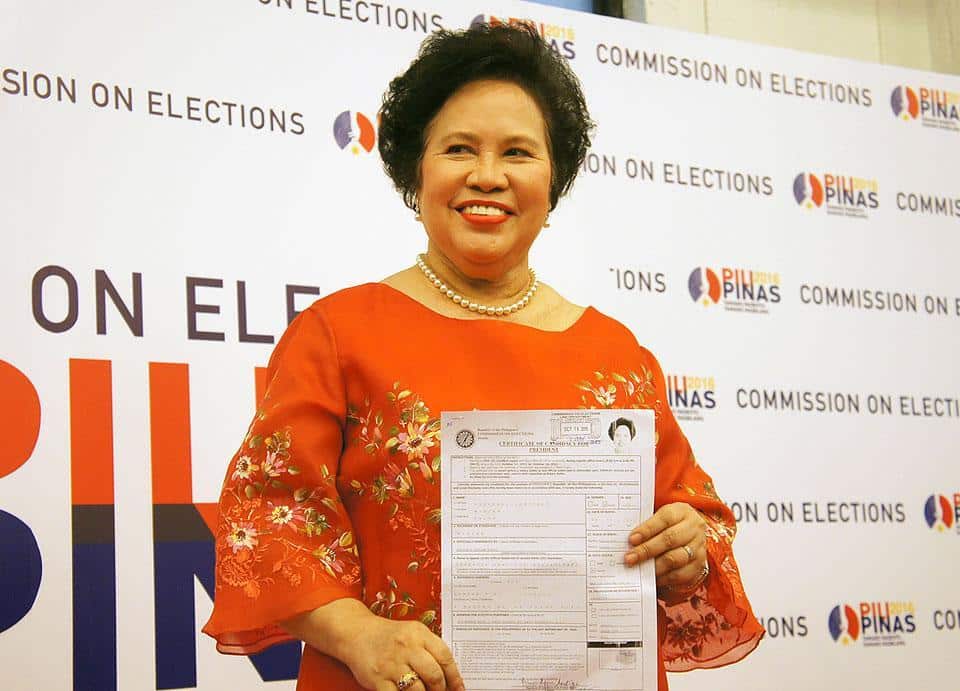
The Marcos family doesn’t owe the Filipino people an apology over the the late dictator Ferdinand Marcos’ imposition of martial law, Senator Miriam Defensor Santiago said on Friday after she filed her certificate of candidacy to run for president in 2016.
Santiago, however, disagreed that the details of what transpired during martial law should already be relegated to the background in favor of addressing the country’s current problems.
“I don’t think that on a family basis, the Marcoses as a family owe us an apology. In the first place, it was not the case that President Marcos the father pooled all the Marcoses in one table and they all decided jointly to do certain activities,” Santiago said in a news conference at the Commission on Elections.
“That was not the case…. This was all a result not of a familial discussion but a result of policy decisions of the executive department of the government—President Marcos and his advisers,” she added.
Santiago is running for president for a third time since 1992 and has chosen Senator Ferdinand “Bongbong” Marcos Jr., the sone and namesake of the former strongman, to be her vice presidential candidate.
Santiago, however, said she did not agree with remarks attributed to Bongbong that people should discuss present-day problems rather than the past.
“Things that happened in the past need to be validated, so it’s really important to go over the details of Martial Law,” Santiago said.
“I would disagree with Mr. Marcos that the details of Martial Law would have to be buried or forgotten. No. On the contrary, the historians of tomorrow should make the study deeper so they’ll know the importance it holds,” she added.
Santiago said she was “one of the people who did not mind the imposition of Martial Law at first.”
“In the first few years, there was much more order in the streets, but eventually I think that Martial Law did not proceed as intended,” Santiago said.
She told reporters she did not backtrack from decisions she made as Regional Trial Court judge during the Martial Law period.
She said one of the memorable decisions she made was releasing students from the University of the Philippines and the Ateneo de Manila University who were arrested at the time.
“You ask me, ‘Do you still affirm the decision you made in court?’ Yes, I do. I was correct… Truth is still truth, justice is still justice,” she said.
Santiago added: “I do not have to reconcile me as a trial judge [with my decision to run with Marcos]… Time has changed. Your opinions and ideologies are different from those of your parents’. You always have to adjust to the times.”

by MLC | Oct 12, 2015 | News
By Reynaldo Santos Jr
Source: Rappler.com
The son of late dictator Ferdinand Marcos has played as himself in a movie, and claims he has tickets to the first commercial flight to the moon
2016. Ferdinand ‘Bongbong’ Marcos Jr is running as vice president in the 2016 elections. File photo by Alecs Ongcal/Rappler
MANILA, Philippines – One of the controversial candidates for the vice presidency in the 2016 elections is Senator Ferdinand “Bongbong” Marcos Jr – son of the late dictator Ferdinand Marcos.
Even before launching his bid for the vice presidency, he has already made statements that have irked many: He sees nothing to apologize for when asked about the corruption and human rights abuses during his father’s regime. For him, the surname he bears is not baggage, and the atrocities committed under Martial Law are not election issues.
But despite all the rage due to these controversial statements, the senator has ranked well in recent surveys: he is 3rd both as a vice presidential candidate and a senatorial candidate in Pulse Asia’s poll conducted last September.
After 5 years as a senator and more than 3 decades in public service, Marcos is aiming for the vice presidency in the 2016 elections and vows to lead a “revolution in heart, mind, and action.”
Who is this man who carries a dictator’s surname with pride? Here are other things you might not yet know about Bongbong Marcos.
1. Bongbong Marcos, aka Bonggets/Bongets.
Just when you thought the nickname “Bongbong” already sounds peculiar, wait until you hear his other nickname: Bonggets. Apparently, this is what his close friends call him.
The nickname Bongets would later appear in documents related to the controversial Disbursement Acceleration Program. Marcos has since denied endorsing the release of P100 million through the National Livelihood Development Corporation.
2. Showbiz? Bongbong starred in a movie as… himself.

ACTOR? In the movie ‘Iginuhit ng Tadhana’, a young Bongbong Marcos recites a speech about his dream of becoming a politician. Screengrab from Youtube
In 1965, when the elder Marcos first ran for the presidency, a biographical movie came out produced by Sampaguita Pictures entitled Iginuhit ng Tadhana. In the movie, actor Luis Gonzales played President Marcos, while actress Gloria Romero played Imelda.
The young Bongbong also starred in the movie as himself. Perhaps a mere coincidence, or a foretelling of the future, one scene in the movie shows Bongbong giving a speech about his dream of becoming a politician.
An excerpt of the speech goes:
“Dear friends, ladies and gentlemen,
I am Bongbong Marcos.
When I grow up, I want to be a politician.
I will serve my country, especially the poor.
And I will give them plenty of bigas and ulam.
I’ll give them many, many gamot at damit.
And for their children, I’ll give them many toys so they will not cry anymore.”
3. Rumor has it that Bongbong is a clone, and he is Grace Poe’s half-brother.
Rumors always hound politicians, and Bongbong is not an exemption.
Apparently, an urban legend is going around since the 1980s that the real Bongbong has long been dead, and the one who’s alive today is a relative who was convinced by Imelda to play pretend and to undergo plastic surgery.
Here’s a more recent one: Presidential candidate and Senator Grace Poe – a foundling adopted by actors Fernando Poe Jr and Susan Roces – is rumored to be the daughter of the late president Marcos and former Sampaguita Pictures actress Rosemarie Sonora. This would make her Bongbong’s half-sister.
The two senators joke about it, and at one point even called each other brother and sister, but Bongbong dismissed the rumor for having no basis, while Poe said “it’s really not true.”
4. His father influenced his decision to enter politics.
In a rare interview about two decades ago, Marcos answered questions from Kris Aquino, one of the daughters of his father’s arch-political rival, Benigno “Ninoy” Aquino Jr. The interview covered an array of topics, from Marcos’ love life, to the criticisms his family faced.
He also talked extensively about his father, and how he used to argue with the elder Marcos when it comes to political ideologies, although he eventually “came around to [Ferdinand Marcos’] way of thinking.”
His father also influenced his decision to enter politics.
“The only way you can explain my having entered politics is definitely because of how my father really… he even said it when he was still alive, he would say ‘I have committed not only myself to the work that I have done. I have not committed only my person, but my wife and my family too…'”
Eventually, what led him to public service was his desire to serve the province of Ilocos Norte, after Ilocanos helped him and his family when they were exiled in Hawaii. He said he “wanted to be part of the national debate,” but he “did not enter politics to become president.”
But former First Lady Imelda Marcos has always wanted for her son to seek the highest post in the land. Marcos, however, believes “the time is just not right” to run for president.
5. He once saw Ninoy in Malacañang and witnessed a light moment between his father and Aquino.
In the same interview with Kris Aquino, Marcos talked about what seemed like a light moment between the two rivals Ferdinand Marcos and Ninoy Aquino during the latter’s visit to Malacañang when Bongbong was still young.
Bongbong: That was history in the making, nakatago ako sa likod, and I was so surprised, ang tawagan nila brad. (That was history in the making, I was hiding at the back, and I was so surprised, they call each other brad.)
Kris: Because they were both from Upsilon diba? (Because they were both from Upsilon right?)
Bongbong: Your father asked this, sabi niya: “Brad, bakit mo naman ako kinukulong? Bakit mo naman ako nilagay sa Fort Bonifacio?” Ang tanong naman ng tatay ko: “Brad, kung ikaw nasa posisyon ko, hindi mo ba gagawin?” Ayun, nagtawanan silang dalawa.(Your father asked this, he said: “Brad, why are you jailing me? Why did you place me at Fort Bonifacio?” My father asked: “Brad, if you were in my position, won’t you do the same?” Then they both laughed.)
6. The first Philippine-made rockets were named after him.
A 1975 news clipping entitled “Rockets test-fired from Philippines” tackled the country’s experiment in making its own ballistic missiles. Then-President Marcos himself witnessed the “successful” firing of 4 “bongbong” rockets.
“The defense of the Philippines cannot be left to alliance with other countries. We must assume that there will be contingencies where even the United States may not be ready to come to our assistance,” the president was quoted as saying.
7. He claims to have received tickets to the first commercial flight to the moon from former US President Richard Nixon.
In a recent interview, the senator talked about some of the famous people he met in the Malacañang Palace, including former United States President Richard Nixon.
“I like President Richard Nixon. He gave me a ticket to the first commercial flight to the moon… I hope that promise is still valid, when it happens.”
8. He loves reading, cooking, and watching movies.
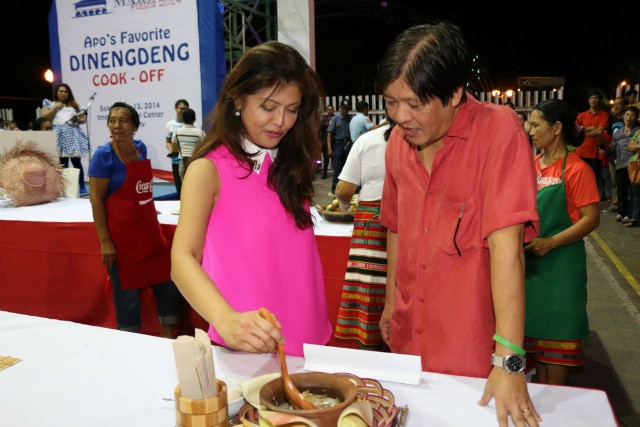
APO’S FAVORITE DINENGDENG. In this file photo, Senator Bongbong and his sister, Governor Imee Marcos taste samples of the Ilocano dish dinengdeng as interpreted by various groups competing in ‘Apo’s Favorite Dinengdeng Cook Off.’ File photo from Bongbong Marcos’ official Facebook page
Bongbong shares common interests with his parents: he loves reading (like his father) and cooking (like his mother).
When there’s free time, he reads books. He can also cook dishes such as Filipino favorites sinigang and pinakbet, and even pan-seared steak.
He loves watching movies and even downloads them from the Internet, he said in an interview.
9. He also loves music and was once part of a band when he was studying in England. He is a huge Beatles fan.
The senator has been interested in music since he was young. While studying at Worth School in England as a teenager, he joined a band and played in local pubs. It was a short stint, since all members of the band were students who had to go back to studying for their finals.
In a recent interview, he revealed that he is a huge Beatles fan, and his favorite album is Sgt. Pepper’s Lonely Hearts Club Band – the band’s 8th album. He collects their memorabilia, and even posed for a photo with the sign of a children’s home where John Lennon grew up.
Ironically, when the band vowed never to return to Manila, it was because of an incident that involved the Marcoses. In 1966, the band played two shows at the Rizal Memorial Stadium but declined an invitation to the Malacañang because they were not informed about it.
Imelda was furious, as Ringo Starr recalled she was screaming on television. There were reports the band was manhandled at the airport before they left the country. The first lady later said she “would never dream of hurting the world’s number one band,” while his son Bongbong invited Starr to return to the country.

by MLC | Mar 5, 2015 | News
By KD Suarez
Source: Rappler.com
The senator did not graduate with a BA in Philosophy, Politics and Economics, as he claims
MANILA, Philippines – When Ferdinand “Bongbong” Marcos Jr said he earned a “diploma in political science” from Oxford University, brushing off a Rappler report that he did not complete a Bachelor of Arts in Philosophy, Politics and Economics (PPE), he failed to get two things right.
First, he misremembered the name of the diploma he acquired. It was a “special diploma in social studies,” not political science.
The spokesperson for the University of Oxford, Clare Woodcock, said in an e-mail:
‘We can confirm that a Ferdinand Marcos matriculated at the University of Oxford in 1975 to read for a BA in Philosophy, Philosophy and Economics. According to our records, he did not complete his degree, but was awarded a Special Diploma in Social Studies in 1978.’
This e-mail was addressed to Matthew Montagu-Pollock, a graduate of Oxford University, who, after reading the Rappler report, made his own inquiries. Montagu-Pollock shared Woodcock’s email with us.
Montagu-Pollock explained in his post in the Rappler comments section that “matriculated” means “began the course.” He continued: “Bongbong…instead left [Oxford University] with a diploma, which is not, in fact, a degree.”
We then clarified with Robert Wilkins, a tutor at St Edmund Hall, the college that Marcos Jr attended, what this “special diploma” was all about. He told us in an e-mail:
‘The Special Diploma operated before my time here, but my understanding is that it was a two-year course that provided a foundation for subsequent study of PPE at the Finals level. It is no longer offered by the University.’
Both Woodcock and Wilkins are clear on the crux of the issue: Marcos Jr did not obtain a BA. He did not complete a degree.
Why special diploma?
We emailed the Oxford University spokesperson to ask what the criteria are for special diplomas. We have yet to receive a reply.
However, a contemporary of Marcos Jr at St Edmund Hall explained: “My understanding is that the special diploma was something given to students on the rare occasion that they failed their first year preliminary examinations and hence disqualified themselves from going on to receive a Bachelor’s degree.”
Similarly, a student from the UK who made his own inquiries e-mailed us: “This could be for someone who didn’t have good enough academic qualifications (A levels) and who would therefore not be offered a place on a full standard undergraduate course. It would set a bad precedent by lowering standards…a bit like a special diploma for ‘special needs’ students.”
“It was possibly a back-door method…a political accommodation,” the student added.
Diploma not a degree
Second, Marcos Jr equates a diploma with a degree, an apparent attempt to fudge the facts. “I got a diploma!” he told reporters. “What do you get when you graduate? A diploma,” he said.
In the UK educational system, a diploma is not equivalent to a degree. The University of Oxford Department for Continuing Education is explicit:
‘An Undergraduate Diploma is the same as the second year of an undergraduate degree.’
A student from a UK university told us that “anyone who only has a diploma did not complete the 3-year degree course, did not take the exams, and therefore has not been conferred a BA.”
A graduate of Oxford, who commenced with Marcos Jr at St Edmund Hall, put it sharply: “Essentially this means that Marcos is a college dropout, in the sense that he has not completed a degree to Bachelor level.”
Marcos Jr has not corrected his resumé, as posted in the Senate and his own websites.

On Wikipedia, the entry on Marcos Jr’s undergraduate degree from Oxford and graduate degree from Wharton was deleted on the same day the story on him was first published on Rappler. It is not known who deleted the entry.

